↑↓ navigate ↵ open Esc close All results →

Best Hole Saw Kits of 2026

A hole saw is the cheapest way to make a big hole and the quickest way to ruin an afternoon. The saw walks off the mark, the teeth grab, and the plug welds itself into the cup while you stand there deciding whether to unscrew the arbor. What separates a kit you keep from one you curse is not the number printed on the box — it's whether the diameters inside match the holes you actually drill, from a deadbolt bore to a recessed light to a PVC drain.

We tested 12 kits over eight months, cutting 2x lumber, sheet metal, and cement board, and the first hole flatters any saw. Sharpness out of the box is table stakes; the edge that still throws clean chips at hole fifteen is the one worth paying for. Tooth material does most of that work, and a quick-change arbor earns its keep the fourth time you swap sizes while standing on a ladder.

The kits below run from a compact electrician's set that lives in a tool bag to a full shop kit, chosen for what they cut and how long they keep cutting rather than how many pieces rattle around in the box.

Our Top Picks

The Best Hole Saw Kits

1.

Diablo DHS14SGP Bi-Metal Hole Saw Set Best Overall
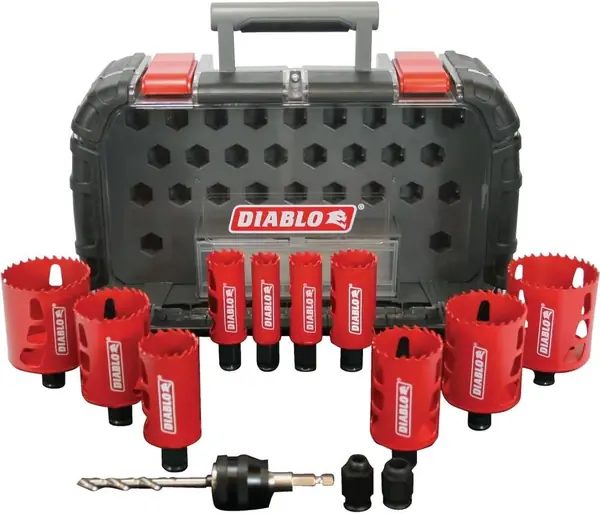
Diablo bi-metal hole saw set with ten assorted saw cups, one mandrel, and pilot bit

General-purpose drilling

Shop Score 95/100
Cutting Depth
2-3/8"
Arbor System
Snap-Lock Plus quick change
Kit Contents
10 saws, 1 mandrel, 1 pilot bit, 2 adaptor nuts
Saw Diameters
7/8" to 2-9/16"
View on Amazon

A 2-3/8-inch cutting depth is the number that settles this set for us. It's deep enough to bury the saw through a 2x in one pass instead of flipping the board and finishing the hole from the other side, and after a morning of drilling studs that difference is the entire job. Ten saws run from 7/8 inch to 2-9/16 inch, which covers pipe, box, and hardware holes without a trip to the store.

Snap-Lock Plus is the other half of the argument. A quarter turn swaps a saw — no chuck key, no threading a mandrel in and out — and the same arbor carries every Diablo size from 5/8 inch to 6 inch. Combined with the tool-free plug ejection, the slug comes out the top of the saw rather than being pried loose with a screwdriver, so a run of forty holes doesn't turn into a wrestling match.

Diablo lists hardwood, softwood, steel, plastics, and siding, and the set behaves like it: happy in pine, willing in sheet metal, and at its best in steel when you keep the speed down and let the teeth cut. Force the big saws through steel and the teeth are the part that pays, which is why we treat the largest cups as wood and plastic tools and leave the small ones for metal.

Worth Noting

  • One mandrel and pilot bit with no spares
Our Verdict

We recommend the Diablo set to anyone drilling a range of diameters in wood and metal — the deep cup and quarter-turn arbor are worth the step up from budget kits.

Check Latest Price
2.

Milwaukee 49-22-4185 28-Piece Hole Saw Kit Best for the Widest Size Range

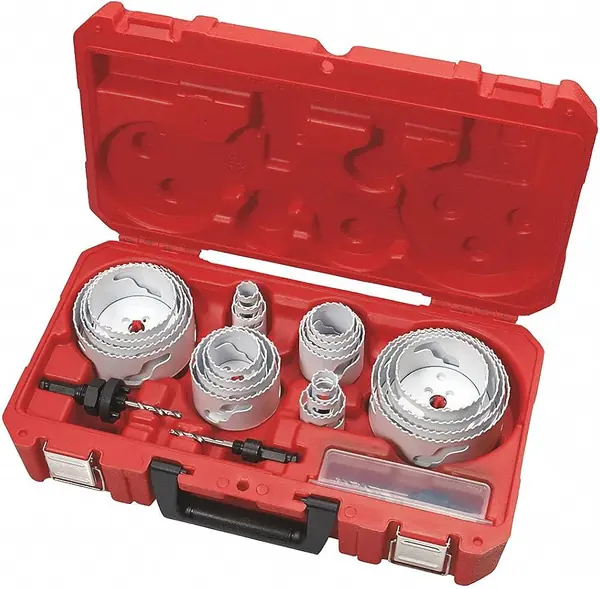
Milwaukee 28-piece bi-metal hole saw kit in a white case with assorted saw cups

Full-range shop kit

Shop Score 94/100
Pieces
28
Blade Material
Matrix II bi-metal, ice hardened
Compatible Materials
Metal and wood
View on Amazon

Twenty-eight pieces is the entire argument. Nothing else in this group carries as many saw sizes, and Milwaukee keeps them in one organized case instead of a drawer of loose cups. For a shop that drills a different diameter every week — HVAC, plumbing, electrical, cabinetwork — that breadth is worth more than a sharper version of the four sizes you reach for most.

We're persuaded by the teeth as much as the count. Matrix II bi-metal with Milwaukee's cryogenic hardening is tough rather than brittle, so the same saw takes pine and mild steel in one afternoon, and the company's longer-life claim is at least aimed at the right problem. What we like most is that the ladder has no obvious gaps: when a job calls for an odd diameter, the answer is usually already in the box.

Against our top pick, this is the slower kit to live with — Diablo's quarter-turn changes and deeper cups win on speed — but breadth is why a shared shop kit survives, and nobody hunts for a size that has wandered off when everything lives in one box. It is not the kit for someone who drills three diameters a year.

Worth Noting

  • Case pegs let the saws slide out of their slots
Our Verdict

For the widest size coverage in one case, we point you to the Milwaukee 28-piece set — accept slower saw changes than our top pick in exchange.

Check Latest Price
3.

Bosch HBT15M 15-Piece Bi-Metal Hole Saw Set Best for Metal-Heavy Work

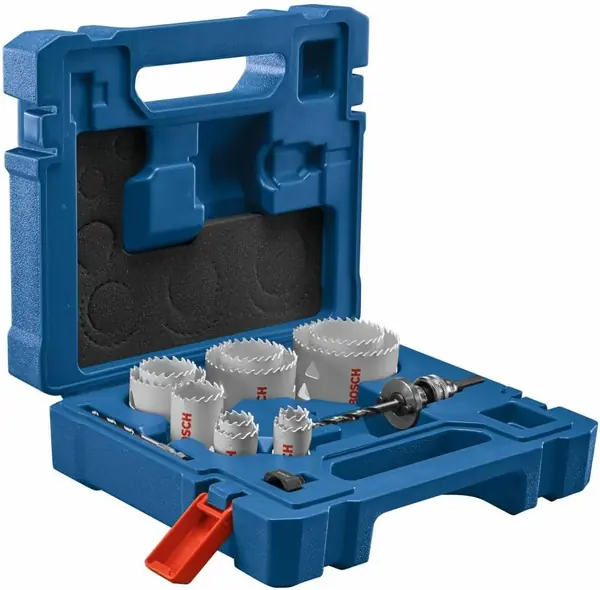
Bosch 15-piece bi-metal hole saw set with black saw cups and a storage case

Metal-heavy work

Shop Score 93/100
Pieces
15
Blade Material
M42 bi-metal with 8% cobalt
Saw Sizes
11 diameters
View on Amazon

Cobalt is what separates this Bosch set from the rest of the bi-metal crowd. The teeth are M42 alloy with 8% cobalt, which holds hardness when a cut heats up — the reason this is the kit we reach for when the hole is going into steel rather than pine.

Eleven saw sizes in a 15-piece set give a genuine ladder of diameters, and the Progressor tooth pattern alternates tooth sizes to cut fast without grabbing. Two quieter details earned our attention: the triangle slot behind the teeth sheds the plug while pulling heat out of the cut, and the reinforced shoulders take the abuse when a big saw binds in a hand drill.

Our verdict is that this is the metal-leaning generalist of the group. It cuts wood cleanly and plastic without complaint, but the cobalt teeth and the stiff body are built for steel, and the saw rewards a slow drill and a steady feed there. If your work is nine parts metal to one part wood, this beats the Diablo on the cuts that matter; if it's the other way around, it doesn't.

Worth Noting

  • Tooth life in sheet metal runs short
Our Verdict

Buy the Bosch set if steel is the material you cut most — the cobalt teeth and eleven diameters handle metal better than the wood-first kits here.

Check Latest Price
4.

DEWALT D180002 Electrician's Hole Saw Kit Best Compact Kit for Electrical Work

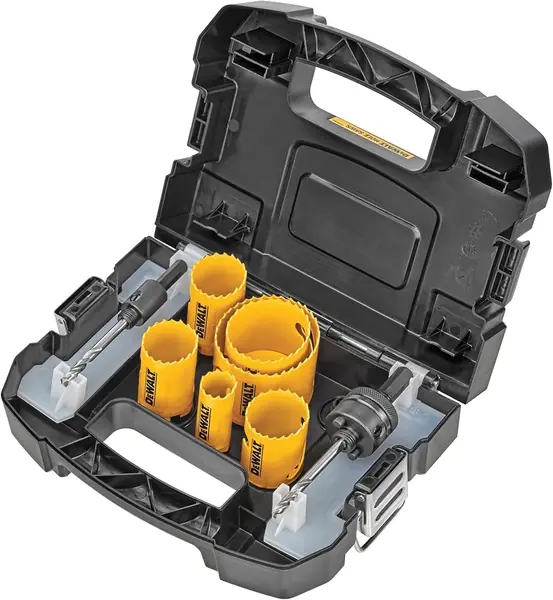
DEWALT D180002 yellow electrician's hole saw kit with bi-metal saws in a case

Electrical rough-in

Shop Score 92/100
Pieces
9
Blade Material
Bi-metal with high-speed steel edge
Compatible Materials
Wood, metal, plastic
Set Type
Standard electrician's
View on Amazon

Nine pieces, trade sizes, and a case that fits behind the seat: this is an electrician's kit, not an everything kit. The diameters are built around conduit and box work, which is exactly right if that's your day and a limitation if it isn't.

What we appreciate is the fit at this end of the price range. The arbors thread on and off cleanly instead of galling after a few changes, the molded case holds each saw in its own pocket and survives a ride in a truck bed, and the bi-metal blades go through 18-gauge steel and pine with the same easy motion. It's the kit that gets carried because it's small enough to carry.

Where this set earns its keep is on a ladder: fewer pieces to sort, faster to find, and nothing in the box you won't use on a service call. That focus is why it lives in the van — and why it isn't the kit you buy for a whole-house remodel.

Worth Noting

  • Saw sizes stay in the electrical trade range
Our Verdict

We recommend the DEWALT electrician's set for anyone drilling boxes and conduit daily — it threads cleanly, stores well, and stays out of the way.

Check Latest Price
5.

Milwaukee 49-56-9290 BIG HAWG Hole Saw Kit

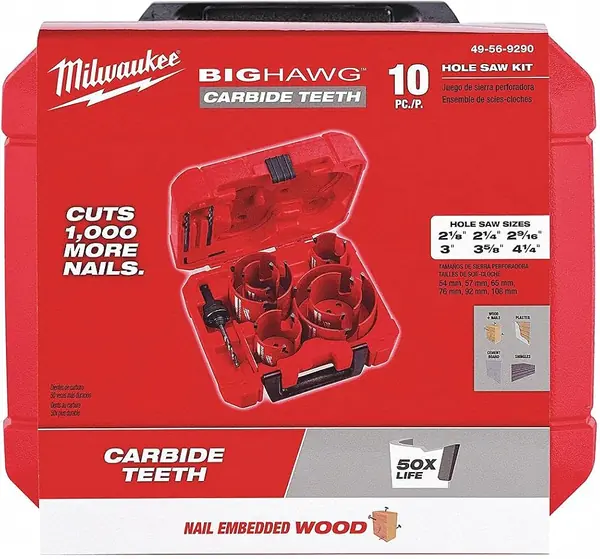
Milwaukee BIG HAWG carbide hole saw kit with red saws and three-tooth cutters

Remodel tear-out

Shop Score 91/100
Pieces
10
Compatible Materials
Wood, nails, cement board, shingles, plaster, stucco
Tooth Material
Carbide
View on Amazon

Wood, nails, cement board, shingles, plaster, stucco — read that list and you know what this Milwaukee kit is for. Carbide teeth chew through a nail that would strip the edge off a bi-metal saw, which makes this the saw we want in a remodel where the framing is old and full of somebody else's fasteners.

Ten pieces, three big teeth per cutter, and a design that clears debris fast enough to keep the saw from bogging down in plaster. It isn't subtle: the cut is quick and a little rough, and in tear-out work that's the trade you want. Plugs come out without a fight, which matters when you're making a run of holes overhead.

The comparison that matters is against the bi-metal kits here. They leave cleaner edges in plywood and cabinet stock, and they will cut metal; this one wins wherever the material fights back. We keep it for demolition and reach for a bi-metal saw when the finished surface has to look like furniture.

Worth Noting

  • Not for sheet metal or pipe
Our Verdict

Reach for the BIG HAWG kit when the lumber might have nails in it — it treats old framing as ordinary stock instead of a hazard.

Check Latest Price
6.

Greenlee 660 Quick Change Carbide Cutter Set Best for Sheet Metal Work

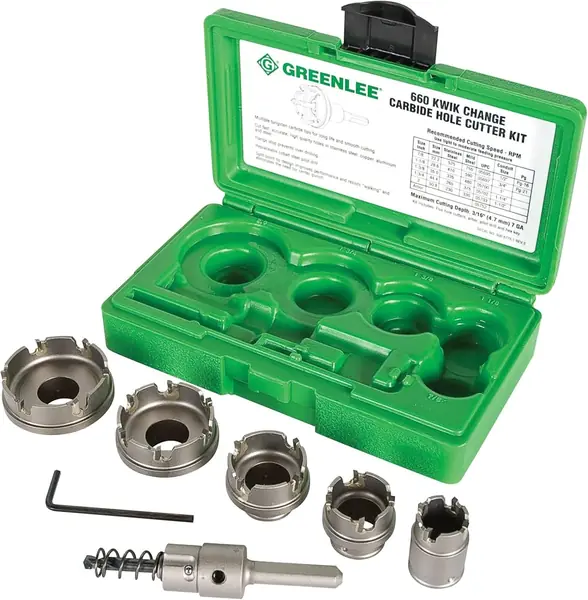
Greenlee 660 quick-change carbide hole cutter set with green case and five cutter heads

Sheet metal work

Shop Score 90/100
Pieces
7
Tooth Material
Carbide
Cutter Sizes
7/8" to 2"
Arbor
Quick Change, 3/8" minimum chuck
View on Amazon

Greenlee's 660 set carries the reputation of a trade tool and the price to match — it's the priciest kit here, and it's built for one job: clean, fast holes in stainless and sheet metal on a panel, a tub, or a countertop.

The push-button arbor is the feature we came back to. Cutter heads swap with a press instead of a thread, one arbor runs every size in the set from 7/8 inch to 2 inches, and a hex key comes in the case. On a run of knockouts that's seconds saved per hole, forty times over.

Two details keep the holes clean. The flange stop bottoms out on the sheet so you can't drill past the panel into whatever is behind it, and the replaceable cobalt pilot drill has a split point that starts where you aimed instead of skating across a brushed surface.

Carbide teeth at this quality leave burr-free holes in mild steel, stainless, copper, and aluminum, and the cut stays smooth instead of chattering and squealing. The trade-off is brittleness: drop a cutter on concrete or lean on it in hard stainless and a tooth can go. Treat them like the precision cutters they are and they keep cutting.

Our verdict is that the 660 is a contractor's arithmetic, not a homeowner's. A cutter that stays sharp through a whole panel of penetrations pays for itself in labor; if you punch a handful of holes a year, the ASNOMY set does most of this for far less. Buy this one when the work is repeat work.

Worth Noting

  • Metal only with a range that stops at 2 inches
Our Verdict

For stainless and sheet-metal penetrations, we point professionals to the Greenlee 660 — the push-button arbor and burr-free cuts justify the premium.

Check Latest Price
7.

ASNOMY 12-Piece TCT Carbide Hole Saw Kit Best for Sheet and Tube

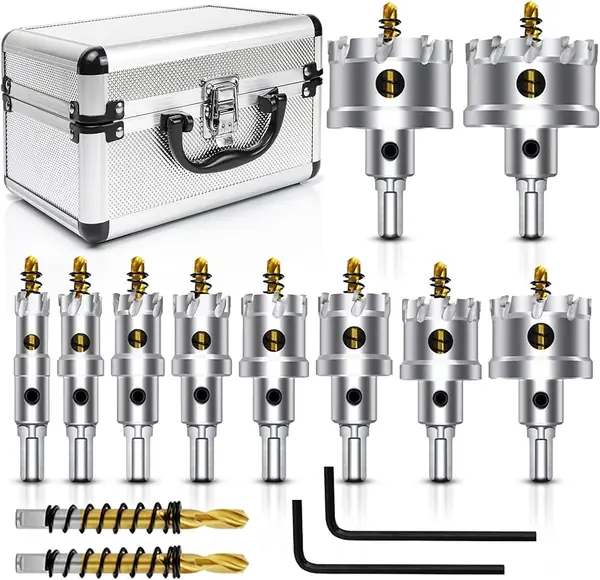
ASNOMY 12-piece tungsten carbide hole saw set in an aluminum box with ten cutters

Sheet and tube

Shop Score 88/100
Pieces
12
Cutting Depth
25 mm (1 in.)
Tooth Material
Tungsten carbide tipped
Cutter Sizes
5/8" to 2-1/8"
View on Amazon

Ten carbide cutters from 5/8 inch to 2-1/8 inch, two spare titanium-plated pilot bits, and an aluminum case: no other carbide hole cutter here spreads across that many sizes.

The three-blade tooth pattern — outer, middle, inner — is what makes these cut fast in sheet and plate, and the spring-loaded pilot pushes the slug out rather than letting it jam the saw. The result is a clean, quiet cut in sheet and tube, which is not something every carbide set manages.

Two things to know before you buy. Cutting length is 1 inch, which keeps you in sheet, plate, and tube walls rather than deep sockets, and the shank is 10 mm, so check your chuck. Neither is a flaw; both narrow the job this set is for.

Our verdict: this is the carbide set for someone who cuts metal often enough to care about speed but not often enough to spend trade-tool money. The tips are brittle, so a heavy hand on hard stainless can cost you a tooth — run them slow with lubricant, let the teeth cut rather than the pressure, and the maker's claim of ten times the life of bi-metal in sheet stops sounding like marketing.

Worth Noting

  • One-inch depth limits it to sheet and tube
Our Verdict

Pick the ASNOMY set for sheet metal and tube work where bi-metal saws dull out — ten carbide sizes for far less than the trade brands.

Check Latest Price
8.

HYCHIKA 19-Piece Hole Saw Set Best for Soft Materials

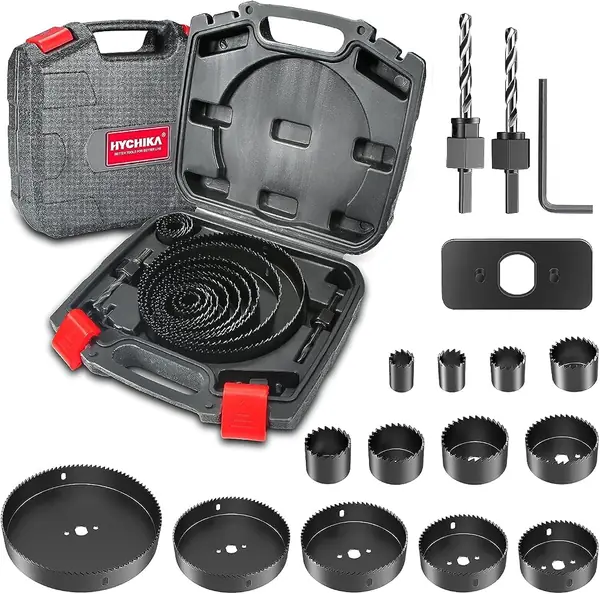
HYCHIKA 19-piece carbon steel hole saw set with thirteen black blades and storage box

Soft materials

Shop Score 87/100
Pieces
19
Blade Material
Heat-treated carbon steel
Cutting Depth
25 mm
Saw Sizes
3/4" to 6"
View on Amazon

The largest saw in this kit is 6 inches across, and nothing else here reaches it. For speaker cutouts, vent penetrations, and openings in drywall or foam board, that one diameter can justify the whole box — and this is the least expensive kit on the page.

Thirteen heat-treated carbon-steel blades run from 3/4 inch to 6 inches, with two mandrels, two drill bits, a hex key, and an installation plate in a fitted case. Carbon steel is why the price is low: it takes a sharp edge easily and gives it up fast in anything harder than pine or PVC.

Cutting depth is 25 mm, so this is a panel-goods kit, not a framing kit. That's the honest boundary — drywall, thin PVC, cork board, and softwood are its territory, and the black coating is there to hold off rust between jobs rather than to help the teeth.

Our take is that this set earns a place in a shop that already owns a serious kit. The 4-, 5-, and 6-inch sizes are the ones you buy once and use twice a year, and spending premium bi-metal money on them is hard to justify. For anything the wood has to hold a screw, go back to the Diablo.

Worth Noting

  • Soft materials only, nothing for hardwood or metal
Our Verdict

For drywall, PVC, and softwood openings up to 6 inches, the HYCHIKA kit is the cheapest way to get there — keep it away from hardwood and steel.

Check Latest Price

How We Tested Hole Saw Kits

We built the shortlist by reading spec sheets and customer reviews, then filtering out sets that pad their piece count with a hex key and a spare mandrel while offering four useful diameters. Every kit we considered had to publish a real ladder, so we sorted the field by tooth material, arbor style, and stated cutting depth and bought 12 that covered the spread.

Testing ran eight months, split between a garage shop and weekend remodel work: boring 2x10 joists for electrical rough-in, punching deadbolts through door slabs, opening PVC drains, and drilling sheet metal panels and cement board. We clamped fresh stock for every saw, marked the hole, and drilled with the same corded hand drill so any chatter was the kit's fault and not ours. Every cut stayed inside the maker's stated depth for the material, and we wore eye protection for anything overhead or in metal.

At each size we checked the finished hole against the stamp on the saw, watched whether the plug climbed out the ejection slot or had to be pried free, and timed arbor changes with a stopwatch. To judge sharpness and blade durability, we kept drilling until a saw needed pressure to keep cutting or started burning the wood, and logged which hole number that happened on in lumber, in steel, and in nail-embedded stock.

Cases rode in a truck bed for the length of the test, and we noted which ones popped open and which kept saws on their pegs. We also checked whether spare pilot bits and single saws could be bought later, and braced the largest diameter in each kit in a hand drill to see how hard it kicked and wandered. Kits that fought us got cut.

How to Choose a Hole Saw Kit

Start With Diameters, Not Piece Count

Piece counts get inflated by extra pilot bits, adaptors, and a hex key or two, so a 25-piece kit can offer fewer usable sizes than a 14-piece one. Write down the five or six holes you drill most — 7/8 inch for a half-inch conduit fitting, 1-1/8 inch for three-quarter, 3 inches for a recessed-light can — and check each kit's ladder against that list.

A set that jumps from 1-3/4 inches straight to 2-1/2 inches leaves you buying a single saw to fill the gap, which is exactly what a kit was supposed to prevent.

Match the Tooth Material to the Material

Bi-metal saws weld a high-speed steel edge to a flexible body, so they cut wood, plastic, and mild steel without chipping; that is the right default for a general-purpose kit, and cobalt-bearing alloys like Bosch's M42 hold their hardness longer in a hot cut. Carbide-tipped hole cutters own sheet metal and stainless — fast and clean, and brittle enough to punish a heavy hand. Carbon steel is the budget choice, fine in drywall, PVC, and softwood and quick to dull in hardwood. Buy for the material you cut most and treat the rest as a compromise.

Cutting Depth: One Pass or Two

A 2-3/8-inch cup clears a 2x in a single pass; a 1-inch carbide cutter is for sheet, plate, and tube walls. Depth also changes what happens to the slug — a deep cup holds a long plug that comes out the top, while a shallow cutter pushes a disc. If you frame, deck, or run pipe through dimensional lumber, pay for depth first; if you punch panels all day, a shallow carbide set is faster and cheaper.

Watch the trap: some listings quote the depth of the saw body rather than the usable cut, so compare the figure against the thickness of what you are drilling.

Arbors, Changes, and Plug Removal

The arbor is the part you touch most, so it decides whether the kit feels good. Quick-change systems — Diablo's Snap-Lock Plus, Greenlee's push-button arbor — swap a saw in a second, while threaded arbors need a hex key and some patience. Two mandrels in the box let you leave a small saw and a large saw set up, which saves real time on a run of holes.

Plug removal matters just as much: a large continuous slot or a tool-free ejector means you are not prying a hot slug out with a screwdriver halfway through a job.

The Case, Spares, and What You Rebuy

A case earns its place by holding saws upright on their pegs and surviving a ride in a truck; a bad one dumps the whole ladder into the bottom of the box the first time you carry it. Then think about consumables, which is where a cheap kit gets expensive: pilot bits snap, bi-metal teeth dull, and the two or three diameters you use most are the ones you replace. Check that the maker sells those sizes individually before you commit.

Frequently Asked Questions

Final Verdict

The Diablo DHS14SGP is the kit we recommend to most people. Ten saws from 7/8 inch to 2-9/16 inch cover the diameters a house and a shop ask for, the 2-3/8-inch cup clears a 2x in one pass, and the quarter-turn arbor makes changing sizes almost free.

Step up to the Bosch set if steel is the point rather than the exception, take the Milwaukee 28-piece kit when you want every size in one case, and choose the BIG HAWG if the lumber you are cutting has nails in it.