↑↓ navigate ↵ open Esc close All results →

Best Pallet Busters of 2026

By the third plank on a stubborn hardwood pallet, a hammer and standard pry bar turn teardown into sore knees and split slats. A dedicated pallet buster puts a twin-tine fork on a long leverage handle so you can stand upright and pop boards off stringers cleanly, yet product photos rarely show what separates a smooth-working bar from a frustrating one.

Eight months of dismantling pallets and lifting weathered deck boards with 12 tools proved that head geometry outweighs almost every spec on the box. Fixed 110-degree forks pry fast with little forgiveness, whereas articulating heads pivot with the plank to rescue more salvageable lumber — though either style requires checking prong spacing against your pallet stringers before ordering.

Handle length dictates posture over a long afternoon, and one-piece welded shafts resist flex better than multi-section handles under heavy loads. Across these six tools, options span full-time pallet breakdown, intact lumber salvage, and tight-quarter prying.

Our Top Picks

The Best Pallet Busters

1.

Insaga 50-Inch Pallet Buster Best Overall
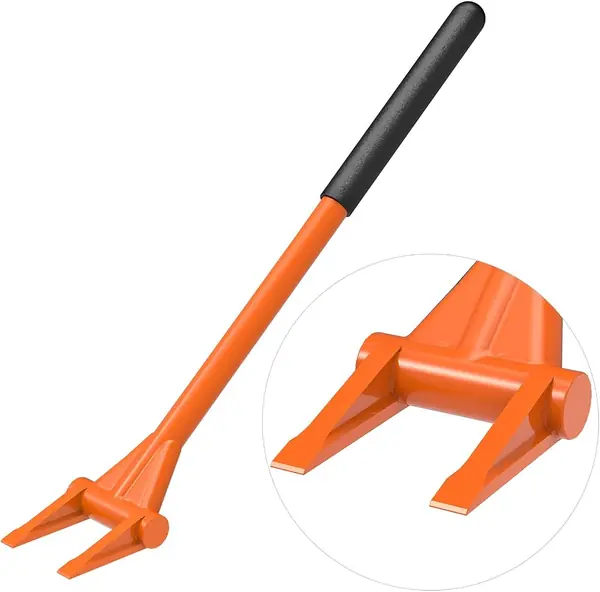
Insaga 50-inch pallet buster with a welded steel handle and a 9.4-inch non-slip grip

All-around pallet work

Shop Score 92/100
Overall Length
50 in
Item Weight
10.7 lb
Handle
One-piece welded
Fork Spacing
4.2 in
View on Amazon

A pallet buster takes its worst beating where the handle meets the head, so a tool that arrives as one welded piece is the one we reach for first. The Insaga is that tool: a 3mm steel tube running the full 50 inches, a 6.5-inch fork, and a 9.4-inch non-slip grip with room for both hands. There is no threaded joint to work loose and no set screws to check before a job.

Fifty inches is the number that sells it. You stand over the pallet, drop the fork into the seam, and push down with your shoulders instead of your lower back, the same motion as a long-handled shovel. At 10.7 pounds it is light enough to carry from the truck to the far end of a deck and still heavy enough that the head does not bounce off a nailed board.

The head does not pivot, and that is the one place this Insaga gives ground. A board comes up at the angle the fork sets, so a stubborn deck plank can crack instead of peeling away; the Vestil below is the gentler tool when the wood has to survive. For pallets headed for the burn pile and decking headed for the dumpster, the simpler fixed head is what we want, and the 250-pound load rating means you can lean on it.

Worth Noting

  • Fork gap fixed at 4.2 inches
Our Verdict

Our pick for most shops: a welded 50-inch handle and a 4.2-inch fork that hold up to steady pallet and deck work.

Check Latest Price
2.

Vestil SKB-DLX Deluxe Pallet Buster Best for Saving Boards

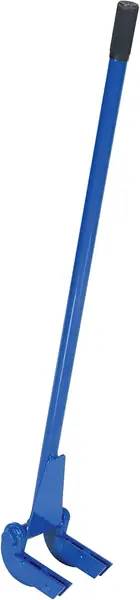
Vestil SKB-DLX blue steel pallet buster with an articulating head and 41-inch handle

Saving reclaimed boards

Shop Score 91/100
Overall Length
45.13 in
Item Weight
15 lb
Handle Length
41 in
Head
Articulating
View on Amazon

The head on the Vestil SKB-DLX pivots, and that changes what happens to the wood. Push down on the handle and the fork rolls a board up off the stringer rather than wedging beneath it and splitting along the grain, which is the difference between lumber you can build with and lumber you sweep up. Everything about the tool is bigger than the rest of this list: 45 inches overall, a 41-inch handle, blue steel, from a company that builds dock and material-handling equipment.

Mass is the mechanism here. Fifteen pounds of head and handle does half the prying before your arms join in, which is what we noticed on oak stringers where lighter bars bounced. We paid close attention to how the head seats, because that is where the tool lives or dies: set the fork square in the seam and the board walks up; catch one tip on a nail head and the head twists sideways and you reset.

It pulls double duty on dock boards, since the same pivoting head lifts planks off a trailer bed. If your pallets are scrap, a fixed head is the simpler tool and the Insaga above is the easier carry. If the wood is worth keeping, this is the one, and the extra heft pays you back in boards.

Worth Noting

  • 15 lb is tiring over a long session
  • Prongs are short for wide-spaced pallets
Our Verdict

The one we hand anyone breaking down hardwood pallets to reuse the boards, thanks to a pivoting head that lifts lumber instead of splitting it.

Check Latest Price
3.

VEVOR 41-Inch Pallet Buster Best Budget

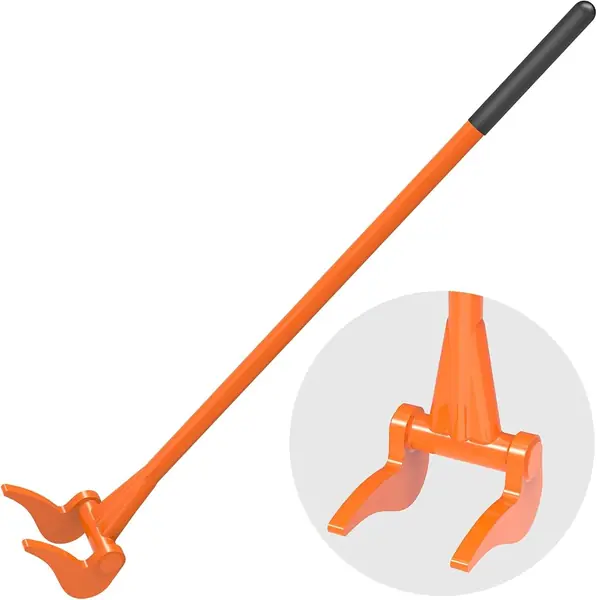
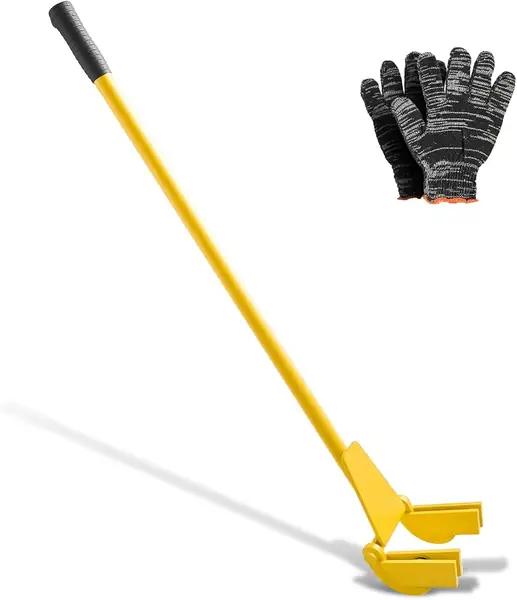
VEVOR pallet buster with a 41-inch carbon steel handle and hinged head

Budget deck removal

Shop Score 87/100
Overall Length
45 in
Handle Length
41 in
Tooth Spacing
4 in
Prying Capacity
2,000 lb
View on Amazon

A hinged head for the least money in this set is the whole case for the VEVOR. The head flips through several angles, so when a stringer blocks your first approach you change the angle instead of your footing, and the tool shows up in one piece, with no threads and no hex key standing between you and the first pallet.

The handle is where the savings show. At 41 inches it is the shortest full-size grip here, and against the 50-inch Insaga that is a few inches of standing height you feel by the end of a deck. What we did not expect at this price is how solid the hinge feels: it adjusts by hand, stays where you set it, and the 45-inch overall length still gives you real leverage. The 2,000-pound prying figure is the maker's number rather than ours, but the head did not flex under a nailed 2x6.

It is a sensible first buster, and the tool we point to when someone is breaking down a handful of pallets a month rather than running a reclaiming operation. The shorter handle is the trade, and it is a real one for taller users.

Worth Noting

  • 41-inch handle leaves tall users hunched
Our Verdict

The budget pick: a hinged head and a 45-inch overall reach for the least money of any full-size buster here.

Check Latest Price
4.

AugFir 48-Inch Pallet Buster Best T-Handle Grip

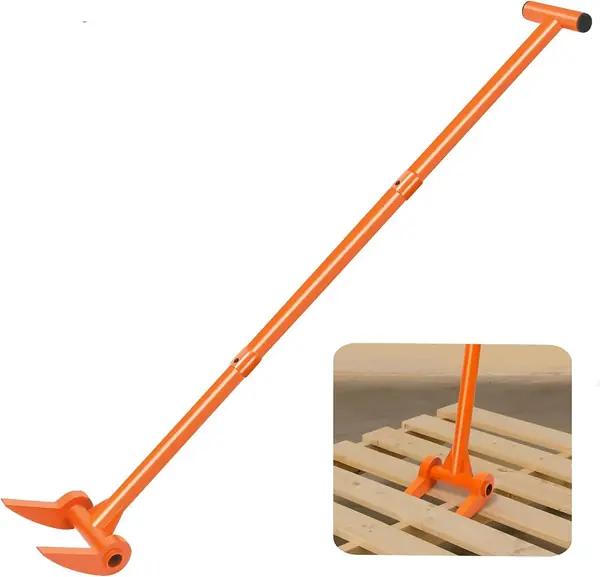
AugFir orange 48-inch pallet buster with a T-shaped handle and steel fork

Two-handed leverage

Shop Score 86/100
Overall Length
48 in
Item Weight
11.2 lb
Fork Angle
110 degrees
Fork Spacing
4 in
View on Amazon

Grip the AugFir by its T-handle with both fists and you can pull a board up as well as push down on one, which matters most on the pallet that fights back. Wedging and leaning gets a board started; the pull stroke is what finishes a screwed-down deck plank that does not want to let go.

The rest of the tool is conventional: 48 inches end to end, an 11.2-pound carbon steel body, a 4-inch gap between the prongs, and a 110-degree angle between fork and handle. The angle is what sold us. At 110 degrees the fork sits almost flat against the surface, so it slides into a seam a steeper head cannot enter, then cams up as you lean on the handle.

Where this one earns its place is control. Two hands on a crossbar beat one hand on a tube when you are steering a fork between deck boards you plan to reuse, and the 48-inch length keeps you upright while you do it. If you never pull, if every pallet is scrap and speed is all that matters, the T-handle is a feature you will ignore and the cheaper HVDI below does the same job.

Worth Noting

  • Assembly can fight you on powder-coated threads
Our Verdict

The best grip in this set: a T-handle you can pull with as well as push, on a 48-inch bar that gets under tight boards.

Check Latest Price
5.

HVDI 48-Inch Pallet Buster Best for Fixed-Head Pallet Work

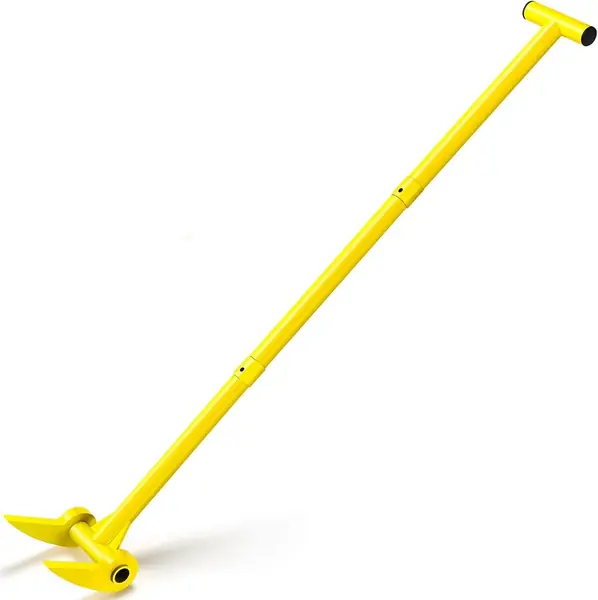
HVDI 48-inch carbon steel pallet buster with a T-shaped handle and 110-degree fork

Fixed-head pallet work

Shop Score 85/100
Overall Length
48 in
Item Weight
11.4 lb
Handle
T-shaped
Fork Angle
110 degrees
View on Amazon

If the budget is the deciding factor, the HVDI is the fixed-head 48 we point at. Nothing about it is clever, a T-handle, a 110-degree fork, 11.4 pounds, and that is the appeal: it does the same work as the picks above it for less money.

The mechanics are worth understanding, because they are shared with every 110-degree tool here. The fork sits almost flat to the surface so it slides into a seam, then cams the board up as the handle goes down, and the crossbar lets you add a pull when a screw holds. The 4-inch gap between prongs suits standard stringer spacing, and the head is welded to a steel tube rather than bolted on.

Set against the AugFir, the closest thing to it here, the two share a layout and a weight class, and the difference comes down to price. What this one does not offer is a story: no pivoting head, no adjustability, no clever grip. What it has is 48 inches of lever, a stiff head, and a price under the picks above it. For a shop breaking down a few pallets a week that does not need to save every board, that is enough.

Worth Noting

  • Handle ships in sections to assemble
Our Verdict

A likeable fixed-head 48 that handles pallets and deck boards for less than the picks above it.

Check Latest Price
6.

Dolibest 28-Inch Demo Bar Best for Close-Quarters Prying

Dolibest 28-inch two-tine demo bar with a steel handle and rubber grip

Close-quarters prying

Shop Score 84/100
Overall Length
28 in
Item Weight
3.89 lb
Handle Length
23.7 in
Fork Length
4.3 in
View on Amazon

Twenty-eight inches is a different tool from the rest of this list. The Dolibest puts your hands at about waist height, so you are bent over the work, which is fine at the edge of a deck or over a bench and miserable over a stack of pallets.

What it does well is reach the places a long tool cannot: the board against the house, the corner of a floor, the seam where a full-size fork will not fit. At 3.89 pounds it is the lightest thing here, the 4.3-inch fork slips into a narrow gap, and the bar is one piece of steel with a rubber grip, so there is nothing to assemble and nothing to loosen.

We keep coming back to it for the first board on a deck and for trim work, where a 28-inch bar is the only thing that fits under the edge. It is not the tool for a pallet stack: the 23.7-inch handle keeps you hunched, and the leverage that makes the long busters worth carrying is exactly what it lacks.

Worth Noting

  • 28-inch length keeps you bent over
Our Verdict

A compact one-piece bar for tight deck seams and trim work, where a 50-inch buster cannot get under the edge.

Check Latest Price

How We Tested the Best Pallet Busters

We started by gathering every pallet buster we could find and comparing the things that actually change how the tool works: overall length, fork angle and prong spacing, one-piece versus sectional handle construction, and weight. That narrowed the field to 12 tools, from compact two-tine bars you can swing in a tight garage to long two-handed models. We bought them at retail so nothing arrived as a sample.

Testing ran eight months. We broke down heat-treated pallets from lumber deliveries in the driveway, pried old boards off a weathered deck, and worked through a garage stack where there was no room to swing anything long. We timed each teardown, counted how many boards came off whole versus split down the grain, and noted where a fork slipped off a stringer or bit in and stuck.

Each tool went up against pallets with different stringer spacing to see whether the prongs straddled a board or crushed it, and we worked standing and from a knee to judge how upright the handle really let us stand. Because gloved hands behave differently on a grip, we wore gloves the whole time, pulled or flattened protruding nails before stacking boards, and kept hands and feet clear of anything under load.

After each session we checked welds, looked for play in articulating pivot pins, and tightened or cursed sectional handles that had worked loose. A few tools sat out in the damp between rounds to see how the steel and grips held up. We finished by setting price against leverage, comfort, and how much teardown each tool could take, which is where the value calls got made.

How to Choose a Pallet Buster

Handle Length Decides How You Stand

Everything a pallet buster does comes from leverage, and leverage starts at the handle. A tool running 45 to 50 inches overall lets you stand over the pallet and push down with your shoulders; the 41-inch VEVOR still keeps you off your knees but costs taller users some height, and a 28-inch bar puts you bent over the work.

Longer is not automatically better, though. A 50-inch handle needs room to swing, which is awkward inside a trailer or tight against a wall. Measure the space you will actually work in, then buy the longest handle that fits it.

Pivoting Heads Versus Fixed 110-Degree Forks

This is the real fork in the road. An articulating head rolls a board up off the stringer, which is gentler on the wood and the reason the Vestil is our choice for reclaiming lumber. A fixed 110-degree head is stiffer and simpler: the fork slides into the seam and cams the board up, with less to seat correctly on a pallet you do not care about.

For salvage work we take the pivot. For pallets headed to the burn pile, the fixed head asks less of you, weighs less, and costs less.

One-Piece Handles Versus Sectional Ones

A welded, one-piece handle is what we look for, because the joint between handle and head carries the whole load of every pry. One continuous piece of steel has no threads to strip and no set screws to check before a job.

Sectional handles exist for shipping, a 48-inch tool folded into a 17-inch box, and they work, but the threads can arrive buried in powder coat. If you buy sectional, run the screws in and out once at the bench before you need the tool on a pallet.

Fork Gap and Prong Length Against Your Pallets

The fork has to fit your pallet before anything else matters. The full-size picks here run a 4- to 4.2-inch gap between prongs, which suits standard stringer spacing; when the stringers sit wider apart, the fork bridges the gap and the head has nothing to pry against.

Prong length matters too. Long legs reach through a thick stringer, while short prongs slip out under load. On decking the opposite applies: a 4.3-inch fork reaches into a seam that a long prong cannot enter, which is where a compact bar earns its place in the truck.

Weight: What the Heft Buys and Costs

Our full-size picks run from about 10 to 15 pounds, and that spread changes the job. Mass breaks a nailed joint, since a heavy head does not bounce off oak the way a light one does, but you are lifting it for an hour at a time, and 15 pounds is a tool you set down between pallets. Ten or eleven pounds is the compromise most of us can work with all afternoon. If you will be working overhead or carrying the tool up a ladder, go lighter.

Frequently Asked Questions

Final Verdict

After working through this set, the Insaga 50-inch is the buster we recommend to most people. The welded handle removes the joint that loosens on sectional tools, 50 inches of reach keeps you standing, and 10.7 pounds is light enough to use all afternoon without giving up the leverage that makes the tool worth carrying at all.

If you are saving boards rather than scrapping them, the Vestil's pivoting head is worth its heft every time the wood is worth keeping. Watching the budget instead? The VEVOR puts a hinged head and 45 inches of reach in your hands for less than any other full-size pick here.