↑↓ navigate ↵ open Esc close All results →

Best Multi-Bit Screwdrivers of 2026

What separates a dependable multi-bit screwdriver from a drawer-filler is rarely how many tips cram into the handle. Too many pack a dozen bits behind a fussy collar, a wobbly collet, or a grip that raises blisters on long runs, whereas a solid driver stores the sizes you actually turn, swaps tips cleanly, and reaches fasteners tucked into tight cabinet corners.

Fourteen multi-bit drivers tackled cabinet hinges, flat-pack furniture, bike racks, and household repairs over six months in a tool bag and kitchen drawer. Comparing standard 1/4-inch hex shafts against proprietary bits, stubby drivers against telescoping shafts, and ratcheting mechanisms against fixed handles showed how little package bit counts reveal — leaving five models distinguished by bit retention, reach, grip comfort, price, and drop-resistant build quality.

Our Top Picks

The Best Multi-Bit Screwdrivers

1.

Klein Tools 32500 11-in-1 Best Overall
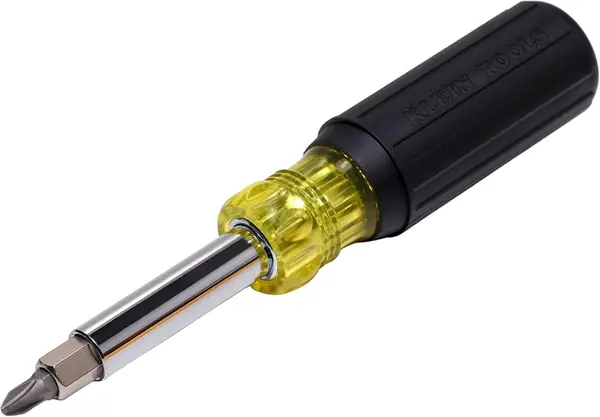
Klein Tools 32500 11-in-1 multi-bit screwdriver and nut driver with yellow and black handle

General shop use

Shop Score 97/100
Weight
7.68 oz
Tips
8 (Phillips, slotted, Torx, square recess)
Nut Drivers
1/4, 5/16, 3/8 inch
Overall Length
10.96 inches
View on Amazon

Three nut drivers riding on the same shaft as the bits is the detail that separates the 32500 from a drawer full of screwdrivers. Alongside #1 and #2 Phillips, 3/16- and 1/4-inch slotted, T10 and T15 Torx, and #1 and #2 square recess, it converts to 1/4-, 5/16-, and 3/8-inch nut drivers — enough for a bench vise bolt, a router fence knob, or the levelers under a workbench.

That range is why it is the one we tell people to buy first. Most multi-bit drivers stop at screw heads; this one also covers the hex hardware scattered across jigs, clamps, and knockdown furniture, and it does it at 7.68 ounces with a shaft rigid enough to lean on. There is no ratchet, which we count in its favor: fewer parts to slip, and every ounce of torque goes straight into the tip.

The Cushion-Grip handle is the same shape Klein puts on its fixed drivers, and the blast finish on the tips bites hard enough that cam-out was not the fight we expected. Swapping bits takes two hands — pull one out of the shaft, press the next in — which is slower than the quick-load collar on our ratcheting pick but never fiddly.

At 10.96 inches overall it stores where your other full-size screwdrivers do. It is also sold as a two- or three-piece set with the stubby in this guide, and in a magnetic version, so you can cover both ends of a job in one order.

Worth Noting

  • Handle runs thick for smaller hands
  • Bits can stay lodged in the fastener
Our Verdict

We recommend the 32500 as the default: eleven configurations, a grip that takes real torque, and the broadest track record here, so it covers cabinet hardware, outlets, and furniture without a bit box.

Check Latest Price
2.

Klein Tools 32561 6-in-1 Stubby Best for Tight Spaces

Klein Tools 32561 stubby 6-in-1 screwdriver with short shaft and yellow black grip

Tight cabinet work

Shop Score 96/100
Weight
2.6 oz
Tips
4 (Phillips, slotted)
Nut Drivers
1/4, 5/16 inch
Shaft Length
1-1/4 inches
View on Amazon

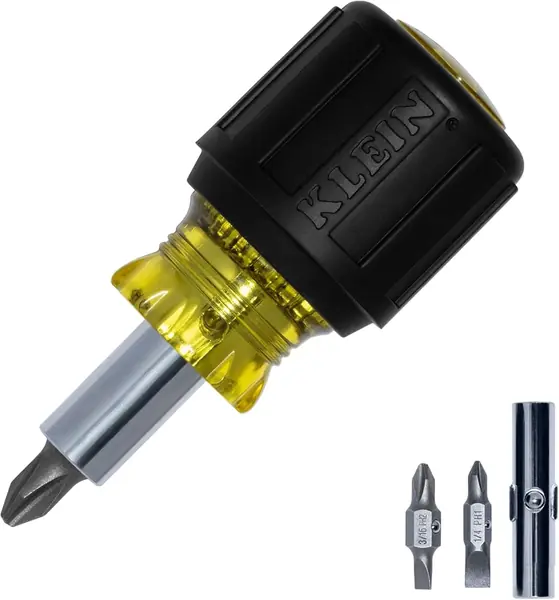
Drawer slides, hinge cups, and the sliver of space between a cabinet side and a wall all have the same problem: a full-size driver will not fit. The 32561 answers with a 1-1/4-inch shaft, and it is the driver we reach for first when a hinge screw has to come out without taking the door off.

The bits are #1 and #2 Phillips, 3/16- and 1/4-inch slotted, and 1/4- and 5/16-inch nut drivers, all swapped through the same short shaft — the right list for cabinet hardware, outlet plates, and the bolts on a euro hinge. What surprised us is the torque. A lot of stubbies shrink the handle along with the shaft and leave you pinching the tip between two fingers; this one keeps the full grip diameter, so a stubborn screw gets the same lean you would give the big driver. At 2.6 ounces it disappears into an apron pocket.

Klein sells replacement bits for it under catalog numbers 32396, 32398, and 32412, so a rounded tip does not retire the tool. On a driver this small that matters, because the bits are the whole set.

Worth Noting

  • No Torx or square-recess bits on board
Our Verdict

Our pick when the driver has to fit where a full-size one will not: the stubby reaches drawer slides and hinge cups and still takes a real grip.

Check Latest Price
3.

WORKPRO 12-in-1 Ratcheting Best Ratcheting

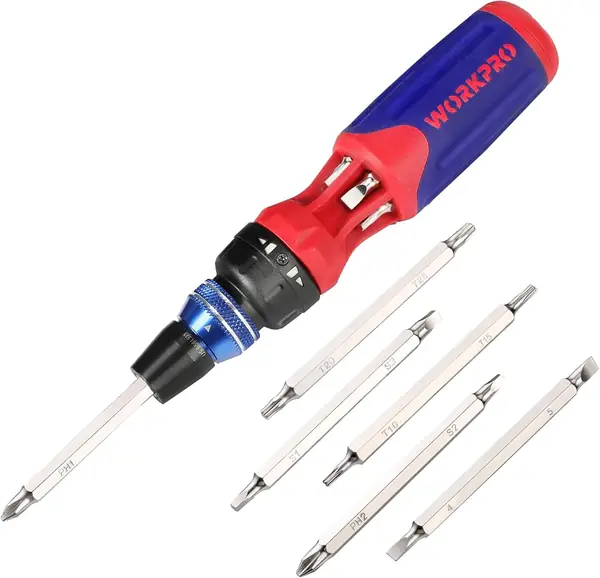
WORKPRO 12-in-1 ratcheting multi-bit screwdriver with blue and red handle and onboard bit storage

Long assembly runs

Shop Score 95/100
Weight
4.48 oz
Bits
6 double-ended (12 tips)
Bit Shank
1/4 inch hex, S2 steel
Ratchet
Forward, reverse, locked
View on Amazon

Our top pick does not ratchet, and on a long run of identical screws that is the difference between finishing a job and quitting it. The WORKPRO's collar clicks between forward, reverse, and locked, and the action is fine enough that you feel each tooth catch instead of the handle lurching.

The quick-load collar is the feature we did not expect to use as often as we do. Press it, drop in one of the six double-ended bits, and it locks with one hand while the other keeps the workpiece steady. That is the moment this driver separates itself from a bit box sitting on the bench.

Twelve tips in Phillips, slotted, Torx, and square store inside the handle, and they sit on a standard 1/4-inch hex shank, so a lost bit is a hardware-store errand rather than a manufacturer order. The whole tool is 4.48 ounces, and the slip-resistant handle has enough texture to keep turning when your palm is damp.

The lock position matters more than it sounds. Set to fixed, the driver behaves like any other and takes the last hard quarter turn on a hinge screw without backdrag, which is the setting we leave it in when we do not know what the next job is.

Worth Noting

  • Bits can snap on seized or rusted screws
Our Verdict

For long assembly runs we reach for this one: the ratchet and one-handed bit loading keep a driver in your hand instead of a bit set on the bench.

Check Latest Price
4.

VESSEL 220W-3 Ball Grip Best for Japanese and European Fasteners

VESSEL 220W-3 ball grip screwdriver with three double-ended bits and a magnetic tip

JIS and Pozidriv

Shop Score 94/100
Weight
5.01 oz
Bits
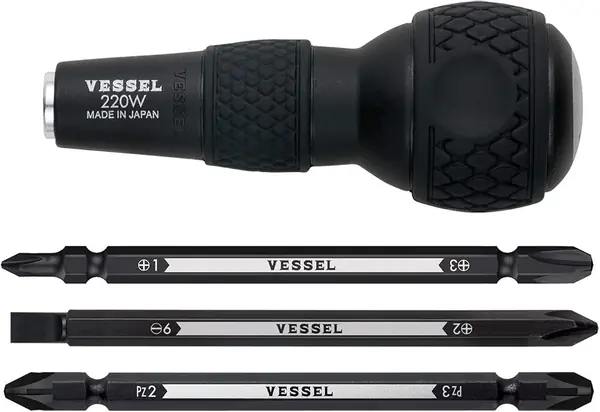
3 double-ended (+1, +2, +3, -6, PZ2, PZ3)
Bit Shank
1/4 inch hex
Blade Length
3 inches with bit seated
View on Amazon

A Phillips tip that cams out of a Japanese crosspoint screw is a screw you are about to round off. VESSEL's ball grip driver is the simplest way we have found to avoid that: the set carries JIS crosspoint bits alongside Pozidriv, and both seat in fasteners a Phillips tip only pretends to fit.

The handle is the other half of the argument. It is a ball that sits in the palm, so you can press straight down the axis of the screw and turn with your fingertips — the posture that keeps a small crosspoint from climbing out of its slot. The tip is magnetic, and at 5.01 ounces the whole thing rides in a pocket. It also takes any 1/4-inch hex bit you already own, provided the bit measures at least 2 inches overall; the short insert bits from a bit box will not seat, so plan on longer power bits. With one in, you get 3 inches of blade, enough to clear an obstruction without a full-length driver crowding the work.

Ours lives next to the machine it serves. This is the driver kept with the Japanese tablesaw or the hinge jig, not the one carried for everything.

Worth Noting

  • No Torx, square-recess, or nut driver bits
Our Verdict

If your work runs to Japanese machinery or European cabinet hardware, we point you here: JIS and Pozidriv tips fit screws a Phillips tip chews up.

Check Latest Price
5.

Wera Kraftform Kompakt 20 Best for Compact Tool Bags

Wera Kraftform Kompakt 20 multi-bit screwdriver with telescoping bayonet blade and storage pouch

Compact tool bags

Shop Score 93/100
Weight
9.17 oz
Bits
Slotted, Phillips, Pozidriv
Blade
Two-position telescopic bayonet
Pieces
7
View on Amazon

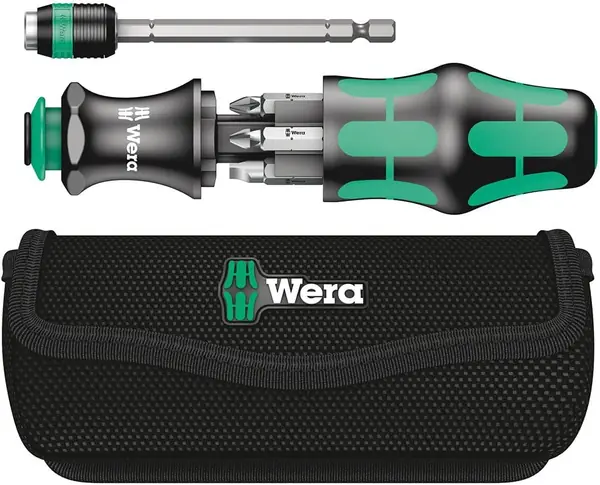
The Kraftform Kompakt 20 is the most expensive driver here by a wide margin, and the premium buys one specific trick: a bayonet blade that retracts into the handle, locks out at full length, and pulls free to serve as a bit holder in a power tool.

In hand, those two positions cover ground that otherwise takes two tools. Retracted, it works in the space a stubby needs; extended, it reaches past a cabinet stile to a hinge screw. The Rapidaptor collar takes a bit one-handed and releases it with a spring-loaded sleeve, and the bits ride in a magazine that opens with a button.

We keep it in a backpack, and the reasons are the pouch and the weight: 9.17 ounces loaded, in a package that rolls smaller than a bit box. The Kraftform handle does what its shape promises — the fluted section gives your fingers somewhere to sit when you are spinning a screw out by hand rather than driving it.

The chuck takes standard insert and power bits, so the pouch can grow with your work rather than staying fixed at seven pieces. What it will not do is stand in for a fixed driver on a corroded fastener, where a solid shaft and a fat handle still win.

Worth Noting

  • No Torx or hex bits included
Our Verdict

We think it is worth the premium if you want one compact driver in a bag: the bayonet blade covers stubby and full-length reach, and the chuck takes standard bits.

Check Latest Price

How We Tested Multi-Bit Screwdrivers

To build the shortlist, we read spec sheets and replacement-bit listings, then sorted models by bit coverage across Phillips, slotted, Torx, square, Pozidriv, and nut drivers, along with shaft length, handle size, and price. We noted whether each used a standard 1/4-inch hex shank or a maker-specific bit, and we tested 14 multi-bit screwdrivers for six months, keeping the same set in rotation from start to finish.

They lived in kitchen drawers, tool bags, and on a workbench. We hung cabinet doors, assembled flat-pack furniture, tightened bike racks, ran nut drivers on threaded rod and cabinet levelers, and used stubby, standard, and telescoping shafts in cabinet corners and behind drawer slides. That mix showed us quickly that a long shaft can be the difference between a two-minute job and a dismantled cabinet, and that a short handle is not always the easier one to turn.

We timed one-handed bit changes, noted how each handle stored its bits, and watched for dropped, stuck, or wobbly bits. We drove screws overhead and at bench height to judge handle diameter and grip, then compared ratcheting with fixed handles over long runs of machine screws, noting backdrag, skipped teeth, and how much torque we could apply without the bit twisting.

With eye protection on, we leaned on stubborn fasteners to check tip wear and bit retention, and we did not use any driver as a pry bar; we treated every one as uninsulated and kept them away from live circuits. We also weighed each tool, carried it in a pouch and a back pocket, compared replacement-bit cost with what came in the handle or pouch, and rechecked handles for cracks and collar play after six months.

How to Choose a Multi-Bit Screwdriver

Match the bits to the fasteners you turn

Phillips and slotted cover most household screws, but a woodworking bench collects more: square recess in cabinet hardware, Torx in jigs and power tools, hex bolts on clamps and vises. Before you compare drivers, walk your bench and count the fastener types within arm's reach — that list, not the in-1 number, is what you are buying against.

The Klein 32500 pairs eight bits with 1/4-, 5/16-, and 3/8-inch nut drivers, which is why it handles a bench vise bolt and a hinge in the same pass. The VESSEL set trades that breadth for JIS and Pozidriv, the crosspoints used on Japanese machinery and European cabinet fittings.

Check the shank, not just the bit count

A driver is only as useful as its supply of replacements, and that comes down to how the bit is held. Bits on a standard 1/4-inch hex shank can be refilled from any hardware store or from the bits already in your drill kit. Makers that use their own double-ended bits leave you ordering from them, which is fine until a tip rounds off mid-project.

Both approaches work, so read the shank before the feature list. The WORKPRO's bits are standard hex. The VESSEL grip takes standard bits too, but only ones at least 2 inches long overall. The Wera's Rapidaptor chuck takes standard insert and power bits, which is how you widen a narrow set.

Reach decides more jobs than bit count

Shaft length decides which fasteners the driver can physically reach, and it is the spec shoppers misread most. A stubby like the Klein 32561 uses a 1-1/4-inch shaft for hinge cups and drawer slides; a full-size driver runs about 11 inches overall; an adjustable or telescoping blade, like the Wera's, covers both ends of that range.

The trap: compact in a listing often describes the handle, not the shaft. Measure the recess or the clearance around the fastener, then match the shaft to it rather than to the photograph.

Ratchet, torque, and the handle in your hand

A ratchet saves wrist work when you drive the same screw over and over — flat-pack, a run of hinges, a deck. The WORKPRO's three-position collar also locks out to behave like a fixed driver, which is the version we prefer over a ratchet that can only ratchet. A fixed shaft still wins on corroded or over-torqued fasteners, where nothing between your palm and the tip can give.

Handle diameter is the other half of the decision. Klein's grips run thick, which suits a large hand and a hard turn and feels bulky to a smaller one. If you drive a dozen screws a week, either design is fine; if you drive a hundred, buy the ratchet.

Frequently Asked Questions

Final Verdict

Start with the Klein 32500. Eleven configurations, three nut drivers, and a shaft that takes real torque make it the multi-tool we recommend to anyone who wants one driver for cabinet hardware, outlets, and furniture, and it has the broadest track record in this guide.

If your screws hide inside a drawer slide or a hinge cup, add the 32561 stubby. If you drive the same screw fifty times in an afternoon, the WORKPRO's ratchet earns its place. Reach for the VESSEL instead only when the fasteners themselves are Japanese or Pozidriv.