↑↓ navigate ↵ open Esc close All results →

Best Respirators for Epoxy Resin of 2026

Working over uncured resin or sanding a finished tabletop in a paper paint-aisle mask leaves solvent odor hitting the back of your throat within minutes. Epoxy creates two distinct airborne hazards — chemical vapors off-gassing during pours and fine cured dust raised by abrasives — requiring a respirator that pairs an organic-vapor cartridge with a particulate filter on top of steady cross-ventilation.

Eight months of pouring, sealing, sanding, and swapping cartridges across 12 respirators showed that facial seal and correct filter class protect far better than a higher sticker price. A comfortable silicone seal that passes a quick negative-pressure check and stays bearable past the first hour prevents the mid-project urge to pull the mask down.

Suitable for anything from an occasional weekend repair to weekly studio pours, these four certified masks use readily restocked cartridges and seal reliably before the first batch is mixed.

Our Top Picks

The Best Respirators for Epoxy Resin

1.

3M Multi-Purpose Reusable Respirator 62023 Best Overall
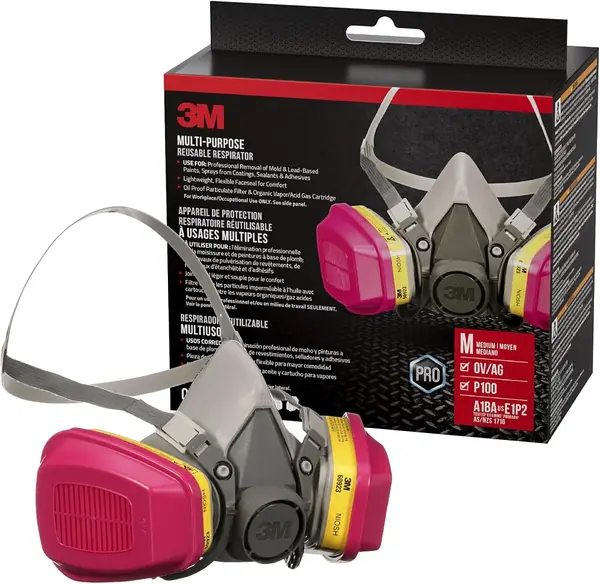
3M 62023 reusable half-face respirator in gray with a pair of combination cartridges attached

Everyday epoxy work

Shop Score 94/100
Certification
NIOSH-approved OV/AG/P100
Size
Medium
Particulate Rating
P100, 99.97% filtration
Cartridges Included
One pair OV/AG/P100 (60923)
View on Amazon

The cartridges are in the box. Open the 3M 62023 and there's a pair of 60923 organic-vapor, acid-gas and P100 combination units already in the bag, and they twist into the facepiece with a quarter turn. That is the whole reason this is our top pick: a respirator that's ready the day it lands gets worn for the first pour, while one waiting on a second order tends to sit on the bench through the project it was bought for.

Both hazards are covered by that single cartridge. The organic-vapor side handles the solvent and hardener smell coming off an open pot while you mix and pour, and the P100 side is rated for at least 99.97 percent filtration against solids and oil-based aerosols, which is more than enough for the dust you raise block-sanding a cured flood coat. You keep the same mask on from the wet phase through the sanding phase, which is how epoxy projects actually run.

We also like the mount. It's 3M's standard bayonet fitting, so replacements are simple and the facepiece takes a wider range of vapor and particulate filters than the kit ships with. Fit is where any half mask lives or dies, though, and this is a medium facepiece with adjustable head straps. Spend a minute on a seal check every time: cover the cartridges, inhale, and the mask should pull in against your face and hold. If it relaxes, air is getting past the seal and the cartridges aren't doing the work.

What settled it for us is the second half of the job. After the pour cures you're back at the bench with a sander, and the same cartridges that handled the wet resin handle the dust. Pick up a spare pair when you buy the mask, keep the facepiece and spares in a sealed bag between sessions, and this becomes a kit you can count on project after project.

Worth Noting

  • Medium facepiece only, with no small or large option
  • Head strap can crack under steady use
Our Verdict

We recommend the 62023 as the default for epoxy work because the OV/AG/P100 cartridges come in the box, so you're covered on the first pour rather than after a second order.

Check Latest Price
2.

3M Full Facepiece Reusable Respirator 6800 Best Full-Face

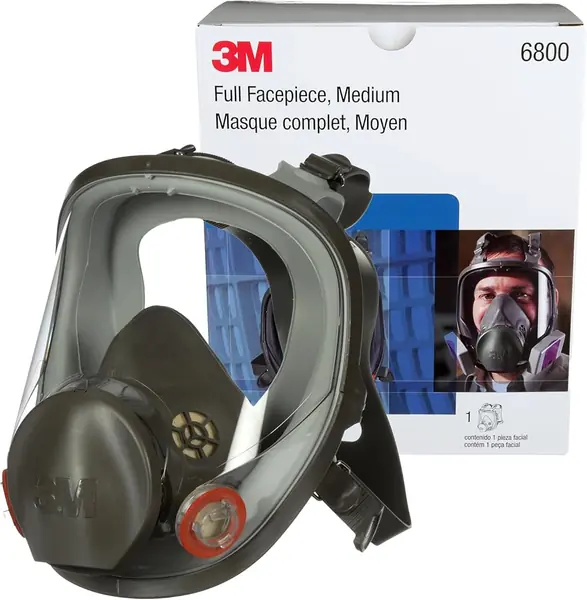
3M 6800 full-face reusable respirator with a large clear lens and silicone face seal

Heavy epoxy use

Shop Score 93/100
Certification
NIOSH-approved facepiece
Face Seal
Silicone, four-point harness
Eye Protection
ANSI Z87.1-2010 high impact
Cartridge Mount
3M bayonet, 6000 Series vapor cartridges
View on Amazon

The 3M 6800 is the most expensive mask we recommend, and most of what you pay for is the window. It's a full facepiece with a large, clear lens rated to ANSI Z87.1-2010 at the high impact level, which means it takes over the job your safety glasses were doing.

For epoxy work, we think that's a bigger deal than it sounds. Resin and hardener splash when you pour and when you tip a cup back out, and the vapor hanging over an open pot stings your eyes well before it bothers your lungs. A half mask and a pair of goggles covers a small repair; across a long laminating session, a sealed lens is the more comfortable way to keep both out, and you never have to stop and reseat a goggle with a gloved hand.

The facepiece itself earns the rest of the price. The seal is silicone rather than the firmer thermoplastic on the cheaper masks, the harness has four points, and the bayonet mount takes 3M's 6000 Series vapor cartridges and particle filters. NIOSH approves the assembly when it's paired with those cartridges, and that pairing is what counts. The same facepiece also accepts 3M's powered-air and supplied-air units, so it's the one mask here with an upgrade path if a job ever outgrows a filter.

Two things to know before you commit. The cartridges and particle filters aren't in the box, so your first order is the mask plus a filter set. And a full facepiece is a real commitment in a small shop: it sits heavier on your head than a half mask, it runs hot in a garage in July, and you look through its lens instead of through your own glasses. For a few small repairs a year, the 62023 does the same work for a fraction of the outlay.

Worth Noting

  • Cartridges and particle filters sold separately
Our Verdict

Buy the 6800 if you want your eyes behind a sealed lens while you pour and sand; we think that protection is worth the jump for anyone working epoxy regularly.

Check Latest Price
3.

AirGearPro G-500 Reusable Respirator Mask Best Value Kit

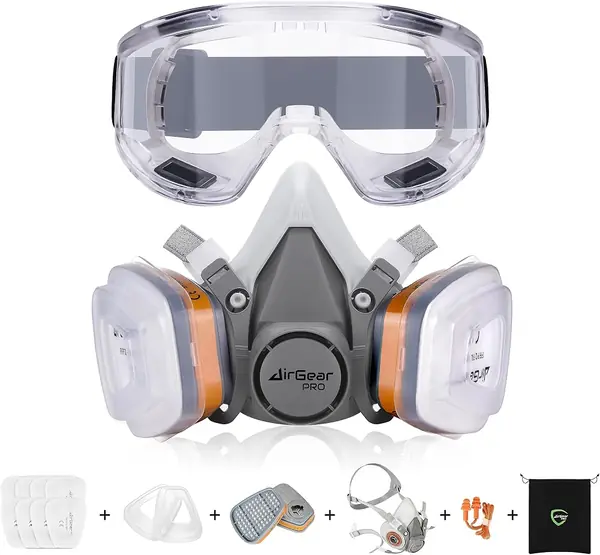
AirGearPro G-500 gray half-mask respirator with A1P2 filters and clear safety goggles

Occasional projects

Shop Score 92/100
Certification
CE certified
Size
One size
Included
Mask, A1P2 filters, safety goggles
Filter Class
A1P2
View on Amazon

The safety goggles in the box are the detail that makes the AirGearPro G-500 worth a look. One order gets you the half mask, a pair of A1P2 filters and a set of goggles, and the whole setup is light enough that a mixing session doesn't leave you watching the clock.

A1P2 is a European classification: A1 for organic vapor, P2 for particles, with the mask and filters CE certified as a set. For mixing resin, laying it up and hand sanding a cured piece, that covers both jobs. Where it sits below our top pick is the particulate side — P2 isn't the P100 rating on the 3M kits, and for a long session with a random-orbit sander we prefer a P100 cartridge, which gives more margin on fine dust.

The fit check is the whole game here, as it is with any mask. Cover the filters and inhale: the facepiece should pull in and stay in. If air slips past your chin, work the elastic straps one notch at a time, and if you can't close the leak, send it back rather than talk yourself into it. The goggles sit over the mask without fighting it, which is more than we can say for most add-on eyewear.

Where the G-500 earns its place is the occasional project — a river table, a repair, a few coats over a turning. It's the least fussy way to get mask, filters and eye protection onto the bench in one delivery, and the light build is easy to keep on while you mix. Heavy production work is where the 3M kits pull ahead.

Worth Noting

  • One size only, so the seal depends on your face
  • Goggles can collect condensation in a cool shop
Our Verdict

For a hobbyist who wants filters and goggles in one box and can make a one-size seal work, we think the G-500 is the easiest place to start.

Check Latest Price
4.

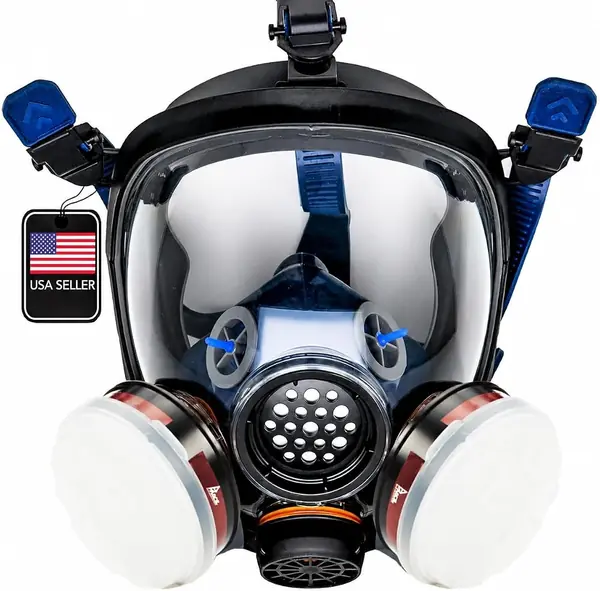
Parcil Distribution Full Face Respirator

Parcil Distribution full-face air-purifying respirator mask with a clear lens

Budget full-face

Shop Score 91/100
Certification
CE tested
Lens
Clear
Type
Full facepiece
Protection
Organic vapor and particulate
View on Amazon

A full facepiece for a good deal less than the 3M 6800 is a real gap in this category, and the Parcil is the mask that fills it. It's an air-purifying full-face respirator rated for organic vapor and particulate, CE tested, with a clear lens.

What you're buying for the money is the shape. A sealed lens keeps splashes off your face and eye-stinging vapor out of your eyes, and it stands in for safety glasses — the same argument we make for the 6800 at several times the outlay. For someone who wants that coverage and doesn't need a powered-air path or a known name on the strap, it's a sensible place to look.

Before you order, pin down the consumables: which replacement cartridges the mask takes, whether they cover organic vapor and particulate rather than particles alone, and whether you can buy another set in a year. A full facepiece that only takes one obscure cartridge is a paperweight. Buy from a seller who names the cartridge model, and check the return window before you commit.

Worth Noting

  • Replacement cartridge model and future supply must be verified before ordering
Our Verdict

We see the Parcil as the low-cost route into a full facepiece for epoxy, provided you confirm the cartridge supply before you order.

Check Latest Price

How We Tested Respirators for Epoxy Work

We started with the cartridge, since the mask is only as good as what clips onto the front of it. The shortlist came from research rather than a store shelf: masks that could take an organic-vapor cartridge paired with a particulate filter, sold either in the box or as a combination we could buy separately; facepieces and cartridges certified together; and the sizes each one was offered in, noted because a one-size mask is a gamble on somebody's face. Twelve made the cut, and we wore them for eight months.

Every unit went through the same sessions — mixing and pouring two-part epoxy at a bench in a garage with the door up and a fan pulling air through, sanding cured pieces, and a run of small weekend repairs. We ran a seal check before each session, on clean-shaven faces only; stubble along the sealing edge lets vapor past the cartridge, and no amount of strap tension fixes that. We noted fogged lenses and goggles, red pressure lines, and how hot the face seal got once a session ran past an hour.

We kept track of the ongoing costs, too. Each box was opened and inventoried to see what had to be bought separately, replacement cartridges were priced and checked for how easily they could be reordered, and masks went into a sealed bag between sessions. Harnesses got flexed and cartridges swapped repeatedly to see which mounts stayed tight, and any cartridge that let a taste or smell of solvent through was retired on the spot.

How to Choose a Respirator for Epoxy Resin

Start With the Cartridge, Not the Mask

An epoxy project throws two different hazards at you: organic vapor while the resin and hardener are wet, and fine particulate when you sand the cured piece. You need both covered, which means an organic-vapor cartridge with particulate filtration — either a combination unit like the OV/AG/P100 pair that ships with the 3M 62023, or a vapor cartridge with a P100 prefilter clipped over it.

A particulate-only filter leaves you breathing the vapor, and a bare vapor cartridge does nothing for sanding dust. Before you buy a facepiece, check that its cartridges are ones you can reorder a year from now, and that the vapor-plus-particulate combination is approved for that specific facepiece. That approval belongs to the pair, not to either part alone.

Fit Decides Whether Any of It Works

Every mask here is built to filter; none of that counts if air takes the short route around the seal. That's why the sizing question comes before the spec sheet — a medium 3M facepiece and a one-size imported mask sit very differently on the same head, and only one of them may seal on yours.

Run a seal check every time you put the mask on: cover the cartridges, inhale gently, and hold it. The facepiece should pull in slightly and stay pulled in; if it relaxes, air is coming past the seal. A clean-shaven sealing surface is part of the equipment, not grooming advice — stubble at the chin or cheek breaks the seal, and no amount of strap tension fixes that.

Half Mask or Full Face for Epoxy?

A half mask plus safety glasses is the light, inexpensive, comfortable route, and it's what most woodworkers want. A full facepiece changes what you can do: the lens carries an impact rating — the 3M 6800's is ANSI Z87.1-2010 high impact — so it replaces your safety glasses and keeps splashes and eye-stinging vapor away entirely.

The trade is weight, heat, and the fact that you look through the lens instead of through your own glasses. If you wear a prescription, that last point settles the choice for you. Whichever you pick, the mask supplements ventilation rather than replacing it: keep air moving through the shop and leave the area if vapor keeps building.

What's in the Box, and What You'll Keep Buying

A facepiece on its own isn't respiratory protection; it's the thing you attach protection to. Check whether the kit includes cartridges — the 3M 62023 and the AirGearPro G-500 do, the 3M 6800 doesn't — and price the replacements before you commit to a model. Combination cartridges are the simplest system to live with: one part to stock, one part to change.

Store the mask and your spare cartridges in a sealed bag between sessions. An organic-vapor cartridge keeps working on whatever it's sitting in, and a bag stops it from spending its capacity on garage air before you've poured a single ounce of resin.

Frequently Asked Questions

Final Verdict

Buy the 3M 62023 first. It's the pick here that arrives with organic-vapor and P100 filtration already in the box, so the mask is working on your first pour instead of after a second delivery, and the bayonet mount means you're only ever reordering cartridges.

If you want your eyes behind a sealed lens while you mix, sand and tip out a cup, the 3M 6800 is the one we point regular epoxy finishers toward. If goggles in the same order matter more than carrying the maximum particulate rating, the AirGearPro G-500 covers both jobs in one kit.