↑↓ navigate ↵ open Esc close All results →

Best Tape Measures for Woodworking of 2026

Stretching eight feet across a sheet of plywood solo quickly exposes a flimsy tape measure when the blade buckles mid-air and snaps back at your knuckles. Reliable shop tapes pair stiff standout with a lock that holds steady while you strike a mark.

Six months of plywood breakdowns, face-frame layout, deck joists, and basement framing with 14 blades from 12 to 30 feet confirmed that most tapes fail at the hook first. Loose rivets and battered boots throw the first inch off by a sixteenth—distinct from the deliberate, controlled slide that lets a hook shift by its own thickness for accurate inside and outside measurements.

Spanning compact 12-foot bench tapes to wide 30-foot blades with legible fraction markings, varied lock styles, and magnetic hooks, dependable layout starts with a first inch that stays dead true.

Our Top Picks

The Best Tape Measures for Woodworking

1.

FastCap ProCarpenter Standard Reverse 16-Foot Best Overall
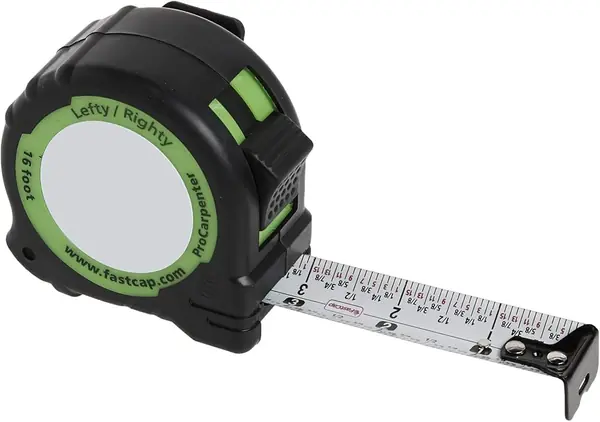
FastCap ProCarpenter 16-foot tape measure in green with rubber boot and dual-reading blade

Shop and cabinet work

Shop Score 98/100
Blade Length
16 feet
Blade Width
1 inch
Blade Scale
Standard scale readable from either direction, fractions to 1/16 inch
Case Features
Built-in pencil sharpener and erasable notepad
View on Amazon

Print the blade so it reads correctly with the case on either side of the mark, and you have removed the small annoyance that sends most of us back across the shop to measure again. That dual-direction scale is why this FastCap lives by our bench: mark a sheet from the far end, walk to the saw, and the number reads in the direction you marked it. On stock that gets flipped and measured from both ends, it quietly removes a whole class of mistakes.

The rest of the blade is aimed at the same user. Fractions are printed in numerals down to 1/16 inch, which we found easy to read at arm's length in ordinary shop light, and the blade is a full inch wide and 16 feet long with a four-rivet nose clip, so the hook keeps its square after the tape has been dragged across a bench edge a few hundred times.

Two extras we expected to ignore turned out to earn their space: a pencil sharpener built into the case and an erasable pad on the side. A lot of marks that drift by a 32nd start with a blunt pencil, and the pad means a measurement comes off the blade and onto the case instead of onto the back of your hand. Neither is a reason to choose this tape on its own; both are reasons we stopped putting it down in the middle of a cut.

The rubber boot around the case is there for the drop you don't plan on, and the belt clip is the part to keep an eye on — on a tape that rides a tool belt all day, that is what gives out first, so give it a tug now and then. Everything else about the case is built for a shop rather than a truck bed, which is exactly the trade we want a bench tape to make.

Worth Noting

  • 16-foot blade is short for room dimensions
Our Verdict

We think it's the best tape here for furniture work: a scale that reads from either direction, 1/16-inch fractions, and a sharpener you will actually use.

Check Latest Price
2.

CRAFTSMAN Self-Lock 25-Foot Tape Measure Best for Measuring Alone

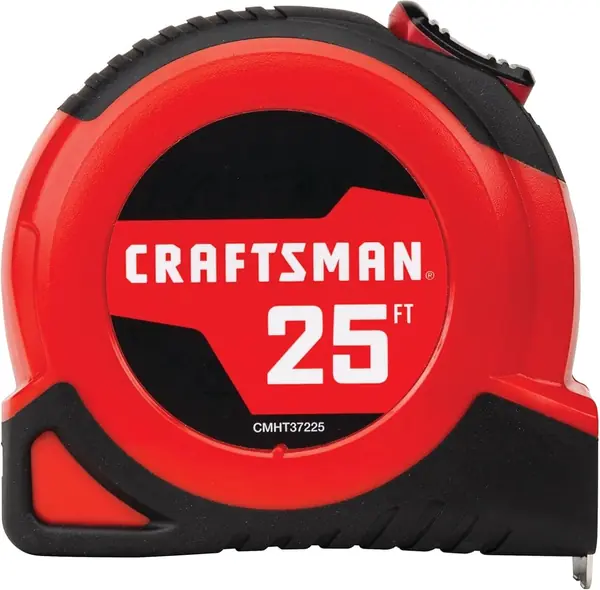
CRAFTSMAN 25-foot self-lock tape measure in red and black with rubber overmold

One-person measuring

Shop Score 97/100
Blade Length
25 feet
Blade Width
1 inch
Blade Markings
Fractions printed on the blade
Accuracy
±1/16 inch per 10 feet
View on Amazon

Pull the blade out and it locks itself, and it stays where you left it until you press the release. That is the whole case for the self-lock design, and we think it is the right one for anyone measuring alone: hook a sheet of plywood, walk the case across it, read the number, and the blade is not trying to reel itself back while you look for a pencil.

Fractions are printed on the blade rather than left to the quarter-inch ticks, the blade is an inch wide, and the stated accuracy is ±1/16 inch per 10 feet — the tolerance that matters when you are laying out a run of cabinets and want the same number twice. The red and black rubber overmold is grippy enough to hold with a pencil in the same hand, and the red case is easy to find under a pile of offcuts.

Against the Komelon self-lock further down, the choice comes down to the printing: fractions here, 16-inch stud marks there. We prefer the Craftsman's grip for one-handed work, and the numbers sit at a size you can read with the tape lying flat on the bench. Twenty-five feet covers sheet goods and most room dimensions.

Worth Noting

  • Blade can jam and stop retracting
Our Verdict

We recommend it to anyone who measures alone: the blade locks the moment it leaves the case, the fractions are printed on it, and it's one of the better values here.

Check Latest Price
3.

DEWALT Atomic Compact 30-Foot Tape Measure Best for Long Distances

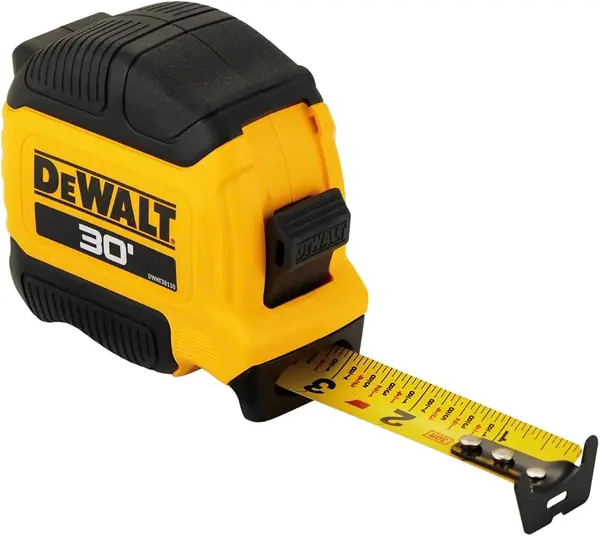
DEWALT Atomic compact 30-foot tape measure in black and yellow with slide lock

Long distances

Shop Score 96/100
Blade Length
30 feet
Blade Markings
Fractional graphics
Lock Type
Slide with integrated finger brake
Max Reach
13 feet
View on Amazon

Thirty feet of blade is more than most shops need; the 13-foot reach is the part that earns its keep. Hook one end of a deck or a long wall, walk the case to the far mark, and the blade is still straight when you get there, so a measurement that normally takes two people takes one.

The integrated finger brake is the feature we noticed first in use. Your index finger rides the blade and drags on it, so a spring that has to return 30 feet of steel comes back at the speed you allow. That is less about safety theater than about accuracy: a hook that slams into the case eventually bends, and a bent hook is a tape that measures wrong from then on.

Fractional graphics run the length of the blade, the coating is there to keep that printing alive after a few hundred feet of being dragged across plywood, and the grip is 20 percent more compact than DeWalt's full-size Atomic case. Nothing about it is delicate. It is a tape you can set down on a floor of shavings and pick up without thinking about it.

Worth Noting

  • Pound-heavy case pulls on a belt
Our Verdict

Thirty feet of blade and 13 feet of reach make this our pick for long layout, and the finger brake keeps all that spring under control.

Check Latest Price
4.

Komelon 4912IM Professional 12-Foot Best Compact Bench Tape

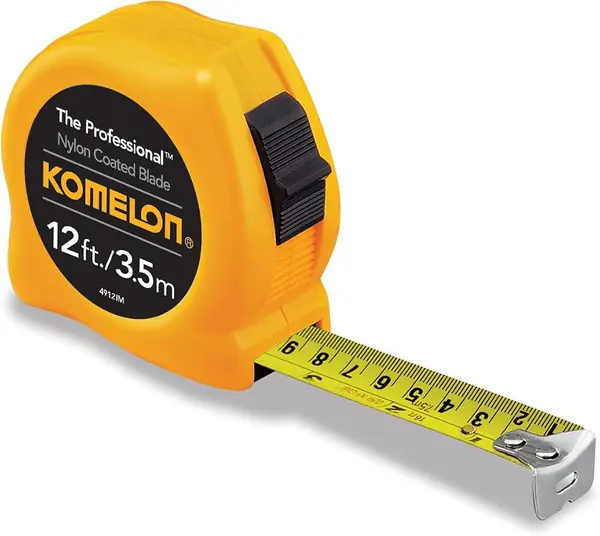
Komelon 4912IM 12-foot yellow tape measure with inch and metric blade

Bench work

Shop Score 95/100
Blade Length
12 feet (3.5 m)
Blade Width
5/8 inch
Accuracy
±1/32 inch
Blade Scale
Inch and metric
View on Amazon

If your drawings are in millimeters, this is the tape that stops the conversion happening in your head: inch and metric scales run down the same 12-foot blade, and the print is small but clean enough to read at arm's length. We keep it in the drawer with the marking knives, because a 25-foot case is just extra plastic in the way when the longest cut in the shop is four feet.

The blade is 5/8 inch wide and nylon coated, which keeps the whole tape at 4.5 ounces so it vanishes into an apron pocket; the flip side is a blade that gives up its stiffness sooner than the 1-inch tapes here. The slide lock holds on a firm thumb, stated accuracy is ±1/32 inch against the ±1/16 inch of the bigger tapes, and the yellow ABS case carries a metal belt clip rather than the plastic hook you find on cheap ones.

Worth Noting

  • 12 feet is short for room dimensions
Our Verdict

We keep this one by the bench: 12 feet of inch-and-metric blade in a case that disappears into an apron pocket, and it's the least expensive tape we recommend.

Check Latest Price
5.

Klein Tools 9225 25-Foot Tape Measure Best Magnetic Hook

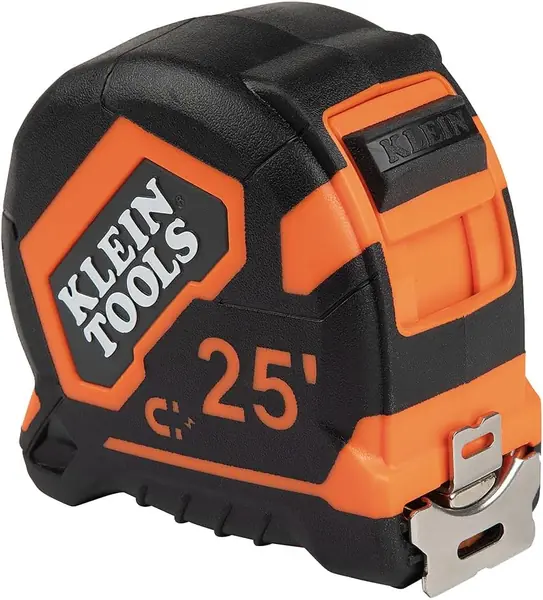
Klein Tools 9225 25-foot tape measure in black and orange with magnetic hook

Job-site measuring

Shop Score 94/100
Blade Length
25 feet
Standout
13 feet
Blade Scale
Bold 1/8-inch lines printed on both sides
Hook
Magnetic double hook
View on Amazon

At 1.3 pounds this is the heaviest tape in the group, and the trade is obvious the first time you hang it off a belt: a nylon-coated steel blade, printing on both faces, and 13 feet of standout before the blade folds over and drops the hook.

The magnetic double hook is the feature we care about most. It grabs from either face of the tip, so you can hook it over an edge or stick the end to a steel stud, a duct, or a metal door frame and pull the case with one hand. On metal, a measurement that used to need a helper takes one person and a couple of seconds.

The retraction brake is the other working detail: your thumb controls the return, which keeps the hook out of the case at speed and keeps your fingers out of the blade path. Bold 1/8-inch lines on both faces mean you can read the number from whichever side you happen to be standing on, and the housing has a tether channel for work at height. Where it can disappoint is over the long haul — housings and blades on this model do not always survive the daily-pouch life the rest of the tool is built for.

So we treat it as a job-site tape more than a bench tape: buy it for the magnet and the standout, and know you are paying the most here for the privilege. In a shop where the tape gets set down politely on a bench, the FastCap or the Craftsman will do the same work for less.

Worth Noting

  • 1.3 pounds drags on a tool belt
Our Verdict

We take this one to framing and steel-stud work: the magnetic double hook holds on metal, and the 13-foot standout saves a walk.

Check Latest Price
6.

Komelon SL2825 Self Lock 25-Foot Best for Framing and Value

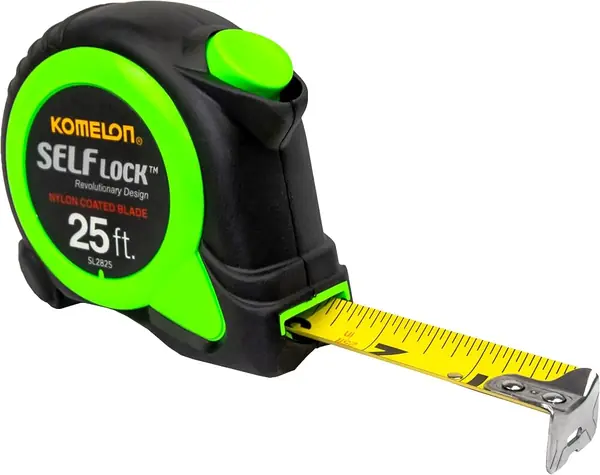
Komelon SL2825 self-lock 25-foot tape measure in green and black rubber case

Framing and value

Shop Score 93/100
Blade Length
25 feet
Blade Width
1 inch
Blade Markings
Stud marks every 16 inches
Accuracy
±0.03 inch
View on Amazon

The least expensive 25-footer here is also one of the wider ones: a full inch of high-carbon steel with stud marks printed every 16 inches. For a framing layout where you are stepping off 16s down a wall, having the marks on the blade saves a running count in your head while your hands are full.

The self-lock does what the design promises — pull the blade and it holds, push the button and it retracts under control — and the nylon coating is there to keep the print from rubbing off where the blade feeds back into the case. It runs 13.3 ounces in a rubber-overmolded ABS case, with a one-year warranty that is the shortest coverage in this group.

Where it earns a place in a shop that already has better tapes in it: the second tape in the truck, the one that goes to the lumberyard, the one you are not sorry to leave on a tailgate. We rate the blade and the printing well above what the price suggests, and the green case is easy to spot in a dark toolbox.

Worth Noting

  • Self-lock can lose grip at full extension
Our Verdict

We rate it the value pick here: a full inch of blade, stud marks every 16 inches, and a self-lock that makes solo measuring easy.

Check Latest Price
7.

STANLEY FATMAX 25-Foot Tape Measure Best for Long Reaches

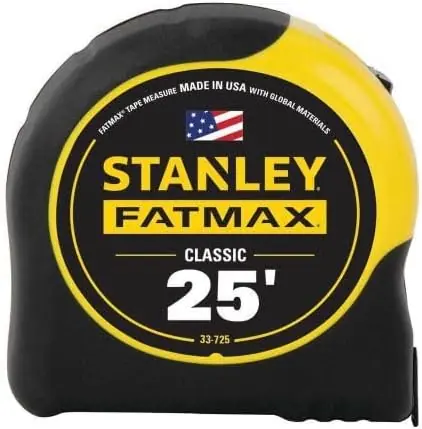
STANLEY FATMAX 25-foot tape measure in black and yellow with wide blade

Long reaches

Shop Score 92/100
Blade Length
25 feet
Blade Width
1-1/4 inches
Standout
11 feet
Warranty
Limited lifetime
View on Amazon

A 1-1/4-inch blade is the widest in this set, and width is what makes the FATMAX's 11-foot standout possible: the blade holds itself out in a straight line instead of bowing and dropping the hook off the end of the board while you walk the case. On a roof or a long wall, that difference is the whole exercise.

The first three inches of blade carry a BladeArmor coating and the rest is wrapped in Mylar-polyester film, which targets where a tape usually dies — the printing wears through before the spring gives up. The case is high-impact ABS with a rubber bumper, stated accuracy is ±1/16 inch, and the warranty is a limited lifetime, the longest coverage in this group.

Our reservation is the lock. It is a slide, it wants a deliberate thumb, and on a 25-foot blade it can let go when you are reaching for a mark rather than holding the blade still for it. If you mostly measure long runs alone and want the stiffest blade here, that is the compromise; if you want a lock you can trust one-handed at full extension, the self-locking Craftsman is the safer buy.

Worth Noting

  • Bulky case takes up belt space
Our Verdict

We reach for this when a long measurement has to happen solo: the 1-1/4-inch blade is the widest here and holds 11 feet of standout.

Check Latest Price
8.

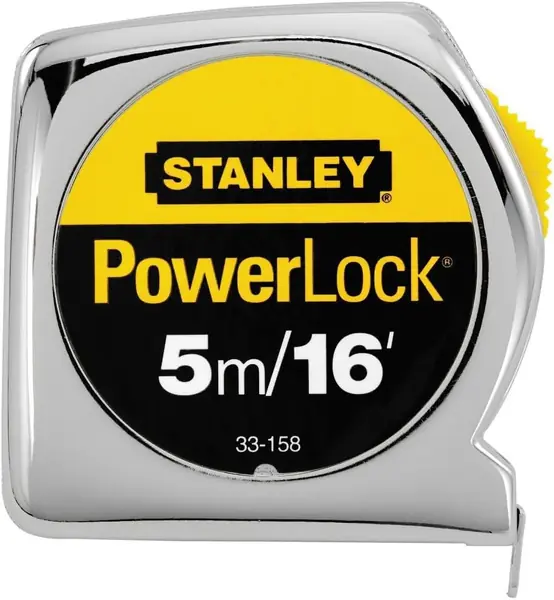
STANLEY PowerLock 16-Foot Tape Measure

STANLEY PowerLock 16-foot tape measure with chrome case and 3/4-inch blade

Apron-pocket carry

Shop Score 91/100
Blade Length
16 feet (5 m)
Blade Width
3/4 inch
Blade Markings
16- and 19.2-inch stud center marks
Standout
7 feet
View on Amazon

Three-quarters of an inch of blade and a case you can close your hand around: this is the tape that lives in an apron pocket rather than hanging off a belt. Sixteen feet covers casework, jigs, and the inside of a cabinet, and 7 feet of standout is enough to hold the hook on a shelf edge while you walk back to read the number.

What we like most is the printing for framing: 16-inch and 19.2-inch stud center marks on a blade that also carries centimeters, plus a tru-zero hook that reads the same whether you hook it over an edge or push it against one. At 7 ounces it does not pull an apron sideways, and the chrome ABS case shrugs off being shoved into a bag with clamps and screws.

The narrow blade is the thing to weigh. Three-quarters of an inch keeps the case small and light, but it folds sooner than the 1-inch blades here, so long solo measurements across a room are not its job. Within arm's reach of a bench it does everything a bigger tape does with less in your hand.

Worth Noting

  • Slide lock can slip and stop holding
Our Verdict

The compact tape we keep in an apron: a 3/4-inch blade, 16 feet, and stud marks at 16 and 19.2 inches for framing layout.

Check Latest Price

How We Tested These Tape Measures in the Shop and on Site

We started by making a list of tape measures in blade lengths from 12 to 30 feet and widths from 5/8 inch to 1-1/4 inches, then narrowed it by lock style — self-lock, slide, and thumb — and by hook design, keeping riveted, double, and magnetic hooks in the mix. Fourteen tapes at a range of prices came into the shop, and we used them for six months.

Testing happened where tapes actually live: a garage shop for breaking down plywood and laying out cabinet face frames, a deck build, and a basement framing job. At the bench we pulled every blade out to full extension to see where it folded under its own weight — standout matters most when you are alone and reaching across a sheet. We also compared inside and outside readings against a fixed steel rule and cut test pieces to confirm each hook read true.

We read each blade in dim light and from both directions where the scale allowed, noting whether the fractions were printed or molded and whether the 1/8-inch lines were bold enough to catch at arm's length. Each lock was set at full extension and pulled against; we watched for creep. Hooks were tried inside corners and over end grain. Retraction ran through the brake or a guiding hand every time, and we logged which tapes slapped their case and which fed back smoothly.

For carry, each tape spent full working days on a belt clip or in an apron pocket and was weighed on a kitchen scale, since blade width buys reach and costs weight. Over the months we checked coating wear, spring strength, and the condition of clips and boots, then re-measured the ones that survived to see whether the first inch still read true.

How to Choose a Tape Measure for Woodworking

Start With What Is Printed on the Blade

Shop work lives at 1/16 inch and smaller, so the markings decide more than the case does. Look for fractions printed in numerals rather than bare ticks, a high-contrast blade you can read in ordinary shop light, and, if you measure from both ends of a board, a scale that reads correctly with the case on either side. That last point is why the FastCap earns its place at the top of this list.

One trap worth naming: a few blades number inches cumulatively instead of restarting at each foot, which turns a simple reading into arithmetic. If you work in metric at all, insist on a dual-scale blade rather than converting in your head; the Komelon 4912IM prints both scales down the same 12 feet.

Standout and Blade Width

Standout is how far the blade reaches before it folds, and since it is usually quoted at the breaking point, plan on a foot or two less in real use. Width is the mechanism behind it: a 1- to 1-1/4-inch blade holds a line far longer than a 5/8-inch one, but it also makes the case bigger and heavier. For bench work a narrow compact tape is easier to control; for decking, walls, and solo layout, pay for the wide blade.

For scale, the quoted reaches in this group run 13 feet on the DeWalt and the Klein, 11 feet on the FATMAX, and 7 feet on the PowerLock. Treat those as best-case numbers and confirm the reach you actually get with the hook on the material you use.

Lock Type: Self-Lock, Slide, or Thumb

Self-locking blades lock every time you pull them out and release with a button; slide locks are levered with the thumb and hold wherever you set them. Measure alone most of the time and self-lock is faster and stops the blade running back at you. If you also use the tape as a marking reference, a slide lock is more deliberate and easier to feather.

The trap with any lock is that it is the first thing to wear. An auto-lock that has lost its grip past 20 feet is worse than no lock at all, and a stiff slide lock will cost you marks on a long pull.

The Hook, the Case, and How Tapes Die

The end hook takes more abuse than any other part: it gets stepped on, pried under stock, and dropped hook-first onto concrete, and a hook that has been straightened is a tape that measures wrong. Check that the rivets are tight and the hook sits square before you trust a new tape on a critical cut.

A magnetic or double hook grabs edges and steel and is worth the extra money if you work alone. Cases die from drops and blades die from being dragged, so a rubber boot and a coated blade are worth paying for, and a retraction brake on anything longer than about 16 feet is cheap insurance for your fingers.

Frequently Asked Questions

Final Verdict

The FastCap ProCarpenter is the tape we point a woodworker to first: the dual-direction scale, the 1/16-inch fractions, and the sharpener and notepad on the case all serve the way a shop actually works, where you mark far more often than you measure a room.

If your measuring happens on a deck or across a wall rather than at a bench, the DeWalt Atomic's 30 feet and 13-foot reach are the better tool, and if you work alone in a small shop on a budget, the self-locking CRAFTSMAN does most of the same job for less.