↑↓ navigate ↵ open Esc close All results →

Best Tool Bags of 2026

Buying a tool bag by its advertised pocket count usually catches up with you on the third trip back to the bench for a missing socket. On the shelf every bag looks organized, yet in daily work a good layout lets you spot a driver, pull it clear without unpacking half your kit, and get right back to the cut.

Loading 14 tool bags with identical kits—and weighing each empty before packing it to the maker's limit—over eight months across garage benches, truck beds, and damp basements highlighted two patterns. Deep pockets consistently beat sheer pocket quantity, and a rigid molded base determines where you can set a bag down far more than the denier of its fabric.

This lineup spans compact single-job carriers to long bags built around saws and levels, alongside shoulder-carried options designed for longer walks from the parking lot.

Our Top Picks

The Best Tool Bags

1.

WORKPRO 16-Inch Wide Mouth Tool Bag Best Overall
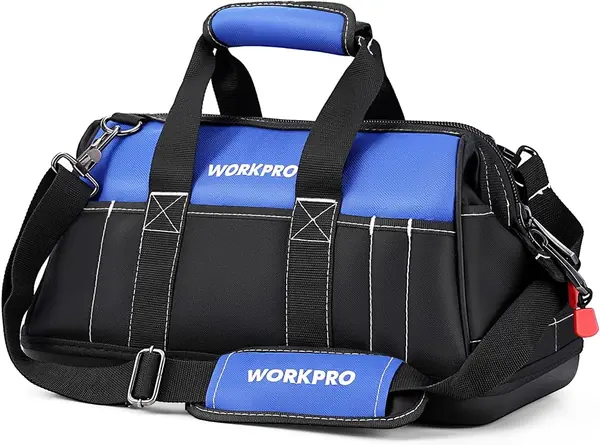
WORKPRO 16-inch blue and black wide-mouth tool bag with molded waterproof base

All-purpose hand tools

Shop Score 98/100
Load Limit
33 lb
Dimensions
15.75 x 8.66 x 9.84 in
Compartments
29
Water Resistance
Waterproof
View on Amazon

A metal frame sewn into the rim holds this bag's mouth open, so when you unzip it the top stays where you put it and you can look straight down at the bottom instead of prying the sides apart with one hand. The organization runs to 29 compartments — eight pockets inside, 13 outside, and eight belts for drivers and chisels — and the body measures 15.75 by 8.66 by 9.84 inches, long and low rather than tall.

That frame is why this is our default recommendation. A bag you have to hold open is a bag you stop using, and this one behaves like a bucket: it sits on a hard waterproof molded base, opens wide, and takes a full hand-tool set with room for a block plane or a hammer at one end. The padded handle and adjustable shoulder strap both carry a loaded bag sensibly, the double-pull zipper meets in the middle instead of making you drag one slider the full length, and the stated 33 lb limit is a fair ceiling for the size.

What it will not do is hold a long tool. At just under 16 inches, a 24-inch level or a full-size back saw has to ride outside or stay home, which is why we keep a second bag for saws. For the kit that goes to a job and back — chisels, drivers, pliers, squares, a block plane — the size is right, and the two-year warranty is longer than the one-year warranty Klein puts on its totes.

Worth Noting

  • Exterior pockets are shallow for full-size tools
Our Verdict

This is the bag we recommend to almost anyone building a first hand-tool kit: it opens wide, stands on a waterproof base, and costs less than the bigger bags here.

Check Latest Price
2.

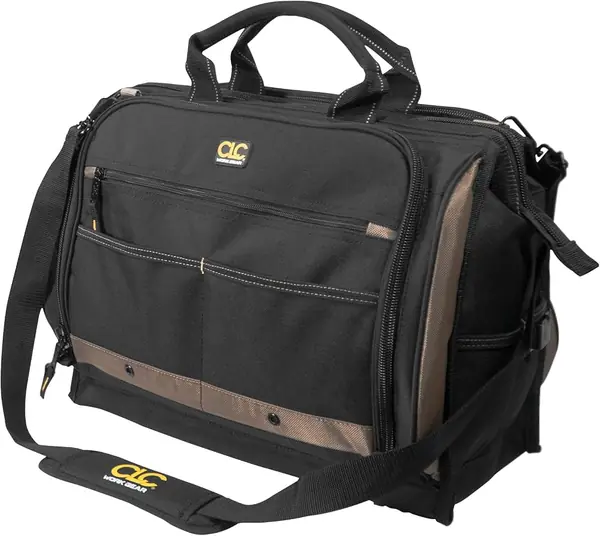
Custom Leathercraft 1539 Multi-Compartment Tool Bag Best for Large Tool Collections

Custom Leathercraft 1539 multi-compartment tool bag with 50 pockets and shoulder strap

Large tool collections

Shop Score 97/100
Dimensions
18 x 14 x 7 in
Pockets
50
Empty Weight
6 lb
Carry
Side handle and shoulder strap
View on Amazon

Fifty pockets is the number that matters, and it is why we hand this bag to anyone whose tools have outgrown a 16-inch carrier. Three sides open into separate compartments around a large center well, so a drill, a charger, and a meter can live in the middle while pliers, cutters, and screwdrivers stand in vertical pockets you can read at a glance. The zippered side panels close over the outside pockets, which means nothing spills out when the bag rides in a truck bed.

Those vertical pockets are the part we appreciate most. Tools stand up in their own slots instead of lying in a heap, so at the end of a day you can see what is missing without emptying the bag onto a bench. It measures 18 by 14 by 7 inches and weighs 6 lb empty, and the stiff shell holds its shape when you set it down — a bag this size that slumped would be no use at all.

We think of it as a vehicle bag: happiest going from truck to cart to bench, big enough that you stop carrying two bags at once. The 14-inch width is what lets that center well take meters and testers a slimmer bag cannot manage, and the side handle gives you a second grip when the shoulder strap is on. Pair it with a small bag for the tools you reach for every hour and let this one hold the rest.

Worth Noting

  • Heavy once it is fully loaded
  • No water-resistant base
Our Verdict

We reach for the CLC when a tool set has outgrown a 16-inch bag: 50 pockets and a center well that swallow a drill, a charger, and a meter.

Check Latest Price
3.

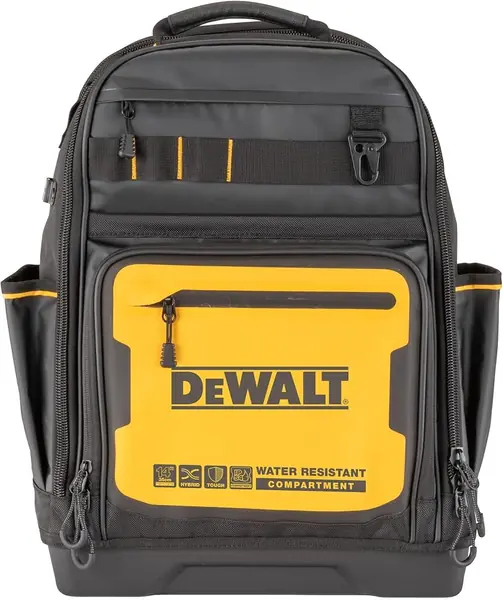
DEWALT Pro Tool Backpack Best Backpack

DEWALT black and yellow tool backpack with 43 pockets and waterproof base

Walking to jobs

Shop Score 96/100
Load Limit
55.1 lb
Pockets
43
Laptop Sleeve
Up to 15 in
Storage Volume
1998.04 cubic inches
View on Amazon

Two shoulder straps turn the trip from the truck into a walk instead of a one-arm haul, and that is the whole argument for a tool backpack. This one is built for it: 1680 denier fabric with a dirt-repellent tarpaulin panel, a waterproof base, and a body 18.75 inches tall and 13.75 wide that spreads a full load across both shoulders instead of one hand.

The layout is what sold us. Both main compartments unzip almost to the bottom, so the pack opens flat and you can see everything rather than fishing in a tube; there is a dedicated bay for a drill and batteries, a padded sleeve for a laptop up to 15 inches, a bottle pocket, and a long-tool section that keeps a level from sinking out of sight. Forty-three pockets in all, and the shoulder straps and top handle are both reinforced.

Where it earns its keep for us is anywhere the tools come with something else — up three flights, across a parking lot, into a customer's hallway where a clanking bag is unwelcome. The stated 55.1 lb limit covers a full hand-tool set plus a drill and batteries. It is also the pick for anyone who has been carrying a bag in one hand and a clipboard in the other, and the separate laptop sleeve means the computer is not riding against a hammer.

Worth Noting

  • Tools sit behind zippers, slower than an open bag
Our Verdict

If you walk to the work, this is the pack we hand you: 43 pockets, a laptop sleeve, and both hands free on the stairs.

Check Latest Price
4.

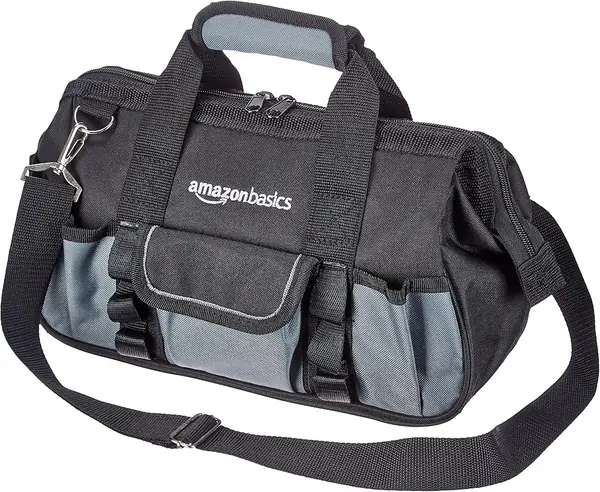
Amazon Basics 12-Inch Tool Bag Best Small Kit

Amazon Basics black and gray 12-inch tool bag with 16 pockets and shoulder strap

Small fixed kits

Shop Score 95/100
Dimensions
12.2 x 5.5 x 7.9 in
Pockets
16 (9 internal, 7 external)
Empty Weight
1.1 lb
Material
600D Oxford polyester
View on Amazon

This is the least expensive bag in this guide, and it is honest about its scale: 16 pockets (nine inside, seven out) in a body 12.2 inches long, 5.5 wide, and 7.9 tall. The shell is 600D Oxford polyester over a firm PE base, the top closes with two zippers, and it weighs 1.1 lb empty, so it disappears under a bench or behind a seat.

For a small, fixed kit that is exactly right, and it is why we keep pointing people here when a 16-inch bag is more than they need. Screwdrivers, pliers, a tape measure, a utility knife, spare fuses, and zip ties each get a slot or a pocket, and the top opens wide enough to see what is inside without tipping the bag over. It is the bag for the apartment drawer, the car trunk, or a second set of tools kept at a rental.

Think of it as a kit bag rather than a full-set bag. If you are consolidating an entire bench, step up to the WORKPRO, which holds far more for a little more money. If you want two or three small kits — one for the house, one for the car, one for the camper — this is the one to buy in multiples.

Worth Noting

  • Fabric has no water resistance
Our Verdict

We keep recommending this one for a small, fixed kit — it is inexpensive, light, and organized enough for the tools most of us actually own.

Check Latest Price
5.

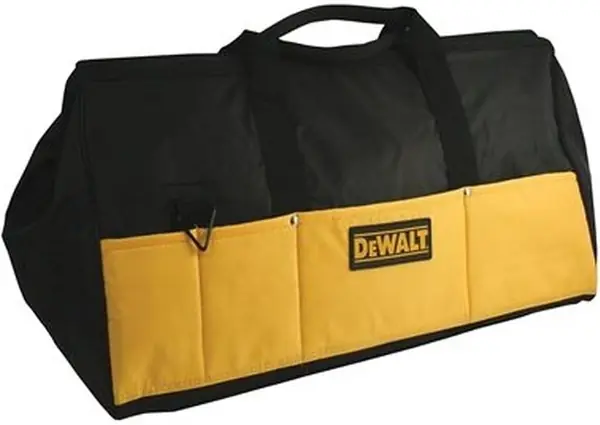
DEWALT 18-Inch Contractor Tool Bag Best for Long Tools

DEWALT 18-inch yellow and black contractor tool bag with exterior pockets and plastic runners

Saws and levels

Shop Score 94/100
Load Limit
75 lb
Compartments
8
Length
18 in
Tool Length
Up to 21 in
View on Amazon

Tools up to 21 inches long fit inside this bag, and that single number is the reason to buy it. A corded reciprocating saw, a circular saw, a long framing square, or a two-foot level goes in complete instead of riding diagonally across the top of a shorter bag. The bag itself is 18 inches long and 12 wide, in nylon, with exterior pockets and plastic runners under the base for stability on rough ground.

We keep this one for the tools that fit nowhere else, and it has settled more than one argument about whether a saw needs its own case. The stated 75 lb load limit is the highest in this group, the bottom is solid and the seams are sewn evenly, and the runners keep the base off wet concrete when you set it down at the end of a cut.

It is a second bag rather than a first one: pair it with an open bag for hand tools and let this one carry the saws and the levels. Against the CLC it trades 50 pockets for length; against the backpack it gives up your free hands. For a woodworker with a truck and a growing pile of long tools, that is a fair trade.

Worth Noting

  • Arrives in bulk packaging without a retail box
Our Verdict

For the tools that fit nowhere else, we keep this 18-inch bag: it takes a recip saw or a two-foot level whole.

Check Latest Price
6.

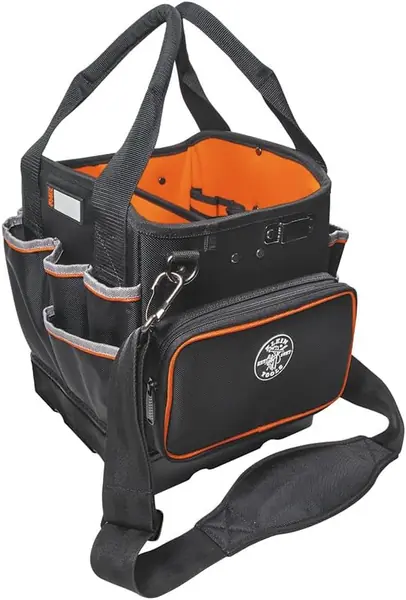
Klein Tools Tradesman Pro 10-Inch Tool Bag Best for Daily Organization

Klein Tools Tradesman Pro 10-inch black tool bag with orange interior and shoulder strap

Compact daily kits

Shop Score 93/100
Load Limit
10 lb
Dimensions
12.4 x 12.2 x 10 in
Pockets
40
Material
1680d ballistic weave
View on Amazon

The inside is orange, and that is not decoration. Dark tools in a dark bag are how five minutes disappear while you hunt for a pair of cutters; against the black 1680d ballistic weave, that lining makes a gap in the row obvious the moment you look down. It is the detail we noticed first and the one we kept noticing on every trip back to the bag.

Forty pockets in a 12.4-by-12.2-by-10-inch body means slots rather than a bucket: tools stand upright in their own places, the large zippered pocket on the front holds screws, staples, and small parts without letting them migrate into the tool rows, and the fully molded bottom keeps the whole thing standing on gravel or an uneven floor. Of everything here, it is the closest to a tool case that happens to be soft.

Where it beats the bigger bags is in a small workspace — a bench corner, a footwell, the top of a rolling cart — and the shoulder strap means one trip from the truck instead of three. It is the most expensive small bag here, and for daily work we think the pocket count and the orange lining justify it. If the bag lives in a garage and comes out twice a month, they do not.

Worth Noting

  • 10 lb load limit is low for its size
  • Front zip pocket is the weak point
Our Verdict

We point anyone who works out of one compact bag all day here: 40 pockets, an orange lining, and a base that will not tip.

Check Latest Price
7.

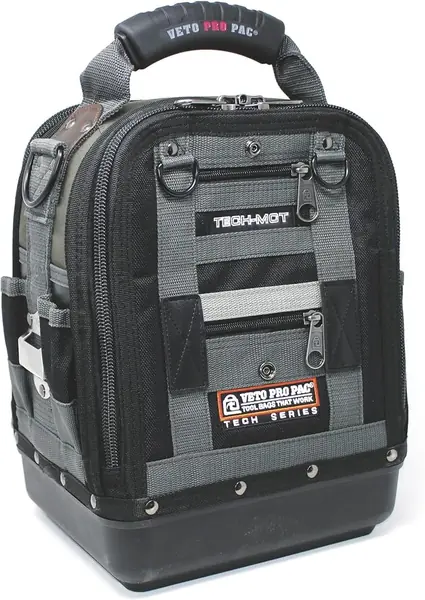
Veto Pro Pac TECH-MCT Tool Bag Best Premium

Veto Pro Pac Tech MCT polymer tool bag with three compartments and molded base

Daily technician work

Shop Score 92/100
Dimensions
14 x 12 x 14 in
Compartments
3
Empty Weight
5.47 lb
Capacity
13 liters
View on Amazon

Set it down and it stays put. The molded polymer body holds its shape, the base is wide enough that it does not tip, and the waterproof bottom means a wet floor does not wick up into your tools. It is the difference between a bag you can work out of and one you have to hold open with your knee.

Thirteen liters does not sound like much, and the layout is what makes it work: three compartments, vertical pockets that keep drivers and pliers where you can count them, and an over-molded handle that stays comfortable with the bag full. Because the body is rigid, nothing collapses between calls, and the walls do not fold in on the tools when you lift it by one hand.

The materials are the argument: a polymer shell instead of fabric, a waterproof base, and hardware that is not the weak link. Cheap bags fail at the strap ring or the base seam, and this one is built around avoiding both — which is why it is the bag we point to for someone who has already replaced a fabric carrier once.

If you carry power tools it is the wrong shape: two drills and their chargers will not fit, and the CLC or the backpack is the better answer there. What we did not expect to use as much as we do is the stainless tape clip — a tape measure that lives on the outside of the bag never gets buried under anything.

Worth Noting

  • Costs more than every other bag here
Our Verdict

A technician who works out of one bag every day gets our vote: the rigid, waterproof body holds its shape and keeps 30 tools readable.

Check Latest Price
8.

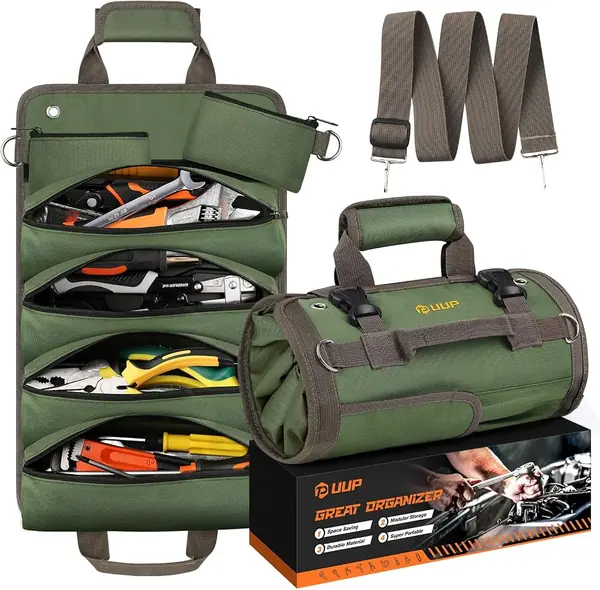
UUP Roll-Up Tool Bag Best for Chisels and Gouges

UUP green roll-up tool bag unrolled with compartments and shoulder strap

Chisels and gouges

Shop Score 91/100
Load Limit
17 lb
Compartments
11
Empty Weight
1.5 lb
Rolled Size
12.9 x 3.2 x 3.8 in
View on Amazon

Unroll it on a bench and the whole kit lies flat at once: four large compartments, two small detachable pouches on D-rings, and five outside pockets, 11 in all. Nothing has to be dug out from under anything else, and each tool arrives at the job without having knocked against its neighbors on the way.

The materials suit the work: Oxford fabric with a PVC coating inside, rust-proof zippers, and a 45-inch adjustable shoulder strap so it can ride over a shoulder or be carried by the handle. It weighs 1.5 lb empty and rolls down to 12.9 by 3.2 by 3.8 inches, which is small enough to live in a drawer or behind a truck seat without claiming the space a bag does.

For a woodworker it solves a specific problem, namely chisels and gouges that should not be knocking edges with everything else in the toolbox. Rolled, it is the bag we leave in the vehicle for the tools we do not want to carry back and forth; unrolled on the bench, it behaves like a drawer liner that happens to have a strap.

That is also the limit of it. It is built for a matched set — chisels, gouges, drivers, wrenches — rather than a jumble of everything, and it will not replace a bag you can drop a drill into. If you want one carrier for the whole kit, the WORKPRO holds more of everything; if you want your chisels to travel without touching each other, this is the shape you want.

Worth Noting

  • Oversized pouches let small tools rattle around
Our Verdict

We like the roll-up for a matched set of chisels or wrenches — it lays every tool flat and packs down smaller than any bag here.

Check Latest Price

How We Tested the Best Tool Bags

We started by reading through customer reviews and spec sheets, sorting bags by how they open, the length and volume they offer, pocket depth and layout, base construction, carry options, and empty weight. Then we bought 14 of them and put those bags to work for eight months, with the same kits and the same jobs.

Each bag got loaded with a comparable set of hand tools and carried through the same week: workbench to truck bed, truck bed to a job site, up and down stairs, across a parking lot. We noted how much of the interior we could see while working — whether a frame held the mouth open, whether the top stayed open on its own, whether a zippered compartment meant fishing in the dark. We slid an 18-inch level and a handsaw into every bag to see what fit and what jammed the zipper. We measured pocket depth with a tape and reached in wearing work gloves to see whether a screwdriver disappeared to the handle.

For the base, we set each bag on a damp basement floor, wet concrete, gravel, and a truck bed after a rain, then checked the fabric and the contents for seepage. We weighed every bag empty on a kitchen scale, loaded it to the maker's stated limit without going past it, and carried it by the handle, over one shoulder, and on both, watching where the weight pulled. We cycled the zippers open and shut, tugged the strap rings and hardware for give, and tipped loaded bags over on a bench to see if they stayed upright.

We compared what each bag offered against others at the same price, because a bag that costs more should show it in the stitching and the hardware, not the logo. On ladder work we hoisted bags or left them at the bottom — a loaded bag carried up one-handed is a fall waiting to happen. Anything that failed at its own stated limit came off the list.

How to Choose a Tool Bag

How It Opens

The mouth of the bag decides how you will work out of it. An open top or a frame-held wide mouth lets you reach in one-handed while the bag sits on the floor, which is why we favor that design for a bag that travels to a job; the WORKPRO's internal frame keeps its top open without you holding it.

A zippered lid keeps dust, rain, and prying eyes out, and a backpack's compartments stop tools shifting on your back, but both make you open something before you can grab a screwdriver. If you work out of the bag all day, buy the mouth you can see into. If it rides in a truck bed, buy the zipper.

Size It to the Kit You Actually Own

A 12-inch bag holds a household kit; 16 inches is the sweet spot for a full hand-tool set; 18 inches and up is where saws and levels start to fit. Measure your longest tool before you order, because a 24-inch level will not go into a 16-inch bag no matter how many pockets it has.

Depth matters as much as length. A long, low tote lets a hammer lie down across the top, while a square bag like the Klein 10-inch stands tools upright and takes less bench space. If your set includes a saw, plan on a second, longer bag rather than forcing everything into one.

Pocket Depth Beats Pocket Count

Forty pockets are worthless if a screwdriver falls out of each one. Deep, gusseted pockets hold pliers and drivers; shallow slots are for pencils, rules, and small parts. Count the pockets that will hold the tools you actually use and ignore the rest of the tally.

A bright interior does more for organization than another ten slots, because it shows you at a glance which tool is missing at the end of a day. That is a big part of why the Klein's orange lining earns its place, and why we would pay for visibility before we would pay for extra pockets.

The Base Decides Where You Can Set It

A molded plastic or rubber base is the single most useful feature on a working bag. It keeps fabric out of puddles on a garage floor or a wet deck, stops the bag sagging when loaded, and wipes clean in seconds. Fabric-only bottoms soak through and grind grit into the seams.

If your bag lives in a truck bed or on a site, look for a waterproof base or plastic runners, as on the DEWALT 18-inch bag. If it lives on a bench in a dry shop, a plain fabric bottom is fine and saves weight.

Carrying: Handle, Strap, or Both Shoulders

A padded handle is enough for a bag that moves ten feet at a time. A shoulder strap matters the moment you park a hundred yards away, and it should be wide enough not to cut in once the bag is full. A backpack is the answer when the walk is long or the load is heavy, since two shoulders carry better than one hand.

Whatever you choose, respect the stated load limit. A strap ring or zipper that fails under load is how tools end up on a stairwell, and a bag that is too heavy to carry up a ladder safely is a bag that should stay on the ground.

Frequently Asked Questions

Final Verdict

For one bag and no debate, we recommend the WORKPRO 16-inch wide-mouth. It opens and stays open, sits on a waterproof base, and carries a full hand-tool set for less than most of the bags here — the combination that gets a bag used instead of left in the truck. When the set outgrows it, the CLC 1539's 50 pockets are the next step; when the walk is the problem, the DEWALT backpack puts the load on both shoulders.