↑↓ navigate ↵ open Esc close All results →

Best Tool Box Drawer Liners of 2026

Dependable drawer liners lie flat right up to the front lip and keep sockets from sliding together every time a steel drawer rolls shut. Thin, slick rolls curl at the corners, tear along trimmed edges, and let chrome tools skate against bare paint until the whole chest rattles.

Cutting and living with a dozen liners across three months in a home tool chest, a rolling cart, and a workbench showed where buyers trip up before opening the roll. Measuring the inside width of your widest drawer comes first—a narrow roll leaves exposed steel where small parts collect—followed by choosing oil-resistant rubber for grip or foam for quieter cushioning without sacrificing drawer height.

Comparing coverage by the square foot alongside edge durability separates clean-cutting rolls in varied widths and thicknesses from cheap foam that bunches up after a few weeks.

Our Top Picks

The Best Tool Box Drawer Liners

1.

B&C Home Goods Anti-Slip Toolbox Liner Best Overall
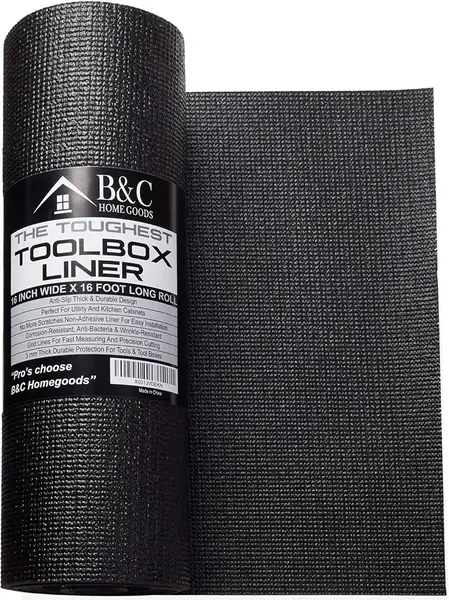
Black rubber toolbox liner roll from B&C Home Goods, 16 inches wide

Home tool chests

Shop Score 96/100
Material
Rubber
Color
Black
Care
Rinse and air dry
Dimensions
16 in x 16 ft
View on Amazon

Out of the packaging this roll is coiled tight, but it gives up the curl once it's in a drawer — no books piled on the corners, no gap at the front edge where sockets disappear under the lip. What you feel in the hand is rubber, faintly tacky rather than slick, and that is the whole point: set a socket rail down and it stays, and a drawer loaded with wrenches closes with a thud instead of a rattle.

That material is why it is the roll we recommend first. Rubber is the more forgiving surface at a cut edge, so trimming it to fit doesn't leave the frayed border that soft foam develops into a tear, and it takes the weight of a heavy socket tray without sinking into a permanent groove. The grid printed on it gives a straightedge something to follow, and when the shop dust builds up it rinses clean and dries flat.

Sixteen inches is the number to check before you order, because cut-to-fit only subtracts. Most 26-inch chests measure wider than that inside, so you'll be laying two strips with a seam where small parts collect; step up to the 30-inch Precision Defined roll if that's your chest. On a cart, a bench drawer, or a mid-size home box, one strip spans the whole width and the question never comes up.

Worth Noting

  • 16-inch width requires two strips in wider 26-inch tool chests
Our Verdict

We point most people here: the rubber grips, lies flat without weighting, and shrugs off a drawer of steel better than any other roll in this group.

Check Latest Price
2.

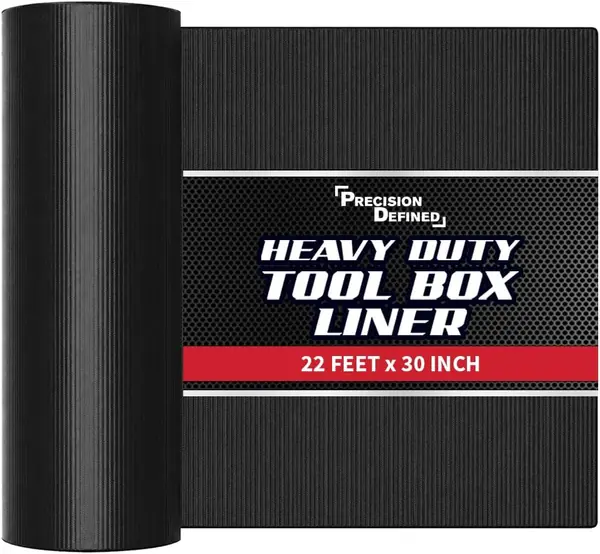
Precision Defined Tool Box Liner Best for Wide Drawers

Precision Defined black tool box liner roll, 30 inches wide and 22 feet long

Wide chest drawers

Shop Score 95/100
Material
Polypropylene
Roll Size
30 in x 22 ft
Care
Wipe with a damp cloth
Coverage
55 square feet
View on Amazon

Thirty inches is the widest roll in this group, and width is the one dimension you cannot cut your way out of. On a 24-inch drawer it goes down as one continuous sheet, with no seam down the middle for screws and washers to migrate into, and with 55 square feet on the roll you finish a full chest and still have a length left for the bench top or the lid of a rolling cart. For deep, wide drawers that's the whole argument.

The material is a stiff, memory-foam-like polypropylene with a tacky underside, and it clings — set a wrench on it and the wrench stays where you put it. The trade-off is the edge. This foam is the least forgiving here when something sharp drags across it, so a chisel corner pulled the wrong way can gouge where the rubber B&C roll would shrug it off. It suits drawers of sockets, wrenches, and drivers far better than drawers of bare cutting edges.

Handling a 30-inch sheet takes more room than a narrow roll does. Lay it on the floor, use a straightedge and a fresh blade, and score it in two light passes instead of bearing down through in one. Cleaning is a wipe rather than a rinse, since polypropylene doesn't want to go in the sink, and the company will replace or refund a roll you're unhappy with even after you've cut into it.

Worth Noting

  • Some rolls arrive cut into two sections
Our Verdict

We reach for this one on wide drawers: a 30-inch roll covers a 24-inch drawer in a single sheet, with enough left over to do the bench top.

Check Latest Price
3.

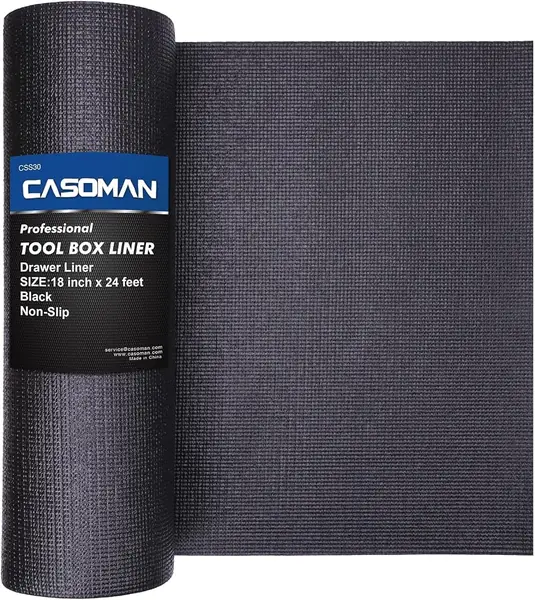
CASOMAN Professional Tool Box Liner Best for a Whole Chest

CASOMAN black rubber-foam tool box liner, 17⅜ inches wide by 24 feet

Full chests

Shop Score 94/100
Material
Rubber foam
Roll Size
24 ft x 17⅜ in
Color
Black
Warranty
1 year
View on Amazon

Roll a loaded drawer out and everything in it shifts toward the front; a slick liner turns that into a pile of sockets against the drawer face. The quilted texture on this one is what stops it — tools sit in the surface rather than on top of it, and a stand-up chest is still organized at the end of a day of opening and closing.

Add the length and this becomes the roll we reach for when a whole chest needs lining in one sitting. Twenty-four feet is enough for a five-drawer box plus the top tray, the grid lines make straight cuts quick, and the material is non-adhesive, so you can lift a corner and nudge it while you're fitting. Thickness is generous for foam: enough to cushion a wrench without letting a row of small sockets tip over.

The roll is listed at 18 inches wide but the maker's own spec puts it at 17⅜, which shows up as a sliver of bare metal along one edge of a drawer that measures a true 18 inches inside; measure your widest drawer's inside before you order. A one-year warranty backs the roll, and dry-cloth cleanup is all it asks, since oil and shop dust wipe off the surface rather than working into it.

Worth Noting

  • Actual 17-3/8-inch width leaves a gap in true 18-inch drawers
Our Verdict

We pick it when a whole chest needs lining from one roll, as long as your drawers are narrower than about 17 inches inside.

Check Latest Price
4.

MIXPOWER Tool Box Liner Best Budget

MIXPOWER black foam tool box liner roll, 16 inches wide by 16 feet

Budget builds

Shop Score 93/100
Roll Size
16 in x 16 ft
Color
Black
Thickness
3 mm
Warranty
1 year
View on Amazon

This is the least expensive roll in the group, and nothing in the hand announces it. The foam has real density — set a rail of sockets on it and it doesn't collapse into a permanent dent — and it unrolls flat enough to cut on the bench without weights holding the ends down.

Cutting is where cheap foam gives itself away: the blade drags, the edge tears, and the strip comes out looking chewed. This one trims cleanly along the printed grid, and a utility knife tracks straight through it without wandering off the line; the absence of shredding at the edge afterward is the first thing we check on a foam roll, and it passed.

Where it earns its keep is the work that doesn't deserve the good liner: the drawer of a rolling cart, the shelf under a miter saw, the toolbox riding in a truck bed, the drawer you keep meaning to line. At 3 mm it cushions without stealing drawer height, and it wipes down with a dry cloth. There's a 6-foot length as well if a single bench drawer is all you need, and a one-year warranty behind both.

Worth Noting

  • Sold only in a 16-inch width
Our Verdict

Our value pick: 16 inches by 16 feet handles the cart, the second box, and the bench drawer without asking much of your budget.

Check Latest Price
5.

HooTown Foam Toolbox Liner Best for Quieter Drawers

HooTown black PVC foam toolbox drawer liner roll, 20 inches wide by 24 feet

Quieter drawers

Shop Score 92/100
Material
PVC foam
Roll Size
20 in x 24 ft
Care
Hand wash
Thickness
3 mm
View on Amazon

An empty steel drawer pushed shut makes a sound that carries across a garage. Line it with this and the sound becomes a low knock instead: 3 mm of soft PVC foam has enough give to swallow the clatter of a drawer full of combination wrenches. The first time you close a lined drawer after years of unlined ones, that is the change you notice.

Twenty inches puts it between the 16- and 18-inch rolls here and the 30-inch sheet, and it is the width that spans a lot of mid-size chest drawers in a single strip with a little to trim — no seam, no waste. The face is grippy rather than sticky, so a socket tray stays put while a piece you just set down still slides into place when you nudge it.

It belongs where heft and quiet matter: a cart of hammers and pry bars, a bench top under the vise, a truck box that rattles over every bump. Black hides the oil that collects in a working drawer, and a hand wash takes care of shop dust when it gets ahead of you. In a drawer of bare chisels and files, look elsewhere.

Worth Noting

  • Soft foam can tear under sharp heavy tools
Our Verdict

We recommend it to anyone who winces at the clang of a closing steel drawer; the 20-inch foam quiets a whole chest.

Check Latest Price
6.

ChiKiner Tool Box Liner Best for Light-Duty Drawers

ChiKiner gray foam tool box drawer liner roll, 16 inches wide by 193 inches

Light-duty drawers

Shop Score 91/100
Material
Foam
Roll Size
16 in x 193 in
Color
Gray
Thickness
3 mm
View on Amazon

Gray looks sharp for the first week. Then the shop gets to it — oil off a ratchet, graphite, the fine black dust that comes off a grinder — and every mark shows, because there is nothing for it to hide against. The roll is good; the finish is the problem, and the same liner comes in black, which is what belongs under a working set of tools.

What sits underneath that color is honest 3 mm foam with a grid pressed into it for measuring, and it cuts with a pair of scissors in a couple of passes. We were struck by how little memory the material has: it lies flat right off the roll instead of fighting you for a week, and it holds light tools and small parts boxes in place without adhesive.

At 193 inches there's more length here than in a 16-foot roll, so it goes further across a bank of drawers or a workbench top than the price suggests. Put the gray in a home drawer, a desk, or a bench where tools live in trays and hands are clean, and put black in anything that sees oil.

Worth Noting

  • Gray shows oil and shop dust quickly
Our Verdict

We like the roll and not the color: buy it in black for a working drawer, or use the gray where light tools and clean hands live.

Check Latest Price

How We Tested the Best Tool Box Drawer Liners

We started with the specs rather than the photos. Every candidate had to state its material, its roll width, and its length, so we could run the coverage math and compare price per square foot across the field before ordering anything. From there we narrowed to a dozen rolls spanning rubber, rubber foam, PVC foam, and plain foam, in widths from the narrow standard up to rolls wide enough for deep chest drawers.

Each roll came out of the coil and sat flat on a bench for a week, which showed us quickly which ones relaxed and which kept the memory of the packaging. We measured the inside width of every drawer we planned to line, cut each piece slightly oversized, and trimmed to fit. Some rolls had printed grid lines that kept a utility knife tracking straight; others let the blade wander and left a frayed edge we had to clean up. Every piece was trimmed clear of the slides, latches, and the drawer lip, then we shut and latched the drawer to confirm nothing caught or propped it open.

After that we loaded up — sockets, wrenches, a drill, a box of screws — and used the drawers the way a garage gets used: yanked open, shoved shut, dust and oil left to sit. We checked whether tools crept forward after a week, how each material held in a vertical chest drawer, whether heavy pieces left dents, and how much usable depth each one cost once a socket rail sat on top of it. A dropped wrench told us something about thickness too, since the loud ones were the thin ones.

We wiped up shop dust and oil spills with a damp cloth and noted which colors started to look grimy first. Three months in, we went back over the cut edges for fraying or crumbling and checked the front lip where tools rest, since that is where liners give out. The rolls that held up stayed flat, kept their grip, and were still worth the square footage.

How to Choose a Tool Box Drawer Liner

Start With the Inside Width of Your Widest Drawer

Measure across the inside of the drawer, not the outside of the cabinet. A chest that is 26 inches wide on the outside usually gives you 22 to 24 inches inside, and the slides eat more of it. Cut-to-fit only subtracts: a 16-inch roll cannot cover a 24-inch drawer in one piece, so you end up laying two strips with a seam where washers collect.

The trap is trusting the headline width. One roll here is sold as 18 inches and measures about 17⅜, which leaves a sliver of bare metal on a drawer that is truly 18 inches inside. Measure first, then buy a roll at least that wide — the 30-inch Precision Defined for wide chests, a 16- or 18-inch roll trimmed down for narrow ones.

Choose Rubber for Steel, Foam for Sound

Rubber is the tougher material at a cut edge and under heavy steel; foam is lighter, quieter, and generally cheaper. We want rubber such as the B&C roll in drawers of sockets, wrenches, and anything with a sharp corner, and we want foam where the goal is deadening noise or covering a bench top.

Thickness gets oversold. Three millimeters is the working standard in this group and cushions a wrench without tilting a row of small sockets. Go thicker only where the drawer has height to spare, because a mat that lifts tools too far starts rubbing on the drawer above.

Cut Slightly Oversize, Then Trim

Grid lines are the feature that earns its keep during fitting, because they give a straightedge something to follow so the cut comes out square instead of wavy. Use scissors on 3 mm foam and a fresh utility blade with a straightedge on anything denser, and make two light passes rather than one heavy one.

Cut the length first, then trim the width in small increments. A liner a hair oversize settles against the drawer walls and stops creeping forward; one cut short slides every time you pull the drawer out. If a new roll arrives with a curl, give it time in the drawer before deciding it is wrong, since foam relaxes.

Do the Coverage Math Before You Order

Multiply each drawer's inside length by its width, total them, and compare that number to the roll: 16 inches by 16 feet is about 21 square feet, 30 inches by 22 feet is 55. Add roughly a foot per drawer for trimming and rounded corners.

Two narrow rolls often beat one wide roll when the drawers are small, since offcuts from a 30-inch sheet are awkward to use up. Don't forget the surfaces outside the drawers either — a bench top, a cart shelf, and a truck box lid will take the leftover length happily.

Frequently Asked Questions

Final Verdict

The B&C Home Goods roll is what we tell most people to buy: rubber that grips, lies flat without coaxing, and takes the weight of a full drawer of steel. The one thing to check is its 16-inch width, which means two strips on a wide chest drawer.

If your drawers run wider than that, the Precision Defined roll covers them in a single sheet and gives you 55 square feet to work with. Lining a cart or a second box on a tight budget? The MIXPOWER roll does the job for the least money here.