↑↓ navigate ↵ open Esc close All results →

Best 360 Laser Levels of 2026

Setting a 360-degree laser level down once wraps a continuous reference line around all four walls—eliminating the constant re-marking a bubble level requires on upper cabinets or tile layouts. Once that first line lights up, though, real differences emerge in whether the pendulum settles cleanly after a bump, stays visible across a sunlit room, and holds charge through a full workday.

Testing 14 rechargeable levels over eight months across living rooms, an unfinished basement, a cold garage, a tiled bath, and outdoor runs confirmed two practical rules. Green beams read noticeably clearer indoors, yet no beam beats direct sunlight without a detector—and keeping the horizontal plane below eye level protects anyone walking through the room.

Mounting hardware separates basic kits from versatile ones, with strong magnets, 1/4-inch tripod threads, and remotes saving trips across the room. Options range from compact red-beam layouts for apartment projects to four-plane kits with a dedicated floor line for full-room work.

Our Top Picks

The Best 360 Laser Levels

1.

Huepar HM03CG 360 Laser Level Best Overall
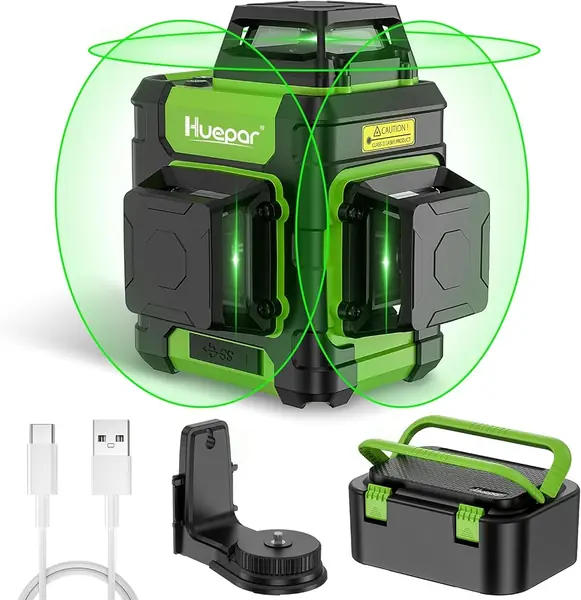
Huepar HM03CG green-beam 360 laser level with magnetic bracket and hard carry case

General layout work

Shop Score 95/100
360° Planes
1 horizontal, 2 vertical
Runtime
Up to 8 hours
Beam
Green
Weight
1.32 lb
View on Amazon

At 1.32 pounds, this is a laser you carry to the work instead of building the work around it. We mounted it on a steel stud with the magnetic bracket, set the line, and moved it to the next room one-handed. The hard case holds the bracket and the charging cable, so it leaves the shop as one bag rather than a pile of parts.

We think it is the best value in this group. One horizontal 360-degree plane and two verticals in green cover nearly everything a woodworker needs — cabinet runs, tile, drop-ceiling grid, shelf standards and picture rails — and the line is easy to pick out against drywall and plywood. Up to eight hours on a charge and USB-C charging instead of a proprietary brick make it a tool you stop managing.

Setup is the part that sold us. Unlock the pendulum, let it settle, and the line appears; the magnetic bracket handles a wall mount, and the tripod thread takes a stand when there is no steel at the right height. We paid close attention to the verticals, since a wandering vertical is what ruins a corner, and they stayed true against a framing square.

What it does not do is put a line at your feet or on the ceiling, so wall plates and ceiling grid want a four-plane tool — the Huepar LS04CG below is the one we reach for there. For everything that happens on a wall, this is the laser that earns its place in the truck.

Worth Noting

  • No floor or ceiling line
Our Verdict

The 360 laser we recommend to most woodworkers: 1.32 pounds, a bright green three-plane layout, USB-C charging, a five-year warranty, and a price well under the pro-brand tools.

Check Latest Price
2.

CIGMAN CM-701 3x360 Laser Level Best All-In-One Kit

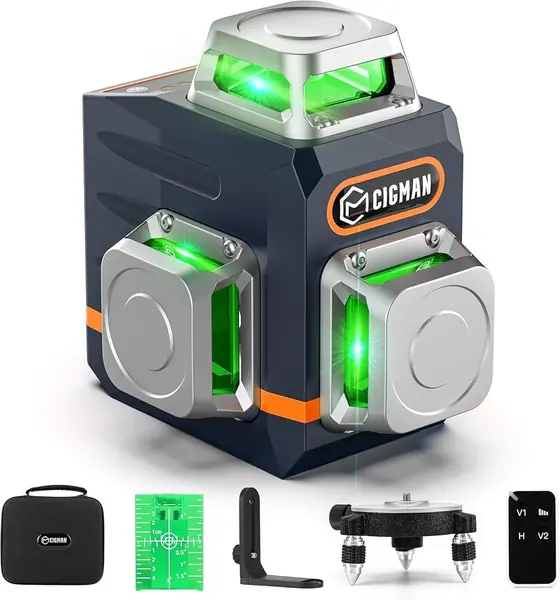
CIGMAN CM-701 blue and yellow 360 laser level with remote and magnetic L-base

Starter kit buyers

Shop Score 94/100
Accuracy
±1.5 mm at 5 m
Battery
Built-in 4,000 mAh
Protection
IP54
Laser Lines
12 across three 360° planes
View on Amazon

The remote sounds like a gimmick until the laser is bracketed to a joist above your head. We used it to shut off the verticals, drop to a single horizontal line and switch modes without climbing down, which is the difference between a one-person layout and a two-person one.

Twelve lines over three 360-degree planes, plus-or-minus 1.5 mm at 5 m accuracy, an IP54 body and a 4,000 mAh battery put the CM-701 alongside the Huepars on paper, and it is genuinely small — a 3.78 by 2.87-inch footprint at 1.76 pounds. The kit is the other half of the pitch: a magnetic L-base, a mini tripod, a target plate and a bag, so nothing else needs buying on day one.

Where the money went is the accessories and the remote rather than the beam. In a dim room the green lines read as easily as anything here; in direct sun they fade sooner than we wanted, which is worth knowing before you plan an outdoor layout. It is the laser we hand someone who is starting from nothing.

Worth Noting

  • Magnet grip is modest on vertical steel
Our Verdict

The most complete box here: 12 lines, a remote, a magnetic base and a mini tripod, with accuracy that holds up for framing and tile work.

Check Latest Price
3.

DEWALT DW089LG 3x360 Green Laser Level Best for Jobsite Conditions

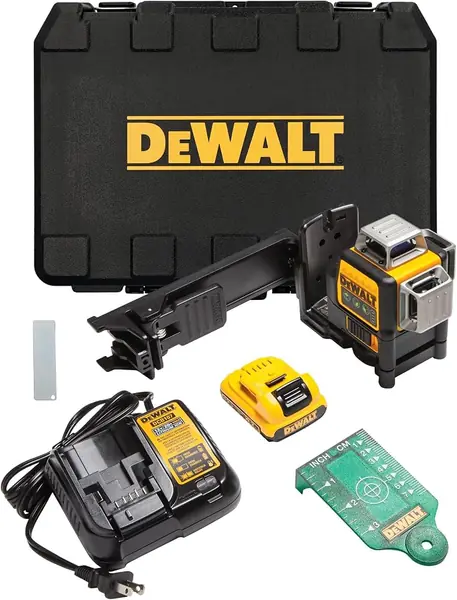
DEWALT DW089LG green 3x360 laser level kit with 12V battery, charger and carrying case

Jobsite conditions

Shop Score 93/100
Accuracy
±3 mm at 10 m
360° Planes
3
Battery
12V MAX 2.0Ah with charger
Protection
IP65
View on Amazon

If your truck already carries DEWALT 12V MAX batteries, this laser joins the family: it runs on the same 2.0Ah pack, charges on the same charger, and the kit adds a hard case, an extended ceiling bracket and a target card. For a crew already on the platform, that is one less charging system to manage.

The tool is the most protected one here — an overmolded housing and an IP65 rating against dust and water. Three green 360-degree planes, plus-or-minus 3 mm at 10 m accuracy, a magnetic bracket with 1/4-inch and 5/8-inch threads for tripods and poles, and a hundred-foot range with a full-time pulse mode that keeps the beam at full brightness for a detector.

The ceiling bracket is the piece we came back to. It hangs the laser below a drop-ceiling grid without a tripod, and together with the 5/8-inch thread it covers the two setups crews actually use. It is also the one here you do not think twice about setting down on a slab or in a truck bed.

The premium is real, and it buys durability, a battery platform and service rather than a brighter line. For anyone billing hours on a commercial site, that trade is easy to justify; for a home shop, the same three planes cost a fraction of this elsewhere in the list.

Worth Noting

  • Detector for full outdoor range sold separately
Our Verdict

For anyone already on DEWALT's 12V platform, this is the jobsite laser: IP65 housing, detector-ready pulse mode, a ceiling bracket and three green planes built for a real site.

Check Latest Price
4.

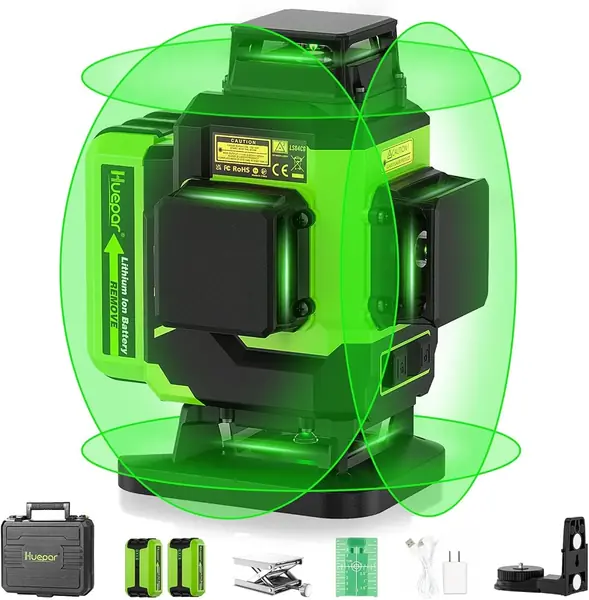
Huepar LS04CG 4x360 Laser Level Best for Floor and Ceiling Lines

Huepar LS04CG green 4x360 laser level with lifting base, two batteries and hard case

Floor-to-ceiling layout

Shop Score 92/100
Accuracy
±1/9 inch at 33 ft
360° Planes
4, with top and floor lines
Batteries
Two rechargeable Li-ion
Warranty
5 years
View on Amazon

The second horizontal plane is the reason to look at this one. The LS04CG projects four 360-degree lines — two horizontals, with one sitting near floor level, plus two verticals — so you get a mark at your feet and overhead as well as a line around the walls. For wall plates, baseboard, ceiling grid and any floor layout that has to agree with the ceiling, that saves a transfer you would otherwise make with a tape measure.

We like it as the step-up pick: plus-or-minus 1/9 inch at 33 feet, a strong magnetic bracket threaded for tripods and poles, a hard case, and two rechargeable batteries so one is on the charger while the other works. The five-year warranty is the same coverage Huepar puts on its cheaper model, which makes the extra outlay easier to justify.

Four planes also mean a busier line set — three lines crossing a doorway takes a beat longer to read, and you will switch some off for simple jobs. If your layout lives on the walls, our top pick does the same work for about half the money.

Worth Noting

  • Heavier and bulkier than the three-plane picks
Our Verdict

The step-up pick for crews laying out floors and ceilings as well as walls: four 360-degree planes, two batteries, threaded mounting and a five-year warranty.

Check Latest Price
5.

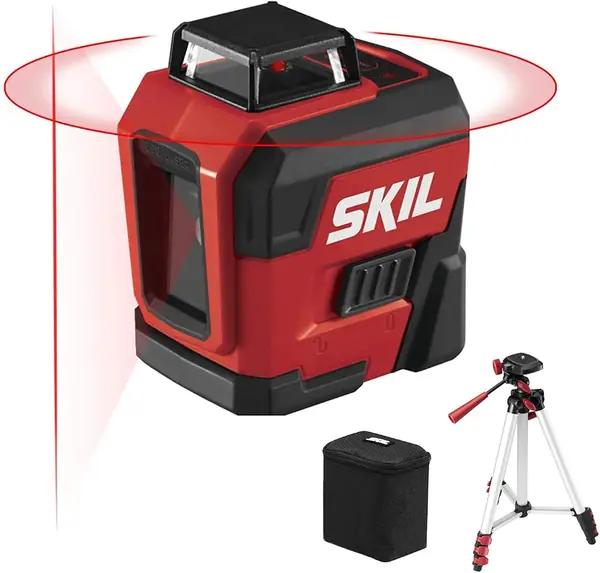
SKIL LL932201 360 Cross-Line Laser Best for Beginners

SKIL LL932201 red 360-degree cross-line laser level with compact tripod and carry bag

Indoor DIY

Shop Score 91/100
Accuracy
±3/16 inch at 30 ft
Beam
Red, 360° plus plumb crosses
Range
Up to 65 ft in diameter
Tripod
Included, 43 in. maximum
View on Amazon

Red is the honest headline. The 360-degree line reads clearly against interior walls and all but disappears once direct sun hits it, so treat this as a room-by-room indoor tool. For tile, chair rail and cabinet runs inside a house, that is a trade we can live with.

What you get for it: a continuous horizontal line up to 65 feet in diameter, plumb cross lines, plus-or-minus 3/16 inch at 30 feet, self-leveling within plus-or-minus 4 degrees, a built-in lithium-ion battery that charges over micro-USB, and a five-year warranty.

The tripod is what makes it a starter kit rather than a bare tool — it lifts the laser to 43 inches, enough for most wall work — and the locking mode holds any angle, which is what we reach for on a diagonal backsplash. Set it up once in a room and leave it; that is the workflow this one is built for.

Worth Noting

  • Included tripod is short and lightly built
Our Verdict

A sensible first laser for indoor remodeling: a continuous 360-degree line, plumb crosses, a tripod in the box and a five-year warranty.

Check Latest Price
6.

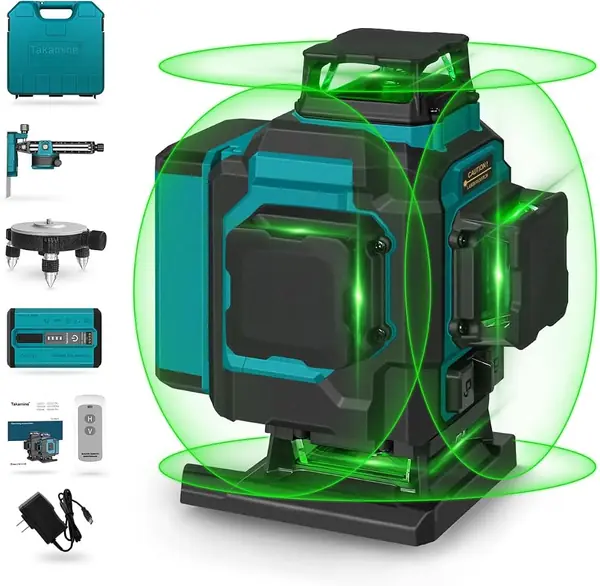
Takamine GM160 4x360 Laser Level Best for Ceiling and Floor Work

Takamine GM160 green 16-line 4x360 laser level with remote, rotating base and case

Ceiling and floor work

Shop Score 90/100
360° Planes
4, 16 lines
Protection
IP54
Mounting
1/4-inch thread, rotating base
Floor Line
1/2 inch above the surface
View on Amazon

Half an inch is the number that matters here. The GM160's lower horizontal plane sits about a half-inch above the surface, low enough to mark a wall plate, a baseboard or the bottom course of tile without measuring down from a line higher up.

The rest of the kit aims at the same work: four 360-degree planes and 16 lines, a rotating base that lets you dial a line without touching the tripod, a 1/4-inch thread, an IP54 housing, USB-C charging, and a remote that saves a walk when the tool is overhead. The green beam is bright enough for interior work, and the case keeps the accessories together.

What we like most is the rotating base, which turns adjusting a line into a twist rather than a walk back to the tripod. Sixteen lines is more than most rooms need — the extra planes earn their keep on ceilings and floors, and on a wall-only job they mostly add clutter you have to switch off. If that describes your work, a three-plane kit is simpler and cheaper.

Worth Noting

  • Battery can stop accepting a charge
  • Lines thin out in bright sunlight
Our Verdict

The four-plane kit for ceiling and floor layout at a mid-range price, with a half-inch floor line, a rotating base and a remote.

Check Latest Price
7.

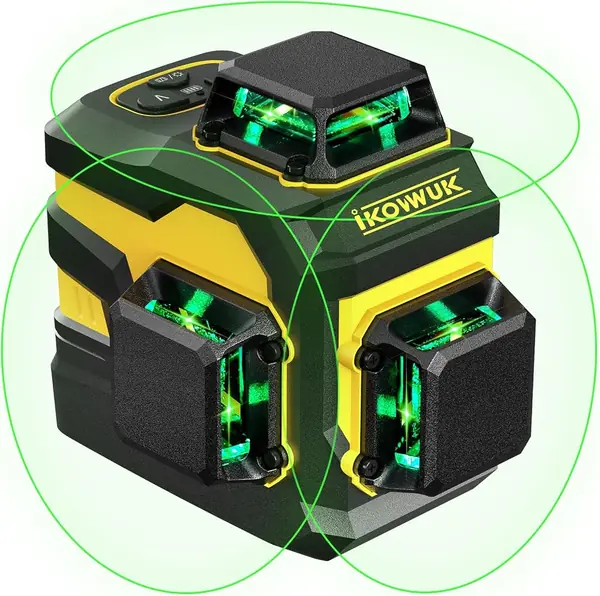
IKOVWUK 12-Line 3x360 Laser Level Best for All-Day Indoor Work

IKOVWUK green 12-line 3x360 self-leveling laser level with built-in battery and remote

All-day indoor work

Shop Score 89/100
Battery
Built-in 5,200 mAh
Runtime
Up to 8 hours
Laser Lines
12 across three 360° planes
Self-leveling Range
Within 3°
View on Amazon

On paper this is the best-equipped kit for the money in the group: twelve green lines over three 360-degree planes, a remote, self-leveling within 3 degrees, a pulse mode, and a built-in 5,200 mAh battery rated at up to eight hours. The walkthrough did not change our minds — it levels, it holds a line on a wall across a garage, and the remote works from the far side of the room.

The remote is the genuine difference from our top pick, which covers the same three planes without one, and the bigger battery means fewer swaps on a long day. Two brightness levels are useful too: the weaker pulse setting for detector work, the strong one for a room-wide line.

What we could not find is a warranty term on the listing, so confirm the coverage with the seller before you order and keep the receipt. A laser is the kind of tool that eventually needs service, and that conversation is easier before the sale than after it.

Worth Noting

  • No warranty term stated on the product listing
Our Verdict

Three 360-degree planes, twelve green lines, a remote and an eight-hour battery make this a well-equipped kit for indoor layout work.

Check Latest Price
8.

WEIDDW 360 Green Cross-Line Laser Level Best for Occasional Home Projects

WEIDDW 360-degree green cross-line laser level with tripod, remote and two batteries

Occasional home projects

Shop Score 87/100
Runtime
3 to 4 hours per battery
Batteries
Two 2,400 mAh
Self-leveling Range
Within 4°
Included
Tripod and remote
View on Amazon

This is the least expensive laser on the list, and it still arrives with two batteries, a tripod and a remote. That combination is why it earned a place: a first 360-degree line for a home shop, or a second one to leave in the basement.

Setup is simple. Auto-leveling takes over within 4 degrees, manual mode locks the pendulum for a slope, and the fine-tune bracket and rotating base let you nudge the line without moving the stand. Each 2,400 mAh battery is rated for three to four hours and there are two of them, so a full day is realistic if you swap at lunch.

The green line is the part that surprised us — bright and clean indoors, enough for a one-room tile or shelf job. What you notice as you handle it is where the money went: the brackets and the tripod are light-duty next to the kits from Huepar and CIGMAN, and they will not enjoy being thrown into a truck.

We think it is the right buy for someone who wants a 360-degree line for a handful of projects a year and does not want to spend much finding out whether they will use it. If it becomes a weekly tool, the accessories are the first thing to replace.

Worth Noting

  • Batteries can stop accepting a charge
Our Verdict

The least expensive way into a green 360-degree line; a good fit for a home shop that needs level marks a few times a year.

Check Latest Price

How We Tested 360 Laser Levels

We started with a shortlist of about 40 laser levels, dropped anything that ran on disposable batteries, and then compared the survivors on plane count and orientation, beam color, mounting hardware, and whether the kit included a hard case or just a cloth bag. We bought 14 of them at retail and used them for eight months.

Testing happened where these tools actually work: a living room with a gallery wall, a bathroom in the middle of a tile job, an unfinished basement, a garage, and a driveway on a clear morning. We timed setup solo, from opening the case to a usable line, and timed it again after deliberately nudging the base to see whether self-leveling recovered quickly or hunted around. Then we walked the full perimeter of each room to find the spot where the line thinned out or vanished.

For accuracy, we snapped a chalk line across a long wall and measured how far each beam drifted from it at 10, 20, and 30 feet. For brightness, we read the same line with the lights on, off, and outdoors at midday, using a detector outside rather than staring into the beam, and keeping the line below eye level whenever someone was in the room.

We ran every battery to shutdown and timed the recharge, magnet-mounted each bracket to a steel stud, threaded each tool onto a tripod, and knocked them off a step stool onto concrete to see what cracked. At the end we tallied what actually came in the box — spare battery, bracket, case — against the price, then packed each one back up, weighed it, and read the warranty terms.

How to Choose a 360 Laser Level

Three planes or four

Nearly every cross-line laser here is a 3x360: one horizontal plane around the walls and two verticals that cross to give you plumb. A 4x360 adds a second horizontal — usually a floor line, sometimes a ceiling line — and that is the difference between marking a wall and marking a wall, a floor and a ceiling from one setup.

We reach for a four-plane model when wall plates, baseboard or a ceiling grid have to agree with each other. For shelves, cabinets and tile on walls, the third plane is dead weight you switch off. Pay for the extra plane only if you lay out floors and ceilings regularly.

Green beam, red beam, and the daylight limit

Green reads brighter than red at the same power, which is why almost every pick here is green; the exception is a budget tool where red keeps the price down. What no beam color fixes is sunlight. A line that is obvious across a dim garage can vanish on a sunlit slab, and the working ranges in the listings assume indoor light or a receiver.

If your work goes outside, look for a pulse or detector mode and plan on buying the detector, since most kits leave it out. Indoors, spend the difference on a brighter beam instead of a longer range claim.

What the accuracy figure actually means

Accuracy is quoted as an angle over a distance — plus-or-minus 1.5 mm at 5 m, plus-or-minus 3 mm at 10 m, plus-or-minus 3/16 inch at 30 ft — and the error grows with the distance from the tool. Across a 30-foot run the gap between a tight spec and a loose one is a fraction of an inch, which matters for a long cabinet run and not at all for hanging pictures.

Always check the distance the figure is quoted at before you compare two tools. A small number at a short distance is not better than a larger number at a longer one, and the tightest spec on the page is meaningless if the beam is too dim to read at that distance.

Mounting: magnets, threads and one-person setup

Two mounting facts decide whether a laser is pleasant to use: whether the bracket holds on what is in front of you, and whether the threads match your tripod or pole. A magnetic bracket is the fastest option on steel studs, a 1/4-20 thread fits most camera tripods, and 5/8-11 fits survey poles and heavier stands.

Think the room through before you buy. If there is no steel at the height you need, the tool has to go on a tripod or a pole, and a bracket with fine adjustment saves walking back and forth to nudge a leg between marks.

Battery, charging and what comes in the case

Runtime claims cluster around eight hours, which is a full day if you switch lines off between tasks and optimistic if you run three planes continuously. A second battery is worth more than a bigger single one, and USB-C charging means the same cable as your phone instead of another wall brick.

We also weigh the case. A hard case with molded slots keeps the bracket, charger and target plate together; a soft bag is where brackets go missing. It sounds minor until the morning you drive to a job without the mount.

Frequently Asked Questions

Final Verdict

Most woodworkers should buy the Huepar HM03CG. It puts a bright green 360-degree line on the wall, runs a full day on a USB-C charge, weighs so little that you stop thinking about carrying it, and costs less than the pro-brand alternatives — with a five-year warranty behind it.

Two situations change the answer. If your layout has to agree between floor and ceiling, the four-plane Huepar LS04CG saves a transfer. If the tool lives on a commercial site, the DEWALT's IP65 housing, standard batteries and detector range are worth the premium.