↑↓ navigate ↵ open Esc close All results →

Best T-Squares for Woodworking of 2026

A T-square with a loose head or a blade that flexes under a sharp pencil racks a cabinet carcass before the saw ever touches wood. Because the head registers against the board's reference edge, its bearing surface and rigidity govern accuracy more than the etched scale itself.

Over eight months of laying out face frames, shelf-pin holes, and small joinery with 14 models from 3-inch pocket rules to 24-inch machined beams, the field split cleanly by task. Long aluminum beams bridge 24-inch panels cleanly, while compact stainless rules with 1/64-inch graduations handle tight setups at the drill press; scribing holes, sliding stops, protractor heads, and dual inch-and-metric scales add precision when plans call for them.

Picking the blade length and head features that match the work ensures the square sits flat, holds 90 degrees, and drops every mark right on the line.

Our Top Picks

The Best T-Squares for Woodworking

1.

Woodpeckers 24-Inch T-Square Best Overall
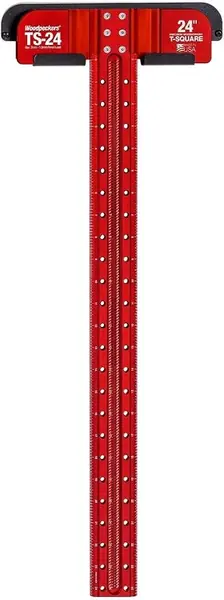
Woodpeckers 24-inch aluminum T-square with red blade and black billet handle

Cabinet layout

Shop Score 94/100
Material
Machined aluminum
Graduations
1/32 inch
Blade Length
24 inches
Scribing Hole Spacing
1/16 inch
View on Amazon

Most T-squares ask you to hold the head against the edge and hope it stays there. This one has a lip machined into the beam that rests on the top face of your stock, so the tool registers on two surfaces at once and won't roll off the board. That detail is why it's our top pick: on a 24-inch cabinet side, the square stays where you set it while both hands are busy with a pencil.

Everything behind that lip is built for layout rather than measuring. Scribing holes run down the blade every 1/16 inch, so you drop a mechanical pencil point into the hole at your dimension and slide the square along a jointed edge for a parallel line you never had to read off a scale. Quarter-inch holes on 1-inch centers do the same job for shelf pins, the beveled edges bring the scale right down to the work surface instead of a sixteenth above it, and the laser engraving is specified to hold within 0.004 inch.

The blade spans a cabinet side or a sheet-goods rip, and the Rack-It wall mount in the box gives it somewhere to live instead of rattling around a drawer. It is not a light tool; ours hangs above the bench and doesn't travel.

What we don't love is the price. It costs several times what anything else here does, and that is the entire trade — you are paying for the lip, the hole pattern, and machining that holds its accuracy. Build cabinets and casework most weekends and we think that is money well spent; square a fence post twice a year and one of the cheaper picks will do it happily.

Worth Noting

  • Premium price compared with every other pick here
Our Verdict

We recommend it to anyone whose layout has to be repeatable at 24 inches — the beam lip and the scribing holes are worth the premium if you build casework.

Check Latest Price
2.

Violetfox 3-Piece Pocket Ruler Set Best Value

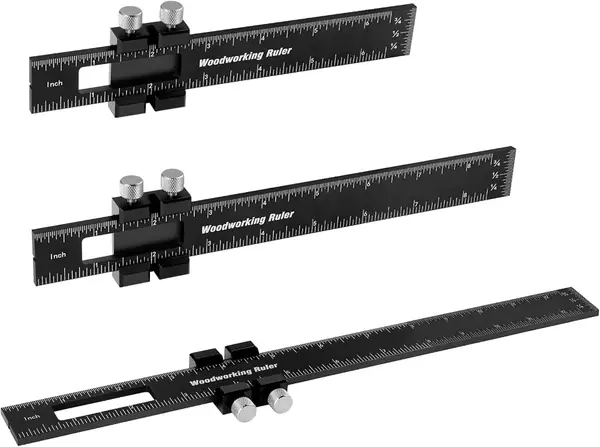
Violetfox three-piece black aluminum slide rule set with removable stop blocks

Parallel scribing

Shop Score 93/100
Material
CNC-machined aluminum
Stops
Removable slide stops with locking screws
Scales
Inch and metric on both faces
Rule Lengths
6, 8, and 12 inches
View on Amazon

The stop block is the whole idea. Loosen the screw, slide it to your dimension, tighten it down, and the notch at the end of the rule holds a pencil point while you drag the whole thing along the edge of a board. Two seconds later there is a line exactly parallel to that edge.

Three rules come in the set — 6, 8, and 12 inches — and the 12-inch one is what we reach for most, because it covers most casework layout without becoming a nuisance to store. The scales are laser-engraved in inches and metric on both faces, so a metric plan doesn't need converting in your head, and the CNC-machined aluminum is thicker in the hand than the money suggests.

We also like that the stop comes all the way off. Slide it into the cut-out in the blade and the rule stands on edge as a small T, which is the quickest way we have found to mark down the face of a board rather than across it. Set the stop once and every repeat mark sits the same distance in, with no tape involved. Twelve inches is where the set stops, though, so sheet goods and full cabinet sides still call for a long beam square.

Worth Noting

  • Twelve-inch maximum reach
Our Verdict

We think this set is the smart first T-square for most shops: three lengths, sliding stops, and parallel lines without a tape measure.

Check Latest Price
3.

POWERTEC 6-Inch Precision Marking T-Square Best for Fine Marking

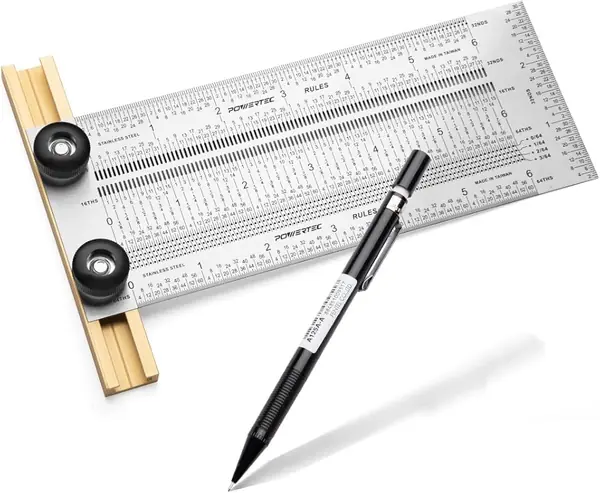
POWERTEC 6-inch stainless steel marking T-rule with gold anodized T-bar and pencil

Fine layout work

Shop Score 92/100
Material
Stainless steel blade with aluminum T-bar
Graduations
1/16, 1/32, and 1/64 inch
Blade Length
6 inches
Included
0.5mm mechanical pencil and mounting knobs
View on Amazon

Six inches of blade isn't much, and that is the point. This is the square we pick up for drill-press setup, bit heights, hinge and hardware layout, and any mark that has to land within a couple of inches of an edge — work where a 24-inch beam is more tool than you want in the way.

The stainless blade carries marking holes and slots at every 1/16, 1/32, and 1/64 inch, and the anodized aluminum T-bar bolts on with two knobs and screws, so it comes off when you want the rule loose as a plain scale. A 0.5mm mechanical pencil ships in the box, which matters because the lead has to match the holes.

Readability is where it earns its keep. The graduations are cut deep enough to shrug off pencil dust and shop light, and the numbers stay legible at the arm's-length distance you actually read them from. Keep the job in mind, though: this is a marking rule, not a straightedge you lean on and not a saw guide. Its work is to hold a mark exactly where the scale says, and it does that without fuss.

Worth Noting

  • Six-inch reach limits it to fine work
Our Verdict

We like it best as a second square for fine marking and drill-press setup, where its 6-inch blade and 1/64 holes beat anything longer.

Check Latest Price
4.

INCRA Tiny T-Rule Best for Small Parts

INCRA Tiny T-Rule, a small stainless steel marking square with fine etched graduations

Small-part joinery

Shop Score 91/100
Material
Stainless steel
Graduations
1/16, 1/32, and 1/64 inch
Weight
2.24 oz
Blade Size
3 by 4-1/2 inches
View on Amazon

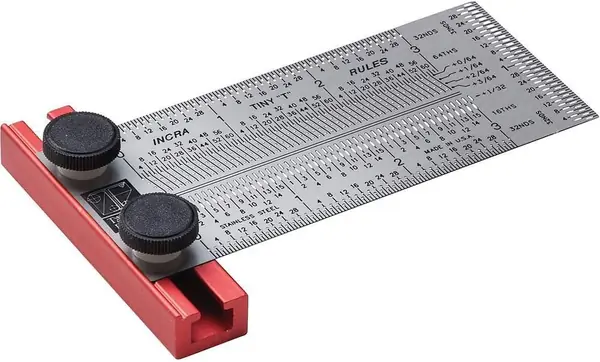
Three inches by four and a half, a couple of ounces, and it lives in an apron pocket rather than on the wall. The Tiny T-Rule comes out for a hinge gain, a small box joint, or a mark that has to sit a hair off an edge, then goes back in the pocket.

Incra's marking holes are the whole appeal. They are drilled at every 1/16, 1/32, and 1/64 inch from zero to three inches, with slotted height holes every 32nd along the end, so a pencil point drops into the position you want and you slide the rule along the edge. No scale to read, no reading error, and no resetting a combination square for the next mark — you move the pencil to a different hole.

Where it earns a place in a shop full of bigger squares is repeatability at sizes nothing else here handles well: shelf-pin spacing on a small cabinet, a drawer-bottom groove, the shoulder line on a one-inch rail. Move the pencil over one hole and the next line is exactly a sixteenth away — slow with a tape, instant with this.

If your layout runs past a few inches, this isn't the tool, and the 12-inch rules and the beam squares take over from there. Inside its three inches, nothing here is faster.

Worth Noting

  • Stainless blade bends under careless handling
Our Verdict

We keep it for small parts and tight joinery: three inches of marking holes gets you repeatable lines nothing else here reaches.

Check Latest Price
5.

Saker Aluminum T-Square Best for Angle Marking

Saker red aluminum T-square with adjustable protractor head and 18-inch engraved blade

Angle marking

Shop Score 90/100
Material
Aluminum
Blade Length
18 inches
Weight
15.8 oz
Head
Adjustable protractor
View on Amazon

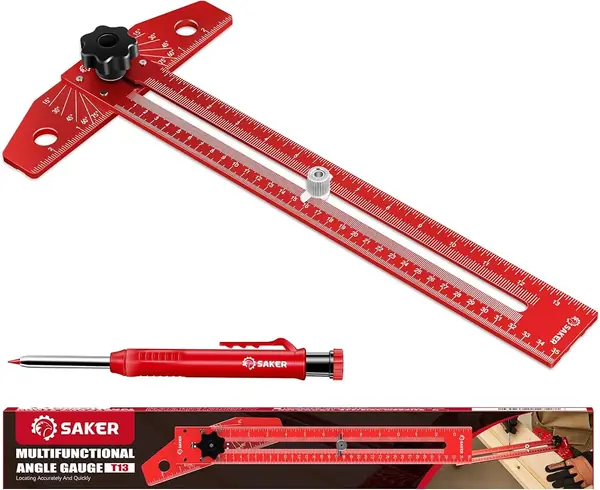
Eighteen inches of aluminum with a protractor head at one end. Swing the head to the angle you want, lock it, and you can carry a line across a wide board at something other than 90 degrees — nothing else in this group does that, and for trim, stair stringers, and odd wall angles it saves setting a bevel and hoping.

The scale is laser-engraved along the blade and stays legible in a dim garage, and the red finish is easy to spot when the tool is buried under offcuts. A mechanical pencil and eight refills come in the box, and the whole thing weighs a hair under a pound — light enough to hang on a peg within reach of the bench.

The adjustable head is both the reason to buy this and the reason to be careful with it. Angles are set against the dial rather than fixed by machining, and the 45- and 90-degree settings can land about a degree off — enough to matter on a picture frame, not enough to matter on a fence rail. Run yours against a known square before you trust it on joinery and treat it as a trim and framing tool first, which is where it is happiest: outdoors, on a sawhorse, marking something too big to bring to the bench.

Worth Noting

  • Eighteen-inch blade won't span a cabinet side
Our Verdict

We take it on trim and angle work where a degree doesn't matter, not for cabinet joinery that has to close tight.

Check Latest Price
6.

THORVALD 6-in-1 Carpenter Square Best for Beginner Tool Kits

THORVALD 7-inch aluminum carpenter square with protractor markings and mechanical pencil

Beginner tool kits

Shop Score 89/100
Graduations
1/16 inch
Blade Size
7 by 7 inches
Functions
Six, including protractor and drill gauge
Thickness
4 millimeters
View on Amazon

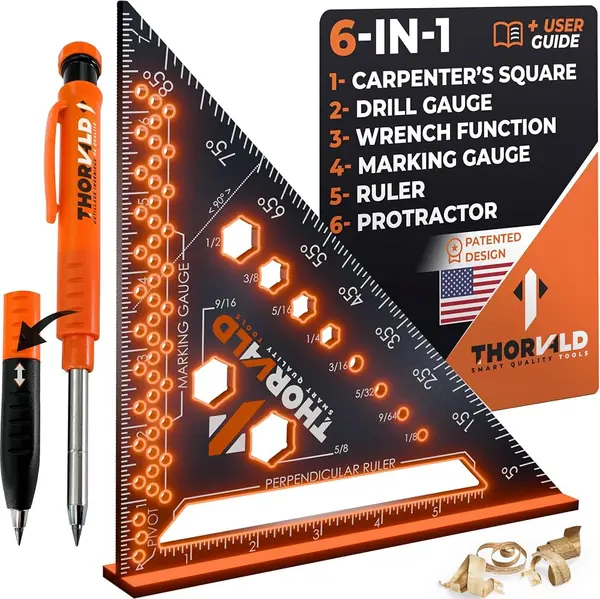
Think of this as the square that stays in the bag for a job where you don't yet know what you'll need. It is a 7-inch triangle of 4mm aluminum with a protractor, marking-gauge holes, a drill gauge, and a wrench cutout, and a 2-in-1 mechanical pencil rides along with it. For a first kit, or for the square that lives in a truck, that is a lot of layout capability in one small tool.

What it does, it does simply. The legs reference the end of a board for a 90-degree line across a rail, the protractor handles the angles, and the etched 1/16-inch scale reads without squinting. The marking holes line up with the pencil that ships with it, so a quick parallel mark doesn't need a second tool out of the box.

Seven inches is the whole blade, though, and that is a real ceiling. Anything you scribe down the length of a sheet or a cabinet side is out of scope — that is beam-square territory, and no amount of cleverness in a triangle changes the geometry. Where it earns its keep for us is rails, stiles, small parts, and the repair nobody planned for.

Worth Noting

  • Included pencil may give out before the square does
Our Verdict

We suggest it for a first tool kit or a truck box, where six layout functions and a pencil beat one perfect square.

Check Latest Price

How We Tested the Best T-Squares

We started with research — reading specs and owner reviews, then pulling tools that covered the range of the category: 3-inch pocket rules up to 24-inch machined beams, aluminum and stainless, plain scales alongside scribing holes, slide stops, and one adjustable protractor head. Fourteen of them spent eight months in a working garage shop, laying out cabinet face frames on Saturday mornings, marking shelf-pin holes and small joinery on weeknights, and setting bit heights at the drill press.

Squareness came first. We drew a line against a known machinist square, flipped the test square over, and drew a second line on the same mark; any gap between them doubled the tool's error, which we read with a feeler gauge. We also pressed each head against a freshly jointed edge and rocked it to feel how much lip actually registered, then checked whether a heavy head stayed put on a vertical panel or slid.

For reach, we marked across panels at the top of each tool's range and watched for the far end drooping or lifting. Scribing holes and slide stops laid out a row of shelf pins and a set of parallel lines, and we checked every stop for creep between marks. We read each scale under shop light and at an angle to see which graduations held up, and timed head attachments, stop locks, and protractor swings with a stopwatch.

Then we lived with them — in a tool bag, in a drawer, knocked off the bench — and noted whether dings raised a burr along a marking edge. Value was weighed against the rest of the field rather than in isolation: what an extra stop, a finer graduation, or a few more inches of reach actually bought. And when a cut followed a mark, we clamped a straightedge or reached for a track — a T-square marks a line, it doesn't guide a saw.

How to Choose a T-Square for Woodworking

Match the Blade Length to the Work

Reach is the first thing to settle. A 3- or 6-inch rule handles drill-press setup, hinge layout, and small joinery, where a 24-inch beam is simply in the way. A 12-inch rule covers most casework marking and slides into a drawer; a 24-inch beam spans a cabinet side or a rip in sheet goods, which nothing shorter does cleanly.

If you build cabinets, plan on the long one and accept that it hangs on the wall. If you build boxes and small parts, the short rules here are the ones you will actually pick up, and a long beam will spend its life in a corner.

Look at How the Head Registers

A T-square earns the name from its head, so look at how it meets the workpiece. A plain head butts against the edge and relies on your hand to hold it there. A head with a lip that rests on the top face, as the Woodpeckers design does, registers on two surfaces at once and resists tipping while both hands are busy.

Slide stops, like the ones on the Violetfox rules, trade that bearing surface for a set distance from the edge, which is the better arrangement when your marks repeat. The trap with any adjustable head is that you have added a setting to verify: a dial that reads 90 degrees is not the same as a machined corner.

Marking Holes or a Clean Scale

Two philosophies live in this group. A conventional scale asks you to read a number and put a pencil on it. A blade drilled with marking holes asks you to drop the pencil point into the hole at the dimension and slide, which removes the reading error that creeps in at arm's length in poor light.

Holes come at 1/16, 1/32, and 1/64-inch spacing on the Incra, PowERTEC, and Woodpeckers tools, and they are what we reach for when a mark has to land exactly. If you mostly transfer dimensions from a tape measure, a deeply engraved scale with beveled edges does more for you than a hole pattern.

Steel Rules, Aluminum Beams, and a Two-Minute Check

Stainless marking rules are thin and precise: they hold a mark beautifully and they are not straightedges to lean on or saw guides to run a shoe against. Machined aluminum beams are the ones that stay flat over 24 inches and survive a drop onto concrete.

Whatever you buy, verify it before anything has to close. Butt the head against a known straight edge, mark a line, flip the square over, and mark the same line again. If the two lines coincide, the tool is square; if they don't, send it back before it costs you a joint.

Frequently Asked Questions

Final Verdict

Buy the Woodpeckers 24-inch if layout accuracy is the thing you are solving for. The lip on the beam is the difference between a square that stays put on a cabinet side and one you chase with your free hand, and the scribing holes turn a two-tool job into one motion.

If your marks stay under a foot and the budget is small, the Violetfox set does the parallel-line work for a fraction of the cost — we keep that 12-inch rule closer to the bench than anything else here. Between the two, that covers most woodworkers' layout.