↑↓ navigate ↵ open Esc close All results →

Best Folding Rulers for Woodworking

A tape measure is fine until the number you need is inside a cabinet, behind a door casing, or across an opening the case won't fit into. That's when a folding rule earns its keep: the sections snap into a rigid stick you can lay into a corner or hook over an edge, then fold down to pocket size. It fixes the awkward measurement — the one you'd otherwise guess at.

We tested 14 folding rulers over six months, working them on the bench, out of an apron pocket, and on a wet afternoon of trim work. Length being equal, what separates them is reading direction, how fine the graduations go, and whether the hinges still hold a straight line after a drop.

Print that shrugs off pencil marks and thumb grease matters more than the price tag, and a rule that folds into an apron pocket gets used more than a longer one left in the truck. The seven below cover it, from a first shop setup to decimal-foot site math.

Our Top Picks

The Best Folding Rulers for Woodworking

1.

Klein Tools 910-6 Folding Ruler Best Overall
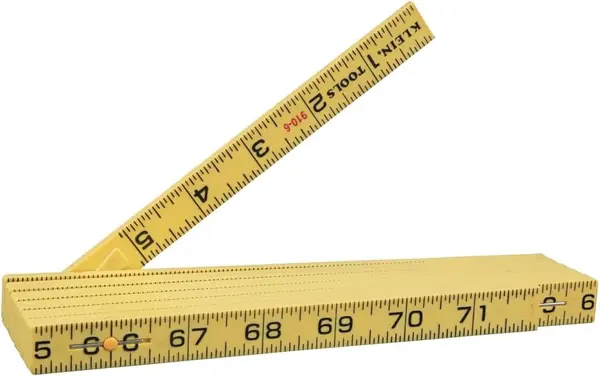
Klein Tools 910-6 yellow fiberglass folding rule with black inside-read graduations

Inside layout work

Shop Score 93/100
Material
Fiberglass-reinforced nylon
Length
6 feet
Graduations
1/16 inch
Reading
Inside read
View on Amazon

Numbers that start at the inner face are the reason to own this rule. Because the inside-read scale begins at the end that goes into an opening, you can push the rule into a cabinet carcass, a door reveal, or the space between two studs and read the dimension where the far surface lands, with no allowance to add and no tape to fold. Klein prints the 1/16-inch graduations on both faces and both edges, so there is always a readable edge facing up.

We reach for it ahead of a tape for anything under six feet that has to be held one-handed. The fiberglass-reinforced nylon sections run on positive-locking joints and stainless steel springs, which snap straight and stay straight while your other hand holds a pencil, and the yellow body does not mind a wet bench or a gritty toolbox.

The limit is coverage: this one speaks inches only, with no metric scale for plans drawn in millimeters — fine in most American shops, a nuisance in a shop that has gone metric. Otherwise there is little to manage, with no wood to dry out and no printed scale to wear off. The red stud marks every 16 inches turn out to be as useful for shelf pins and cabinet spacing as they are for walls.

Worth Noting

  • Joints can crack if the rule is dropped open
Our Verdict

Inside-read graduations make this the rule we hand anyone who fits cabinets and doors, and the locking joints hold a straight line while you mark.

Check Latest Price
2.

Wiha 61602 MaxiFlex Folding Ruler Best for Metric Plans

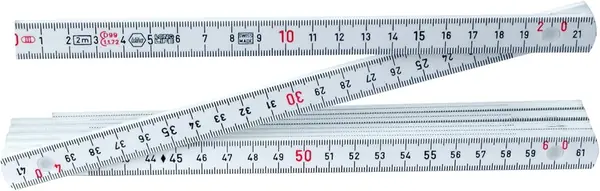
Wiha MaxiFlex white and black metric folding ruler with ten hinged sections

Metric plan work

Shop Score 92/100
Material
30% fiberglass-reinforced polyamide
Length
2 meters
Graduations
1 mm to 1 cm increments
Sections
10
View on Amazon

A full 2-meter metric scale with bold red marks every 10 centimeters is what this rule brings to a shop that builds from millimeter drawings, and it reads a metric plan straight off the stick without conversions. Fifteen-millimeter sections and ten of them are enough to reach across a sheet of plywood and still fold into a chest pocket.

The body is polyamide molded with 30 percent fiberglass, which makes it resistant to scratches, most shop chemicals, and weather, and the graduations are embossed into the material instead of printed on it. That matters over years of use, when paint on a cheaper rule starts to disappear under your thumb. At 6.4 ounces it is easy to carry all day.

Where it separates itself is the hinge: a patented play-free joint with a steel spring and a positive 90-degree stop, and we count it as the tightest joint in this group, since nothing else here snaps into line with the same lack of slop. Two meters of straight, stable rule from a tool that folds into a pocket is the whole argument.

Worth Noting

  • No inch graduations anywhere on the rule
Our Verdict

For metric plans this is the rule we buy: play-free joints, an embossed scale, and a body that ignores weather.

Check Latest Price
3.

Crescent Lufkin X46SLN Wood Rule Best Classic Wood Rule

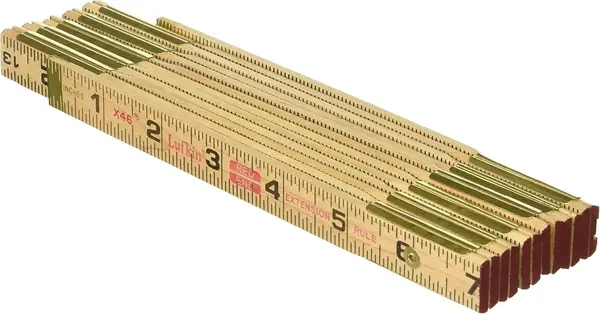
Lufkin X46SLN wood folding rule with brass extension slide and black graduations

Furniture layout

Shop Score 91/100
Material
Wood
Length
6 feet
Graduations
1/16 inch
Extension
Brass slide
View on Amazon

A brass slide at the tip is the small thing that makes this classic wood rule worth its following. Push it out with a thumb and it adds reach past the end of the rule, which is how you take an inside measurement — the depth of a built-in, the space between two cabinet sides — and read the number off the slide instead of folding a tape into the corner and hoping.

The rest is tradition: six feet of wood, 1/16-inch graduations, and sections that unfold into a rigid straightedge you can lay across a board and mark against, which is the job a tape measure does badly. It is light enough to carry all day and folds back into a stick that slides into an apron pocket.

Wood is the trade. This is not a rule to leave out on a wet deck or in a damp toolbox, and if it does get rained on, wipe it dry before folding it away so the sections do not swell and bind.

We keep coming back to it for furniture work, where the 1/16-inch scale covers most plans and the wood stays dead straight as a reference edge. The limited lifetime warranty is a fair signal of how long Lufkin expects it to last.

Worth Noting

  • Wood sections can swell and bind if stored damp
Our Verdict

For furniture work this is the wood rule we trust: rigid, easy to read, and fitted with a brass slide that takes inside readings directly.

Check Latest Price
4.

Perfect Measuring Tape Co. FR-72 Folding Rule Best Budget

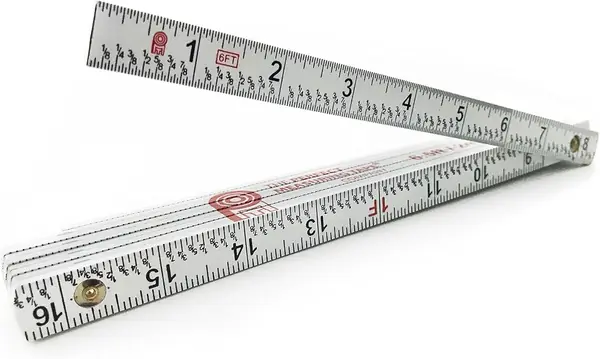
Perfect Measuring Tape FR-72 white composite folding rule with fraction and metric markings

Everyday pocket carry

Shop Score 90/100
Material
Fiberglass-reinforced composite
Length
6.5 feet / 2 m
Graduations
Inch fractions and metric
Weight
4.59 oz
View on Amazon

Fractions printed right on the scale — 1/8, 1/4, 1/2 — are what set this folding yardstick apart. Instead of counting sixteenth lines between two numbers, you read the label sitting on the mark, which is faster when you are calling dimensions out to someone or working under a dim bench light.

We like it as a second rule for a small shop, because both scales live on the same stick: fractional inches across the top faces, split-scale inches and metric along the bottom. The composite body is thin and weighs well under half a pound, so it drops into a shirt pocket and you forget it is there until you need it.

Rigidity is the catch. Fiberglass-reinforced composite does not have the stiffness of wood, and out near full extension the sections want to flop, so brace the rule against the work for a long reading or use a tape past arm's reach. For everything short — marking a mortise, checking a reveal, setting a fence — it is the rule we grab most, and the fraction labels are the reason.

Worth Noting

  • Graduations run small at arm's length
Our Verdict

The fraction labels make this the fastest-reading budget rule here, and we recommend it for pocket carry and mixed inch-and-metric work.

Check Latest Price
5.

Rhino Rulers 355125 Folding Ruler Best for Decimal Feet

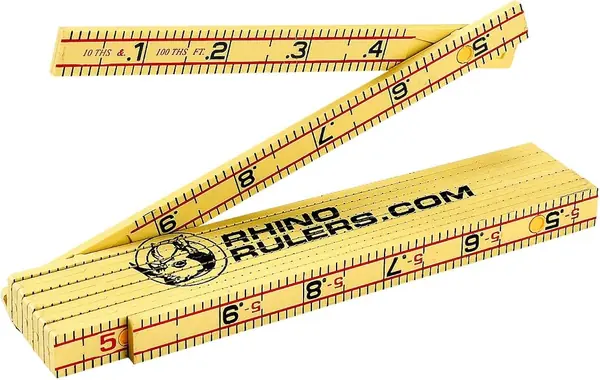
Rhino Rulers 355125 folding rule with tenths scale on one yellow face

Decimal-foot site math

Shop Score 89/100
Material
30% fiberglass-reinforced polyamide
Length
6 feet
Joints
90-degree positive stops
Scales
Tenths/hundredths/feet front, inches/feet back
View on Amazon

Decimal tenths on one face and fractional inches on the other is the pairing that makes this the rule we reach for when dimensions have to be divided rather than cut. The tenths side lets you add and split decimal feet without converting fractions, while the inch side handles ordinary marking.

Its body is polyamide reinforced with 30 percent fiberglass, with scales embossed deep enough to survive a season of grit and a positive 90-degree stop at every joint. Waterproof, flexible and scratch resistant, it is built for the tailgate rather than the bench, and it takes a soaking without warping the way a wood rule will.

If your work stays in fractional inches, the decimal face is weight you will never use, and there is no metric scale on either side. Check the scale before you order, too: the same rule is sold in mason's and carpenter's versions, and only this 55125 carries tenths alongside inches.

Worth Noting

  • No metric graduations on either face
Our Verdict

Buy it if your work involves decimal feet: the tenths face saves a conversion every time, and the body does not mind water or grit.

Check Latest Price
6.

Stabila Type 600 Folding Ruler Best Wood Rule for Wet Weather

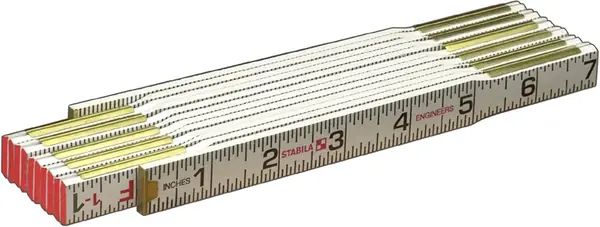
Stabila Type 600 beech wood folding ruler with white weather-resistant painted faces

Wet-weather site work

Shop Score 88/100
Material
Beech wood
Graduations
1/16, 1/10, 1/100 inch
Finish
Weather-resistant paint
Hinges
Hardened steel springs
View on Amazon

Hardened steel springs under high-strength hinges, plus a weather-resistant paint over the wood, is the combination that makes this the wood rule we trust on a wet site. The scale is printed in dark, high-contrast lettering with bold numbers, so it reads from a few feet away without leaning in.

The sections are premium beech, which is what keeps a folding rule straight after a season of use; cheaper wood sections cup and twist, and every measurement taken off a twisted rule is a guess. Around the hinges the positive lock is firm and the 90-degree stop is a real one, not a suggestion.

This is an engineer's scale — 1/16 inch on one edge, then 1/10 and 1/100 decimal divisions — which suits layout that mixes fractions with decimal feet, and the print is the easiest to read of the wood rules here. If your work is plain fractional inches, a less expensive rule will do the same job.

Worth Noting

  • Four scale versions make the wrong pick easy
Our Verdict

For a wood rule that lives in a truck and gets rained on, we choose the Stabila for its steel springs, firm locks and legible print.

Check Latest Price
7.

csjzzt Folding Wooden Ruler 2-Pack

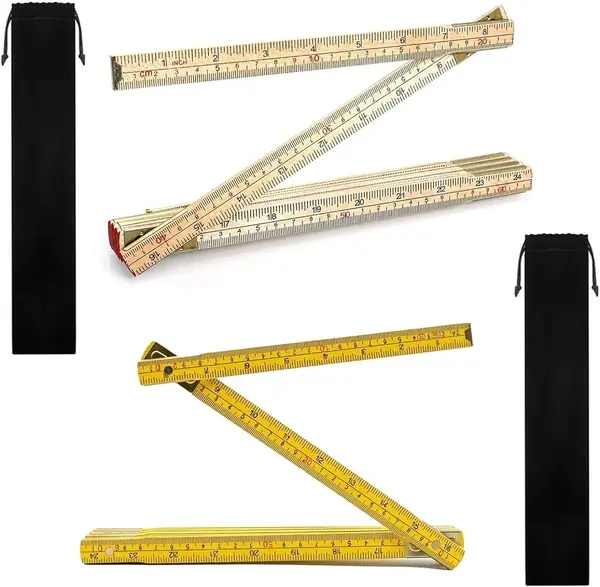
Two birch wood folding rulers in natural wood and yellow with velvet storage pouches

Beginner shop setup

Shop Score 84/100
Material
Birch wood
Length
6.6 feet (2 m)
Graduations
Inch and metric
Included
Two rulers and two velvet bags
View on Amazon

Two birch rules and two drawstring pouches arrive together here, which suits a shop with more than one bench: hang one by the saw and keep the other in the truck. Each rule runs 6.6 feet (2 m) with imperial inches on one face and metric centimeters on the reverse, so both sets of plans are covered.

In the hand these are the plain version of the classic wood rule: birch sections, zinc-plated steel hinges that snap and hold at 90 and 180 degrees, and clear markings on both sides. The velvet bags are a small thing, but they keep the rules from rattling around in a toolbox where the edges get chipped.

The 90-degree stops are the detail we did not expect at this price — they hold the rule square for marking across a face, which is most of what a folding rule does in a small shop. Keep both in the shop rather than in a bucket of tools on a wet site and the pair will earn its place; for a first bench or a second one, that is an easy call.

Worth Noting

  • Birch wood construction is unsuited for wet job sites
Our Verdict

We recommend the two-pack to anyone setting up a first shop or outfitting a second bench, where two decent rules beat one good one.

Check Latest Price

How We Tested These Folding Rules

We started with the folding rules stocked by tool suppliers and specialty measurement shops, then filtered by reading direction, graduation coverage, material, reach, and price — the things that actually change how a rule works on a job. That left 14 units: wood, fiberglass, and composite rules, in 6-foot and 2-meter lengths, sold on their own and in packs.

For six months they rode in apron pockets and toolbags, laid out cabinet sides and door trim, and hooked over framing to check openings. Before the first use we checked every rule against a steel square and a known dimension, then again at the end of testing, watching for joints that had opened up or print that had drifted out of register.

Joints took the worst of it. We snapped each rule open and closed dozens of times, folded it into a corner to feel the 90-degree stops, and dropped it open from bench height onto concrete to see which ones came up dead straight and which developed play. A few got wiped with a damp rag, and one spent a rainy afternoon outside.

Readability we judged at arm's length in shop light and in shade, noting whether the fractions, tenths, and metric marks were legible without leaning in. Folded size went against an apron pocket and a small toolbag, and where a rule had a brass side slide we used it for inside readings between jambs, then compared that result with the same measurement taken end-on.

How to Choose a Folding Ruler for Woodworking

Inside Read or Outside Read

An inside-read rule begins its graduations at the inner face, so you can push the body into a cabinet opening, a reveal, or the gap between studs and read the dimension where the far surface lands. An outside-read rule starts its scale at the outer end, which is what you want when the rule hooks over an edge or stands on a surface and you read down to a mark. If you fit doors and cabinets, inside read earns its keep; if you measure outside dimensions all day, outside read is quicker. One trap: double-sided means markings on both faces, not both reading directions.

Match the Scale to Your Plans

Fractional inches to 1/16 are the working standard in American shops, and that is the scale we prioritize for furniture and framing. Metric rules such as the Wiha MaxiFlex carry a full 2-meter scale for plans drawn in millimeters, while dual-scale rules like the Perfect Measuring Tape and the csjzzt pair cover both. Engineer's scales in decimal tenths, found on the Rhino and the Stabila, suit layout that gets divided rather than cut.

Finer is not automatically better. A 1/32 line over the first few inches helps small work, but printed too small it slows you down at arm's length, so read a rule at the distance you actually use it.

Judge the Hinges Before the Wood

Every folding rule fails at the joint first, which makes the hinge the part worth inspecting. Look for a positive lock that clicks and holds at 90 degrees and springs made of steel rather than plain rivets, because a rule that will not hold a straight line is just a stick with numbers on it. Play develops where grit gets into the hinge, so keep the rule folded when it is not in use and wipe it down after a muddy day. A rule dropped while open is where most joint damage happens, so close it before you set it down.

Wood, Fiberglass, or Composite

Wood rules such as the Lufkin, the Stabila and the csjzzt pair are stiffer, hold a straight edge, and feel traditional in the hand; they also do not like being wet, and printed graduations eventually wear. Fiberglass and polyamide rules — the Klein, Wiha, Rhino and Perfect Measuring Tape — shrug off water, mud and shop chemicals, and their graduations are usually embossed rather than painted on. The trade is stiffness, since a long composite rule flexes more at full extension. Shop-based woodworkers will be happier with wood; anyone working outdoors or out of a truck should take the composite.

Reach, Folded Size, and the Brass Slide

Six feet or 2 meters is the size that covers a doorway, a sheet of plywood and most room dimensions in one pass, while longer sections sag and get awkward to handle alone. Check the folded length against where the rule will live — a shirt pocket, an apron, a tool pouch. And if you take a lot of inside measurements, a rule with a sliding brass extension, like the Lufkin, lets you read an opening without arithmetic, which is why that design has survived a century.

Frequently Asked Questions

Final Verdict

We recommend the Klein Tools 910-6 for most woodworking. The inside-read scale saves you arithmetic on every opening, the 1/16-inch graduations cover both faces and edges, and the fiberglass body does not care about rain or sawdust.

Your plans decide the alternative. If they are drawn in millimeters, take the Wiha MaxiFlex and its play-free joints; if you want a traditional wood rule that reads inside dimensions off a brass slide, take the Lufkin X46SLN. On a tight budget, the Perfect Measuring Tape rule reads fractions and metric for the least money here.