↑↓ navigate ↵ open Esc close All results →

Best Contour Gauges of 2026

Most buyers grab a contour gauge based on bar length and lock style, overlooking the single dimension that determines accuracy: pin thickness. Thin pins drop into a routed bead or chipped tile edge, whereas thick pins bridge straight across small steps and carry a falsely smooth curve back to the saw.

Pressing 16 lockable gauges against uneven door casings, sagging crown molding, toilet flanges, and under-sink plumbing over four months confirmed how quickly sloppy pin tolerances show up at the miter box. A reliable locking cam freezes the profile firmly enough that bumps on the walk back to the saw do not shift a single pin.

Because many gauges sell in multi-size packs or gift sets, comparing included lengths and spare parts against the price separates useful trim tools from novelty clutter.

Our Top Picks

The Best Contour Gauges

1.

RAK Contour Gauge 10-Inch Best Overall
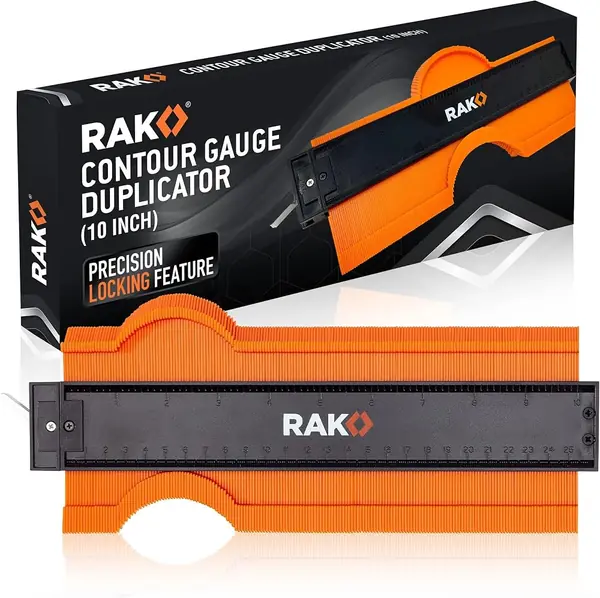
RAK contour gauge with an orange and black ABS body and 182 fine sliding pins

Trim and tile work

Shop Score 94/100
Material
ABS plastic
Length
10 inches
Pin Count
182
Body Width
4 inches
View on Amazon

The pins do the talking. RAK packs 182 of them into this 10-inch body, and that density is what separates it on real trim: a chipped door casing or the bead on a spindle comes back as a row of fine steps you can follow with a pencil instead of a wavy approximation. Between the fine pins and a lock that does not budge, this is the gauge we reach for first.

That lock is the other half of the argument. Engage it and every tooth stays where you left it, so the profile survives the trip from the wall to the bench and the line you trace matches the line you took. We paid close attention to that on a few narrow, awkward transfers, and the shape came through unchanged, which is more than we can say for a friction-fit tool held against a wall.

Depth is where it stops. The teeth are short, so a crown that stands well proud of the wall or a deep cove will not register all the way to the back, and this gauge is happiest on casings, baseboard, tile, and plank, where the shape is wider than it is deep. The 4-inch body helps in the places that count: it stands upright on a windowsill on its own, leaving both hands free for the pencil.

Worth Noting

  • Short pins miss deep crown profiles
Our Verdict

Our default pick: 182 fine pins catch the detail coarser gauges smooth over, and the lock holds the shape all the way to the saw.

Check Latest Price
2.

Saker Contour Gauge 10-Inch Best Adjustable Pin Tension

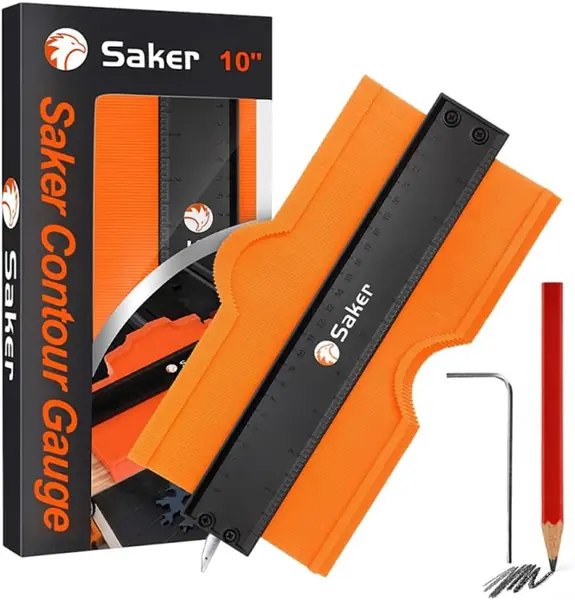
Saker 10-inch contour gauge in bright orange plastic with a row of sliding pins

Wall and ceiling trim

Shop Score 93/100
Material
ABS plastic
Weight
13.7 oz
Length
10 inches
Pin Tension
Adjustable end screws
View on Amazon

Compared with our top pick, the Saker asks for a little setup first. Two screws at the ends of the housing set how stiff the pin stack feels, so you decide whether the pins glide across a profile or drag against it, and the gauge keeps that setting. It is a different philosophy from a one-motion lock.

We ended up preferring it for vertical work. Tightened a touch, the pins hold their position on a wall long enough to get a pencil where it needs to go, which is the moment a loose gauge usually costs you the profile. Loosen them and the same tool slides along a curved stair skirt without skipping. Not many gauges here let you make that call.

The 10-inch body is standard issue and covers stringers, baseboard heights, and tub aprons, and the bright orange shell is easy to find under a pile of offcuts. Set the tension for the material you are working and it stops asking for attention, which is the version of this tool we want in a shop.

Worth Noting

  • Allen key has no home on the gauge
Our Verdict

We reach for it when the pins need to grip more: screw-adjustable tension you set once, in a 10-inch frame that costs less than most here.

Check Latest Price
3.

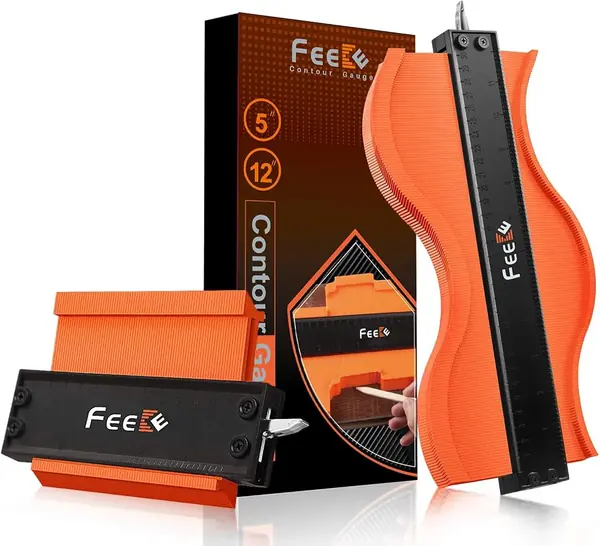
Feeke Contour Gauge Set 12+5 Inch Best for Wide Profiles

Feeke contour gauge set with a 12-inch orange body, a 5-inch gauge and two hex keys

Wide moldings

Shop Score 92/100
Material
ABS plastic
Sizes
12 and 5 inches
Pin Thickness
0.05 inches
Width
50% wider than standard
View on Amazon

Long runs of crown and wide casing are where a 10-inch gauge starts to feel short, and Feeke answers with a 12-inch body and a pin row 50 percent wider than the usual. The extra width takes more of the profile in a single press, and the extra length means fewer overlapping captures across a full wall. We keep this set for exactly those jobs.

The 5-inch companion is not filler. It reaches inside a cabinet corner or between a casing and a perpendicular wall where the long body will not sit flat, and the pair ships with two hex wrenches for the end screws. Pins run 0.05 inch thick, fine enough to catch the step between a baseboard cap and the wall above it.

Reach costs you in the hand. A 12-inch gauge is awkward inside a closet or between close obstructions, so the small one does more work than its size suggests. On a full wall run, though, the long one saves a second pass, and that is a trade we are glad to make for trim carpentry.

Worth Noting

  • Head is too thick to slip under trim
Our Verdict

For long runs of crown and wide casing, the 12-inch body and wider pin row are worth the bulk; the 5-inch handles the corners it cannot.

Check Latest Price
4.

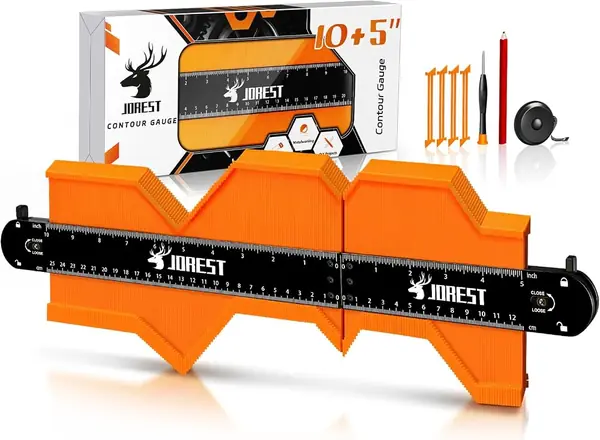
JOREST Connectable Contour Gauge 10+5 Inch Best Convertible Set

JOREST contour gauge set with 10-inch and 5-inch orange sections plus printed scales

Whole-room trim work

Shop Score 91/100
Sizes
5, 10, and 15 inches
Weight
1.8 lb
Scales
Inches and centimeters
Blade Thickness
0.05 inches
View on Amazon

Two gauges here do something most of the others cannot: the 10-inch and 5-inch bodies splice into a 15-inch tool, long enough to take a whole window stool or a wide arch in one press. Split them and you are back to a 10-inch for casings and a 5-inch for the gap between a supply line and a wall.

The joint is the whole trick, so it is worth knowing what it asks: the two sections butt together and the pins are set and locked as one row. The blades are 0.05 inch thick, and the scales are printed on both sides in inches and centimeters, which saves turning the tool over to read a depth.

What we like most is the range for the money: 15 inches when you need it, two ordinary gauges when you do not, and a lock that held from the wall to the bench on every transfer we made. It is the set we hand to someone trimming out a whole room, because one purchase covers the long run and the tight corner.

Worth Noting

  • Pins flex and can snap under pressure
Our Verdict

The most flexible set here: 10-inch and 5-inch bodies that splice into 15 inches when a shape runs longer than the bench.

Check Latest Price
5.

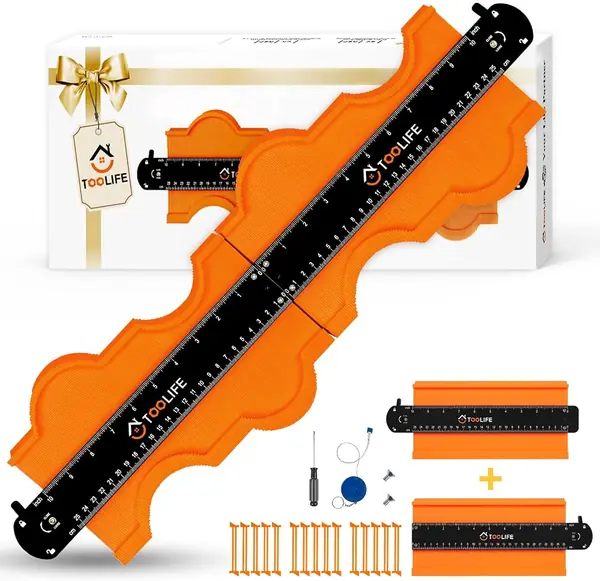
TOOLIFE Connectable Contour Gauge 20-Inch Best for Oversize Shapes

TOOLIFE connectable contour gauge with two orange 10-inch sections and printed dual scales

Oversize curves

Shop Score 90/100
Weight
2.23 lb
Scales
Inches and centimeters
Connected Length
20 inches
Individual Gauges
Two 10-inch
View on Amazon

A curved countertop face, a wide arch, or a scribe along a bowed wall is where a 10-inch gauge runs out of reach. Two 10-inch bodies here splice into a 20-inch tool, the longest span in this group by a comfortable margin, so one capture covers a shape the others need three passes for.

The sections butt together and the pins lock as one row, and the scales are printed in inches and centimeters. The package adds a tape measure and spare pins, the sort of thing you are glad to find the first time one gets bent.

Most of the work still happens with one half. The sections come apart for casings and door jambs, and the full 20 inches comes out for large-format tile, a laminate run around a hearth, or a countertop template.

It also arrives gift-ready, with a printed bow on the box and a written manual. That is genuinely useful if the gauge is a present for someone who has never used one, and easy to ignore if it is headed for your own bench.

We keep it for the jobs nothing else here can do rather than as a daily driver, and that is the honest way to judge it: 20 inches is a specialty, and the two halves make it earn its drawer the rest of the year.

Worth Noting

  • Heaviest gauge here at 2.23 pounds
Our Verdict

When a shape is wider than a foot, this is the gauge that covers it in one press, with 20 inches of span at the top of the price range.

Check Latest Price
6.

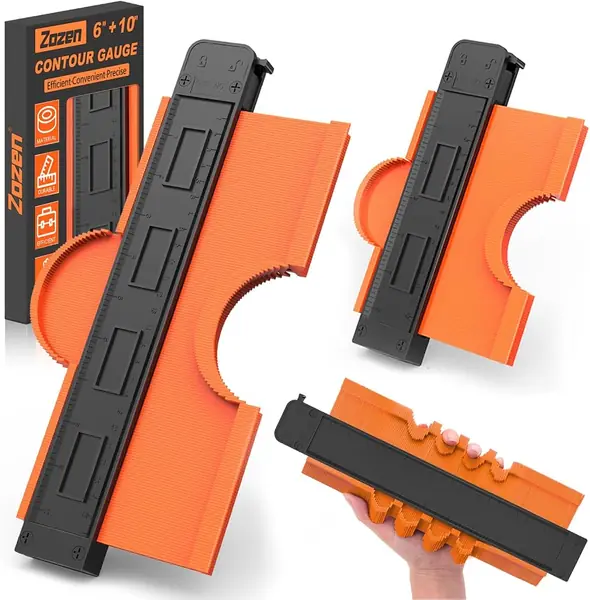
Zozen Contour Gauge Set 10+6 Inch Best Budget

Zozen contour gauge set in orange ABS with engraved scales on a 10-inch and 6-inch body

Budget flooring jobs

Shop Score 89/100
Material
ABS plastic
Sizes
10 and 6 inches
Pin Thickness
0.05 inches
Markings
Engraved scale
View on Amazon

One of the least expensive sets here still gets you two gauges, and the detail that stood out first is the scale: engraved into the body rather than printed on top, so it survives the abrasion that erases painted markings on cheaper tools. Ten-inch and 6-inch bodies cover most of what a homeowner runs into.

We think it is the right first contour gauge. The 10-inch handles a toilet flange or a door casing, the 6-inch gets between a supply line and a wall, and the lock holds the pins while you carry the shape to the saw. For a pair that costs less than most single gauges here, that is the whole argument.

Neither tool feels precious, and that suits the work: a gauge that gets shoved into a vanity cabinet and dropped in a bucket of offcuts. The 6-inch is the one we reach for more than expected, which is the case for buying a pair instead of one long body.

Worth Noting

  • Fine curves come back rounded
Our Verdict

We think it is the best first gauge: two sizes, an engraved scale that will not rub off, and a price that undercuts most single gauges here.

Check Latest Price
7.

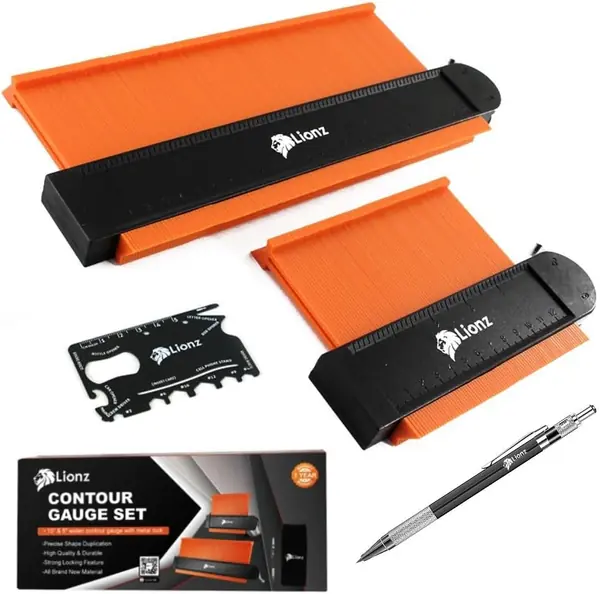
Lionz Contour Gauge Set 10+5 Inch Best for Weekly Shop Use

Lionz contour gauge pair in orange ABS with metal locks and an aluminum core

Weekly shop use

Shop Score 88/100
Material
ABS plastic
Sizes
10 and 5 inches
Lock
Metal locking mechanism
Core
Aluminum core
View on Amazon

Pick this set up and the body does not flex. An aluminum core runs through each gauge behind the pin row, with ABS around it, so a 10-inch span stays straight when you press it against a bowed wall. That is a different feel from the all-plastic kits here.

The lock is metal rather than plastic, and it clamps firmly enough that you can carry the gauge by one end without the profile shifting. Both sizes, 10-inch and 5-inch, carry the same core and the same lock, so the small one is not a stripped-down version of the big one.

Lionz bundles a mechanical pencil and a small multi-tool with the set. We could take or leave the multi-tool; a pencil that lives with the gauge is the part that gets used.

Where it earns its place is a shop where the tool comes out most weeks: the core takes the pressure, the metal lock takes the wear, and the two sizes cover trim, pipe cutouts, and flooring around a vanity. It is the pair we hand over when someone borrows tools, because it does not need explaining.

Worth Noting

  • Bundled multi-tool adds little practical value
Our Verdict

A metal lock and an aluminum spine make this the sturdiest-feeling pair here, with two sizes that share the same build.

Check Latest Price
8.

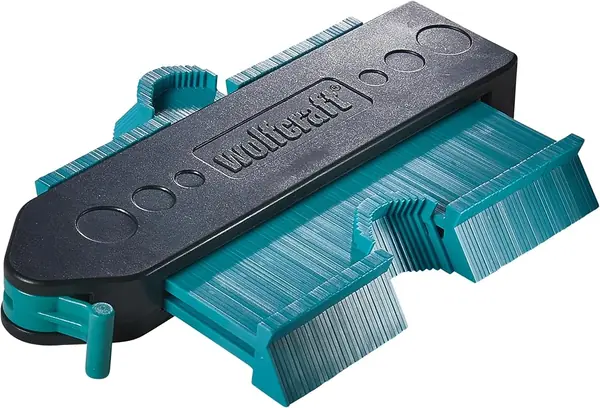
wolfcraft 6949000 Contour Gauge Best for Pipe Cutouts

wolfcraft contour gauge in black plastic with a clamping lever and short pin row

Pipe cutouts

Shop Score 87/100
Weight
9.17 oz
Lock
Clamping lever
Contour Depth
Max 30 mm
Contour Width
Max 130 mm
View on Amazon

The clamping lever is the reason to look at this one. Instead of screws at the ends, a single lever clamps the whole pin row: press the gauge to a profile, flick the handle, and the shape is set. For laminate work around heating pipes, which is what wolfcraft builds it for, that is faster than anything else here.

The head is compact and light at 9.17 ounces, easy to steer into a corner and hold against a wall with one hand while the other works the lever. Depth runs to 30 mm, about 1.2 inches, enough for laminate around a pipe and most casings but not for a deep cove or a thick slab edge.

For the jobs it is built around, a pipe through a laminate run, a cutout behind a toilet, a scribe to a stone hearth, the small head is an advantage: it fits where a 10-inch body turns into a lever you are fighting.

We like it best as a specialty tool in a kit that already has a longer gauge. A single lever and a 5-inch reach make it the one we grab when the cut is small, awkward, and half-hidden behind a fixture.

Worth Noting

  • Contour width capped at 130 mm
Our Verdict

One lever clamps the pins and a compact head slips around pipes, so it is the pick for laminate and small cutouts rather than wide trim.

Check Latest Price
9.

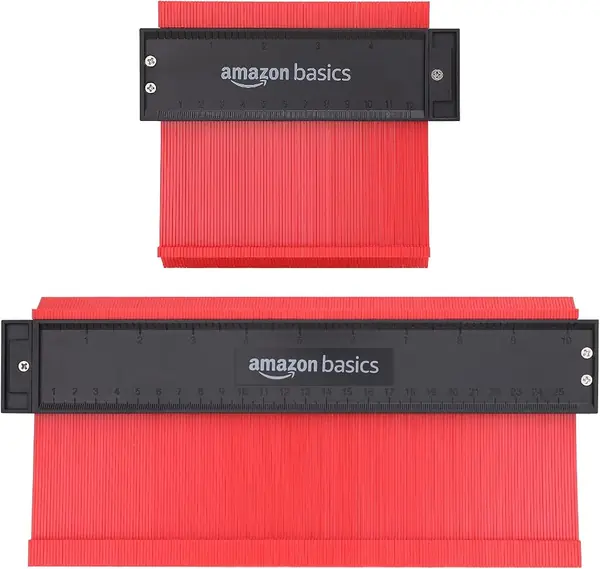
Amazon Basics Contour Gauge Set Best for One-Off Cuts

Amazon Basics contour gauge set in black and red with a 10-inch and 5-inch body

One-off cuts

Shop Score 86/100
Material
40% ABS, 60% PS
Sizes
5 and 10 inches
Scales
Inch and metric
Magnets
4 on 10-inch, 2 on 5-inch
View on Amazon

Friction holds the pins on this pair, and there is something to be said for a gauge with nothing to adjust: press it to a profile, lift it straight off, and trace what is left. Amazon Basics sells it as a two-gauge starter set, 10-inch for casings and 5-inch for tight work, with inch markings on one side and metric on the other.

Four magnets on the back of the 10-inch and two on the 5-inch are the detail we did not expect to use. On a steel bench or the side of a toolbox they keep the gauge where you left it, which matters when the alternative is a drawer full of clamps pressing on a row of thin pins.

At the bottom of the price range, we think of it as the one-project gauge: a single flooring repair, a tile cutout around a flange, a notch for a shelf. Neither body feels overbuilt. The 5-inch is the one that ends up in your hand most, and it is the reason to buy the pair rather than a single 10-inch.

Worth Noting

  • No lock, so pins shift on walls
Our Verdict

Two gauges and magnetic backs for less than most single gauges here, a fair budget pick for flat one-off cuts.

Check Latest Price

How We Tested the Best Contour Gauges

We started with a few dozen listings from marketplace sellers and woodworking suppliers and cut anything without a lock, since a comb of pins you can't freeze is just a comb. What was left we sorted by pin thickness and depth, gauge length, whether sections splice into a longer tool, engraved versus printed scales, and how many sizes came in the box for the money. Sixteen gauges came in for testing, and we used them for four months.

They lived in a garage shop, a half-finished bathroom, and a kitchen where the cabinets didn't meet the wall squarely. We pressed each gauge against door casings, crown molding under a sagging ceiling, a toilet flange surrounded by tile, and the supply pipes under a sink, then locked the pins and walked the gauge to the saw to see whether the profile survived the trip. We also noted whether the lock could be worked with one hand while the other held the body flat against the wall.

Pin thickness separated the field quickly: fine pins picked up a routed bead that thicker ones bridged, handing us a profile that read smooth when the trim wasn't. We scribed pencil lines off the pin tips to see whether the line wandered, squeezed each body hard to check for flex, and dropped them onto concrete from bench height to see what survived. Printed numbers got rubbed with a sawdusty thumb; engraved ones got the same treatment.

On connectable gauges, we spliced the sections and dragged the joint across a curve to check whether the profile broke at the seam, and we measured head bulk against a toe kick and into a tight inside corner. Finally, we counted what came in each package against the price.

How to Choose a Contour Gauge

How the Pins Lock

The word lock covers three different things on these tools, and it is the choice that matters most. A lever or clamp grabs the whole pin row in one motion, the fastest option and the one we want when we are holding a profile gauge against a wall one-handed. End screws tighten the stack so the pins drag; that takes longer to set but lets you tune the feel, which is how the Saker and Feeke tools work. Friction-fit gauges have no lock at all.

Our advice: if you are copying anything more involved than a notch in a flat board, buy one with a lock. The pins are only useful if the shape survives the walk from the wall to the saw.

Pin Depth, Pin Thickness, and Clearance

Pins have to reach the full depth of the shape you are copying. If a crown stands an inch and a half proud of the wall, short pins bottom out before they register the back edge and you get a profile that stops halfway. Thinner pins, and 0.05 inch is the figure several of these list, pick up finer steps, so a beaded casing comes out crisper than it does on a coarse row.

The trade is bulk. A wide, deep pin block will not slide under a baseboard or into the gap beside a door jamb, which is exactly where a slim 10-inch gauge still earns its place on flooring jobs.

Length, Sets, and Spliced Gauges

Five inches of gauge handles a pipe cutout; ten inches is the standard for casings, tile, and most trim; twelve inches and up comes out for crown and full-wall runs. Several sets here splice two bodies into a 15- or 20-inch tool, which is genuinely useful for a curved countertop and largely unnecessary for trim.

The catch with a spliced gauge is the joint. A 20-inch tool is only as straight as the seam you set, and that seam sits in the middle of the pin row, so butt the sections together carefully and check the assembled body against a straightedge before you press it onto a shape.

Materials, Markings, and Wear

ABS is the standard body material and it is stiff enough for hand pressure; a few sets add an aluminum core, which keeps a long span from bowing against a wall. Scales deserve more attention than they get: printed markings wear away after a season of sliding across tile, while engraved ones do not.

The pins are what fail first on any of these tools, thin plastic teeth doing all the work, so store the gauge flat with nothing heavy on top of it and keep it out of the pile of clamps at the bottom of the toolbox.

Frequently Asked Questions

Final Verdict

Our default is the RAK 10-inch. Its 182 pins capture detail that coarser gauges round off, the lock carries the profile through the walk to the saw, and it sits in the middle of the price range rather than the top. For trim, tile, and flooring around a fixture, that combination is the one most people should buy first.

If you need to span more than a foot, a curved countertop, a wide arch, a long scribe, go to the TOOLIFE 20-inch, which covers in one press what our top pick does in three. And if the budget is tight and the work is one flooring repair, the Zozen pair does the flange and pipe cutouts most people actually start with.