↑↓ navigate ↵ open Esc close All results →

Best Marking Gauges of 2026

What separates a dependable marking gauge from a frustrating one is whether the fence locks dead square and stays put across repeated strokes. When a beam slips mid-pass, the error stays hidden until a dovetail or mortise comes off the saw gap-toothed and unusable.

Fourteen wheel, knife, and pin gauges scribed dovetails, mortises, and cabinet panels in oak, maple, and pine over four months of bench work. Cutter geometry proved just as critical as lock hardware—a bevel-edged wheel slices cleanly across end grain where a pin tends to lift fibers—and spare cutters were swapped in to track how long the edges lasted.

Because panel layout, mortising, and fine joinery ask different things of a beam and fence, the six gauges below divide by job rather than forcing one cutter style onto every cut.

Our Top Picks

The Best Marking Gauges

1.

Clarke Brothers Wheel Marking Gauge Best Overall
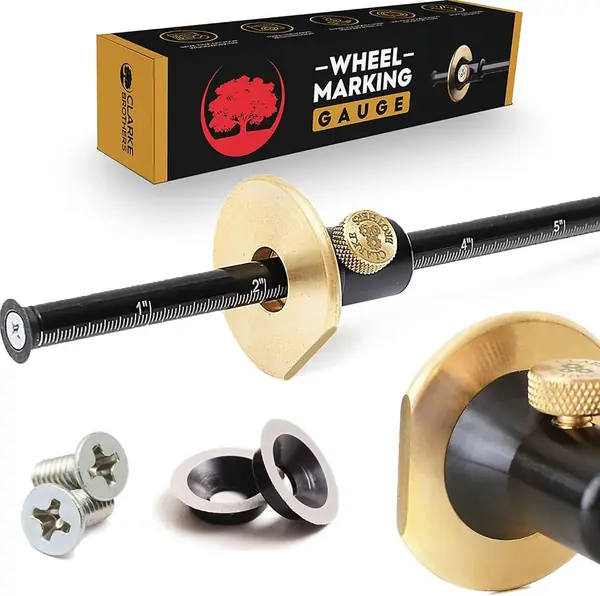
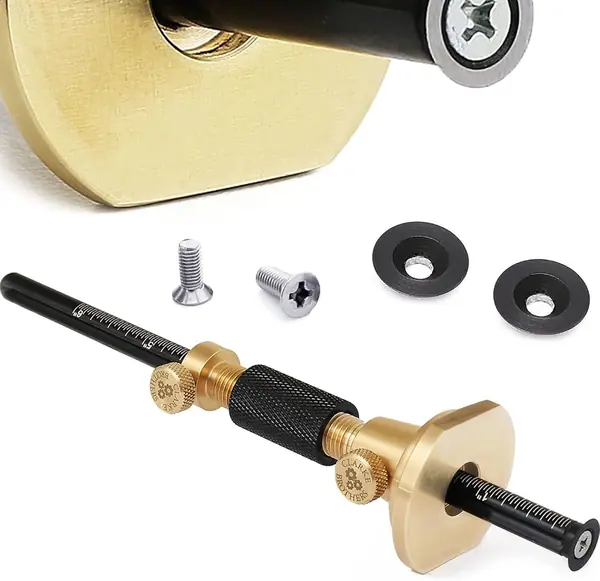
Clarke Brothers wheel marking gauge with brass fence and graduated steel bar in black

All-around layout work

Shop Score 94/100
Material
Brass, steel, aluminum
Bar Length
8 in
Included
Two spare cutters
Graduations
Inch and metric, to 6 in (150 mm)
View on Amazon

The case for this one is boring in the best way: it locks, it marks, and it survives being set down on a bench full of offcuts. Eight inches of brass, steel, and aluminum at 6 ounces, a 2-inch knurled head you can spin with one hand, and a brass face that glides along an edge without scarring it. We recommend it as the default in this group, and it sits in the middle of the pack on price.

The details are what put it ahead. A machined flat on the fence keeps the tool from rolling off the bench between marks, and the hardened wheel leaves a fine line in hardwood and softwood alike instead of tearing the surface. The laser-etched scale runs to 6 inches in both inch and metric on that 8-inch bar, so most widths can be set straight off the tool. Two spare cutters come in the box.

Hand feel is where it quietly wins. In the hand it feels balanced rather than top-heavy, which helps keep the fence flat on the work, and the head is wide enough to hold with a thumb and two fingers while your other hand steadies the stock. The brass face is the detail we appreciate most: it polishes the edge it registers against rather than scratching it, which matters on visible stock.

Worth Noting

  • No micro-adjuster for fine setting
  • Etched scale can wear with heavy use
Our Verdict

For a first and only marking gauge, this is the pick: an 8-inch brass-and-steel wheel gauge with a readable scale and two spare cutters, priced so you still have money for wood.

Check Latest Price
2.

Clarke Brothers Micro-Adjust Marking Gauge Kit Best with Micro-Adjust

Clarke Brothers 7-inch brass wheel marking gauge with dual thumbscrew micro-adjuster

Fine joinery settings

Shop Score 93/100
Bar Length
7 in
Included
Two spare cutters and bolts
Fence
Brass anti-roll head
Fine Adjustment
Dual thumbscrew micro-adjuster
View on Amazon

Fine adjustment is the reason this gauge exists. Where the plain 8-inch model asks you to loosen a knob and slide the fence, this 7-inch kit drives the head with two thumbscrews that move it in small, repeatable steps, so the dovetail baseline you set on Tuesday is still on Friday's board.

We like it for repeated work. The micro-adjuster takes the guesswork out of a knife wall, and the scale is engraved into the bar rather than printed onto it, so the numbers survive contact with a sweaty thumb. Flat spots machined into the brass head keep it from rolling, and the cutter retracts into a countersunk hole in the head when the gauge goes back in the drawer.

Seven inches of bar is a little less reach than the 8-inch model, and for most joint layout you won't notice. Two spare cutters and two spare bolts travel in the package, which is the kind of thing you appreciate the day a wheel dulls halfway through a set of drawers. For batch work, eight drawers or a run of mortises, the extra money buys back time.

Worth Noting

  • Lock is fiddly to tighten one-handed
Our Verdict

Batch work is where the micro-adjuster pays for itself, and this is the gauge we set once and return to: dual thumbscrews move the fence in fractions, on the same brass body as our top pick.

Check Latest Price
3.

KAKURI Kebiki Marking Gauge Best Japanese-Style Gauge

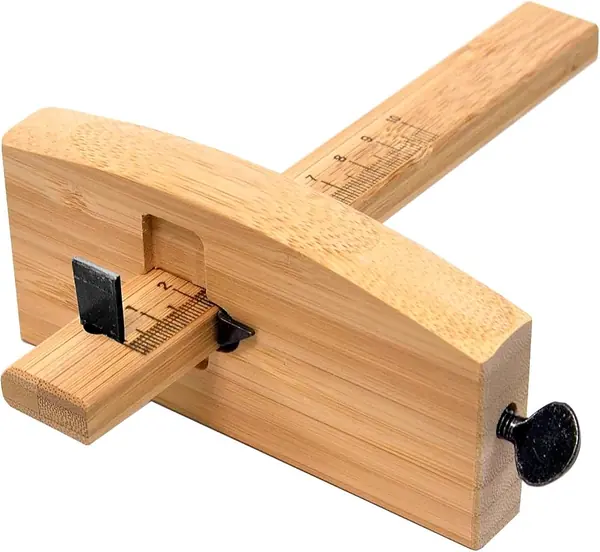
KAKURI Japanese kebiki marking gauge with bamboo body and carbon steel blade

Japanese-style joinery

Shop Score 88/100
Weight
4.2 oz
Body
Bamboo
Blade
Japanese carbon steel
Marking Width
120 mm (4.7 in)
View on Amazon

A wheel gauge scribes a line; this one cuts it. The carbon steel blade on the KAKURI kebiki slices across the fibers and leaves a narrow trench, the difference between a line you can see and a line a chisel can sit in.

The body is laminated bamboo at 4.2 ounces, with a broad square face that registers against an edge more positively than a small brass disc, and width runs out to 120 mm (about 4.7 inches). Setting it is two steps: loosen the hand screws, slide the rod to the width you want, then tap the end of the rod with a rule held alongside and tighten. The blade retracts into the body when you're finished.

We keep coming back to the cut. On hard maple, where a wheel can skate, this blade bites and holds its groove for a second pass, and the light body makes an afternoon of dovetails easy on the wrist. It is not a precision setting tool, since you check the width with a rule every time. For hand-cut joinery where the chisel registers off the line, that is a fair trade.

Worth Noting

  • Fence fit can arrive loose and need snugging
Our Verdict

If your joinery is chisel-registered, the kebiki's carbon steel blade cuts a line the chisel can sit in, and its bamboo body stays light through an afternoon of dovetails.

Check Latest Price
4.

Frienda Mortise Gauge Best for Mortise Layout Work

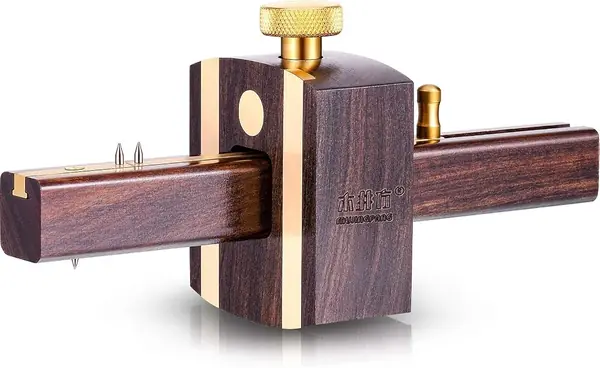
Frienda ebony mortise gauge with brass slider and three marking pins

Mortise layout work

Shop Score 87/100
Material
Ebony and brass
Pins
Three, on two faces
Pin Spacing
5.5 to 100 mm (0.21 to 3.9 in)
Overall Length
6.4 in
View on Amazon

Two lines from one setting is the whole point of a mortise gauge, and this ebony-and-brass one handles it from both faces: three pins spaced anywhere from 5.5 to 100 mm, plus a single spur on the opposite side for the tenon. We think it earns its keep as a second gauge rather than a first, since nobody lays out dovetails with it, but the first time you cut a mortise by hand the double line saves a rule and a square on every joint.

Ebony is dense and stays flat, and the brass slider moves smoothly once it is seated. At 6.4 inches overall it is compact in the hand, with a square fence face that sits flush on a jointed edge and hand-turned screws big enough to grip. Budget twenty minutes to clean the sliding slot and snug the pin screws before the first project; it is a value tool, and a little fettling is part of the deal.

Where it fits in a shop is as the gauge you keep set for one job. Pin it to a drawer width and leave it, because the brass slider holds once the screws are firm and the pins stay where you put them. It won't replace a wheel gauge for general layout, and it isn't meant to.

Worth Noting

  • Requires minor slot cleaning and screw tuning before first use
  • Specialized mortise design will not replace a general-purpose wheel gauge
Our Verdict

For hand-cut mortises it is a sensible second gauge: two pins set the mortise and a spur sets the tenon, all from one compact ebony body.

Check Latest Price
5.

YOSELIN Reader Window Marking Gauge

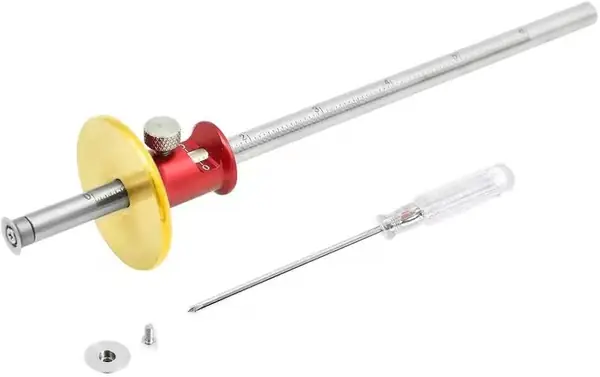
YOSELIN red wheel marking gauge with viewing window and brass base

First shop gauge

Shop Score 86/100
Material
Brass base, anodized aluminum
Bar Length
8 in
Weight
5.3 oz
Cutters
Two fixed blades
View on Amazon

A window over the scale is a small idea that solves a real annoyance: instead of crouching to sight past the fence, you read the setting through a panel in the head while you lock it down.

We found the rest of the tool keeps up with the idea. The base is solid brass and glides on an edge, the anodized aluminum body weighs 5.3 ounces, and the two fixed cutters leave a clean, consistent line in hardwood and in plywood. The window is at its best in good light; in raking shop light the etched scale on bright metal all but disappears, so we set ours against a rule and treat the window as confirmation.

What's in the box is more than we expect at this price: a screwdriver, a spare blade screw, and a fitted case that keeps the whole thing together in a toolbox drawer. It is the gauge we hand to someone setting up a first shop, and the one that rides along in a road kit for the same reason, since nothing expensive goes missing when it walks off.

Worth Noting

  • Lever lock is fiddly to engage
Our Verdict

A first-shop gauge we are happy to recommend: the viewing window makes a setting easy to confirm, and the brass base and spare parts cost less than any other gauge here.

Check Latest Price
6.

Woodraphic Scriber Gauge

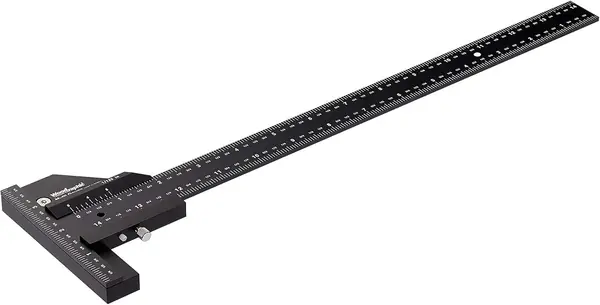
Woodraphic 14-inch aluminum scriber gauge with laser-etched measuring scale

Cabinet panel layout

Shop Score 85/100
Material
CNC-machined aluminum
Bar Length
14 in
Graduations
0.05 mm
Origin
Made in Korea
View on Amazon

Fourteen inches of graduated aluminum is a different tool from a 7-inch gauge. Setting out a cabinet side, marking a shelf dado, or carrying a width from one end of a board to the other happens at a reach a small gauge can't cover.

Woodraphic machines the body from aluminum, anodizes it, and laser-etches a 0.05 mm scale into the bar. It is made in Korea and sold in several lengths and in inch or metric versions, with this 14-inch model in the middle of the range. The frame is light for its size, which matters when you are holding the fence against an edge with one hand and marking with the other.

We think of it as a casework tool rather than a replacement for a small gauge. You are paying for length, machining, and a scale that reads cleanly in either unit, and it is the most expensive gauge here by a wide margin. Where cabinet parts are the day's work, that is a fair trade.

Worth Noting

  • Long bar is awkward on small parts
Our Verdict

Cabinet work is where this earns its keep: 14 inches of machined aluminum with graduations fine enough to trust across a panel.

Check Latest Price

How We Tested Marking Gauges

We started with research rather than a workbench, reading spec sheets and owner reviews for wheel, knife, and pin gauges and sorting them by bar length, fence style, adjustment mechanism, and what ships in the box. From that pool we bought 14 and put them to work over four months, on the theory that a gauge reveals itself in repetition rather than in the first pretty line.

Testing happened where layout actually happens — at the bench on Saturday mornings, laying out dovetails on maple and oak, then mortises for a shop cabinet, then panel lines on 3/4-inch stock. For each gauge we set the fence to a known distance, locked it, scribed ten strokes along the same edge, and measured whether the setting had budged.

We scribed both with and across the grain to watch how each cutter behaved, noting where a pin plowed and lifted fibers instead of slicing. On pin and mortise gauges we tightened the holding screws again and again through a session to see whether the pins crept; where a micro-adjuster was fitted, we returned to a setting, nudged it a hair, and tried to hit the same number twice. We also set and locked each gauge one-handed while the other hand held the board, because that's how you actually work.

Scale graduations got read in dim light on day one and again at the end of four months, to see whether the printing wore or the numbers went soft, and the spare cutters several gauges include were swapped in mid-test to check the edges. Between sessions, cutters went back into the body or into their cases — these are sharp edges and we treated them that way.

How to Choose a Marking Gauge

Wheel, Knife, or Pin

A wheel cutter, the disc you will see on most modern scribers, is the best place to start. It leaves a fine, consistent line, handles cross-grain and end-grain better than a pin, and the hardened wheels are cheap to replace. Move to a knife or a Japanese kebiki when the line has to register a chisel, because the blade cuts a shallow trench and tenon shoulders come out cleaner for it. Pins and spurs belong on a mortise gauge, where two lines have to be set at once. Most woodworkers end up with a wheel gauge and one cutting gauge, in that order.

Bar Length and What the Scale Actually Covers

Most joinery sits within a few inches of an edge, so a 7- or 8-inch gauge covers it; a 14-inch bar is for cabinet panels and other wide layout. Watch the scale rather than the bar. Our top pick is 8 inches long but graduated to 6 inches, which is plenty of range and still less than the headline length suggests. If you set widths off the tool instead of a rule, a graduated bar earns its place; if you always set with a rule, spend the money on the fence instead.

Does the Fence Hold?

A gauge that creeps is worse than a pencil. Look for a fence with a milled flat or a groove running the length of the bar, since that is what keeps the head square, and for a lock you can tighten without shifting the setting. Round bars without a flat rotate under hand pressure, which is why so many gauges now machine a spot into the fence so the tool sits down on the bench instead of rolling. Set a width, lock it, then push the fence hard with your thumb before you trust it to a workpiece.

Micro-Adjustment: When It Is Worth Paying For

A thumbscrew micro-adjuster moves the fence in increments too small to hit by loosening and sliding, and it matters when you return to the same width over and over: dovetail baselines, a run of mortises, a batch of drawers. If you mark one-off lines and set everything from a rule, skip it. Our top pick has no adjuster and we don't miss it. The step up in price is modest, so the question is your workflow rather than your budget.

Frequently Asked Questions

Final Verdict

For most woodworkers this comes down to one tool. The 8-inch Clarke Brothers wheel gauge locks, marks, and arrives with two spare cutters, all for less than the micro-adjust kit, which is why it is the gauge we recommend first.

Add the kit when you cut the same joint in batches, or the KAKURI kebiki when your joinery is chisel-registered and you want a line the chisel can sit in. One gauge you trust beats three you have to check.