↑↓ navigate ↵ open Esc close All results →

Best Marking Knives of 2026

A pencil line runs roughly a sixty-fourth of an inch wide—enough slop to leave visible daylight along a dovetail shoulder. A marking knife slices a crisp wall into the fibers instead, giving a chisel a physical ledge to register against and a backsaw a clean kerf wall to follow.

Testing 14 bench knives over six months across dovetails, tenons, and hinge gains highlighted bevel geometry and storage above brand names. A single bevel with a dead-flat back hugs a square without wandering, whereas a double bevel marks from either side with a lighter touch; meanwhile, high-carbon steel needs a sheath, cap, or fitted box to survive a humid shop without pitting.

Evaluated on factory sharpness, edge retention between honings, grip balance, and price, the seven knives ranked here range from compact apron-pocket blades to deep-reach cutters built for tenon cheeks.

Our Top Picks

The Best Marking Knives

1.

Narex 822302 Thin Blade Marking Knife Best Overall
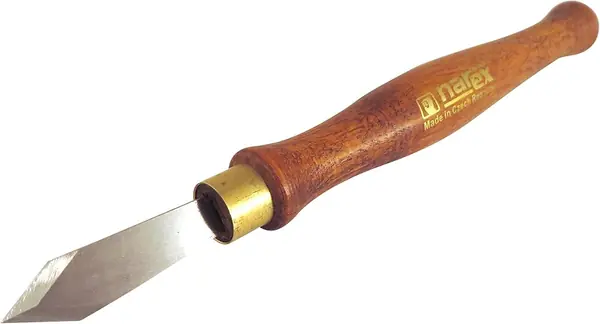
Narex 822302 marking knife with hornbeam handle and brass ferrule

Fine dovetail joinery

Shop Score 93/100
Blade Length
1.5 inches
Hardness
HRc 61
Blade Thickness
0.055 inch
Blade Steel
Mn-V steel
View on Amazon

Dovetail layout happens in a slot about the width of a fingernail, and the .055-inch blade of the Narex 822302 is built for exactly that slot: it drops into a pin socket, lays a line along the baseline, and comes back out without wedging the joint open. The blade runs 1.5 inches, ground double-bevel at 20 degrees, with the tip finished at 55 degrees, keen enough to sever end grain and blunt enough at the point to survive a small mistake.

That balance is why we recommend this one first. Heat treated to HRc 61, it takes a very keen edge and holds it far longer than the softer blades here, and because both bevel faces lie flat, the edge comes back in a handful of strokes. The 55-degree tip is the detail we appreciate most, since a marking knife usually fails at the point rather than along the edge.

The handle is European hornbeam with a solid brass ferrule, slim enough to hold like a pencil and shaped so your index finger sits close to the blade for control. We marked a run of drawer sides in one sitting without any urge to change grip. It is also the priciest knife here, and for a woodworker who marks a joint or two a month that premium is hard to justify.

What it will not do is reach. The 1.5-inch blade is shorter than the 2.75 inches on the Narex 813800, so on deep shoulders you work closer to the handle, and the thin blade is not built for a mallet tap. For pins, tails, and any joint where the line has to sit exactly where the chisel will land, the thin blade and the protected point are what you are paying for.

Worth Noting

  • Knife rolls on the bench between cuts
Our Verdict

We recommend it first because a thin, hard, dual-bevel blade marks tight sockets from either side and keeps its point, the safest default for joinery that has to fit.

Check Latest Price
2.

KAKURI Kiridashi Knife 18mm Best Single-Bevel

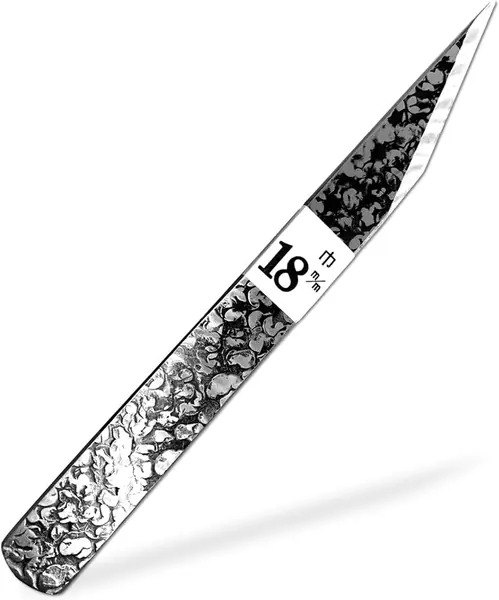
KAKURI 18mm kiridashi knife with hand-hammered steel blade and one-piece handle

Scribing and layout

Shop Score 92/100
Blade Edge
Single bevel, right-handed
Blade Length
1.9 inches
Overall Length
7.3 inches
Blade Width
0.7 inch (18 mm)
View on Amazon

One dead-flat face is the whole idea behind a single-bevel knife: you lay that face against the blade of a square or the edge of a board, the bevel cuts on the other side, and the line lands exactly where the steel sits. That is the KAKURI kiridashi, and it is why this is our pick of the single-bevel knives here. The 18 mm blade is forged from laminated high carbon steel over soft iron, hand-hammered into a tsuchime pattern, and formed in one piece with the handle, so there is no ferrule or joint to work loose.

Width is the thing to weigh. At 0.7 inch across, this is the broadest blade in this group, and broad is good: it stays stiff along a shoulder line, registers a long mark in one pass, and handles hinge gains and general scribing without wandering. What it will not do is enter a pin socket, where the opening is narrower than the blade is wide.

Maintenance is the pleasant part. The back of the blade carries the slight convex shape that lets you lay the whole face flat on a stone, so refreshing the edge is a two-minute job rather than a sharpening session. The caution is the point: a hard, thin, hand-forged edge can chip if it is levered sideways in a socket, so cut with it and resist the urge to pry, and check the tip before you start a layout.

Worth Noting

  • Right-hand single bevel only
Our Verdict

For single-bevel work this is our pick: the flat back rides a square or rule, and the hand-forged blade takes a keen edge you can refresh in minutes.

Check Latest Price
3.

Narex 813800 Striking Marking Knife Best for Deep Layouts

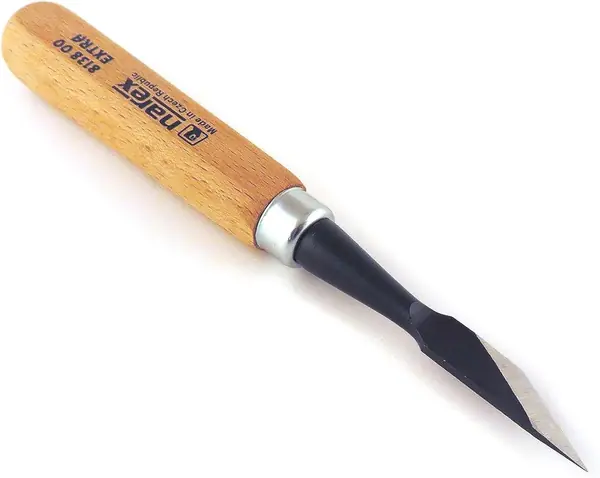
Narex 813800 marking knife with octagonal European beech handle

Deep tenon work

Shop Score 91/100
Handle
European beech, octagonal
Blade Length
2.75 inches
Hardness
HRc 58
Blade Thickness
0.090 inch
View on Amazon

Some layout jobs want more blade than a dovetail knife gives you: a deep tenon shoulder, a curved brace, a mark you have to make from an awkward angle. The Narex 813800 answers those with 2.75 inches of Cr-Mn steel, .090 inch thick and hardened to HRc 58, about two-thirds thicker and more than an inch longer than the 822302 here.

The grind gives it range: a 25-degree bevel with a small 5-degree micro-bevel on each face, so it marks from either hand and from either side of a board. The handle is European beech, 4.125 inches long and cut octagonal, and the octagon turns out to matter more than we expected, because this knife sits on the bench where you put it instead of rolling away under the shavings.

Between the two Narex knives in this article, this is the one we pick up when the layout is bigger than a dovetail: deep shoulders, curved parts, and trimming to a line after the saw. HRc 58 is softer than the 822302's HRc 61, so it touches up more often, but it comes back fast on a fine stone and the longer blade gives you a straight reference to sight down when you are cutting to a line.

Worth Noting

  • Edge may need honing before first use
Our Verdict

We reach for this one when the layout is bigger than a dovetail: a long, stiff blade for deep shoulders, and an octagonal handle that stays put.

Check Latest Price
4.

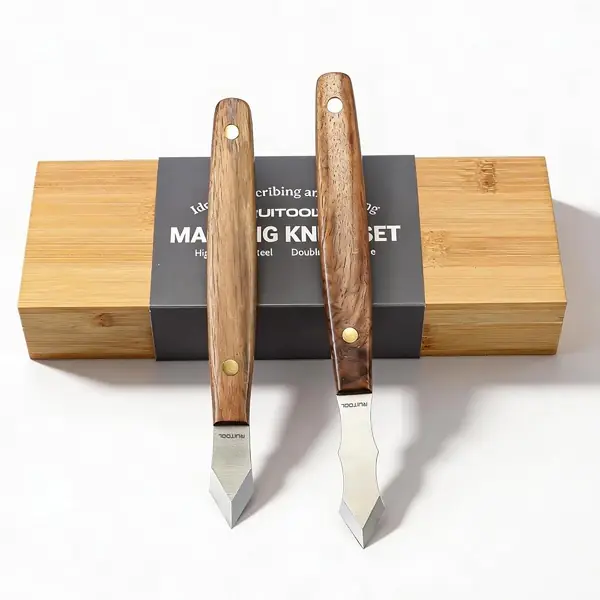
RUITOOL 2-Piece Marking Knife Set Best for Tight Dovetails

RUITOOL two-piece marking knife set with standard and long-neck blades in a bamboo box

Half-blind dovetails

Shop Score 90/100
Blade Material
High carbon steel
Handles
Flat-sided riveted hardwood
Storage
Bamboo box
Blade Lengths
1.77 and 2.6 inches
View on Amazon

Half-blind dovetails are where a standard marking knife runs out of room: the socket is deep, the opening is narrow, and a 1.5-inch blade bottoms out against the pin before it reaches the baseline. The long-neck knife in this RUITOOL set exists for that job, with 2.6 inches of slim blade that reaches the bottom of a socket the standard 1.77-inch knife cannot touch.

We recommend the pair rather than either knife alone. Both blades are dual-beveled high carbon steel, so either hand works and either face of a joint can be marked; both handles are flat-sided hardwood fixed with rivets, which keeps them from rolling off the bench; and the bamboo box means the long-neck blade is where you left it rather than lost in a drawer. It is the pick here built specifically for reach.

The set sits toward the top of this group on price, above every single-bladed knife except our top pick, and what you are paying for is the long-neck blade and the fitted box. If your joinery is through-dovetails and casework, a single standard knife marks just as well for less. If you cut half-blinds with any regularity, the second blade earns its place the first afternoon.

Worth Noting

  • Thin long-neck tip chips if levered
Our Verdict

Our pick when the joint is deep and narrow: the long-neck blade reaches into half-blind sockets, and the second knife covers everything else.

Check Latest Price
5.

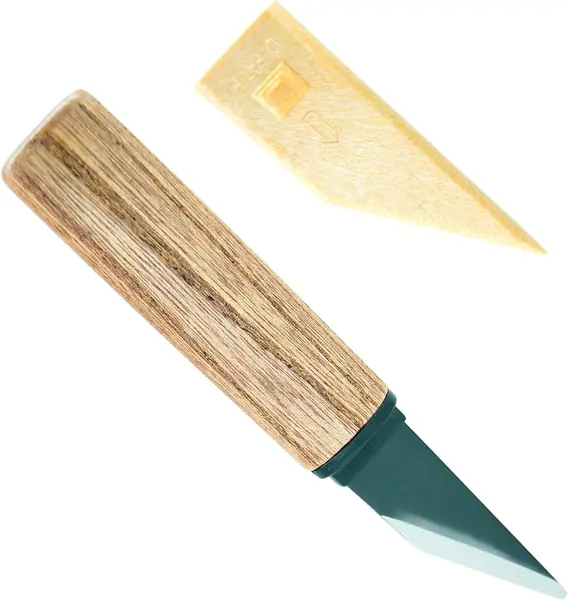
Seki Japan Kiridashi Pocket Knife Best Budget

Seki Japan kiridashi pocket knife with wood-grain handle and fitted blade cover

Apron-pocket scribing

Shop Score 89/100
Blade Edge
Flat
Overall Length
6.89 inches
Cover
Included
Handedness
Right- and left-hand versions
View on Amazon

It is one of the cheapest knives here, and it is still a proper kiridashi: 6.89 inches overall, a flat-backed blade, a wooden handle, and a fitted cover with a projection that lets you pull the knife out one-handed. We like it as the knife that lives in an apron pocket or on a shelf by the bench, where a small flat blade is what you want for a quick mark and a fine shaving.

What you give up is refinement. The blade is broad and flat, better for general scribing and stock layout than for pin sockets, and the finish is workmanlike rather than pretty. The knife is sold in right- and left-handed versions, so the flat face lands on the correct side for your hand, which is worth checking before you order. The broadness has not bothered us: this is a knife you sharpen, drop in a toolbox and use, and it comes back cutting.

Worth Noting

  • Plastic cover rather than leather
Our Verdict

We like it as the knife that lives in an apron pocket: a cheap, sharp, flat-backed kiridashi with a cover you can work one-handed.

Check Latest Price
6.

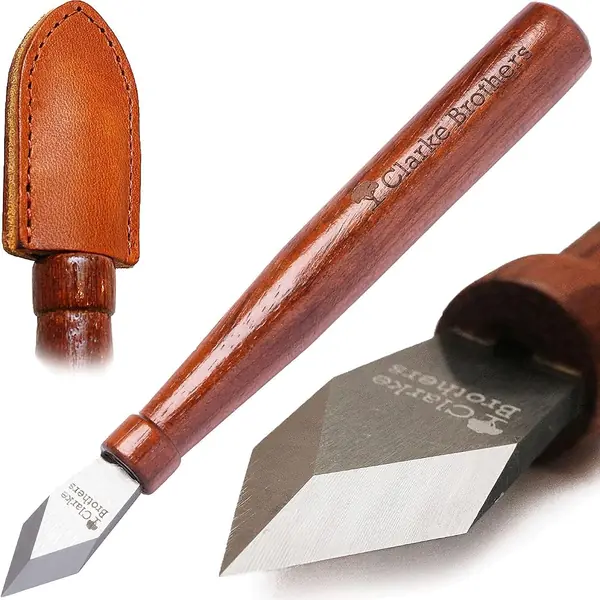
Clarke Brothers Marking Knife with Sheath Best with a Sheath

Clarke Brothers marking knife with Padauk handle and real leather sheath

Gifting and storage

Shop Score 88/100
Handle
Padauk wood
Blade Material
Carbon steel
Blade
Double-edged
Sheath
Real leather
View on Amazon

The first thing you notice is the leather: a real stitched sheath rather than a plastic cap, which is rare on a marking knife. The second is the handle, a piece of Padauk with the maker's mark burned into the side, dense and red-brown and finished smooth enough to sit comfortably in a pencil grip.

The blade is symmetrical, beveled to a point from both faces in high carbon steel, so it marks from either side of a board and in either hand, and it sharpens the same way from both sides. Carbon steel takes a keener edge than most stainless and it will spot with rust if it lives in a damp toolbox, so wipe it down after a session and keep the sheath dry.

In use it is a comfortable knife for general marking rather than a specialist's tool. The point is centered, so you can choke up with a thumb along the spine for control, and the grind lets you roll the blade to whichever face of the joint you are marking. For shoulders, casework, and trimming to a line, that covers the work most of us actually do.

Where it earns its place is as the complete package: a double-ended blade, a hardwood handle, and a leather sheath for about the same money as the KAKURI kiridashi. If your marking knife has to hang on a peg or ride in a tool roll, the sheath settles it, and the wood makes it the one here that looks like something worth handing over.

Worth Noting

  • No flat back to register on a square
Our Verdict

We recommend it as the one to give: a double-ended blade in Padauk and real leather that marks from either hand.

Check Latest Price
7.

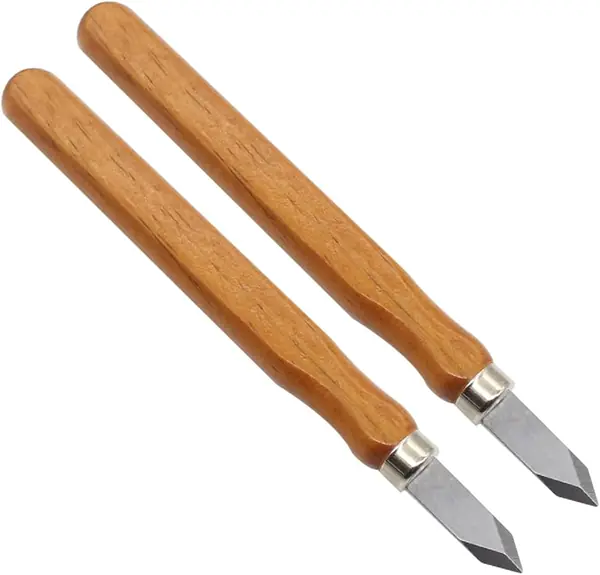
NIIIYTYB 2-Pack Marking Knife Best for Everyday Shop Marking

NIIIYTYB two-pack marking knives with carbon steel blades and wood handles

Everyday shop marking

Shop Score 85/100
Handle
Wood
Blade Edge
Dual bevel
Blade Material
Carbon steel
Overall Length
5.55 inches
View on Amazon

Two knives arrive in this pack, each a little over five and a half inches long, with wooden handles and dual-bevel carbon steel blades. There is nothing fancy about either one, and that is the point: this is the cheapest way to put a marking knife at the tablesaw and another at the bench, without giving up the flat, thin blade shape that makes a scribed line useful.

The blades are thin in stock, noticeably thinner than the Narex or the Clarke Brothers knife, and thin is what you want when you are scoring a line: it slices the surface fibers in plywood instead of skidding across them. The handles are light enough to hold like a pencil through a long layout session, and the bevels are ground on both faces so left- and right-handers can both use them.

For a shop that marks sheet goods and framing rather than fine joinery, this is the sensible buy. Two knives also mean two people can lay out at once, or one stays at the saw while the other stays at the bench, which is worth more in a small shop than another premium blade in a drawer.

Worth Noting

  • Blades arrive burred and need honing
  • Softer steel dulls faster than hardened blades
Our Verdict

The pair we suggest for the saw and the bench: two thin blades that score cleanly once you have honed them, at a price that makes a spare easy.

Check Latest Price

How We Chose and Tested the Best Marking Knives

We started with a list of about 30 marking knives sold for bench work, reading the listings for bevel type, blade thickness and length, handle material, and whether the blade came with a sheath, cap, or box. Storage went into the scoring rather than the shortlist, since some very good knives ship bare. That left 14, which we bought at retail and used for six months. Blades that shifted in the handle after a few weeks of striking, or edges that crumbled at the first honing, dropped out along the way.

Every knife went through the same rotation: dovetail layout in poplar and white oak, tenon shoulders, hinge gains, and scribing across end grain. We held each blade against a combination square and sighted for light underneath, then cut pins and checked whether the blade fit the gap it had just marked. In a pencil grip we noted which handles stayed where we put them, where each knife balanced in the fingers, and whether the left-handed among us could use it without fighting the bevel.

Blades were honed on the same stones, and we logged how many joints each one cut before it stopped shaving end grain cleanly. We never levered with a point — these are fixed blades, not pry bars — but we did watch for chips at the tip after ordinary layout work. Every blade got wiped dry after each session and checked for rust anyway. Sheaths, caps, and boxes were opened and closed dozens of times to see if stitching or clasps loosened, and we kept track of which knives we'd leave out on the bench for their looks alone.

Value came last: after six months, did the pricier knives actually mark any better? The seven that made the list did.

How to Choose a Marking Knife

Single Bevel or Double Bevel

One dead-flat face is what makes a single-bevel knife accurate: you lay that face on the stock or against the blade of a square and the bevel cuts on the other side, so the line lands exactly where the reference sits. The KAKURI 18mm is that design. A double-bevel blade is symmetrical and marks from either side of a board and either hand, which is what the Narex 822302 gives you.

Go single bevel for the tightest registration against a square, and go double bevel if you switch hands, share a bench, or mark both halves of a joint.

Blade Thickness and Width Against the Joint

The blade has to go where the joint goes. A pin socket is narrow and deep, and a blade much thicker than a sixteenth of an inch wedges it open instead of marking the baseline, which is why the Narex 822302 at .055 inch is the one we reach for there. A wide, stiff blade such as the KAKURI's 18 mm is steadier on shoulder lines and hinge gains but will not enter a socket at all.

Judge the choice against the tightest joint you cut, not the biggest one.

Hardness and the Point

Harder steel holds an edge longer; softer steel gives it back faster on a stone. The two Narex knives show the trade plainly, at HRc 61 and HRc 58, and the harder blade goes longer between honings while the softer one recovers in fewer passes. The point matters just as much: a very fine, very hard tip is the first thing to chip, so if you tend to lever a knife in a socket or knock it off the bench, favor a thicker blade with a blunter tip grind.

Handles That Stay Where You Put Them

You hold a marking knife like a pencil, close to the blade, so a slim handle and a short distance from your fingers to the edge give the most control. Shape matters more than species: the octagonal beech on the Narex 813800 and the flat-sided hardwood on the RUITOOL set stay where you set them down, while a round handle rolls across the bench.

If the knife travels in a tool roll rather than living on the bench, a sheath or a fitted box counts as much as the handle does.

Keeping the Edge

Sharpen a single-bevel knife on the bevel with the flat face laid dead on the stone. Lift that flat face and you round it, and the knife stops registering against a square, which is the one mistake that turns a precise tool into a vague one. Double-bevel knives get honed on both faces at the existing angle. Either way, a few strokes on a fine stone and a strop restore a scribing edge; you are not grinding a new bevel.

Frequently Asked Questions

Final Verdict

We recommend the Narex 822302 first. Its .055-inch blade fits a pin socket, both bevel faces hone flat, and the 55-degree tip survives the small mistakes that take the point off thinner knives, which is the combination that makes joinery layout repeatable.

When the work is bigger than a dovetail, the Narex 813800's longer blade marks deep shoulders and trims to a line; when the knife is meant to be given, the Clarke Brothers knife arrives in leather and Padauk and marks from either hand.