↑↓ navigate ↵ open Esc close All results →

Best Chalk Lines of 2026

The snap should be the easy part: hook the end, pull the line taut, lift a couple inches, let go. What goes wrong instead is everything around it — a box that spits chalk in clumps, a line that jams halfway out, a housing that tips over the second you set it down. A chalk line exists to give you one straight, repeatable reference across plywood, deck framing, or a cabinet panel, and the good ones rarely cost more than the fussy ones.

We snapped lines with 14 reels over three months, and what surprised me most is how much line diameter matters. A 0.3 mm line leaves a mark you can cut to on finished material; a bold 1.5 mm line survives rough lumber and glare but blurs a tight layout.

Our picks run from a 50-foot reel that lives in a tool bag to a 110-foot box for long pulls, plus a two-reel set and a kit with chalk included. Every one had to hold a clean snap without jamming first.

Our Top Picks

The Best Chalk Lines

1.

Tajima Chalk-Rite Jam Free Best Overall
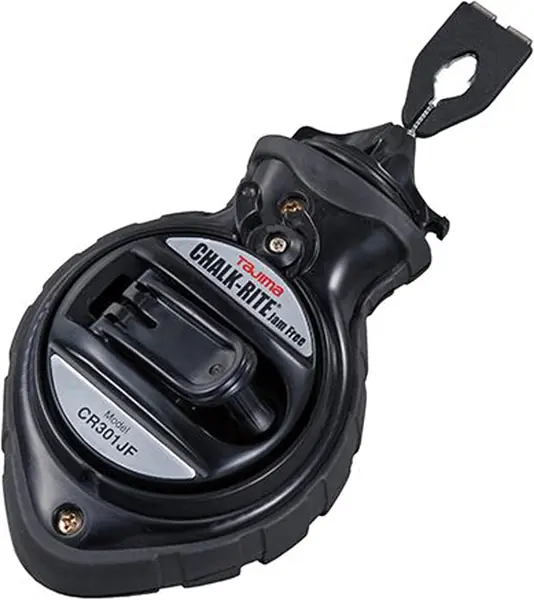
Tajima Chalk-Rite Jam Free chalk box in black with rubberized grip

Most woodworking layouts

Shop Score 95/100
Line Length
100 ft
Line Diameter
1.0 mm
Case
Rubberized ABS
Rewind
5-gear fast wind
View on Amazon

The first thing we noticed about the Chalk-Rite Jam Free is how little chalk it takes to leave a readable mark on plywood: the 1.0 mm braided line lays down a crisp edge instead of a soft cloud. With 100 feet on the spool, it covers a sheet-goods layout or a room outline without a second reel, and the line comes back clean enough that we were not stopping to re-chalk between short pulls.

That combination is why this is the reel we recommend first. The five-gear rewind is quick, the thumb lock holds the line tight while you walk it out and releases as you wind, and the rubberized ABS body has enough grip to stay put on a sawhorse. For one-person layout, those details save more time than a fancy case.

Filling it is straightforward: the wide, gasketed neck takes chalk without a funnel, and the elastomer cover shrugs off being set down on concrete. We did keep an eye on the braided line after hard use, since that is the part that wears; for a shop that snaps a few lines a week, it is a fair trade for the crisp mark.

Worth Noting

  • Braided line wears over time under hard use
Our Verdict

For most woodworkers, this is the chalk reel we recommend first: a crisp 1.0 mm line, fast five-gear rewind, and a lock that makes solo layout easy.

Check Latest Price
2.

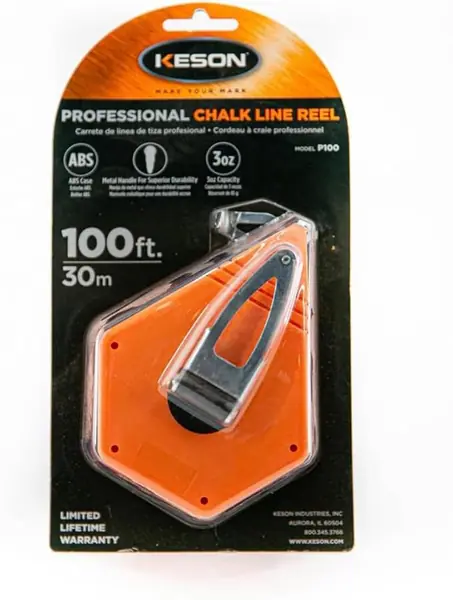
Keson P100 Chalk Line Reel Best Bold-Line Value

Keson P100 octagonal chalk line reel in black with steel crank

Bold framing lines

Shop Score 93/100
Line Length
100 ft
Line Diameter
1.5 mm
Crank
Heavy-duty steel
Chalk Capacity
3 oz
View on Amazon

The P100 is the value argument in this group: a 100-foot spool, a bold 1.5 mm line, and a heavy-duty steel crank without a lot of extra mechanism. We recommend it for framing and deck work, where you want a mark that reads across a subfloor and a reel that does not ask for delicate handling.

The fat line holds chalk well and puts down a solid, easily seen mark. The crank has a direct feel, and the octagonal body is shaped to sit into a corner while you pull a line along a plate. We also liked the simple spool: fewer gears means less to strip when the reel is bouncing around in a truck.

This is not the reel for cabinet layout; the 1.5 mm line is a fat mark, and fine joinery wants something closer to 1 mm. But for rough framing, concrete forms, and deck framing, that width is the point. We reach for the P100 when the line has to survive boots and lumber, not when it has to disappear under a finish pass.

Worth Noting

  • Bold 1.5 mm line is too fat for cabinet joinery
Our Verdict

The Keson P100 is our bold-line value pick for framing and deck work, where its 1.5 mm line and simple steel crank beat a fussier geared reel.

Check Latest Price
3.

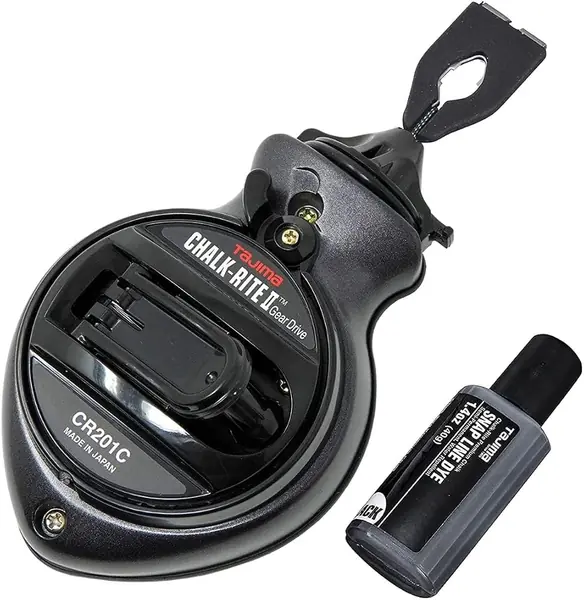
Tajima Chalk-Rite II Extra Bold Best Aluminum Upgrade

Tajima Chalk-Rite II Extra Bold charcoal die-cast aluminum chalk box

Daily jobsite use

Shop Score 92/100
Line Diameter
1.0 mm
Case
Die-cast aluminum
Rewind
5-gear fast wind
Weight
10.2 oz
View on Amazon

The aluminum case is the first thing you feel: this Chalk-Rite II has a denser, more planted heft than the plastic reel above, and the charcoal finish hides scuffs instead of showing every knock. The five-gear rewind and positive lock work on the same principle, but the metal body makes the tool feel at home in a gang box.

The 1.0 mm braided line leaves a crisp mark, and the sealed fill neck keeps chalk where it belongs while you load it. We liked the gear lock for solo pulls: it holds the line while you set the hook and releases when you crank. The 10.2-ounce body sits steady on a sawhorse, which matters when you are pulling a long line by yourself.

For a crew that snaps lines every day, that aluminum shell is worth the step up. We prefer it when the reel lives in a tool bag and gets set down on concrete, gravel, and a tailgate; the plastic-body version is lighter, but this one takes the knocks with less fuss.

The extra mass is the trade: at 10.2 ounces, it is noticeably heavier than the 7.2-ounce Chalk-Rite, and you feel that on a long walk. We still take it for finish layout and stair work, where the line's crispness matters more than shaving ounces.

Worth Noting

  • Costs more than plastic-body reels
Our Verdict

If you want an aluminum-bodied reel for daily jobsite handling, we think this Tajima is the premium step up from the plastic Chalk-Rite.

Check Latest Price
4.

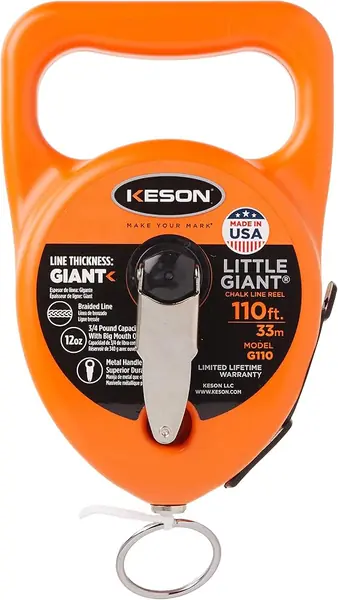
Keson G110 Little Giant Chalk Reel Best for Long Runs

Keson G110 Little Giant orange chalk line reel with large handle

Long site pulls

Shop Score 91/100
Line Length
110 ft
Crank
Steel
Chalk Capacity
12 oz
Line Material
Cotton polycord
View on Amazon

The G110 is built around its chalk load: a 12-ounce chamber and 110 feet of cotton-polycord line, with a handle wide enough for a gloved hand. That is a different assignment from a 3-ounce touch-up reel; you fill it less often and you can keep pulling long lines across a slab without stopping to top up.

For long runs, that is exactly the reel we want. The steel crank has a solid, direct feel, and the big body sits steady when you walk a line out. We also like that the cotton-poly line holds plenty of chalk, so the second and third snap stay readable instead of fading.

It is not the reel we grab for a cabinet layout: the bold line and the 15-ounce body are built for distance and capacity, not for slipping into an apron. But for concrete pads, deck frames, and long wall plates, the Little Giant's extra reach and chalk supply make the size worth it.

Worth Noting

  • Bulky 15-ounce body does not fit easily in an apron
  • Bold line is too wide for fine cabinet layout
Our Verdict

We keep the Little Giant for long pulls and big chalk loads, where its 110-foot line and 12-ounce chamber save refills.

Check Latest Price
5.

Milwaukee 100 ft. Bold Line 2-Pack Best Two-Reel Set

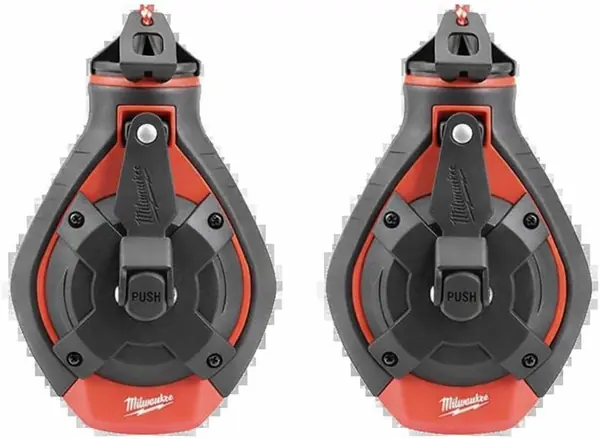
Two Milwaukee bold-line chalk reels in clear housings with rubber grips

Two-color layouts

Shop Score 90/100
Line Length
100 ft
Gear Ratio
6:1
Line Type
Bold braided line
Pack Count
2 reels
View on Amazon

The two-reel pack is the appeal here: two complete 100-foot reels with bold line, clear housings, and a 6:1 retraction ratio. If you keep blue chalk in one and red in the other, you stop swapping line mid-layout and you always have a spare on the truck.

The 6:1 gearing is the reason to consider these over a basic crank reel. The line comes back quickly, and the bold braided line leaves a mark you can see from a few steps away. We found the clear housing useful for checking the chalk level without opening the case.

The trade-off is refinement. The body is bulkier than a compact reel, and the bold line is not the one for fine cabinet marks. For daily production layout, we prefer the metal-bodied Tajima; for two-color shop work, the pair is hard to beat.

What tips us toward the pair is the logistics: one reel can live in the shop with blue chalk and one in the truck with red, and you are never swapping chalk mid-layout. The value is in having two complete reels, not one reel and a spare spool.

Worth Noting

  • Plastic gears can wear under daily use
Our Verdict

We suggest the Milwaukee two-pack when you want two bold 100-foot reels for separate chalk colors without paying premium prices.

Check Latest Price
6.

OX Pro Chalk Reel & Chalk Kit Best All-In-One Kit

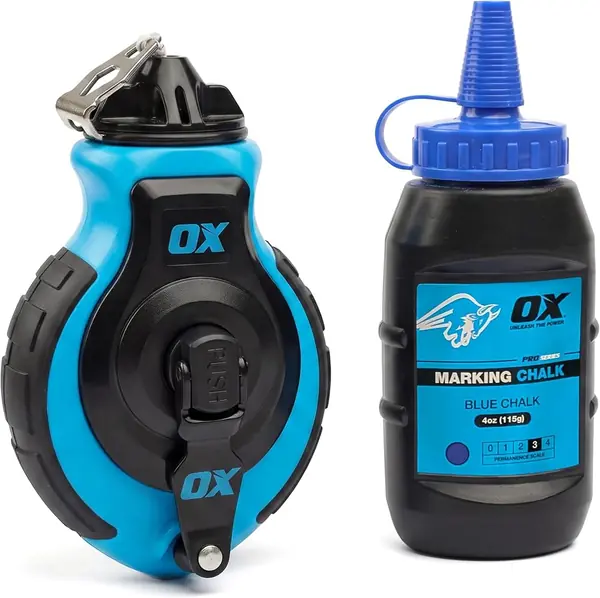
OX Pro blue chalk reel with four-ounce blue chalk powder bottle

Starter chalk kits

Shop Score 88/100
Line Length
100 ft
Line Diameter
0.9 mm
Gear Ratio
6:1
Included
4 oz blue chalk
View on Amazon

The first useful thing in the box is the bottle of blue chalk; the OX kit arrives ready to fill, with a 100-foot, eight-strand line and a 6:1 rewind. That makes it a true starter kit rather than a reel that sends you back to the store for a refill.

The 6:1 gear ratio makes short work of reeling in, and the rubber overmold gives the body a surer grip than smooth plastic. The eight-strand line is thick enough to hold chalk and resists twisting, which we noticed when pulling around a corner. The top-loading fill door is wide enough to load without a funnel.

What sells us on the kit is the completeness: one purchase gets you the reel, the line, and enough blue chalk to start a layout. The plastic body is lighter than the aluminum Tajima, and we see it as a solid first reel or a second kit for occasional work rather than the one we trust for a daily framing crew.

Worth Noting

  • Gear train can bind under load
Our Verdict

We like the OX kit for a first layout, since the reel and a bottle of blue chalk arrive together.

Check Latest Price
7.

Lufkin CL50 Compact Chalk Reel Best for Compact Tool Bags

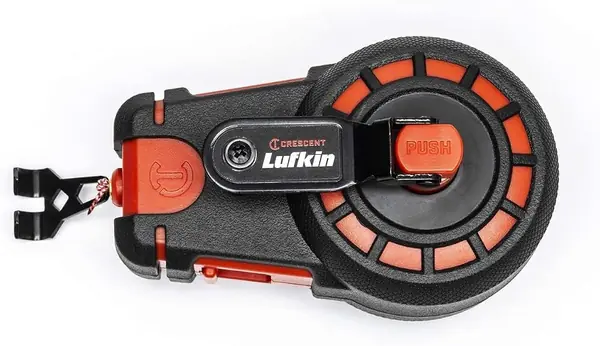
Lufkin CL50 compact blue chalk reel with fold-away handle

Compact tool bags

Shop Score 87/100
Line Length
50 ft
Gear Ratio
3:1
Included
Blue chalk
Handle
Fold-away
View on Amazon

The 50-foot compact body is the point of the CL50: it drops into a tool bag, takes up little shelf space, and still carries enough line for sheet goods and cabinet runs. We recommend it as a second reel for a small shop, not as the only reel on a framing crew.

The push-button release lets line pull out fast, and the 3:1 gear ratio brings it back without a lot of cranking. The fold-away handle locks the retrieval arm in place, which keeps it from snagging on other tools in a bag. We liked the slim profile; it is easier to carry to a bench than a full-size 100-foot reel.

The 50-foot spool is the boundary: it covers a small shop, a cabinet run, or a sheet-goods breakdown, not a deck or a long wall. The included blue chalk means it is ready for a first mark, and the body disappears into a bag between jobs.

Worth Noting

  • Line can bind near full extension
Our Verdict

We find the CL50 a handy compact reel for short shop layouts, as long as you do not expect full-site reach.

Check Latest Price
8.

Milwaukee Fine Line Chalk Reel Best for Fine Finish Marks

Milwaukee fine-line chalk reel in clear housing with 0.3 mm line

Fine finish marks

Shop Score 86/100
Line Length
100 ft
Line Diameter
0.3 mm
Weight
8.82 oz
Housing
Clear
View on Amazon

The 0.3 mm line is the whole story here. It leaves a thin, sharp mark that is easier to follow than a fat framing line, and the 100-foot spool gives it enough reach for trim, cabinet, and stair layout. The clear housing and 8.82-ounce body make it easy to check the chalk level and carry to the bench.

We liked it for the last mark before a cut, especially on finished or prefinished material where a wide chalk cloud is unwelcome. The fine braided line holds chalk well enough for a clean snap, and the line comes back without the fuzzy overspray we associate with cheap cotton string. It is a specialist, not a general-purpose reel.

The fine line is also the limitation. It is not the reel we choose for snapping across a concrete slab, rough framing, or anything abrasive; the thin line has less margin for a burr or a sharp edge. If your work is mostly framing, the bold Keson or the standard Tajima is the better tool.

Where this reel earns its place is finish work: setting cabinet lines, marking stair stringers, and laying out trim on a wall that will be painted or stained. We treat it as the precision reel in the bag and leave the bold-line work to the others.

Worth Noting

  • Thin 0.3 mm line wears fast on rough or abrasive surfaces
  • Not suited for general framing or concrete slab layout
Our Verdict

We reach for the Milwaukee fine-line reel when a layout needs a sharp finish mark rather than a bold framing line.

Check Latest Price

How We Tested Chalk Lines

We started with a list of about 40 chalk reels and narrowed it by line diameter, stated reach, gear ratio, chalk capacity, and whether the box was built to be refilled rather than replaced. That left 14 reels, which we used for three months on subfloor sheets, deck framing, cabinet panels, and a garage floor.

Each one got the same workout. We pulled the string to the hook and measured how much line we actually got, then snapped beside a pencil line on the same board to compare mark widths. We hooked onto framing nails and the edge of a 2x4 and walked the line out solo, watching for a hook that slipped or snagged. Jamming got its own test: we reeled in with the line running off-center and counted the cranks it took to bring it home. Housings were set on a sloped subfloor and nudged to see whether they tipped or rolled.

Chalk is where a cheap box shows itself. We filled each one and noted whether the port took chalk without a funnel and how much dust ended up on the bench, then snapped ten lines on rough lumber to see which marks faded first. We also weighed what came in the box, chalk included or sold separately, against the price. Over the three months we dropped each reel from waist height onto concrete and kept using it, watching for crank play, gear slip, and fraying.

We wore eye protection whenever we filled a box, kept our faces out of the dust, and followed each chalk maker's directions.

How to Choose a Chalk Line

Choose the line width before the housing

A chalk line's width is its personality. A 0.3 mm to 0.5 mm line is for finish work: it leaves a thin mark you can follow with a knife or pencil, but it has less margin on rough surfaces. A 1.0 mm braided line is the all-around choice for cabinet and stair layout, while a 1.5 mm line is a framing tool that puts down a fat, highly visible mark. We prefer to match the line to the mark, not buy the boldest reel and fight it on trim. The Milwaukee fine-line reel is the specialist here; the Keson P100 is the opposite end.

Match reach to your longest run

Measure the longest line you actually snap, then add a few feet for the hook and the walk-back. A 30- to 50-foot compact reel is enough for a small shop, cabinet runs, and sheet goods; a 100-foot reel covers a room, a deck, or a wall plate. Longer is not automatically better: extra line means a bigger housing and more to manage. The Keson G110 goes to 110 feet for slab and long-wall work, while the Lufkin CL50 stays compact at 50 feet. Check the stated line length, not just the model name.

Rewind and lock decide the daily feel

Gear ratio is the difference between a reel you tolerate and one you reach for. A 3:1 reel is fine for short pulls; a 5-gear or 6:1 reel brings 100 feet back quickly and saves wrist work on a busy day. Just as important is the lock: a thumb lock that holds the line while you set the hook and releases as you wind makes one-person layout possible. We prioritize a positive lock over a fancy housing, because the lock is what you touch on every snap. The Tajima Chalk-Rite and the OX kit both use a fast geared rewind.

Chalk capacity and filling

Chalk capacity is a trade between refills and weight. A 3- to 4-ounce chamber is enough for occasional shop layout and keeps the reel light; a 12-ounce chamber like the Keson G110's is for long runs and fewer stops. Look for a wide fill neck and a gasket or sealed cap, because a chalk box that leaks dust into a tool bag is a mess you clean up for weeks. Fill over a trash can, and do not top off a reel that is already throwing excess chalk.

Body material, carry, and durability

Plastic bodies are lighter and cheaper; aluminum bodies take knocks and feel steadier on a sawhorse. For a reel that lives in a bag and gets set down on concrete, we lean aluminum, as on the Tajima Chalk-Rite II. For a shop reel that stays on a shelf, rubberized ABS is plenty, and the weight savings are real. Check the line and gear train as wear items: a crisp line that breaks or a gear that binds is more disruptive than a scuffed case.

Frequently Asked Questions

Final Verdict

For most woodworkers, the Tajima Chalk-Rite Jam Free is the reel we recommend: the 1.0 mm line is crisp, the five-gear rewind is quick, and the thumb lock makes solo layout easy. If your work is rough framing, the Keson P100 gives you a bolder line and a simpler mechanism; if you need a fine mark for trim, the Milwaukee fine-line reel is the specialist. Start with your longest run and the mark you need, and the choice follows.