↑↓ navigate ↵ open Esc close All results →

Best Angle Finders for Miter Saws of 2026

Miter saws repeat whatever angle is dialed in, which is why being off by a single degree only shows up once crown molding meets a corner or a stair skirt requires three return trips to the bench. Between angle finders that read inside corners and digital cubes that stick directly to the blade, reliability rarely comes down to the internal sensor—it hinges on display legibility through sawdust, magnet strength on steel plates, and a lock knob that does not slip.

Five months of fitting trim, baseboard, and repetitive 45-degree cuts with 14 tools—spanning 7-inch analog protractors, long-arm stainless digital rules, and magnetic angle boxes—clarified the basic trade-off. Digital models resolve to a tenth of a degree at the cost of a coin cell or AAA battery, while analog protractors never run out of power in exchange for reading fine hairline ticks in dim light.

Covering both corner-transfer protractors and blade-mounted cubes eliminates second-guessing before the saw comes down.

Our Top Picks

The Best Angle Finders for Miter Saws

1.

LEXIVON 7-Inch Miter Saw Protractor Best Overall
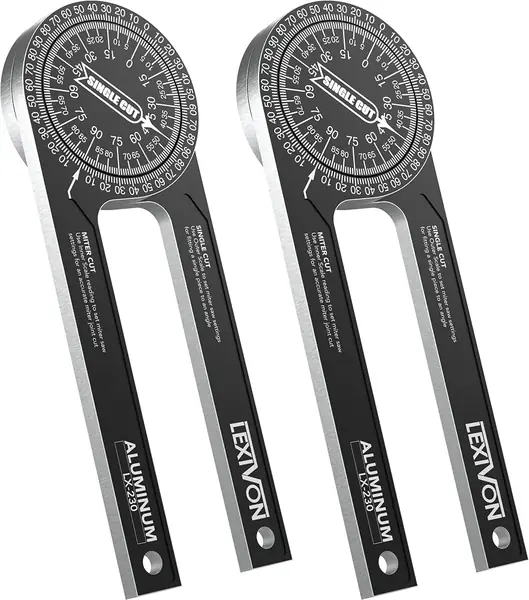
LEXIVON aluminum miter saw protractor with black body and laser-engraved scales

Trim and crown

Shop Score 97/100
Material
Anodized aluminum
Size
7 inch
Scales
Miter cut and single cut
Pack
2-pack
View on Amazon

The scale on top is why we made this our top pick: one side reads the miter cut for the saw and the other reads the single cut, so you are not doing arithmetic with sawdust on your hands. We like that the markings are laser engraved and stand out against the black body, even when the light is not perfect.

The 7-inch anodized aluminum body feels solid, and the fine-friction hinge holds the angle while you carry it to the saw. The 2-pack is genuinely useful: keep one at the miter station and one in the trim bag. We also appreciate the included case, which keeps the scales from getting scratched between jobs. The O-ring hinge has enough drag to hold a reading without feeling stiff.

It is also light enough to hold against a wall with one hand while you lock the arms with the other. The one gap is blade bevels: this reads corners, not the angle of a saw blade. If your work is mostly baseboard, crown, and casework, that is the right trade. For the trim work that sends most people looking for a miter saw protractor, the direct reading is the feature that earns its place. If you also need blade bevels, that is a second tool, not a reason to skip this one.

Worth Noting

  • Measures corners only and cannot read saw blade bevels
Our Verdict

For trim and crown work, we reach for this protractor first: it reads both sides of a corner and holds the angle on the way to the saw.

Check Latest Price
2.

Klein Tools 935DAG Digital Angle Gauge Best Digital Gauge

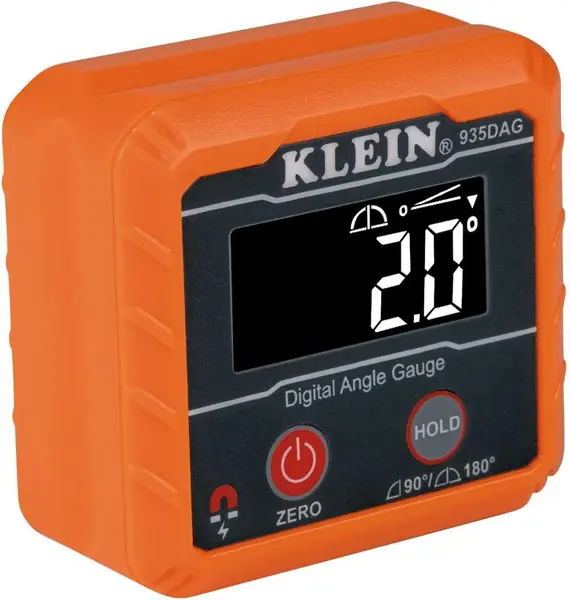
Klein Tools digital angle gauge with black housing and magnetic base

Blade angle setup

Shop Score 96/100
Range
0–90 and 0–180 degrees
Weight
3.5 oz
Display
Auto-rotating reverse-contrast
Base
Magnetic with V-groove
View on Amazon

Clamping a gauge to a miter saw blade is the quickest way to know the blade is at 45 degrees, and the Klein is the one we reach for first. It is small enough to leave in the saw's drawer and heavy enough to feel like a tool rather than a toy.

We recommend it as the blade-setting companion to a protractor. The magnetic base is strong, the V-groove sits on pipe and round stock, and the zero function lets you turn any surface into a reference. The display rotates when the tool is upside down, so you can read it from above the saw instead of crouching. The zero calibration is quick enough to repeat when you move from the table to the blade.

The range covers 0 to 90 and 0 to 180 degrees; the wider range is useful for relative angles and conduit bends, while the first covers most miter saw bevels. The ABS housing is light, and the included case and batteries mean it is ready when you open the box. The V-groove also makes it useful for conduit, so it earns its space beyond the saw. The soft case lives in the saw's drawer, which is where a setup tool should be.

Worth Noting

  • Screen can wash out in direct sun
Our Verdict

We recommend this gauge when the job is setting the blade itself; its magnetic base and rotating display make saw setup quicker.

Check Latest Price
3.

Wixey WR300 Digital Angle Gauge Best for Fine Blade Adjustment

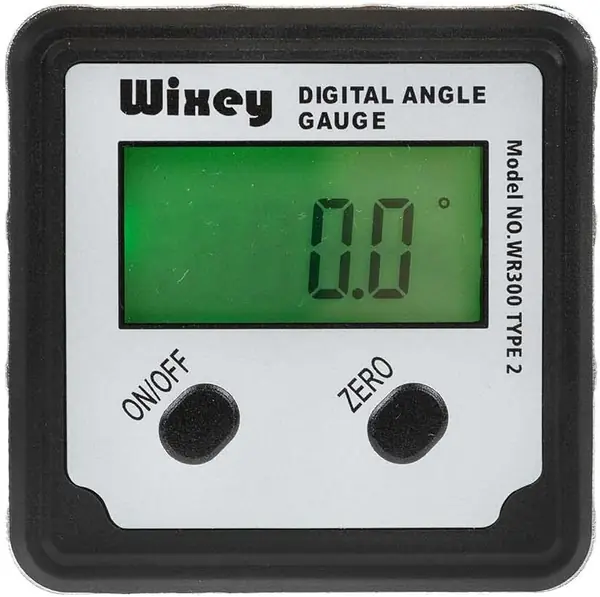
Wixey digital angle gauge with backlit display and magnetic base

Fine blade setup

Shop Score 95/100
Range
180 degrees
Accuracy
±0.2 degree
Display
Backlit LCD
Resolution
0.1 degree
View on Amazon

The number that matters on the Wixey is ±0.2 degree, with 0.1-degree resolution; that is as precise as any digital gauge here. For a miter saw, that tolerance is more than enough to set a blade and repeat the cut.

The backlit LCD is the practical advantage. Saws often sit under a bench or in a garage corner, and the light makes the number readable when the overheads are not. The magnetic base holds the gauge on the blade or table, and the zero function lets you work from the surface you actually have.

Fine adjustment can feel jumpy. The reading may shift by a tenth or two as you tap the blade, so we set the angle, snug the lock, and check it once more before cutting. That is a small annoyance rather than an accuracy problem; the backlight and resolution keep this as our pick for deliberate blade setup. The auto shut-off is also welcome because the gauge spends more time in a drawer than in your hand.

Worth Noting

  • Display readout can jump slightly during fine blade adjustments
Our Verdict

We choose the Wixey when we need the most precise blade angle, thanks to its backlit display and fine resolution.

Check Latest Price
4.

GemRed 82305 Digital Angle Finder Best Digital Protractor

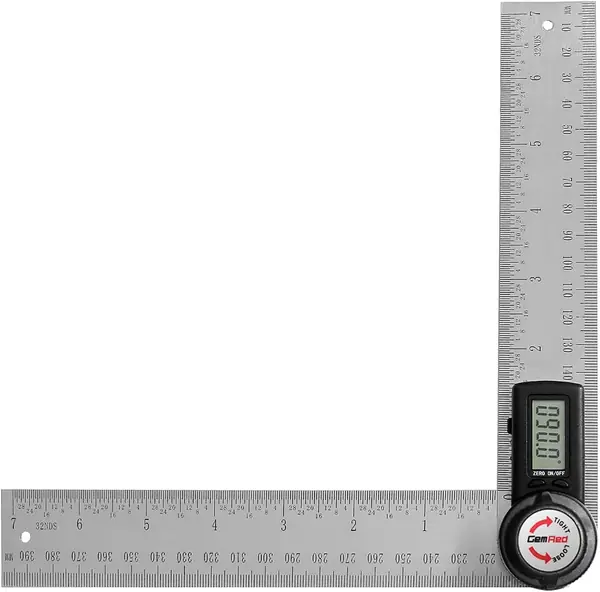
GemRed digital angle finder with stainless steel rules and black buttons

Digital trim angles

Shop Score 94/100
Material
Stainless steel
Accuracy
±0.3 degree
Battery
CR2032
Ruler Length
7 inch / 200 mm
View on Amazon

The GemRed 82305 replaces the needle-and-scale protractor with a digital readout and two stainless steel rules. Its 7-inch arms fold to about pocket length, and the display gives a clear number instead of a line to interpret.

We recommend it for trim work where you want a number instead of a needle. The ±0.3-degree accuracy is fine for baseboard and crown, and the locking screw holds the arms while you carry the reading to the saw. The stainless rules are stiff enough to sit flat on a wall without bowing. The buttons are small but easy to work with a thumb.

The battery is the weak point. A CR2032 can drain quickly in storage, and the cell can work loose, so we keep a spare in the case and check the display before a run of cuts. That is the trade for a low-cost digital finder. The locking screw is the part to check first if the arms start to drift.

Worth Noting

  • CR2032 coin battery can drain in storage or work loose
Our Verdict

We recommend this digital finder for trim work where you want a number instead of a needle, and its locking arms help.

Check Latest Price
5.

Saker Miter Saw Protractor Best Budget Protractor

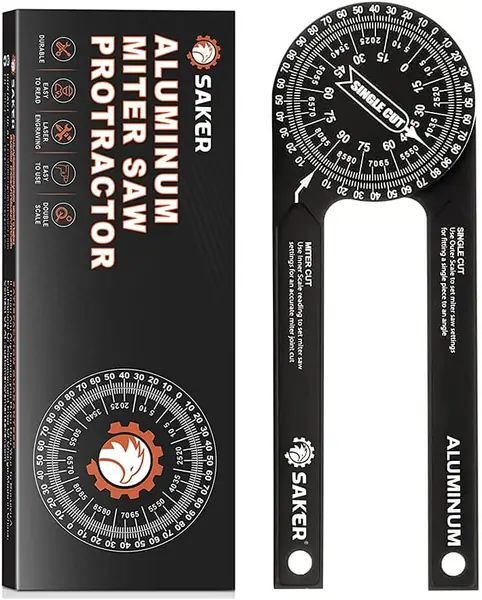
Saker aluminum miter saw protractor with black O-shaped body

Budget trim work

Shop Score 93/100
Material
Aluminum alloy
Size
7 inch
Scales
Laser engraved
Body
O-shape
View on Amazon

The low price for an aluminum protractor is what first makes the Saker worth a look, and the O-shaped body is the reason it stays in the trim bag. It is small enough to toss in a pouch and light enough to hold against a wall.

The laser-engraved scales read inside and outside corners, and the body opens both ways and holds the measurement without slipping. We like the small size: it fits in a pouch and does not crowd the corner the way a long digital finder can. The black finish hides the scratches that come with job-site use.

The pivot can be stiff when new. Work it open and closed a few times before you trust it on finish trim; after that, the drag helps it hold an angle. For occasional baseboard and shelf work, we keep it for rough trim and shelves, where the price and aluminum body matter more than a digital readout. After a few openings, the drag settles into a useful tension.

Worth Noting

  • Pivot feels stiff out of the box until broken in
Our Verdict

We think this is the budget protractor to beat for occasional trim, with an aluminum body and readable scales.

Check Latest Price
6.

Trend DLB Digital Level Box Best Budget Digital Gauge

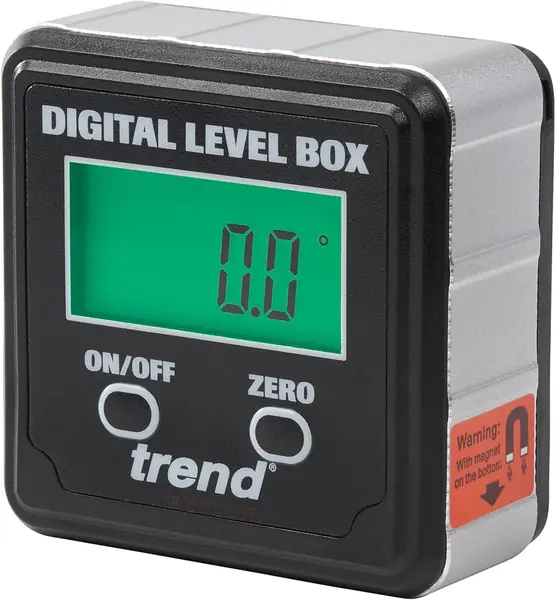
Trend digital level box with black body and backlit LCD

Quick blade checks

Shop Score 92/100
Weight
6 oz
Display
Backlit LCD
Base
Magnetic
Zero Function
Relative angles
View on Amazon

The Trend DLB is a small level box, the kind of tool you can drop in a pouch and forget until you need a quick blade check. Its square body sits on a saw table without much fuss.

The backlit LCD and arrow indicators are the useful parts. The arrows tell you which way to move the blade, and the light keeps the number visible when the saw is in a dim corner. The display is clear enough at arm's length, which is where you usually stand while adjusting a miter saw.

The zero function lets you set a reference on the table and then read the blade relative to it. The magnetic base holds it on the saw table or fence, and the compact body fits where a long protractor cannot. We like it as a second gauge because it is easy to keep in the saw's drawer.

For finish work, we reach for the Wixey; the Trend is better for framing, decking, and quick checks. At its price, we still think it earns a place as the backup gauge. It is not the tool we choose for a whole room of crown, but it is the one we grab when we only need to know whether the blade moved.

Worth Noting

  • No published accuracy or resolution
Our Verdict

We like this little level box for quick, low-cost blade checks when you do not need a protractor's reach.

Check Latest Price
7.

Starrett 505P-7 Miter Protractor Best for Tight Corners

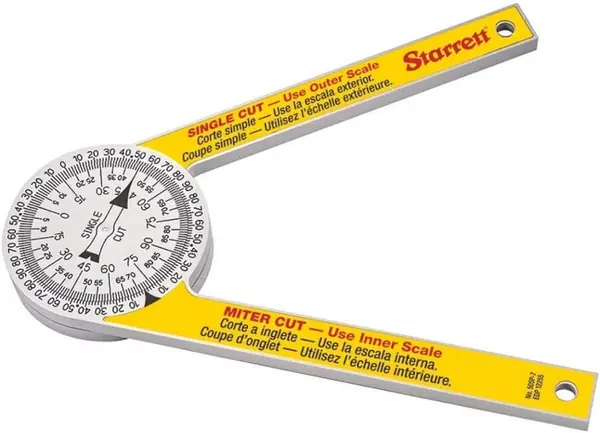
Starrett narrow plastic miter protractor with laser-engraved scales

Tight corners

Shop Score 91/100
Material
Hardened plastic
Size
7 inch
Scales
Two laser-engraved
Weight
3.53 oz
View on Amazon

The narrow plastic body is the Starrett's reason to exist: it folds to pocket size and slips into corners where a wider aluminum protractor will not sit flat.

The two laser-engraved scales transfer miter and single cuts, and the hardened plastic keeps the tool light. We like it for quick trim layout and for checking an odd corner before dragging out the saw. The 7-inch size is enough for most inside corners, but the point is the slim profile.

We keep it for tight corners and quick layout, not as the only protractor in a trim kit. The narrow shape is the advantage; the tool is at its best when the corner is the hard part, not when you are cutting a whole room of crown. The plastic body is light enough to leave in a nail pouch.

Worth Noting

  • Faint markings in low light
  • Plastic body feels less substantial
Our Verdict

We keep this narrow Starrett in mind for tight corners, though its faint markings ask for good light.

Check Latest Price
8.

Neoteck 16-Inch Digital Angle Finder Best for Wide Corners

Neoteck digital angle finder with long aluminum arms and LCD

Wide corners

Shop Score 90/100
Range
0–225 degrees
Accuracy
±0.5 degree
Power
1 AAA battery
Arm Length
16 inch
View on Amazon

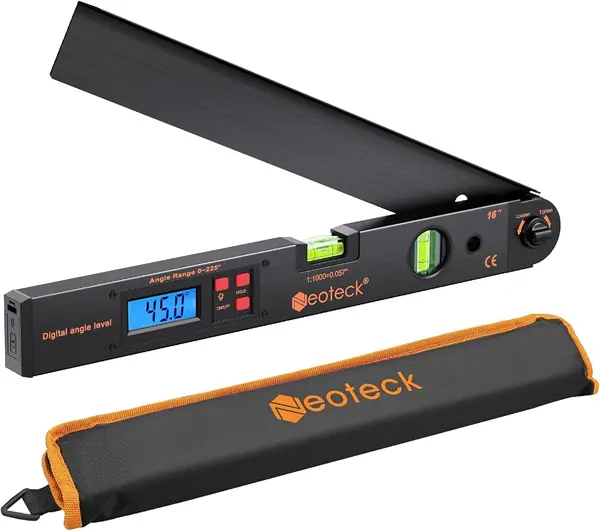
The 16-inch arms are the whole point of the Neoteck: they span a wide casement or stair opening without you having to bridge the gap with a second tool. The aluminum body feels more substantial than a pocket gauge.

The 225-degree range and hold function are useful for reverse angles and for carrying a reading back to the saw. The bubble vials give a quick level check, and the backlit LCD is readable in a garage. The arms lock with a knob, so you can set the angle and take the tool away from the opening.

For rough layout and wide trim, the long arms are usually enough; for finish cabinets, the GemRed 82305 is the better choice. The 16-inch size is not the one we reach for in a small built-in, where all that arm gets in the way.

We keep it for wide openings and rough layout, where the reach matters more than a finish-grade number. If your work is small built-ins, a compact finder is easier; if you regularly measure big openings, the Neoteck saves a step.

Worth Noting

  • Looser ±0.5-degree accuracy than our other digital finders
  • Long arms feel heavy one-handed
Our Verdict

We suggest the Neoteck when you need long arms to span a wide corner or a big opening.

Check Latest Price

How We Tested Angle Finders for Miter Saws

We started with the job rather than the spec sheet. Some tools read a corner and let you transfer that angle to the saw; others sit on the blade or the table and set the angle directly, and most buyers end up wanting one of each. From there we filtered by arm length, scale type, display, lock mechanism, and price, bought 14 units outright, and used them for five months.

Testing happened in a garage shop in the middle of a trim job, in a basement finish with crown and baseboard, and on a deck rebuild full of repeated 45s. We cut test joints and measured the gap at the seam, checked the same corner ten times in a row to see whether the reading drifted, and compared each tool's number against a machined square. Every magnetic gauge came off the blade and the table before the saw was switched on — no exceptions.

Readability got checked twice: once in good light, once in dim garage light with sawdust on the lens, plus whether a display flipped so it could be read from above. We stuck each magnetic base to the cast-iron table and tilted the saw to see whether the gauge slid, locked each arm and tapped it against the bench to see if it held, and noted battery type and how long a fresh cell lasted before the low-battery icon appeared.

After five months we looked at wear at the pivot, since slop in a friction hinge shows up as a reading that won't repeat. We also weighed price against what's in the box, because a second protractor or a spare battery changes the math on value.

How to Choose an Angle Finder for Miter Saws

Start with the cut, not the tool

A miter saw needs two different angle jobs done. One is finding the corner in front of you; the other is setting the blade to the angle you need. A miter saw protractor does the first, a magnetic digital angle gauge does the second, and a digital angle finder with long arms can bridge both.

We reach for a protractor first on trim, crown, and baseboard because it measures the wall and gives you the miter cut without arithmetic. We reach for a magnetic gauge when the saw itself is the question, such as checking that the blade is at 90 degrees or setting a bevel. The trap is assuming one tool covers both: a protractor cannot tell you the blade bevel, and a level box cannot measure an inside corner.

Accuracy is a tolerance, not a decimal count

A display that reads to 0.1 degree is not automatically more accurate than one that reads to 0.5 degree. Look for the tolerance: ±0.2 degree is tighter than ±0.3, which is tighter than ±0.5. For trim and crown, any of those can be fine; for setting a saw blade, the tighter figure gives you more confidence.

We also care about repeatability. Zero the gauge on the table, check it against a known square, and make the same reading twice. A tool that repeats is more useful than one with an extra decimal that drifts.

Readability and hold matter as much as the sensor

A display you cannot see is a display you do not use. Backlighting helps in a garage, and an auto-rotating screen helps when the gauge is upside down on a saw. On a protractor, white-on-black laser engraving is easier to read than faint gray numbers.

The hold matters too. A protractor needs a friction hinge or lock that keeps the arms where you set them; a digital gauge needs a magnet strong enough to stay on the blade while you adjust. Check that the base sits flat on the saw table, since a strong magnet on a dirty surface still reads the dirt.

Match the reach and power to your work

Arm length is a reach decision. A 5-inch finder is handy for cabinets and tight built-ins, a 7-inch protractor covers most trim, and a 16-inch finder is for wide openings and long walls. Longer arms are not automatically better; they are heavier and harder to hold in a small corner.

Power is simpler: AAA and CR2032 cells are easy to find, and auto shut-off saves the battery. Keep a spare in the case if the tool uses a coin cell, and check the display before a run of cuts.

Build quality and the two-tool question

Aluminum protractors shrug off job-site knocks; hardened plastic is lighter and less expensive but can feel less planted. We do not think every DIYer needs the premium body, but the pivot is the part that matters: a sloppy hinge turns a good scale into a bad reading.

If you do trim regularly, we think a protractor and a magnetic gauge are worth owning as a pair. If you do one room, a single 7-inch protractor may be enough.

Frequently Asked Questions

Final Verdict

For most miter-saw work, we start with the LEXIVON 7-inch protractor. It reads the corner directly, holds the angle, and the two-pack means one can live at the saw. That is the tool that saves the most time on trim and crown.

If your real problem is setting the blade rather than measuring a wall, the Klein 935DAG is the better first buy; its magnetic base and rotating display make saw setup quick. Buy the protractor for corners and the digital gauge for the blade, and you have the two jobs covered.