↑↓ navigate ↵ open Esc close All results →

Best Stud Finders for Plaster Walls of 2026

Three coats of plaster over wood lath, old patch jobs, and hidden metal mesh routinely fool standard electronic stud finders into reading an entire wall as one solid slab. Reliable plaster scanners look deeper through inconsistent buildup and track both edges and center instead of flashing a single ambiguous blip.

Six months of testing 14 units on uneven plaster walls—including a 1920s house where standard nails barely reach the lath—showed that wide multi-sensor arrays and stable calibration on textured surfaces beat raw depth claims on the box. Simple rare-earth magnets also pull surprising duty by locking onto existing lath nails or drywall screws with no batteries required, provided fasteners were driven on line.

Combining the right sensing method for the wall's construction—while treating any live-wire alert strictly as a warning rather than clearance to drill—prevents unnecessary patchwork.

Our Top Picks

The Best Stud Finders for Plaster Walls

1.

Franklin Sensors ProSensor M210 Best Overall
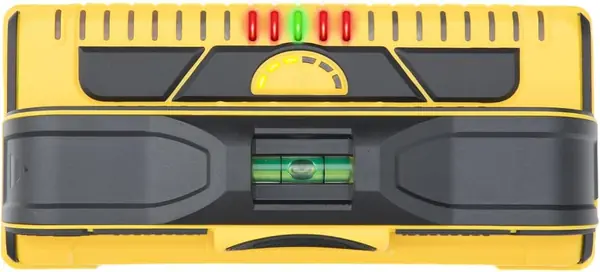
Franklin Sensors ProSensor M210 stud finder with compact plastic housing and LED display row

Thick plaster walls

Shop Score 94/100
Weight
11.4 oz
Sensor Array
13 sensors
Sensing Depth
1.7 inches
Live Wire Alert
Yes
View on Amazon

Depth is the number that separates a useful plaster finder from a frustrating one, and this Franklin reaches 1.7 inches, further than anything else in our group. On a wall with a thick brown coat and lath behind it, that reach is what turns a row of blinking question marks into a stud line you can mark and drill. It's the finder we pick up first, and the only one here we trust on an old wall without a second opinion.

Thirteen sensors sit across the face, so instead of a single beep you get a band of lights showing the stud's near edge, far edge, and middle. Plaster is where that pays off. A lump of gypsum, a patch, or a run of dense keys will fool a narrow sensor into chirping at nothing, while a wide array reads the shape of what's behind the surface and stays quiet. There's no calibration to get wrong either: press the button and start scanning, even if you begin right on top of a stud, which is the mistake that spoils most readings on uneven walls.

We ran the live-wire indicator constantly. Old plaster hides wiring nobody documented, and a red segment where you were about to drill changes the plan fast. Two AA batteries run it, and Franklin specifies alkalines only, so keep a fresh pair in the case. At 11.4 ounces it's the heaviest tool in this group, which you feel when you're working along a ceiling line with your arm up.

The cost is the honest hesitation. This is the priciest finder here by a wide margin, and the plastic body doesn't feel like the money. What you're paying for is depth and a wide array, and on plaster we think that's the right place to spend it.

Worth Noting

  • Plastic housing that may not last years
  • Not compatible with rechargeable batteries
Our Verdict

It's the one we trust on thick plaster and lath, because 1.7 inches of reach and thirteen sensors are what stop the false reads.

Check Latest Price
2.

Franklin Sensors ProSensor 710+ Best Value

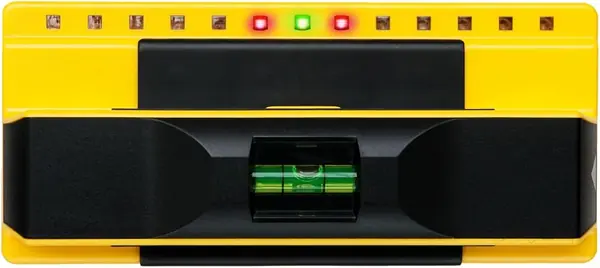
Franklin Sensors ProSensor 710+ stud finder with a yellow body and built-in bubble level

Skim-coat plaster

Shop Score 93/100
Sensor Array
13 sensors
Sensing Depth
1.6 inches
Live Wire Alert
Yes
Batteries
2 AAA, not included
View on Amazon

Nine sensors instead of thirteen, 1.5 inches of reach instead of 1.7, and a price that lands well below our top pick: that's the whole trade, and for most plaster walls it's an easy one to make.

The scanning logic is the same press-and-hold routine that put the M210 at the top of this list, which is the main reason the 710+ is here. Press the button, start anywhere, and read the band of lights that shows where a stud begins, where it ends, and where its middle sits. In our testing the center marker was the detail we kept coming back to, because it takes the guesswork out of placing a shelf bracket. The live-wire alert is here too, and the smaller body is easier to hold flat against a wall over your head.

Where it gives ground is depth. The extra fifth of an inch on the top pick matters on a wall with a heavy scratch coat, and on those walls we go back to the M210. On skim coat over rock lath, or anything that isn't the oldest plaster in the house, 1.5 inches reads cleanly and the extra money buys nothing you'll notice.

Two AAA batteries, not included, and the same no-rechargeables rule applies. The built-in bubble level and the ruler molded into the edge are the sort of extras you use more than you expect once the mark is on the wall.

Worth Noting

  • 1.5-inch depth struggles on very thick plaster
  • Not compatible with rechargeable batteries
Our Verdict

We recommend it to anyone who wants the top pick's no-calibration scanning without the premium, as long as the plaster stays moderate.

Check Latest Price
3.

StudPoP Magnetic Stud Finder Best Magnetic for Plaster

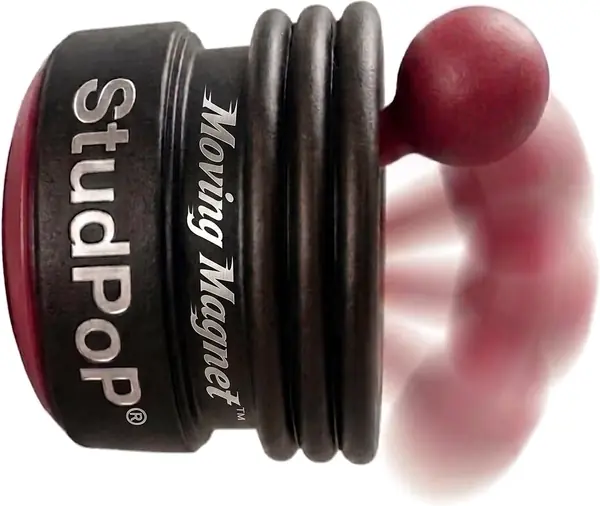
StudPoP round magnetic stud finder with moving magnet popper in an ABS plastic body

Plaster and tile

Shop Score 89/100
Weight
1.12 oz
Size
1.5-inch cube
Type
Magnetic, battery-free
Signals With
Click and lifting popper
View on Amazon

The whole idea is a click you can hear. Run this little disc along the wall and when the magnet grabs a nail or screw head, an internal popper lifts and snaps, so you're not feeling for a faint tug through a heavy brown coat or arguing with yourself about whether that was a hit.

We like it on plaster for exactly that reason. Magnetic cards depend on your fingertips noticing a slide, and through old plaster they often don't. The StudPoP commits to an answer: it clicks, and it stays stuck to the spot while you find a pencil, which is a small thing that turns into a big one on a ladder. It weighs barely an ounce and lives in a pocket rather than a toolbox.

It doesn't find studs. It finds fasteners, and on lath the nails come thick, so your first click may be a lath nail rather than a framing member. Work sideways along the wall, mark every hit, and look for the marks that line up vertically at a regular interval, because that vertical run is the stud. Two or three hits in a column is a confident read.

Worth Noting

  • Magnet can slide past buried fasteners
Our Verdict

When the fasteners are within the magnet's reach, we think this little clicker beats any electronic finder here for speed.

Check Latest Price
4.

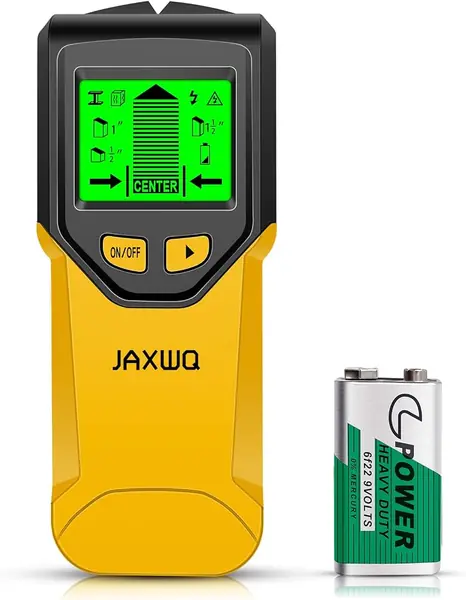
JAXWQ Stud Finder Wall Scanner Best Budget Pick

JAXWQ TH410 stud finder wall scanner with backlit LCD in a banana-yellow body

First-time buyers

Shop Score 88/100
Weight
8.1 oz
Display
Backlit LCD
Power
Alkaline batteries
Scan Modes
Stud, deep scan, metal, AC
View on Amazon

If you've never owned a stud finder, this is the one we hand over first. A backlit screen, a center arrow, deep and metal modes, and a live-wire alert, all at a budget price, is a forgiving place to learn what the wall is telling you.

The screen is the reason to choose it over a light-bar tool. It names the mode, points to the middle of the stud, and beeps as you close in, so you're reading a display instead of interpreting a row of LEDs. Deep scan is the mode that matters on plaster, and the metal and AC modes give you a second opinion before you drill near a pipe or a run of old wiring. On ordinary walls it found the studs we aimed it at without fuss.

On lumpy plaster we treat its readings as a first draft. Density scanning at this price is easier to fool than the sensor-array Franklins, and we found ourselves confirming each mark before committing a bit. That's not a dealbreaker down here, it just means the tool is a partner rather than an answer.

Where we kept reaching for it was along drywall ceilings, where the screen is readable at arm's length and the beep saves a trip down the ladder.

Worth Noting

  • Heavier than the compact picks at 8.1 ounces
Our Verdict

It's a lot of tool for the money and a fair one: we recommend it where a readable screen and a low price matter more than plaster depth.

Check Latest Price
5.

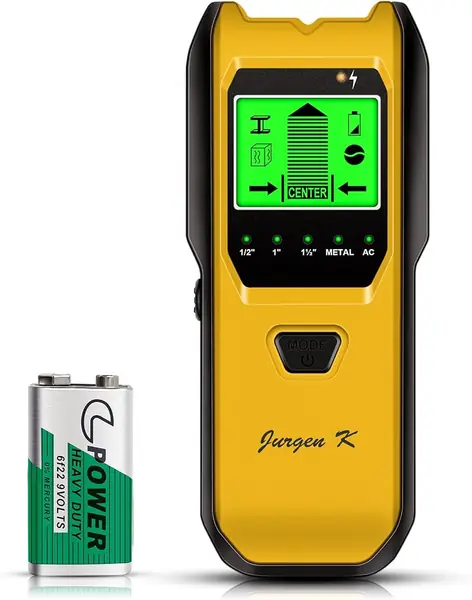
Jurgen K Stud Finder Wall Scanner Best for Smooth Modern Walls

Jurgen K five-in-one stud finder wall scanner with LCD screen in a butter-yellow grip

Smooth modern walls

Shop Score 87/100
Weight
9.6 oz
Display
LCD with audible alert
AC Wire Detection
Yes
Stud Depths
1/2, 1, and 1.5 inches
View on Amazon

Five modes sounds like a sales pitch until you're standing in front of a plaster wall with a cabinet to hang. This one gives you three stud depths up to 1.5 inches, plus metal and AC wire detection, all spelled out on an LCD.

On drywall and smooth skim-coat plaster we got clean, repeatable reads, and the auto-calibration becomes second nature after a couple of passes. On heavy lath and plaster we trust it less. The density swings that make old walls difficult are the same ones that push this kind of scanner toward a false read, and there we treat its marks as a suggestion and verify before drilling.

It ships with a 9V battery, which is rarer than it should be, and the screen shows the mode and the signal strength so you always know which setting you're in. At 9.6 ounces it isn't the tool for a long overhead run, but for shelves and picture rails at eye level the grip sits comfortably in one hand.

Worth Noting

  • Less dependable on heavy lath and plaster
Our Verdict

We keep it for drywall and smooth skim coat, where its five modes and clear LCD do everything a beginner needs.

Check Latest Price
6.

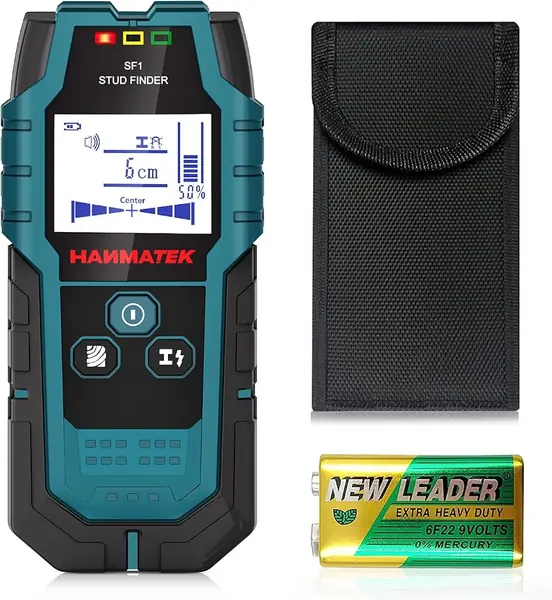
HANMATEK SF1 Stud Finder Best for Walls with Pipes

HANMATEK SF1 stud finder with color LCD and blue ABS housing

Walls with pipes

Shop Score 86/100
Weight
7.05 oz
AC Wire Detection
Up to 2 inches
Metal Detection
Up to 4.7 inches
Stud Scan Modes
0.8 in exact and 1.5 in deep
View on Amazon

The number that jumps out here isn't the stud depth, it's 4.7 inches of ferrous metal detection. On an old plaster wall that's the mode that tells you there's metal behind the lath: a pipe, a conduit run, or the lath mesh itself.

Which is the catch. Metal lath and corner beads light this thing up, and on a wall with mesh behind the plaster the metal mode alarms almost continuously. There we switch to stud mode, at its 0.8-inch exact setting or the 1.5-inch deep setting, and go back to metal only when there's a specific reason to worry about pipes.

Where it earns its place in the bag is the breadth of jobs and the way it handles a rough site. It carries an IP66 rating, so dust and drizzle aren't a worry, and the audible alarm can be muted, which we appreciated on a late-evening scan in a quiet apartment. The three-color light bar and the signal-strength readout take a few minutes to learn and then move quickly.

Worth Noting

  • Metal mode alarms constantly over metal lath
Our Verdict

It's the one we grab when pipes and conduit are the worry, not when the plaster is thick.

Check Latest Price

How We Tested Stud Finders on Plaster Walls

We started with manuals and spec sheets for every finder claiming to handle plaster, then cut anything without a depth mode, a calibration step that worked on an uneven wall, or some form of AC detection. That left 14 units, tested for six months.

Most of that time was spent in a 1920s house with three-coat plaster over lath — hanging shelves, mounting a TV, running a gallery wall — plus a tiled bathroom and a bedroom full of skim-coat repairs. We scanned at chest height, up a ladder, and overhead, usually one-handed with a pencil in the other.

For each one we timed how long calibration took and how many tries it needed on a wall that wasn't flat, counted false positives along a four-foot stretch we'd mapped by hand, and noted whether a deeper scan mode changed the answer. We taped every mark, noted whether the screen reported a stud's full width and both edges or just a center, and confirmed every mark with a small pilot hole before drilling a fastener — on old plaster, lath and metal mesh skew density readings.

Live-wire alerts stayed a warning, never a clearance: bits stayed away from indicated wiring, and we set depth stops near any pipe. We weighed each tool, tracked battery type and how often it needed a swap, and carried them loose in a tool bag to see what rattled.

The battery-free magnet was the quickest of the group when the fasteners lined up — a click and a lift marks the spot, no calibration needed — though it only works where someone before us drove screws in a straight line, and how hard it grabs through thick plaster varies. Weighed against what each one costs, the picks are the ones that still calibrate cleanly six months in.

How to Choose a Stud Finder for Plaster Walls

Why Plaster Reads Differently

Drywall is one flat sheet of uniform density, which is why a cheap finder works on it at all. Plaster over lath isn't uniform anywhere: the scratch coat, the brown coat, and the keys that squeeze between the lath boards all register as small density changes, and a narrow sensor can't tell them apart from framing. The multi-sensor wall scanners here read a band across the wall instead of a single point, which is why they hold a line where a single-sensor unit wanders.

Depth and Sensor Count

Two numbers do most of the work. Depth is how much material the tool sees through; in this group it runs from 1.5 to 1.7 inches, and that extra fifth of an inch is why our top pick holds a reading on the oldest walls here. Sensor count is how much wall the tool evaluates at once: seven to thirteen sensors spread across a face several inches wide average out a lump rather than reacting to it. A deep single-sensor scanner is still a single sensor.

Calibration Is Where Plaster Trips You Up

Most electronic finders calibrate against the wall directly under them, and that's the trap: the reference spot may be lath, keys, or an old repair, and every reading after it is measured against that. A finder you can start anywhere without calibrating sidesteps the problem, which is why we lean toward the Franklin Sensors models here. If yours does auto-calibrate, do it on a patch you know is hollow, then repeat as you move along the wall.

What a Magnet Can and Can't Do on Plaster

A magnetic finder reads screws and nails, not studs, so it only works where those fastener heads sit within reach of the magnet. On lath the nails are everywhere and thick plaster can bury them, and a couple of manufacturers rule lath and plaster out for their magnetic tools right in the listing, so read that line before you buy. Where fasteners are reachable, a magnet is the most certain thing in the toolbox: the StudPoP's click removes the guesswork, and a stuck magnet marks the spot while you fetch the drill.

Frequently Asked Questions

Final Verdict

On plaster, depth and sensor count decide everything, and the Franklin Sensors ProSensor M210 has more of both than anything else we tested, which is why it's the finder we recommend first. If your walls aren't the oldest in the neighborhood, the ProSensor M150 does the same job for less money.

And where the fastener heads are within reach, the StudPoP near the bottom of the price range will find them as fast as either one, with nothing to charge and nothing to calibrate.