↑↓ navigate ↵ open Esc close All results →

Best Magnetic Stud Finders of 2026

Electronic stud finders ask you to calibrate, glide slowly, trust blinking LEDs, and still risk drilling straight into hollow drywall. A magnetic stud finder skips the batteries and sensors altogether by locking directly onto the steel nails or screws already anchored into the framing, proving exactly where the stud runs.

The one catch first-time users overlook is that magnets only detect ferrous fasteners — they pass silently over copper pipe and PEX lines, so shallow pilot holes still matter. Across six months of testing 14 magnetic finders on painted drywall, 5/8-inch board, tile, plywood paneling, and old lath and plaster, we looked at pull strength, whether the tool clung hands-free while reaching for a pencil, and how cleanly notches or level vials marked the center.

Dependable pocket blocks weigh next to nothing, grip firmly through thick wall coverings without scuffing fresh paint, and point straight to the fastener line on the seven models below.

Our Top Picks

The Best Magnetic Stud Finders

1.

C.H. Hanson Magnetic Stud Finder Best Overall
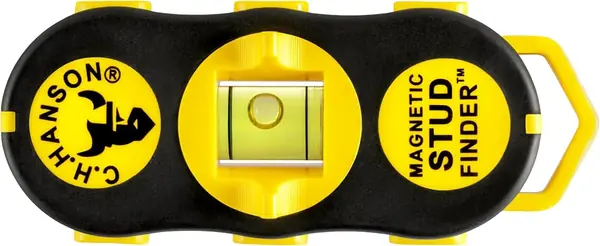
CH Hanson 03040 magnetic stud finder, a small rectangular plastic body with a rotating level

Drywall stud finding

Shop Score 94/100
Weight
2.11 oz
Magnet
Rare earth, no batteries
Built-in Level
Rotating, for level and plumb marks
View on Amazon

An electronic scanner offers an opinion about what's behind the wall. The C.H. Hanson skips the opinion entirely: it's a small plastic block with rare-earth magnets inside, and it latches onto the drywall screw holding the stud, so what you've found is a fastener you can actually hang from. Slide it across the wall and the pull arrives as a clear tug, and the tool stays put where it grabbed, which lets you step back and read the line of fasteners instead of losing the spot.

Of everything here, this is the one we reach for first, and the reasons are unglamorous. At 2.11 ounces it vanishes into a shirt pocket, it hangs on the wall while you pick up a pencil, and the rotating level set into the body gives you a level or plumb tick without dragging out a torpedo level. Nothing to charge, nothing to calibrate, nothing that drifts. Through standard half-inch drywall the grab is unmistakable.

There's a second job in it for anyone with a shop. Running the Hanson over a reclaimed board before it goes near the planer finds the nails you can't see, and that costs a lot less than a chipped set of knives. It will also turn up the screws in a jig, a stray fastener in a stud bay, and the nail hiding in a fence rail. One job on the label, several more once it lives in the shop.

Worth Noting

  • Sparse screws need a slow careful sweep
Our Verdict

For hanging shelves or a television in drywall, this is the one we recommend: no batteries, no calibration, and a rotating level in a two-ounce body.

Check Latest Price
2.

Rack-A-Tiers Stud Ball Best for Thick Walls and Metal Studs

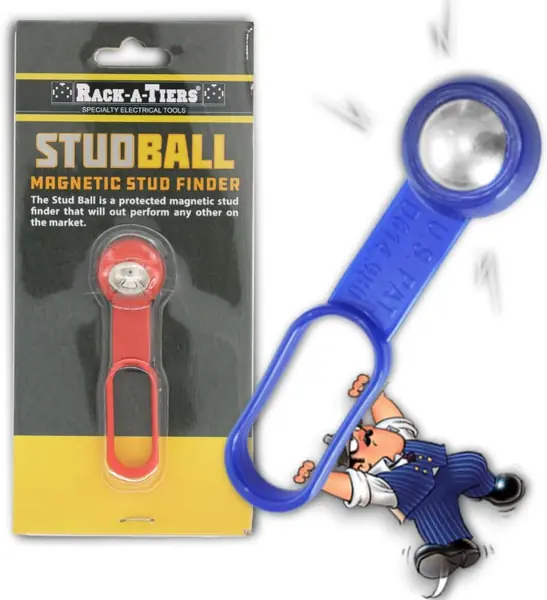
Rack-A-Tiers Stud Ball magnetic stud finder, round body with a finger loop and 27-pound magnet

Thick walls

Shop Score 93/100
Weight
1.6 oz
Pull Force
27 lb
Detection Depth
1/2-inch or 5/8-inch drywall, ceramic tile, 3/4-inch plywood
View on Amazon

Twenty-seven pounds of pull is the number that separates the Stud Ball from every other pick here, and it's why this is the one we hand over when the wall is thick. That much magnet reads a screw through half-inch or five-eighths drywall, through ceramic tile, and through as much as three-quarters of an inch of plywood paneling — assemblies where a flat pocket tool goes quiet.

The shape earns its keep too. A ball has no edge to catch on texture or drag a scuff into paint, and the finger loop lets you swing it in a wide arc down a wall, which is a lot faster than pushing a card along an inch at a time. When it grabs, it holds hard enough to hang there while you fetch a pencil, and on steel-framed walls it snaps onto the stud itself rather than waiting for a screw head.

In older houses with mud and gypsum walls it keeps reading where lighter magnets start to guess. Mark the center of the ball rather than the edge of the housing and your mark lands on the fastener. It is more tool than a plain drywall job asks for — but on tile, on five-eighths board, and on metal studs it has the best reach in this group.

Worth Noting

  • Costs more than the pocket magnets
Our Verdict

We keep the Stud Ball for thick drywall, tile, and metal studs, where its 27-pound magnet reads what the flat pocket tools miss.

Check Latest Price
3.

Klein Tools MSF100 Magnetic Stud Finder Best Built

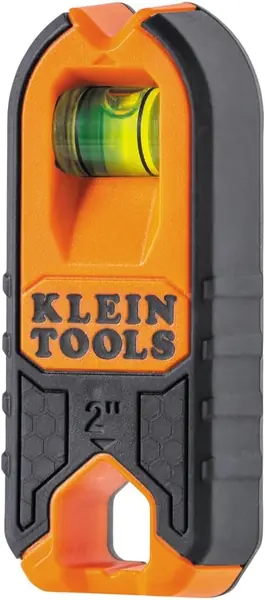
Klein Tools MSF100 magnetic stud finder in orange with felt pad backing and a bubble vial

Finished interiors

Shop Score 92/100
Weight
1.76 oz
Magnet
N52 rare earth
Level
Bubble vial with center notch
Drop Rating
9.9 ft
View on Amazon

The felt pad on the back is the detail most shoppers skim past, and it's the first thing we noticed. Bare plastic dragged across a finished wall can leave a mark you'll see in raking light; the felt glides and leaves nothing behind. That sounds like a small thing until the wall is a freshly painted living room and the shelf has to go up tonight.

The rest of the build matches the care. The N52 magnet holds the tool against the wall while you work, the housing is overmolded so it doesn't skate in your hand, and it's rated to survive a 9.9-foot drop — the number that matters when you're standing on a ladder. A center notch at the top and an opening at the bottom give you two ways to transfer the spot to the wall, and a bubble vial handles a quick plumb tick.

At 1.76 ounces it's still a pocket tool, and of everything here it's the one we trust most in a finished room. Where it gives ground is sheer reach: for tile, five-eighths board, or plywood paneling, the Stud Ball's 27-pound magnet is the better answer, and that's a difference in magnet size rather than in build quality. For shelves, cabinets, and a television in a house you care about, this is the one that goes in the bag.

Worth Noting

  • Less magnetic reach through tile, thick drywall, or plywood paneling
Our Verdict

We recommend the Klein for finished rooms: felt pads, a drop rating, and a strong N52 magnet make it the one we don't worry about using.

Check Latest Price
4.

The Original StudBuddy Best Budget

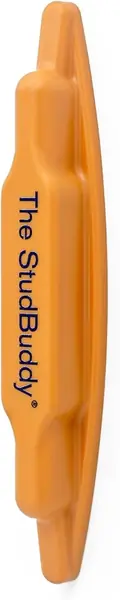
The StudBuddy original magnetic stud finder in orange plastic with encapsulated neodymium magnets

First-time buyers

Shop Score 91/100
Weight
1.6 oz
Magnet
Encapsulated neodymium
Origin
Made in the USA
Includes
Storage case
View on Amazon

This is one of the least expensive picks here, and the smallest thing on the page: a 1.6-ounce orange shell with neodymium magnets sealed inside and a case to keep it in. What you're buying is the idea in its plainest form — slide it, feel the pull, mark the spot.

We like it for exactly that. It sticks to the wall over a screw and stays there as a marker while you fetch a pencil, a level, or a second opinion, which beats holding a tool in place and reaching for a pen with the other hand. For a first magnetic finder, or a spare to keep in a kitchen drawer, the price makes the decision easy.

The pull is the mildest of this group. Keep the body flat against the wall and move slowly; tilt an edge up and you'll lose the grab before you feel it. Keep the case, too — a magnet this size loose in a toolbox finds every stray screw in there.

Worth Noting

  • Not intended for lath and plaster walls
Our Verdict

Buy the StudBuddy if you want the cheapest way into magnet finding: simple, battery-free, and it sticks to the wall as its own marker.

Check Latest Price
5.

Original StudPoP Best for Plaster Walls

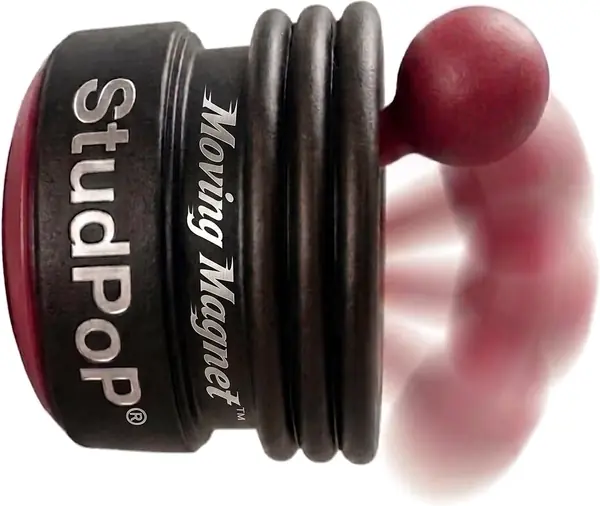
StudPoP magnetic stud finder, a round 1.5-inch ABS body with a moving magnet popper

Plaster walls

Shop Score 90/100
Weight
1.12 oz
Mechanism
Moving magnet with click-and-pop signal
Wall Types
Plaster, tile, double-layer sheetrock, wood and metal studs
View on Amazon

Every other tool here asks you to feel a tug and decide whether it was real. The StudPoP answers the question: a magnet rides loose inside the housing, and when it passes a fastener it snaps up and clicks, so you get a signal instead of a hunch. On walls where fasteners sit under old paint and plaster, having the tool tell you rather than leaving you to feel for it is the whole purchase.

It's 1.12 ounces and about an inch and a half across, small enough to palm and light enough to forget in a shirt pocket. The maker rates it for any construction — wood studs, metal studs, plaster, tile, double-layer sheetrock — and it's the pick here that's built for old plaster rather than merely tolerated on it. Nothing to charge, nothing to calibrate, and it costs little more than the budget pick.

Give it a slow, even sweep and let the mechanism trip on its own; pressing it hard against the wall doesn't help and just wears out your arm. It's a small thing to carry for how much wall it opens up, and in a house full of plaster it's the tool that keeps earning its place in the bag.

Worth Noting

  • Can miss fasteners buried deep in thick plaster
Our Verdict

We recommend the StudPoP when the walls are old: the click tells you it found a fastener instead of leaving you to feel for a tug.

Check Latest Price
6.

Kreg Magnetic Stud Finder with Laser-Mark Best for Marking a Line

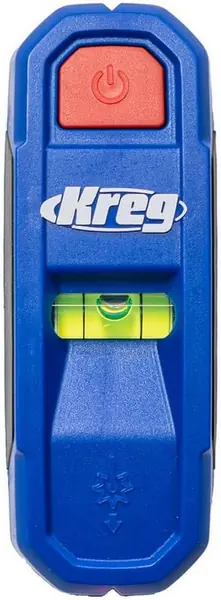
Kreg magnetic stud finder in blue with a laser-mark window, marking notches, and bubble level

Marking long runs

Shop Score 89/100
Magnets
Two rare earth
Laser
Class 2, 1 mW or less
Marking
Center notches and bubble level
View on Amazon

The laser is the reason this tool exists. Press the button and it throws a Class 2 line down the wall; level the body with the vial and the line runs plumb, which turns a single hit into something you can mark against at every height — a cabinet rail, a shelf standard, a run of cleat screws.

The magnet side is conventional: two rare-earth magnets do the finding, there are center notches at the top and bottom, and a bubble level covers the times you don't want the laser on. It's a small blue block that fits an apron pocket, which matters for a tool you'll reach for in the middle of an install.

A laser earns its keep on repetition. Hanging one picture, it's a gadget; hanging a wall of cabinets or a long shelf, it saves the measure-up-from-a-mark routine five or six times over, and it saves the pencil marks that don't quite line up.

This is the premium pick here, and the money goes into the line rather than into anything else. For a woodworker who hangs cabinets, shelves, and cleats in runs, that's the feature worth having; if you're mostly finding one stud behind a mirror, the C.H. Hanson does that job without the laser.

Worth Noting

  • Magnets can let it slide down the wall
Our Verdict

Pay for the Kreg if you mark long runs: the laser projects a line down the wall, and no other pick here does that.

Check Latest Price
7.

The Original StudBuddy Pro Best for Leveled Marking

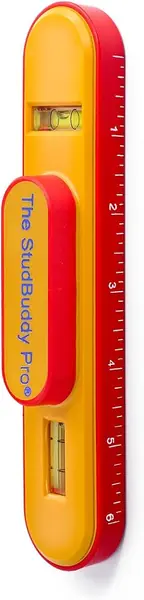
The StudBuddy Pro magnetic stud finder in orange and red with two vials and a side ruler

Leveled marking

Shop Score 88/100
Weight
3.53 oz
Magnets
Encapsulated neodymium
Extras
Ruler along the edge
Levels
Horizontal and vertical vials
View on Amazon

Take the original StudBuddy, add two plastic vials and a ruler along the edge, and you get the Pro. It's also more than twice the weight — 3.53 ounces against 1.6 — which is the first thing you notice with one in each hand.

The vials are the point. A horizontal and a vertical level let you check a picture rail or a shelf bracket without a second tool in your hand, and the ruler on the side is handy for repeating a spacing across a wall. The magnets are encapsulated neodymium like the original's, and there's nothing to charge.

Whether that trade is worth it depends on how you work. For one picture at a time, the lighter original is the better pocket tool; for a run of shelves or a gallery wall, having a level in your hand saves a trip to the toolbox. Ours lives with the picture-hanging kit rather than the tool bag.

Worth Noting

  • Carries the original's lath and plaster restriction
Our Verdict

The Pro earns a place if you want a level and ruler on the finder itself, though the lighter original is the better pocket tool.

Check Latest Price

How We Chose and Tested the Best Magnetic Stud Finders

We started with a spreadsheet of more than two dozen magnetic stud finders and narrowed it by magnet type, weight, marking aids, and price until we had a shortlist that covered the range of what people actually buy: pocket-size budget picks, tools built for thick walls, and models with a level or a line-marking aid. Fourteen of them came home with us.

For six months they lived in a canvas tool bag and a front pocket and came out for real work — shelves in a 1920s house with lath and plaster, a tile backsplash, plywood paneling in a garage, five-eighths board on a newer addition, and a lot of plain half-inch drywall that had just been painted. On every wall we swept in slow overlapping arcs and counted how many passes it took before the magnet grabbed, then pressed each tool along the fastener line to see how far off a hit could land. When we drilled, the first pass stayed shallow.

We let go of each one to see whether it held on the wall while we walked off for a pencil and a level, then tested the marking aids the same way, drawing lines off center notches, bubble vials, and side rulers and checking them against a four-foot level. Felt pads and smooth housings got dragged across fresh paint to see what scuffed, and every tool was weighed on a kitchen scale and carried in a front pocket for a full day of hanging cabinets. We also recorded where a magnet lied — corner bead, metal lath, and the occasional duct or nail plate that reads like a stud.

Durability got its own treatment, with a few of these coming off ladders and out of bags onto concrete while we watched for cracked housings and shifted magnets. We weighed cost against what each tool actually added, whether that was a second magnet, a storage case, or a level that stayed readable at arm's length. One of them projects a laser line; we kept it aimed at the wall and never near anyone's eyes.

How to Choose a Magnetic Stud Finder

Match the Tool to What's Behind the Wall

Drywall over wood studs is the easy case: any magnet here reads the screws, and the differences come down to weight and marking aids. Plaster and lath is the hard one. A lath-and-plaster wall is full of nails holding the lath, so a plain stud magnet grabs constantly and tells you nothing about which hits are studs. That's why The StudBuddy states outright that it isn't intended for lath and plaster, and why the StudPoP, with its click-and-pop signal, is the one we point at for old houses.

Tile, five-eighths board, plywood paneling, and steel-framed walls are the other split. There, reach matters more than features: the Rack-A-Tiers Stud Ball's 27-pound magnet is the one that reads through, and on metal studs a magnet is reading the stud itself instead of waiting for a screw head.

How Much Magnet You Actually Need

Pull is the one number worth hunting for, and only the Stud Ball states it: 27 pounds. Through half-inch drywall a small magnet is plenty and the pocket tools all manage. Through five-eighths board, tile backer, or a second layer of rock, strength is what decides whether you get a reading at all.

More pull has a cost. A very strong magnet grabs hard and snaps onto a screw head, and dragging a bare housing across fresh paint can leave a mark — which is why the Klein wears felt pads on the back. If the wall was painted this decade, favor a felt-backed or smoothly finished housing over raw plastic.

Marking, Levels, and Staying Put

The quiet advantage of a magnet over a scanner is that it stays where it found something. The StudBuddy was patented on exactly that idea — it hangs on the wall as its own marker — and the C.H. Hanson does the same. If you mark alone, that's worth more than any readout.

Then look at what the tool gives you for the mark itself: a center notch, a bubble vial, a ruler along the edge, or the Kreg's laser line, which turns one hit into a markable line for a run of cabinet holes. If someone is holding the other end of the tape while you work, skip the extras and buy the lighter tool.

Size, Weight, and the Pocket Test

These run from about an ounce to three and a half, and the spread matters more than it sounds. A lighter finder is the one you'll leave stuck to the wall while you fetch tools, and the one that stays in a shirt pocket instead of a toolbox.

Weight cuts both ways once the tool is hanging on a screw head: a heavier body has more leverage to slide down a slick wall. If levels and a ruler are worth that trade to you, the StudBuddy Pro is the one that makes it; if not, the lighter picks here are easier to live with.

Frequently Asked Questions

Final Verdict

The C.H. Hanson is the one we hand to a friend who asks which magnetic stud finder to buy: two ounces, no batteries, a level set into the body, and a grab you can feel through standard drywall. It's the least complicated tool on this page, and the one that actually gets carried.

Step up to the Rack-A-Tiers Stud Ball if your walls are five-eighths board, tile, or steel-framed, where its 27-pound magnet reads what the pocket tools miss. And if your house is lath and plaster, start with the StudPoP — its click is the only signal here that doesn't depend on you feeling a faint tug.