↑↓ navigate ↵ open Esc close All results →

Best Laser Levels for Cabinets of 2026

Walls and floors in real kitchens are rarely square, and a slight slope shows up brutally on upper cabinets — tight to the ceiling at one end and a finger's width low at the other. Projecting one steady horizontal line across the studs lets a single installer shim, fasten, and verify alignment without constantly re-leveling a spirit level.

In eight months of cabinet installations with 12 laser levels, three practical details separated the dependable units from the finicky ones: beam visibility against a well-lit cabinet face, fast pendulum settling on uneven subfloors, and brackets that held steady without creeping down the wall.

First-time buyers often overpay for three 360-degree planes when a single wall of uppers only needs a crisp cross line, saving multi-plane coverage for corner runs. Both green and red beams were checked in bright rooms and shadow, narrowing the field to seven models scaled for single walls, corner layouts, and tighter budgets.

Our Top Picks

The Best Laser Levels for Cabinets

1.

Huepar HM03CG Best Overall
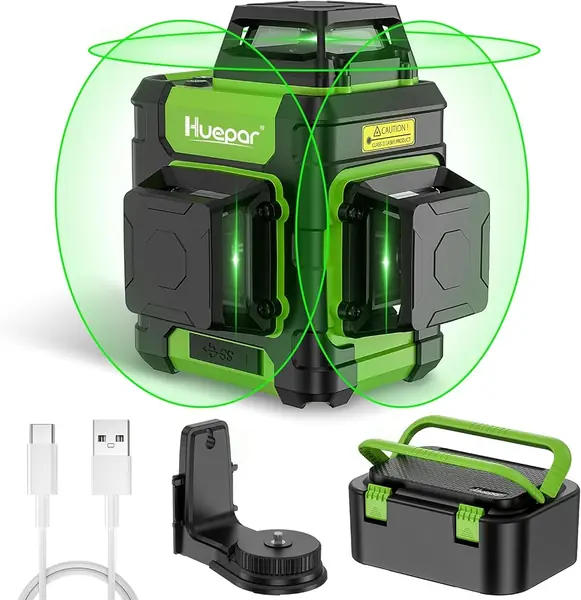
Huepar HM03CG green 3x360 laser level with magnetic bracket and hard case

Corner cabinet runs

Shop Score 95/100
Weight
1.32 lb
Laser Planes
Three 360° planes, one horizontal and two vertical
Self-leveling Range
±4°
Runtime
Up to 8 hours
View on Amazon

Three 360-degree planes are what put this Huepar at the top of our list: one horizontal ring and two vertical rings set at 90 degrees to each other, each switchable on its own. In a kitchen that turns a corner, you set the tool once, carry your level line along both walls, and drop a plumb line down the corner gable without moving anything. That is the whole cabinet layout in a single setup, and none of the two-line lasers here can do it.

The green beam backs it up. We could read the line across a painted cabinet face with the room lights on, which is the only test that matters when you are marking uppers at eye height in a finished kitchen. At 1.32 pounds with USB-C charging and a hard case, it also goes up a ladder without a second trip. The listed runtime is eight hours, and the self-leveling circuit takes up to 4 degrees of out-of-level floor before it complains.

What we miss is a remote. Switching planes means walking back to the body, and on a long run of uppers you will do that more often than you expect, which is where the CIGMAN's handset earns its keep. We were also pleased to find the longest warranty stated here at five years. The magnetic bracket only helps on steel studs or a steel appliance, so budget for a tripod if your walls are wood-framed.

Worth Noting

  • No remote, so switching planes means walking back
Our Verdict

We recommend the HM03CG for cabinet work because three switchable planes let you square a corner in one setup, and the green line holds up under kitchen lighting.

Check Latest Price
2.

CIGMAN CM-701 Best Remote Control

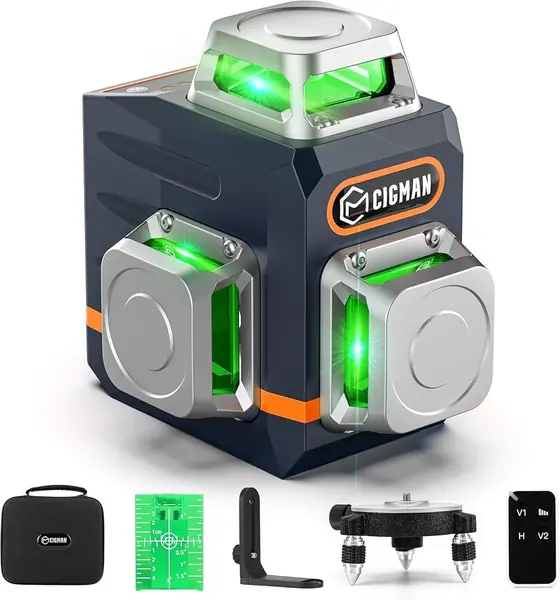
CIGMAN CM-701 green 3x360 laser level with remote control and mini tripod

One-person installs

Shop Score 94/100
Battery
4000 mAh rechargeable, USB-C
Laser Planes
12 lines across 3 x 360°
Self-leveling Range
±4°
Accuracy
±1.5 mm at 5 m
View on Amazon

A handset is the reason to pick the CM-701 over our top pick. Standing at the cabinet with a pencil in one hand, you can kill the vertical lines, dim the beam, or start the whole thing without crossing the room. Twelve lines run across three 360-degree planes, and the box includes a magnetic L-bracket, a mini tripod, a target plate and a case, so the tool moves from countertop to steel stud in seconds.

Twelve lines are more laser than a straight run of base cabinets needs, but squaring a corner or checking a peninsula is where it earns its place on the job. CIGMAN lists accuracy at plus or minus 1.5 mm at 5 m and a 4-degree self-leveling range, and the 4000 mAh battery charges over USB-C from the same brick as your phone. We were struck by the body size as much as the beam: at 3.78 by 2.87 inches it is small enough to sit inside a base cabinet carcass for shelf-pin layout.

The magnet is the part to watch. The L-bracket holds on a steel stud, but it is the piece most likely to shift if you bump the tool, so set it flat and re-check the line before you mark a run. Even with that, this is the one we take when we are working alone and do not want to keep climbing down.

Worth Noting

  • Magnet is the weakest part of the mount
Our Verdict

Our pick for solo installers: the remote saves a trip across the kitchen every time you change planes, and the mini tripod sets the line at cabinet height.

Check Latest Price
3.

DEWALT DW089LG Best for Jobsite Conditions

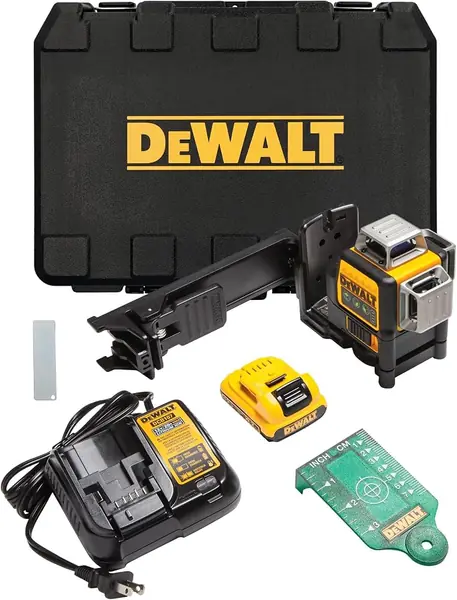
DEWALT DW089LG green 3x360 laser level with 12V battery and charger

Jobsite cabinet work

Shop Score 93/100
Weight
8.25 lb
Battery
12V MAX 2.0Ah with charger
Accuracy
±3 mm at 10 m
IP Rating
IP65
View on Amazon

The price is the first thing to get past. This is the most expensive laser here by a wide margin, and what it buys is a battery platform: it runs on DEWALT 12V MAX packs, charges them in the kit, and ships with a 2.0Ah battery, a charger, a target card and a case. If those packs are already in your truck, the tool costs you less over a year than the number on the listing suggests.

Everything else is built for a house under construction. IP65 sealing handles dust and hose-down, the overmolded housing takes knocks, and the extended ceiling bracket clamps to a joist so you can put the line at cabinet height without a tripod footprint in the way. We liked that bracket more than we expected, and the dual 1/4-inch and 5/8-inch threads mean it mounts to whichever tripod head you already own.

Three green planes at plus or minus 3 mm over 10 m is more accuracy than a cabinet needs, and that is the point: you are buying for the twenty other jobs the tool will do. Visibility is the caveat — the green line is strong indoors but washes out near a bright window, and on some surfaces the beam reads doubled until you find the angle that cleans it up.

Worth Noting

  • 8.25 pounds is a lot on a small bracket
Our Verdict

We hand this one to crews already carrying DEWALT 12V packs: IP65, three green planes, and a ceiling bracket, at a price only daily use justifies.

Check Latest Price
4.

DEWALT DW088K Best for a Single Wall

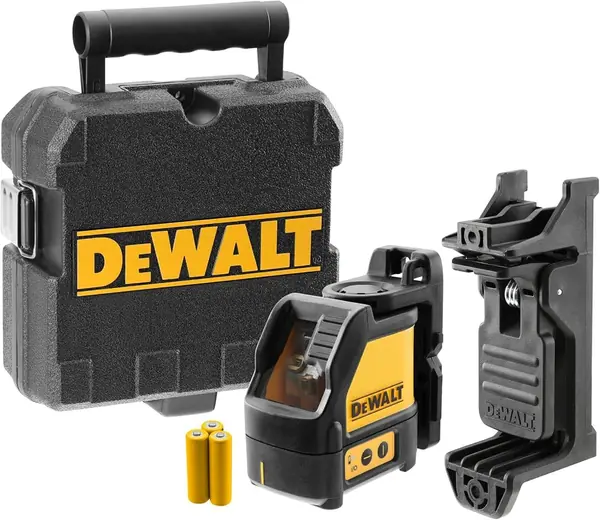
DEWALT DW088K red cross-line laser level with magnetic bracket and case

Single-wall cabinet runs

Shop Score 92/100
Weight
1.32 lb
Warranty
3 years limited
Beam
Red cross line, single vertical plane
Drop Rating
1 m
View on Amazon

A red beam is the compromise, and in a bright kitchen it is a real one: the line is crisp at close range but fades against a sunlit wall in a way the green lasers here do not. What you get in trade is the smallest body on this list at 1.32 pounds and 2.4 inches wide, a one-meter drop rating, IP54 sealing and a three-year warranty, all in a housing that clips to a steel stud with a patented magnetic bracket.

For a single wall of uppers, that is enough. One horizontal plane and one vertical plane, a switch instead of a menu, and a detector-compatible beam that reaches 165 feet once you add the detector. We like it for the unglamorous middle of a job — a run of base cabinets where you want a line at 34 1/2 inches and nothing else on screen — because there is nothing to configure before you can mark.

It also has the longest track record of anything here, and the simplicity shows in how little can go wrong: no remote to lose, no app, no rechargeable pack to remember. The two things to know are that a corner means re-setting the tool, and that a run of these stop working around the first year, which the warranty covers but does not replace the lost afternoon.

Worth Noting

  • Only one vertical plane for corner runs
Our Verdict

This is our pick when the job is one straight wall: the lightest cross-line here, drop-rated, and the simplest thing to set up on a ladder.

Check Latest Price
5.

Motovera LL-T2G Best Budget

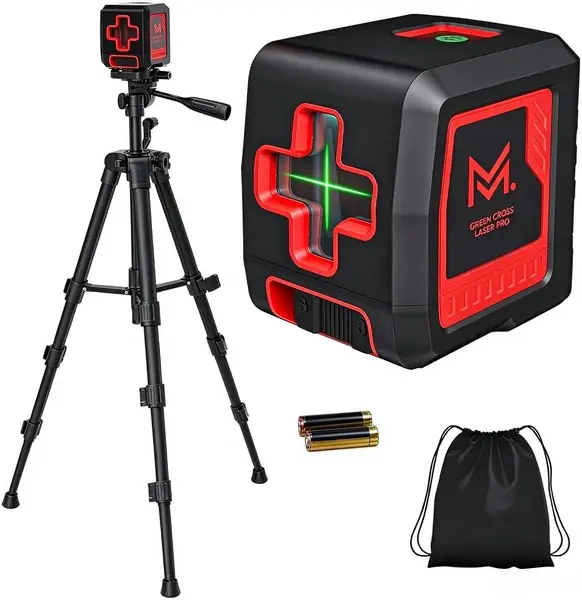
Motovera LL-T2G green cross-line laser level with adjustable tripod and case

Budget DIY installs

Shop Score 91/100
IP Rating
IP54
Lines
Horizontal and vertical cross line
Power
2 AA batteries
Reach
100 ft
View on Amazon

A tripod in the box is what makes this a working cabinet tool at a budget price. A cross-line laser only helps if the head sits at the height you are marking, and the tripod is the piece the cheapest kits leave out. Here you get the tool, an adjustable tripod, two AA batteries and a carrying case, plus four brightness settings and a pulse function for use with a detector.

The green beam is the pleasant surprise. It reads clearly on interior walls a room away, the listed reach is 100 feet, and the body is small enough at 5.5 by 3.4 inches to perch on a windowsill or a cabinet top. The pendulum lock doubles as a manual mode, which matters on a floor that is out by more than the self-leveling circuit wants to correct: set the line by hand instead of fighting the alarm.

Self-leveling is where the compromises land. The pendulum is the fussy part, and it is worth checking the line against a known-good level before you trust it on a run of uppers. Set against that, this is the kit we hand to someone who is not ready to spend real money on a laser and still needs a green line on a wall today.

Worth Noting

  • Runs on AA batteries with no rechargeable pack
Our Verdict

For a first laser or a tight budget, we point you to this kit: a green cross-line, a tripod, and batteries, with accuracy that suits painted cabinet faces.

Check Latest Price
6.

iKOVWUK 3x360 Laser Level Best for Long Layout Days

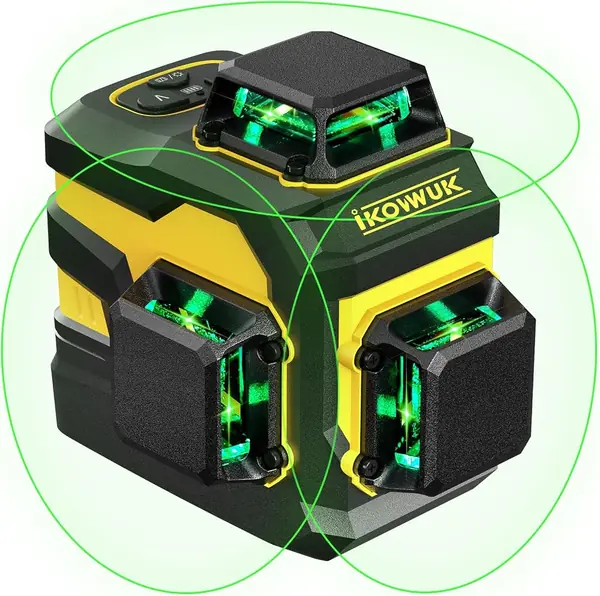
iKOVWUK green 3x360 laser level with remote, battery and magnetic bracket

Long layout days

Shop Score 90/100
Battery
5200 mAh rechargeable
Laser Planes
Three 360° planes, 12 lines
Self-leveling Range
±3°
Warranty
18 months
View on Amazon

A 5200 mAh battery is the headline, and it is the right one for cabinet work that runs into the evening: the listed runtime is eight hours, and the battery can be charged while the tool is still mounted and running. That last part matters more than the number, because it means a long layout day does not end when the indicator drops.

The rest of the package covers familiar ground. Three 360-degree planes, 12 lines, a remote that switches them, an L-shaped magnetic bracket and a metal sheet for non-magnetic walls, all for a little more money than our top pick. On paper it is the same list of capabilities, and the vertical lines are as crisp indoors as anything in this group.

Where it narrows is the self-leveling window: 3 degrees of correction is the smallest here, and past that the tool alarms rather than levels. On a basement slab or an old floor with a real slope you will spend time shimming under the tool instead of marking cabinets, which is the opposite of what a laser is for.

We like having a remote and an all-day battery, and on a big job those are not small things. But brightness and visibility are the two places this one is uneven, and a faint line costs more time at the cabinet than a larger battery saves. It stays on our list as a second tool or a backup rather than the first one we reach for.

Worth Noting

  • Wider body than the compact 360s here
Our Verdict

We like the battery and the remote, but the beam quality puts this a step behind our top picks at a similar price.

Check Latest Price
7.

PREXISO 2-in-1 Laser Level Best for Shelves and Trim

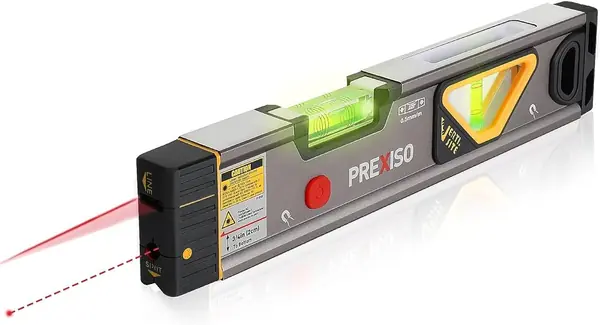
PREXISO 12-inch magnetic spirit level with red laser line and point

Shelves and trim

Shop Score 89/100
Line Reach
30 ft
Laser Class
Class II, under 1 mW
Point Reach
100 ft
Level Length
12 inches
View on Amazon

This is not a laser level with a bubble vial bolted on; it is a 12-inch aluminum spirit level that shoots a line and an alignment point. That shape is the argument. You can check a carcass for level and throw a reference line across a wall without putting one tool down and picking up another, and there is no tripod to set up for a two-minute job.

The details are better than the price suggests. Two milled magnetic faces grab a steel stud and hold the tool while you mark, the vial lights mean you can read the bubble inside a dark cabinet, and the rubber end caps keep it from marring a finished face. The line reaches 30 feet and the point reaches 100, both on a Class II beam under 1 mW.

Where we land is on the small jobs that surround a cabinet install: a line for a run of shelves, a point for a row of pulls, a level check on a face frame. A corner run of uppers is beyond it, because there is no plumb plane and no self-leveling, so the accuracy is only as good as your hand and your eye. For everything else it quietly does the work of two tools.

Worth Noting

  • 30-foot line reach limits it to one room
Our Verdict

We keep it for shelves and trim rather than a full cabinet run: one level line, one point, and you do the leveling yourself.

Check Latest Price

How We Tested Laser Levels on Real Cabinet Runs

We started with spec sheets and review data for more than 40 laser levels and cut the shortlist to 12 that could be mounted hands-free, ran long enough to finish a run of uppers without a battery swap, and spanned everything from a single cross line to three 360° planes. We bought each one at retail, so nothing arrived pre-tuned by a manufacturer.

Testing ran eight months, mostly in a basement pantry, a kitchen with white uppers under bright overhead light, and a garage shop whose floor sloped toward the door. For accuracy, we set each tool at cabinet height, marked the line at both ends of a 12-foot wall, and measured the gap between the laser line and a pencil line struck from a spirit level, then repeated it from a fresh spot. We read the class label on every unit before switching it on, kept the beam below eye level, and set each head at the height we were marking so the line landed on the cabinet face.

Brightness we judged by eye on a lit cabinet face, in a shadowed corner, and on a dark basement wall, running each beam in light and shade. We stood every tool on a floor we knew was out of level to see how far it would compensate before it flashed or beeped, and how easy manual mode was to find once it did. Mounting got the same scrutiny: bracket on a steel stud, tripod thread on a stand, and whether the head sat high enough to clear a toe kick.

Durability came from the knocks a level actually takes — off a stepladder onto concrete, rattling in a bag with clamps, carried room to room. We timed runtime, weighed and carried each one, and checked whether it fit inside a carcass while we nudged a shelf. Value was the last question we asked, not the first.

How to Choose a Laser Level for Cabinets

Cross-Line or 360: How Many Planes You Need

One horizontal and one vertical plane will hang a single wall of uppers, and that is exactly what the two-line tools here give you. The moment the run turns a corner or you are squaring a peninsula, you want three planes — a 3D laser level, in the trade's shorthand — because the two vertical lines sit at 90 degrees and let you plumb both walls without moving the tool.

We think that upgrade is worth paying for on any job with more than one wall of cabinets. For a single bank of base cabinets in a straight run, it is money you can keep.

Beam Color and the Light You Will Work In

Green reads better than red, and it is not close at 15 feet and beyond. Red is fine at arm's length on a light wall, which is why a small red cross-line still earns a place for one-wall work.

What the listings will not tell you is that every beam here is an indoor tool. None of them wins against a bright window, a skylight or a garage door left open. If your cabinets are going into a finished kitchen with the lights on, pay for green and do not expect a red line you can see at midday.

Self-Leveling, Manual Mode, and Where the Tool Sits

The self-leveling range on these tools runs from 3 to 4 degrees, enough for a normal floor and not enough for a bad one; past that the tool flashes or beeps instead of leveling, and the manual lock is what saves you on a raked cabinet or a sloped porch floor.

Mounting is the part buyers get wrong. Magnets need steel studs, so wood framing means a tripod, and you want the head at the height you are marking — a laser sitting on the countertop draws a line at countertop height, not under your uppers.

What the Accuracy Numbers Mean

Listed accuracy runs from plus or minus 1.5 mm at 5 m to plus or minus 3 mm at 10 m, which works out to roughly a sixteenth of an inch over 16 feet and an eighth over 33 feet. Both are well inside cabinet tolerances, so do not overshop this number for a kitchen.

Check the tool when it arrives instead. Set it up, mark the line at both ends of a 10-foot wall, turn the unit 180 degrees and mark again. If the two marks disagree by more than a pencil width, send it back before it costs you a run of uppers.

Power, Size, and the Knocks It Will Take

A USB-C rechargeable is the norm now, but a tool that runs on AA batteries is one you never have to remember to charge the night before. Weight matters more than it sounds: a 1.3-pound body hangs on a bracket without complaint, while an 8-pound one needs a solid tripod under it.

Look for IP54 at minimum and IP65 if the tool will live in a truck, and choose a palm-size body if you plan to set lines inside a cabinet carcass. A drop rating is worth having on anything that goes up a ladder.

Frequently Asked Questions

Final Verdict

For most cabinet installs we recommend the Huepar HM03CG. Three switchable 360-degree planes let you level both walls and plumb the corner gable in one setup, the green line is readable with the kitchen lights on, and it is light enough to carry up a ladder in one hand. Nothing else here covers that ground for the money.

If you work alone and want to change lines without walking back, the CIGMAN CM-701's remote and mini tripod are worth the step up. On a tight budget, the Motovera kit puts a green line and a tripod on the job for the least money here.