↑↓ navigate ↵ open Esc close All results →

Best Laser Level Poles of 2026

A standard tripod tops out long before a reference line needs to hit a soffit or ceiling grid. A telescoping laser pole bridges that vertical gap by wedging a spring-loaded column between floor and ceiling at whatever height the layout calls for, though holding that tension steady without slipping is the whole test.

Across eight months of setting up 12 poles in basements, half-tiled bathrooms, and a sloped garage, headline max height mattered far less than clamping strength under a heavy laser, solo adjustability, and whether the bracket offered both 1/4-inch-20 and 5/8-inch-11 threads.

Because spring pressure can dent soft drywall and a top-heavy laser easily tips an unweighted tripod base, poles belong against solid framing with a skid plate installed and weight kept low when free-standing. Seven models managed that balance cleanly.

Our Top Picks

The Best Laser Level Poles

1.

Huepar LP36A Laser Level Pole Best Overall
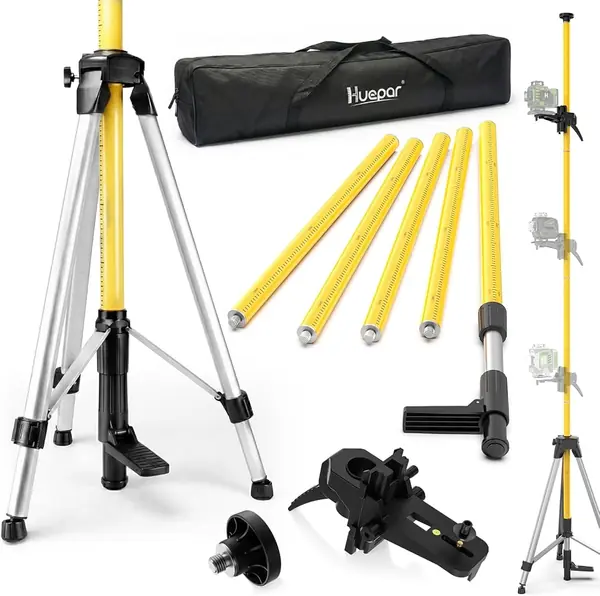
Huepar LP36A yellow telescoping laser level pole with tripod, mounting bracket and carry bag

Ceilings, tile, cabinets

Shop Score 88/100
Laser Mount
1/4-inch-20 male thread plus 5/8-inch-11 adapter
Max Height
12 ft (3.7 m)
Tripod
Aluminum with built-in bubble
Rod Sections
Four telescopic plus tail rod
View on Amazon

Four rod sections, a spring-loaded tail, a bracket, a tripod, and a bag: the LP36A is the kit we tell most people to buy first. The bracket carries a 1/4-inch-20 male thread and the box includes a 5/8-inch-11 adapter, so the same pole takes a line laser for cabinets and a rotary for grading without a second purchase. Nothing here is exotic, and that is the appeal: it is the version of this tool that a finish carpenter and a weekend tiler can both use.

Height is built by screwing sections together until you are close, then tensioning the spring base against the ceiling and locking the bracket where the line needs to be. The ball-jointed head plate is a detail we appreciate, because it lets the top plate sit flat when the ceiling runs out of level, which is most ceilings. The bracket slides the full length of the pole, so the laser goes where the work is rather than where the stand happens to sit.

The tripod earns its place on a finished floor with nothing overhead to push against: under a soffit, mid-room, on a landing. Where there is a ceiling, we usually leave the stand in the bag. Propping the pole takes one person about a minute and gives a taller, steadier reference than any of these lightweight stands, and the skid plate keeps the pressure off a single point overhead.

What settles it is the combination: 12 feet of reach, both thread standards, and a bag that swallows every piece, at a price that sits in the middle of this group rather than at the top. If you are buying one pole to hang cabinets, set tile, and mark a ceiling, this is the one that covers all three without a second mount. For a first pole, or a replacement for one that has stripped its joints, that is the whole argument.

Worth Noting

  • Tripod leg clamps can let the legs creep
Our Verdict

We recommend the Huepar LP36A as the default: it reaches 12 feet, takes both common laser threads, and includes the tripod and bag most shoppers would otherwise buy separately.

Check Latest Price
2.

MUTOOP 15.8 Ft Laser Level Pole Best for High Ceilings

MUTOOP 15.8-foot laser level pole with aluminum tripod, green bubble level and padded carry case

Vaulted ceilings, stairwells

Shop Score 87/100
Laser Mount
1/4-inch-20 plus 5/8-inch-11 adapter
Max Height
15.8 ft (4.8 m)
Collapsed Length
31.5 in
Weight
9.28 lb
View on Amazon

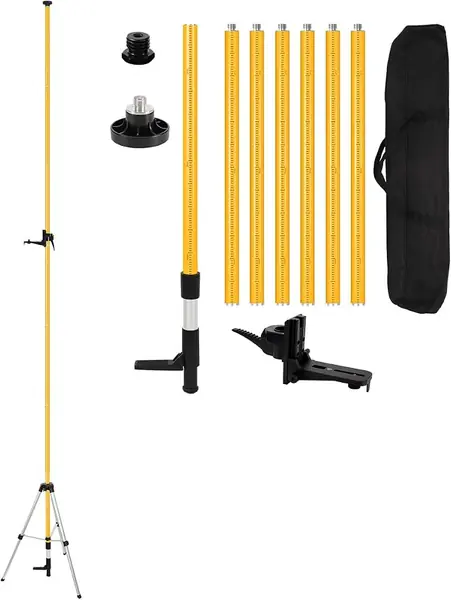
Nearly sixteen feet of reach is more than most of us need, and it is exactly why this kit is here: when the room is the problem, a 12-foot pole leaves you short. Six rod sections plus a tail get the bracket to a listed 15.8 feet, which covers a vaulted ceiling, a stairwell, or the upper half of a two-story foyer where a standard kit runs out of pole. We keep it for those jobs and reach for a shorter, lighter kit the rest of the time.

What earns its keep for us is the fine-tune knob on the bracket, which moves the laser as much as 2.75 inches up or down without collapsing and re-threading a section. The three legs adjust and lock independently, and a green bubble on the head tells you whether the stand is sitting level before the laser goes up. On a ceiling layout, that is the difference between nudging a line onto your mark and rebuilding the pole.

The height is paid for in time. Six sections mean six joints to thread before the pole is up, and the first assembly is the slow one, since the sequence makes more sense laid out on the floor than overhead. It packs down to 31.5 inches in a padded case, so it travels like the shorter kits even though it stands taller than all of them.

Worth Noting

  • Heavier at 9.28 pounds than the 12-foot kits
Our Verdict

We reach for the MUTOOP when a 12-foot pole will not span the room: 15.8 feet of reach, independent legs, and a fine-tune knob that saves re-threading sections.

Check Latest Price
3.

FenorGan 4.2M Laser Level Pole Best for Uneven Ground

FenorGan yellow 13.8-foot telescoping laser pole with retractable aluminum tripod and carry bag

Sloped, uneven floors

Shop Score 86/100
Laser Mount
1/4-inch-20 plus 5/8-inch-11
Max Height
13.8 ft (4.2 m)
Collapsed Length
31.4 in
Tripod
3.9 ft (1.2 m) retractable with crank
View on Amazon

The crank on the tripod column is the reason to look at this kit. Instead of collapsing sections to move the laser a few inches, you turn a handle and the whole pole rises or drops. The pole also screws straight into the tripod head rather than into a separate clamp, which makes for a shorter assembly to carry in from the truck and one less joint to work loose.

Where that pays off is a floor that is not level. Each leg adjusts on its own, so the stand sits square on a sloped drive, a step, or a garage slab with a drain cut through it, and the crank brings the laser to height without hunting for flat ground. That is a real advantage over section-only kits, and it is why this is the one we take to a renovation that has not been finished yet.

The rest of the kit is ordinary in a way that suits the money: six rod sections and a tail reach 13.8 feet, the bracket takes 1/4-inch-20 and 5/8-inch-11, and everything folds into a 31.4-inch bundle with a bag. One thing to plan for: the base is light, so a heavy rotary mounted high will pull it forward. Brace a leg against a wall or bring the laser down a foot and the problem goes away.

Worth Noting

  • Adjustment dials feel light for site work
Our Verdict

Its crank-elevated tripod is what sets this kit apart on renovation work: raise the laser to height without re-threading a single section.

Check Latest Price
4.

Mountlaser SP2 Laser Level Pole Best Budget

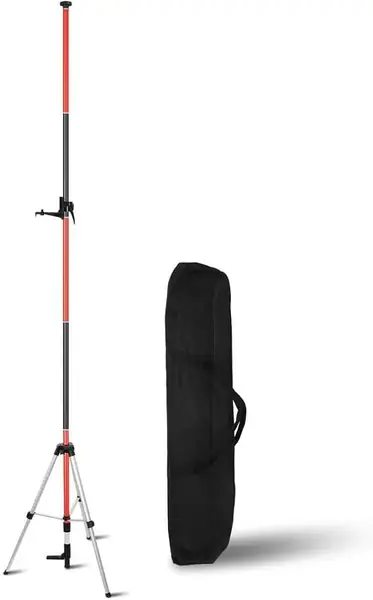
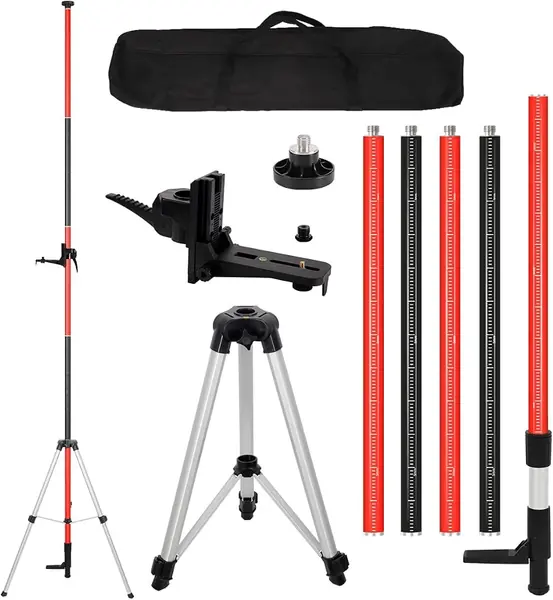
Mountlaser red and black telescoping laser level support pole with tripod and mounting bracket

Budget home projects

Shop Score 85/100
Laser Mount
1/4-inch-20 plus 5/8-inch-11
Weight
7.76 lb
Listed Length
125.39 in
Pole Sections
Five aluminum sections
View on Amazon

The bracket is molded plastic with a socket cut to the pole's 1.24-inch diameter, and it slides and locks with a screw clamp. Plain as it looks, the mount is the part of this kit we have had the least trouble with: it moves smoothly, it stays where you set it, and both thread sizes are there for line and rotary lasers.

Five aluminum sections with a polyurethane coating make up the pole, and the listing gives an overall length of 125.39 inches, a bit over ten feet. That is the one figure to check before you buy: propped floor-to-ceiling, this pole will not span a tall room the way the 12-foot kits do. On the tripod the pole's length stops mattering, because the laser rides at whatever height the stand gives you.

What lets it down is the stand itself. The light base and the leg joints are what move when the laser goes up high, and the fix is the same one we use on every tripod here: weight it, or brace the pole. Given the price, that is a fair trade, and in a normal-height room this kit does everything the midrange ones do. We point budget buyers here first, then point them at the Huepar if the work is in tall rooms or the tripod will be doing most of the holding.

Worth Noting

  • Bracket is plastic rather than metal
Our Verdict

The cheapest complete kit here, and the one we hand budget buyers first when the ceiling is a normal height.

Check Latest Price
5.

Firecore FLP400A Telescoping Laser Pole Best for Propping Under Ceilings

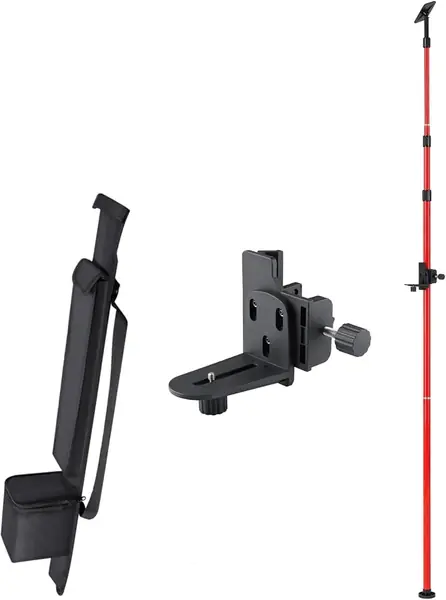
Firecore FLP400A red telescoping laser pole with ceiling skid plate, bracket and carry bag

Propping under ceilings

Shop Score 84/100
Laser Mount
1/4-inch-20 plus 5/8-inch-11 adapter
Max Height
157 in (13 ft)
Sections
Three twist-lock
Minimum Height
51 in
View on Amazon

Three twist-lock sections do the work of a stack of threaded rods: extend, twist, and the pole is up. That is the whole appeal here, and it is real when you are moving between rooms, with no sections to screw together and no joint to hunt down after it worked loose on the last trip.

A skid plate on a ball joint sits at the top, so the pole can lean into a sloped ceiling and still hold, and the bracket clamps anywhere on the rod with 1/4-inch-20 and 5/8-inch-11 threads. That clamp is sized to grip other pipes too, which is worth knowing if you already own a stand and only want the rod.

For a hallway, a stairwell, or a closet where the floor is full of furniture, this is the fastest rig in the group, and it is why it stays on our list. Two cautions. Fine adjustment is coarse compared with a knob-driven bracket, so plan to nudge the section rather than dial a line in. And the bracket is plastic with cast aluminum threads, which is where a heavy laser worries us.

Worth Noting

  • No tripod or stand in the kit
Our Verdict

A pole-only kit that goes up fastest where there is a ceiling and no floor space; you supply the stand.

Check Latest Price
6.

KEZERS FLP370B Laser Level Pole

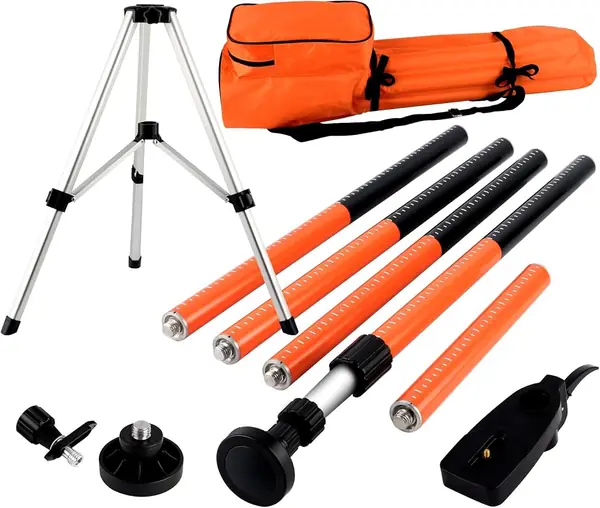
KEZERS orange 12-foot laser level pole with aluminum tripod, mount bracket and soft carry bag

Flat-ceiling basics

Shop Score 83/100
Laser Mount
1/4-inch-20 plus 5/8-inch-11 adapter
Max Height
12 ft (3.7 m)
Rod Sections
Three 23.6 in, one 11.8 in, plus tail
Tripod Height
18.9 to 33.1 in
View on Amazon

The FLP370B is the conventional 12-foot kit: four sections, a spring tail, a bracket with both thread sizes, a tripod with a bubble in the head, and a bag. If you want a pole that behaves the way the pictures suggest, this is the simplest version of that on our list, and it is the one we point to when someone does not want to think about which mode to use.

The section lengths are where the thought went in. Three run 23.6 inches and one runs 11.8, and that short one gives you a finer step when the ceiling height lands between the long pieces. The tail then telescopes through 20.9 inches of spring-loaded travel to press against the ceiling. Build the pole short, stand it up, and let the tail take the last stretch rather than forcing an extra half turn on a joint.

Everything else is what you expect: a 5/8-inch connection between rods, a 10-millimeter wall, and a tripod that adjusts from 18.9 to 33.1 inches. It costs about what our top pick does and works the same way, but the Huepar's ball-jointed top plate handles an out-of-level ceiling better. If your ceilings are flat, that difference disappears and this one is just as good.

Worth Noting

  • Lacks a ball-jointed top plate for uneven ceilings
Our Verdict

A straightforward 12-foot kit at the same money as our top pick; buy it if your ceilings are flat and you want the simplest setup.

Check Latest Price
7.

MOETER 12 Ft Laser Level Pole Best for Tight Budgets

MOETER 12-foot aluminum telescoping laser level pole with tripod and thread adapter

Tight budgets

Shop Score 81/100
Laser Mount
1/4-inch-20 plus 5/8-inch-11
Max Height
12 ft (3.7 m)
Collapsed Length
31 in
Sections
Five adjustable
View on Amazon

Five adjustable sections marked in inches and feet, a screw clamp for the bracket, a bubble in the tripod, and a listed 12 feet of reach from a 31-inch bundle: the MOETER covers the same ground as the kits above it for less money. The pole is aluminum with a polyurethane coating, and both thread sizes are in the box, so it takes the same lasers the others do.

There is nothing clever here, and in a normal-height room you will not miss it. We rank it just behind the Mountlaser, whose bracket and clamp we prefer for a long day of small moves; the step up to a midrange kit buys a sturdier stand and better fittings. If the budget is the deciding factor, this one still puts the line on the ceiling.

Worth Noting

  • Stand and fittings are less sturdy than midrange kits
Our Verdict

Plain and complete, this is the cheapest way to get a 12-foot pole, a stand, and both threads in one box.

Check Latest Price

How We Tested the Laser Level Poles

We started by pulling every telescoping pole we could find that shipped with its own tripod and laser mount, then filtered the field on the things that rule a pole out before you ever set it up: whether it had both a 1/4-inch-20 male thread and a 5/8-inch-11 adapter, its stated maximum height, its collapsed length, and what came in the box for the price. That cut the list to 12 poles, which we used for eight months.

Testing happened where poles actually get used. We set them up under a basement ceiling grid, in a half-tiled bathroom, over a kitchen counter during a cabinet install, and on a garage slab that slopes. For each one, we timed a solo setup from bag to a level line, counted the locks between collapsed and full extension, and noted how the height adjustment worked — threaded sections, twist locks, or a crank. Then we mounted a rotary laser on the 5/8-inch-11 adapter and a line laser on the 1/4-inch-20 thread, checking for thread slop, and ran the bracket through its fine adjustment to see how far we could nudge the line before the pole itself had to move.

With a laser mounted, we loaded the tripod, pushed against the pole, and watched whether the leg clamps crept under the weight. Up top we pressed the base into the ceiling and watched for shifting and for the ring it left in drywall — the skid plate helped, and those marks were a reminder to weight the tripod and keep heavy lasers low. We measured collapsed length with a tape and weight on a luggage scale, noted whether a bag came in the box, and checked that the locks held the sections shut in transit. Over eight months we re-checked every clamp and lock for slop.

How to Choose a Laser Level Pole

How the Height Actually Works

Most 12-foot kits are not one sliding mast. They are four or five aluminum sections you screw together, plus a spring-loaded tail that takes up the last stretch against the ceiling. Height arrives in roughly two-foot steps and setup costs a minute of threading, which is fine once per room and tedious when you are chasing a line up a wall.

Twist-lock sections and crank-elevated tripods are the two ways out, and both are worth the money if you change height all day. Beware the word in the title: telescoping does not promise a smooth slide, so check whether the sections thread together. And measure the room first, because a 12-foot pole covers an ordinary ceiling with room to spare while the tall kits are for foyers and stairwells.

The Bracket Does More Than the Threads

Every kit here carries a 1/4-inch-20 male thread and a 5/8-inch-11 adapter, so thread size will not decide your purchase. The bracket around it might. Look for a fine-adjust knob that shifts the laser an inch or two without touching the pole; on a ceiling layout that is the difference between nudging a line onto a mark and rebuilding the pole.

Plastic brackets are normal at this price and do the job, though metal ones hold a heavy rotary with less flex. If you already own a stand, check whether the bracket clamp grips other pipe diameters before you pay for a second tripod.

Tripod Stability Is the Weak Point

A 12-foot pole is a lever, and the tripod under it is a small base with plastic joints. Creeping leg clamps, a light frame, and a heavy laser mounted high all add up to movement at the top, which is exactly where the line is.

Weight the tripod with a sandbag or a jug hung from the center, keep the laser as low on the pole as the job allows, and prefer a compact line laser over a big rotary when the bracket is near the top. Our usual answer is to skip the tripod entirely and prop the pole against the ceiling, which is stiffer than any of these stands.

Length, Weight, and Storage

Collapsed, these kits run about 31 to 32 inches and 7 to 9 pounds, and each one here ships with a bag or case. That is a package that rides in a truck cab or stands in a closet, but the difference between the lightest and heaviest shows up on a flight of stairs.

If the pole lives in one shop, take the heavier, taller kit and enjoy the reach. If it travels to jobs, weigh the height you actually need against the pounds you will carry up a ladder.

Frequently Asked Questions

Final Verdict

We start with the Huepar LP36A for almost everyone: 12 feet of reach, both thread standards, a tripod, and a bag, at a price in the middle of this group. It is the kit that covers cabinets, tile, and ceilings without a second purchase, and its ball-jointed top plate handles the ceilings that are never quite level.

If the room is the problem, the MUTOOP's 15.8 feet is worth the step up for a stairwell or a vaulted foyer. And if the budget is fixed, the Mountlaser does the same work in a normal-height room for the least money.