↑↓ navigate ↵ open Esc close All results →

Best Rotary Laser Levels of 2026

Swapping a two-person string line for a spinning laser solves the layout bottleneck, yet buyers routinely misread the single number that governs site coverage. Working range on a rotary laser level is listed as a diameter rather than a radius, so a 1,000-foot rating reaches roughly 500 feet in any direction from the tripod. When a single person needs to check grade at the far corner of a pad without walking back to a benchmark, that distinction decides whether the unit covers the lot.

Through nine months on basement slabs, gravel driveways, and rain-soaked barn pads, we tested six rotary laser kits to see how they held plane in rough conditions. Self-leveling range mattered just as often as beam distance, because on sloped ground a unit that cannot find level on its own sends you straight back to adjust the tripod legs.

Grading long runs, shooting flat slabs, and working muddy jobsites each demand different protection, and every kit ranked here includes the receiver, tripod, grade rod, and hard case needed to put the beam to work.

Our Top Picks

The Best Rotary Laser Levels

1.

Bosch REVOLVE900 Rotary Laser Kit Best Overall
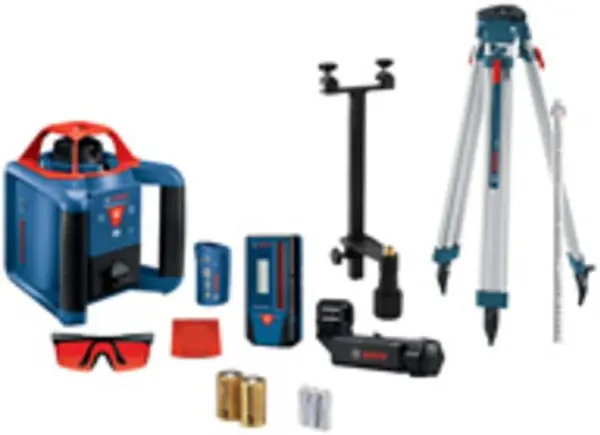
Bosch REVOLVE900 black rotary laser kit with tripod grade rod and receiver

Leveling and layout

Shop Score 92/100
Kit Contents
Laser, LR10 receiver, tripod, 8-ft. grade rod, remote, case
Working Range
Up to 1,000 ft. with LR10 receiver
Accuracy
+/-1/8 in. at 100 ft.
Beams
Horizontal and vertical with 90-degree point
View on Amazon

What sells us on the REVOLVE900 is the case, not the laser. Open it and the LR10 receiver, a BT160 tripod, an 8-foot grade rod, a remote, batteries, and a wall mount are all there. Rotary lasers at this level usually arrive as an instrument and a receiver, with the tripod and rod as separate purchases, so a kit that closes that gap is worth real money to anyone who wants to shoot grade the afternoon it lands.

The laser covers more ground than most of us own. Working range runs to 1,000 feet with the LR10, at plus or minus 1/8 inch per 100 feet, which puts the error under a tenth of an inch at the far end of a typical residential lot — tight enough to trust under a slab or a wall plate. Self-leveling works in both planes, so the same tool plumbs a post, squares a deck frame with the 90-degree point, and checks footing elevations, and the disturbance monitor tells you the moment someone brushes the tripod.

The beam is red, so in direct sun you'll be reading the receiver's display and listening for the tone rather than spotting the beam itself; the LR10 handles that without drama. The remote earns its place too — nudging the scan from the far end of a slab saves a walk back to the tripod.

Worth Noting

  • 8-foot grade rod limits tall elevation checks
Our Verdict

We send most buyers to the REVOLVE900 because it self-levels in both planes and arrives with the tripod, rod, and receiver, so grading and framing start on day one.

Check Latest Price
2.

Topcon RL-H5A Rotary Laser Level Best for Long-Range Grading

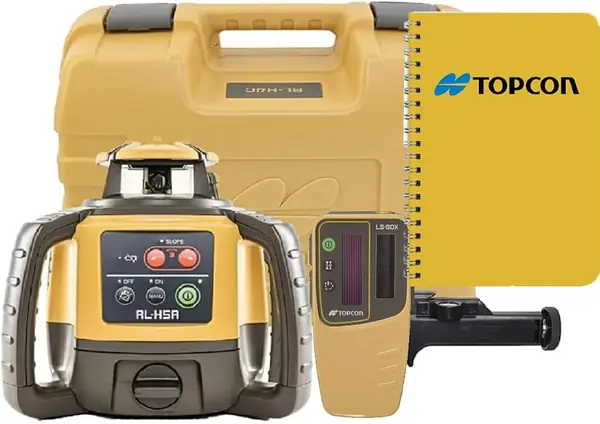
Topcon RL-H5A yellow rotary grade laser with LS-80X receiver and carry case

Long-range grading

Shop Score 91/100
Working Range
2,626 ft. (800 m) diameter
Weather Rating
IP66
Battery Life
Up to 100 hours
Self-leveling Range
+/-5 degrees
View on Amazon

A hundred hours on one set of batteries is the figure that separates the RL-H5A from everything else in this group. Load it at the start of a grading season and forget it; the 2,626-foot working diameter means one setup covers a subdivision lot that otherwise takes two. The IP66 housing makes it a grade laser that can live in a truck bed, and the Class 2 rating is the gentler of the laser classes represented here.

What we appreciate most is how little attention it asks for. Press power, the laser levels itself, and if the tripod gets knocked it re-levels on its own. That is the tool we reach for when there is no second person to hold a rod and no patience for a setup routine, and at 2.4 ounces for the instrument it goes from case to tripod in one hand.

The LS-80X receiver is a big part of why it works in the field: clip it to a rod and it reads elevation and sounds a tone, so you can work alone in bright sun where no red beam is visible to the eye. Slope entry is a button sequence rather than a dial, and it repays practice on a driveway before you need fall on a drainage run.

Worth Noting

  • No tripod or grade rod included
Our Verdict

We point crews with big sites to the RL-H5A: it out-ranges and outruns everything here, though you supply the tripod and rod yourself.

Check Latest Price
3.

Johnson Level 99-027K Rotary Laser System Best Value Kit

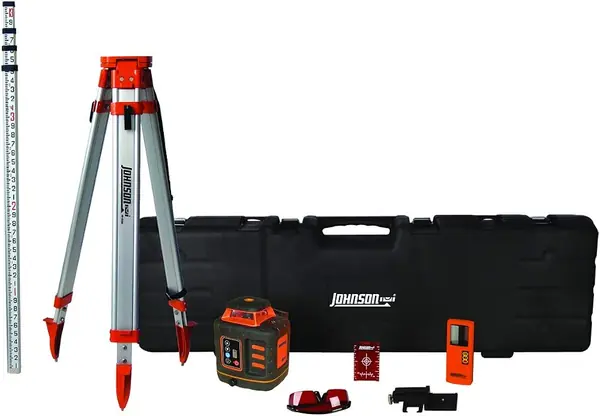
Johnson 99-027K orange rotary laser system with tripod grade rod and hard case

Large flat sites

Shop Score 90/100
Kit Contents
Laser, detector, tripod, 13-ft. grade rod, hard case
Weather Rating
IP66
Accuracy
3 in. per 100 ft.
Working Diameter
2,000 ft.
View on Amazon

Two thousand feet of working diameter, plus a tripod, a detector, a 13-foot grade rod, and a hard-shell case in the box, and it still comes in below the premium kits here. For flat work spread over a large area, that combination is hard to argue with, and it is the reason this kit stays in the guide rather than getting lost among the bigger names.

Where it wins us over is coverage with a short setup. Horizontal self-leveling plus a locking compensator, which protects the pendulum in transit, gets you shooting grade in seconds, and the vertical manual mode with a 90-degree split beam handles layout and squaring. The listed accuracy of 3 inches per 100 feet is the loosest in this group; for drainage, pier heights, and form boards that is plenty, and for trim-level finish work inside a room it is not.

Where this one earns its keep is flat work over a big footprint: slabs, footings, form boards, and checking a whole lot's elevations before you cut. It is also the kit we hand someone who wants the tripod and rod included without moving into premium money, and the IP66 housing means a dusty site or a hose-down is not the end of it.

Worth Noting

  • No slope or grade-matching function
Our Verdict

We recommend the 99-027K for flat work over big areas: 2,000 feet of coverage with the tripod and rod in the box, at the lowest kit price here.

Check Latest Price
4.

Spectra Precision LL300N-1 Rotary Laser Kit Best Rugged Kit

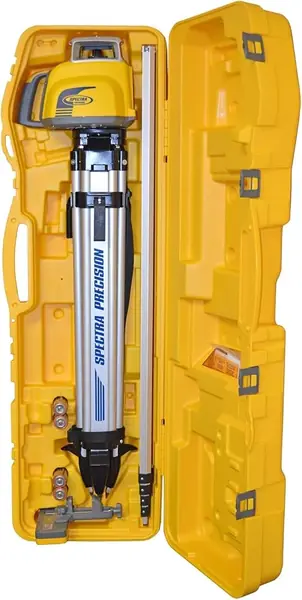
Spectra Precision LL300N-1 yellow rotary laser in hard case with tripod and receiver

Rough jobsites

Shop Score 89/100
Kit Contents
Laser, HL450 receiver, tripod, 15-ft. grade rod, case
Working Range
1,650 ft. (500 m) diameter
Weather Rating
IP66
Warranty
5 years
View on Amazon

Three feet onto concrete, or five feet when it is tipped over on a tripod — that is what Spectra rates the LL300N to survive, and the metal sunshade over the rotating head is the part that takes the hit. When the laser gets set up by whoever is free that morning and rides loose in a truck the rest of the week, that rating matters more than another decimal place on a spec sheet.

The rest of the kit is what you would spec for yourself: the HL450 receiver, which shows grade as digits rather than a bar of light, a tripod, a 15-foot grade rod, D-cells, and a hard case that holds all of it. Range runs to 1,650 feet in diameter, and single cross-axis manual slope lets you match a grade while the cross-axis keeps itself level, which is the practical way to hold fall on a driveway without fighting the compensator.

Five years of coverage is the longest in this group, and paired with the IP66 housing it makes this the kit we hand to a crew that works in weather and drops things. The 32 pounds in the case is what all that armor costs, and the case is the reason you carry it from the truck once and leave it there for the week.

Worth Noting

  • Priciest kit in this group
Our Verdict

For crews who treat tools badly, we like the LL300N-1: drop-rated, IP66, five-year warranty, and a receiver that reads grade as numbers.

Check Latest Price

How We Tested Rotary Laser Levels

We started by pulling rotary laser kits from the major manufacturers, then narrowed the field by what a kit actually includes, a receiver, a tripod, a grade rod, and a hard case, along with self-leveling range, listed accuracy, and weather rating. Any kit missing a receiver or a case was out; on a site, the laser by itself is a paperweight. That left six units, which we ran for nine months across basement slab layouts, driveway and fence-line grading, deck piers, and a barn pad that flooded twice.

Each unit got the same first day: set up on a pad with a deliberate fall to it, switched on, and timed to see whether it leveled itself or threw an error and asked for the tripod legs. We walked the receiver out to the far end of the working range in both directions, checking that the reading held, then matched a slope against a grade we had already shot to see how the slope function behaved in practice. Accuracy got checked over distance by reading the same benchmark from 50, 150, and 300 feet and comparing the numbers.

Beam visibility we judged at midday on bare gravel, with and without the tinted glasses that come in the kits. Those glasses sharpen the beam in sun and are not eye protection, so every setup kept the beam below eye level and pointed away from anyone on site, and we never looked into an aperture. We hosed the housings down, nudged each one off a tailgate onto gravel, and logged what still worked. Battery type and runtime got a full day: switched on at 7 a.m., checked again at quitting time. We also weighed each kit in its case and carried it from truck to setup point to see how the handle and strap held up.

How to Choose a Rotary Laser Level

What the Range Number Actually Means

Every rotary laser quotes a working diameter, not a distance to the far edge. A 1,650-foot rating like the Spectra LL300N-1 puts the receiver roughly 825 feet from the laser at the far end of the shot. Halve whatever the box says, then ask whether that covers your longest measurement.

The second half of the range question is the receiver. An invisible red beam in bright sun is the detector's job, and every kit here that reaches past a few hundred feet depends on one. Treat a quoted range without a detector as a fair-weather number and plan accordingly.

What Should Come in the Case

The instrument and the receiver are the minimum. A tripod and a grade rod are where kits separate: the Bosch, Johnson, and Spectra kits include both, while the Topcon is sold as the laser and receiver alone. Price the missing pieces before you compare totals, because a sturdy tripod and a long rod are not cheap, and a wobbly tripod undoes a good laser.

Rod length is the quiet specification. An 8-foot rod is fine for footings and slabs but runs out on tall walls, while 13 and 15-foot rods cover more elevation per setup.

Slope and Grade Matching

If you need fall for drainage, a driveway, or a sewer run, grade matching decides the purchase. Self-leveling handles the horizontal plane; grade matching tilts the beam on purpose, on one axis or two. The Johnson 99-027K is the one here built for level work only, which makes it a fine flat-site tool and the wrong one for a driveway with pitch.

Ask whether slope is manual or automatic and whether the display shows the percentage you dialed in. Manual slope on a single axis is all most residential work needs.

Red or Green, and How You Will See the Beam

Outdoors in sun you do not see any of these beams, you read the receiver. That makes beam color less important than the detector's display and tone: green is easier to pick up indoors and in shade and usually costs more, while red is standard and works fine with a good receiver.

Laser class matters too. Class 2 is the gentler rating and Class 3A is brighter, so it deserves more care around bystanders. Whichever you buy, never aim the beam at eye level, and treat the tinted glasses in the case as beam enhancement rather than eye protection.

Power, Weather Rating, and Where It Lives

Runtime is quoted in ideal conditions, so read 100 hours as a long time rather than a guarantee, and check what the tool eats. Alkaline C or D cells are cheap insurance and always available; a rechargeable pack is convenient right up until it is flat with no outlet on site.

IP66 — dust-tight and washdown-rated — is the rating to look for on anything that lives outside, and the Topcon, Johnson, and Spectra kits all carry it. If your grade laser spends its nights in a truck, that rating and the drop protection matter more than an extra feature.

Frequently Asked Questions

Final Verdict

The Bosch REVOLVE900 is the rotary laser we point most people to, because it self-levels in both planes and still arrives with the tripod, rod, and receiver, so grading, plumbing, and squaring all work from one case.

If your sites are large and you already own support gear, the Topcon RL-H5A buys you the range and runtime nothing else here matches. If the tool will be dropped and rained on for years, the Spectra LL300N-1 earns its premium with a five-year warranty and a metal sunshade. And for flat work on a wide lot, the Johnson 99-027K covers the ground with the rod and tripod already in the box.