↑↓ navigate ↵ open Esc close All results →

Best Stud Finders with Wire Detection of 2026

Guessing behind drywall by tapping with a knuckle ends one of two ways: an anchor spins loose in hollow plaster, or a drill bit catches hidden wiring. A stud finder with live AC detection turns blind drilling into a measured step by marking framing edges while flagging energized cables nearby.

Putting 14 edge-finders and multi-sensor scanners to work for six months—from hanging shelves on 1950s plaster-and-lath walls to checking ceiling joists one-handed from a step stool—proved that sensor count is no gimmick. Multi-sensor bars illuminate a stud's full width at once and hold calibration without drifting mid-pass, whereas single-sensor tools leave you interpreting isolated blips.

Repeatability across back-to-back passes builds real confidence, though live-wire detection remains a cautionary signal rather than a complete map of what runs inside the cavity.

Our Top Picks

The Best Stud Finders with Wire Detection

1.

Franklin Sensors ProSensor M210 Best Overall
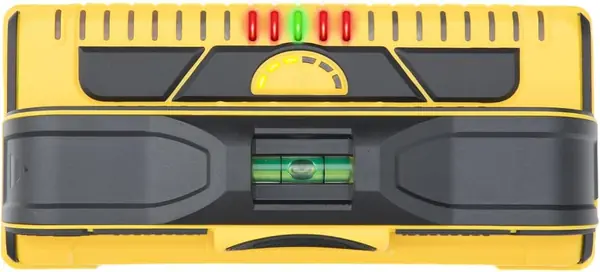
Franklin Sensors ProSensor M210 stud finder with LED sensor bar and live wire warning

Heavy wall mounting

Shop Score 93/100
Weight
11.4 oz
Wire Detection
Live AC warning
Sensor Count
13
Detection Depth
Up to 1.7 inches
View on Amazon

Thirteen sensors sit across the nose of the M210, and the display makes them count: press the button and a bar of LEDs lights up for the full width of the stud, then narrows toward the center. That is a different experience from the one-beep scanners most of us start out with, where you creep along the wall and hope the reading holds. When a fastener has to land dead center, in a TV bracket, a wall cabinet, or a stair handrail, seeing the whole stud takes the guesswork out of it.

The M210 also skips calibration entirely. Press and hold and it starts scanning wherever it happens to be, even directly over a stud, which is the situation that sends a calibration-based scanner into a false reading. We noticed it every time we set the tool back down mid-wall: no lifting, no re-zeroing, no second pass just to convince ourselves.

Depth is where it pulls ahead of this group: 1.7 inches of stud detection, the deepest stud-scan figure among the models we recommend. On thick drywall, on a wall with a layer of paneling over it, or overhead on a ceiling, that extra reach is the difference between a clean reading and a shrug.

Live wire warning rides along on every scan, and we treat it as a pre-drill check rather than a map of the circuit: it flags AC in the wall under the pad, which is exactly the moment you want the reminder. This is the most expensive scanner we recommend, and the thirteen-sensor bar plus the no-calibration routine is what that money buys.

Worth Noting

  • No separate metal or pipe mode
  • Two AA batteries not included
Our Verdict

Thirteen sensors, no calibration, and a live-wire warning make this the scanner we recommend first for anything heavy going into drywall.

Check Latest Price
2.

Franklin Sensors ProSensor M150 Best Value

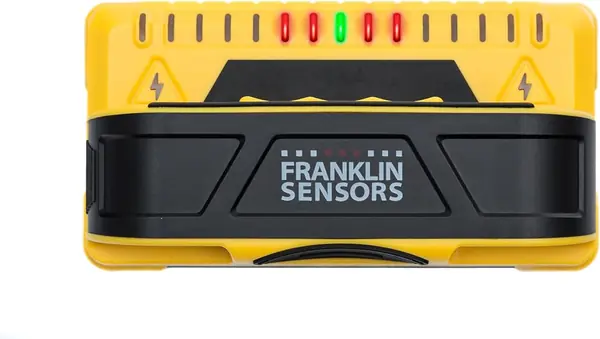
Franklin Sensors ProSensor M150 stud finder with nine-sensor LED display and live wire detection

Everyday DIY scanning

Shop Score 89/100
Wire Detection
Live AC warning
Sensor Count
9
Detection Depth
Up to 1.5 inches
Dimensions
5.51 x 2.99 x 2.01 inches
View on Amazon

The M150 is the same idea as our top pick with a shorter bar: nine sensors instead of thirteen, 1.5 inches of detection instead of 1.7. What you keep is the part that matters day to day — the LEDs still light a stud's full width, and there is still no calibration step between you and a reading.

That second point is why we send most people here. Scanners that need zeroing are the ones that produce the horror-story readings, because it is easy to calibrate over a stud or lift the pad halfway through a pass. The M150 just scans, and live wire warning comes with it, so you are not giving up the AC check that makes this category worth owning.

Power is the thing to plan for. It takes two AAA batteries that are not in the box, and rechargeables are specifically ruled out, so keep a couple of alkalines in the drawer rather than discovering the problem on a Sunday morning. Otherwise the smaller body drops into a tool pouch, and the display is easy to read at arm's length.

Worth Noting

  • No separate metal or pipe mode
Our Verdict

The M150 keeps the no-calibration scanning and live-wire warning that make our top pick easy, and gives up only a little reach for a lot less money.

Check Latest Price
3.

Jurgen K TH530 Stud Finder Best Budget

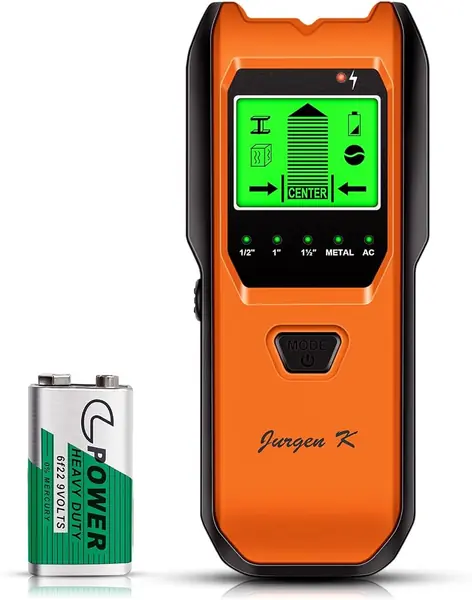
Jurgen K TH530 stud finder in tropical orange with backlit LCD and five scan modes

First-time buyers

Shop Score 88/100
Battery
9V (included)
Display
Backlit LCD
Scan Modes
5 (three stud depths, metal, AC)
Max Stud Depth
1.5 inches
View on Amazon

Half-inch, one inch, one and a half: the TH530 lets you pick the depth instead of deciding for you, and that is the feature we appreciate most at this price. Matching the setting to the wall calms the readings down — shallow for thin paneling, deeper when you are hunting framing behind standard drywall.

The screen is the other reason it punches above its price. It is backlit, it names the mode you are in, and it shows the stud's position rather than only beeping at you, with an audible alarm if you prefer sound to a screen. A 9V battery is included, which not every scanner here can claim.

Metal and AC get their own modes rather than riding along with the stud scan, so you can sweep for conduit or a pipe run without the tool second-guessing what it is seeing. That is a lot of scanner for the least money in this guide, and it is the one we hand to someone buying a first one.

Worth Noting

  • Readings wander on plaster and lath
Our Verdict

We hand the TH530 to first-time buyers: three depth settings, dedicated metal and AC modes, and a screen that names what it just found.

Check Latest Price
4.

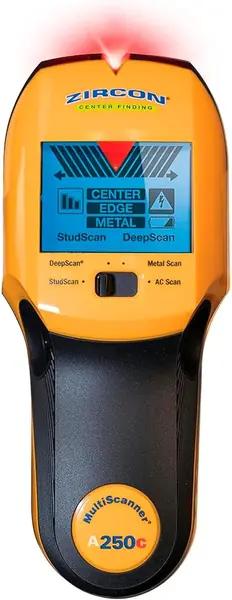
Zircon MultiScanner A250c Best for Metal and Pipes

Zircon MultiScanner A250c stud finder with color-coded LCD and SpotLite pointer

Walls with plumbing

Shop Score 87/100
Metal Depth
Up to 3 inches (rebar)
Stud Depth
3/4 inch standard, 1-1/2 inches deep
AC Detection
Up to 2 inches
Warranty
Limited lifetime
View on Amazon

Green for studs, blue for metal, red for AC: the A250c's display changes color with the mode, and after a few passes your eye stops reading labels and starts reading color. On a wall where you are asking three different questions in sequence, that is a small thing that turns into a big one.

The metal side is what earns it a place here. Metal Scan reaches 3 inches for rebar and 1-1/2 inches for copper pipe, enough to find a pipe run before a fastener does, and the SpotLite arrow projects onto the wall to show where the target sits. StudScan covers standard 3/4-inch edges and DeepScan pushes to 1-1/2 inches for thicker walls.

Center finding is at its best on plain drywall. On ceilings and on thicker or textured surfaces the center reading can wander, so a second pass and a pencil mark are worth the extra minute, and any AC indication is a reason to stop and test rather than a place to drill.

What separates it from the imports is the backing: Zircon covers the A250c with a limited lifetime warranty, which nothing else in this group offers, on a tool priced just under our top pick. That combination keeps it in the bag for walls where plumbing and wiring share space with the framing.

Worth Noting

  • Mode switching means scanning the wall more than once
Our Verdict

Our pick where pipes share a wall with studs: color-coded modes, a three-inch metal scan, and the only lifetime warranty in this group.

Check Latest Price
5.

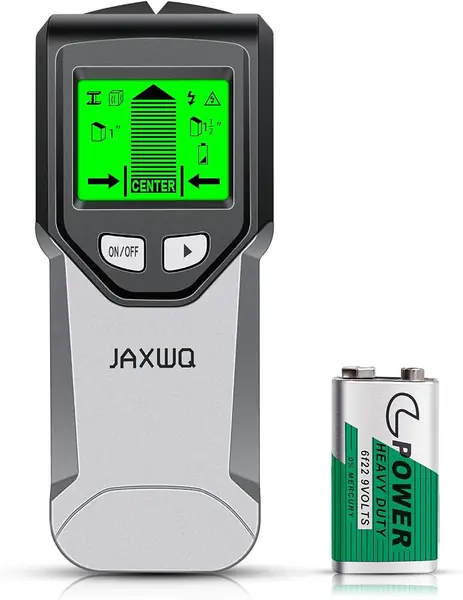
JAXWQ Stud Finder Wall Scanner Best for Wood vs. Metal

JAXWQ stud finder wall scanner in overcast gray with backlit LCD display

Older homes

Shop Score 86/100
Weight
7.7 oz
Display
Backlit LCD
Detection
Studs, metal, AC wire
Calibration
Automatic
View on Amazon

Most budget scanners make you choose a side, wood mode or metal mode, and then interpret the answer. This one reads the difference itself and puts it on the screen, so when it lights up you learn whether the thing behind the paint is a stud or a pipe without cycling through settings. That single design decision is why it holds a place in this guide.

The rest of the package is conventional but well done. Calibration happens automatically when you press the pad flat to the wall, the backlit screen marks the center and the edges, and there is a battery-level readout on the display.

At 7.7 ounces it is light enough to run along a ceiling without your arm quitting, and the display is readable at a glance rather than a squint. This listing is the Overcast gray, one of several colors it is sold in — not a reason to buy, but a pleasant change from the usual yellow. It earns its keep in older houses, where studs wander off the expected spacing and the stud-or-pipe question comes up before every hole.

Worth Noting

  • Conventional budget-tier package aside from automatic material detection
Our Verdict

If you can't tell a stud from a pipe, this is the scanner to grab — it separates wood from metal on its own and shows the answer on a backlit screen.

Check Latest Price
6.

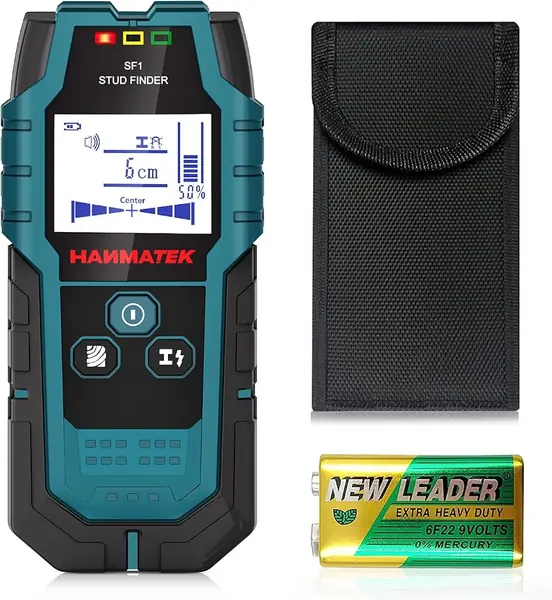
HANMATEK SF1 Stud Finder Best for Deep Metal Scanning

HANMATEK SF1 stud finder in blue with LCD display and three-color indicator lights

Deep metal scanning

Shop Score 85/100
Metal Depth
Up to 4.7 inches (ferrous)
Stud Depth
0.8 inch exact, 1.5 inch deep
AC Detection
Up to 2 inches
Protection Rating
IP66
View on Amazon

Almost five inches of metal detection is the number that keeps the SF1 in the bag. Ferrous metal registers up to 4.7 inches down, matching the deepest metal scan in this guide, and we like it for the jobs where metal is the question: rebar in a slab, a pipe run behind tile backer, a bracket buried inside a soffit. The sealed body is rated IP66 against dust and splashes, and it is the only scanner here with a published rating.

The stud side is more ordinary: an exact mode to 0.8 inch for thin paneling and a deep mode to 1.5 inches, both read through three-color indicator lights with an alarm you can switch off. It asks you to choose a mode before you scan, where the Franklins ask nothing, but the metal depth is real and the price stays low.

Worth Noting

  • Non-ferrous metal reads shallower than ferrous
Our Verdict

We keep the SF1 around for deep metal: 4.7 inches of ferrous range and a sealed body that shrugs off dust and splashes.

Check Latest Price
7.

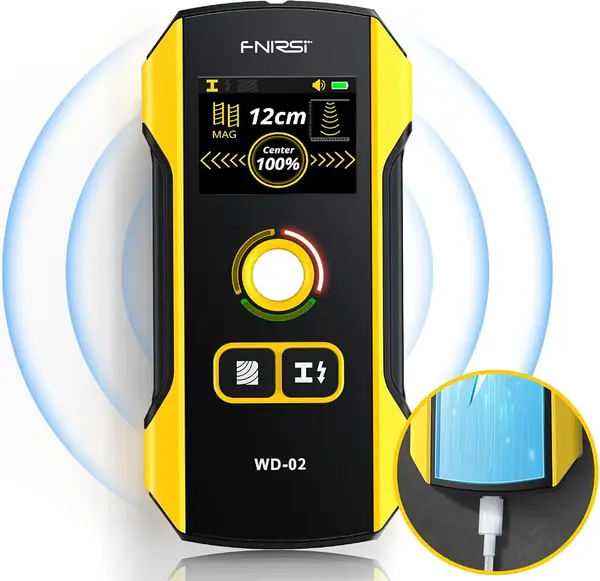
FNIRSI WD-02 Stud Finder Best for Small-Space Projects

FNIRSI WD-02 rechargeable stud finder with color TFT screen and positioning hole

Small-space projects

Shop Score 84/100
Weight
4.2 oz
Battery
Rechargeable 300mAh lithium
Metal Depth
Up to 4.7 inches
Sensitivity
Three levels per mode
View on Amazon

No battery drawer, no spares rattling around in a kitchen drawer: the WD-02 runs on a built-in 300mAh lithium cell you recharge instead of replace. At 4.2 ounces and well under an inch thick it disappears into a pocket, and that is the sort of thing we notice when a scanner has to come along on every trip to the hardware store.

Under each of its three modes, stud, metal and AC, there are three sensitivity levels, which is more adjustment than any other scanner here gives you. The setting also shifts how deep the tool reads, so you can dial it in for the wall in front of you instead of accepting whatever the factory decided.

The color TFT screen is the friendliest of the budget displays, and a positioning hole in the housing lets you mark a spot without hunting for a pencil notch. Learning the mode menu takes a session or two; after that the sensitivity steps do most of the work.

Ownership is where it wins us over: no battery errands, a body that lives in a jacket pocket, and enough adjustment to settle a wall that keeps giving false hits. It is the scanner that gets used because it is already with you.

Worth Noting

  • Plaster and lath give unreliable readings
Our Verdict

A rechargeable, palm-sized scanner with sensitivity you can dial back — we like it for anyone tired of buying batteries.

Check Latest Price
8.

Zircon StudSensor A100 Best for Simple Shelf Work

Zircon StudSensor A100 stud finder with LCD screen and SpotLite pointer

Simple shelf work

Shop Score 83/100
Battery
1 9V (not included)
Display
LCD with SpotLite pointer
Wire Detection
Up to 2 inches
Edge Depth
3/4 inch standard, 1-1/2 inches deep
View on Amazon

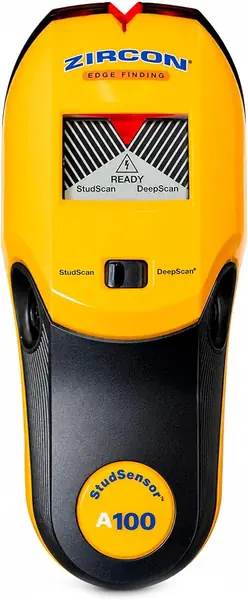
Edge finding is the whole job here. StudScan reads the edge of wood or metal studs to 3/4 inch, DeepScan reaches 1-1/2 inches on thicker walls, and WireWarning flags live unshielded AC up to 2 inches as you scan in either mode. The LCD pairs a tone with Zircon's SpotLite arrow, which points at the spot to mark, and the low-battery indicator is doing real work because the tool will not scan properly on a weak cell.

For hanging a shelf, running a chair rail, or setting a row of anchors, a stud edge is all the information the job needs, and the A100 delivers it without a mode menu or a learning curve. Centering a TV bracket is the case it cannot handle: there is no center readout, so a bar display from elsewhere in this guide is the tool for that. At 8.4 ounces it is light enough to run overhead, and it sits in the middle of the price range.

Worth Noting

  • 9V alkaline battery not included
Our Verdict

The A100 suits simple work: it finds stud edges and flags live AC, and it never pretends to hand you a center it can't measure.

Check Latest Price

How We Tested the Best Stud Finders With Wire Detection

We started with every scanner we could find that advertises live wire detection, read the manuals and reviews, and dropped anything that couldn't warn on live AC or locate wood studs. That left 14 units, from simple edge-finders to multi-sensor models with color displays. We used them for six months on real projects: shelves and a heavy mirror in a 1950s house with plaster-and-lath walls, a TV mount on textured drywall, and ceiling joists reached one-handed from a step stool.

For accuracy, we scanned the same stud three times, marked the spot, and came back a day later to see whether the tool landed in the same place. We compared sensor count against what the display showed — one center blip or the full width of the stud with both edges — and watched how each behaved on plaster and texture, where false positives live. Each got the same calibration drill: empty wall first, then a stud.

Wire detection got its own pass. We swept each scanner past a known live circuit to see how early the warning started and whether it fired on every scan or only in a dedicated mode, then backed away from a pipe run until the signal faded. Before drilling, we shut the breaker off at the panel and confirmed it dead with a non-contact voltage tester. Metal lath and foil-backed insulation set some units chirping at nothing, so unfamiliar walls got a second pass.

The rest was hands-on. We weighed each tool and held it overhead through a full ceiling scan to see which grip tired first, logged battery type, whether one came in the box, and how many swaps six months required, and let them ride loose in a tool bag and take a drop onto a concrete floor. Value came down to what a tool told us at the wall, not how many modes it listed.

How to Choose a Stud Finder With Wire Detection

What the sensor count buys you

The cheapest wall scanners use one or two sensors and report a change in density with a beep; you creep along the wall and infer where the framing is. Multi-sensor bars, nine or thirteen sensors in the models here, read across a span and light the whole stud at once.

If you are centering a TV bracket or a cabinet rail, that width display is worth the money. If you are putting a shelf bracket into the first stud you can find, a single-sensor finder and a pencil mark will do.

Live wire detection is a warning, not a wire map

Every scanner here reads live unshielded AC, usually to about 2 inches, and most keep that alert running while you scan in stud mode. Take the warning seriously, and do not over-trust the silence: a quiet pad means the sensor found no energized conductor under it, not that the wall is clear.

Shut the breaker off at the panel before drilling near an outlet, a switch, or any indicated wire, and confirm the spot with a non-contact voltage tester. Metal lath and foil-backed insulation can also mask or mimic a live line, which is why the tester matters more than the beep.

Calibration is where bad readings come from

Most false readings are not sensor failures, they are calibration errors. A scanner that zeroes itself on the wall will happily calibrate over a stud and then report the whole wall as solid, and lifting the pad mid-pass resets the baseline. Press the pad flat, start on a clear patch, and re-zero when you move to a new wall.

The exception in this group is the Franklin pair, which need no calibration at all and can start anywhere. That is the single biggest reason we rate them so highly for one-handed work.

Depth ratings: standard, deep, and metal

Standard scan reads stud edges at about 3/4 inch, which is enough for ordinary drywall. Deep scan pushes to 1-1/2 inches or a little more for thicker walls, paneling over drywall, and ceilings.

Metal modes go deeper, from about 2 inches up to 4.7 inches on the models here, which helps with pipe and rebar but carries a trap: a strong metal hit may be a pipe or conduit rather than framing. Read the depth number before you trust the target.

Weight, grip, and the button you hold

Almost every scanner here works by holding a button down while you slide the pad across the wall, and overhead work is where that gets old. Under about 8 ounces is comfortable at ceiling height; past 12 ounces your arm notices.

Look for a body you can press flat with one hand while the other holds a pencil, and a display that stays readable when you are reaching up. It is the least technical number on the page and the one you will feel the most.

Frequently Asked Questions

Final Verdict

The Franklin Sensors ProSensor M210 is the stud finder we recommend first. Thirteen sensors show the full width of a stud, it scans without calibration, and the live wire warning runs on every pass. For heavy mounting work, a TV, a cabinet, anything that has to hit the middle of the framing, that combination is worth the premium.

If the budget is tighter, the ProSensor M150 does the same job with nine sensors and slightly less depth. And if the wall has plumbing in it, the Zircon MultiScanner A250c's color-coded metal scan and lifetime warranty make it the better tool.