↑↓ navigate ↵ open Esc close All results →

Best Straight Edges for Woodworking of 2026

A framing square that sits a hair out of true can still build decent shop projects, whereas a 24-inch straight edge bowed by a thousandth of an inch corrupts the reference itself. Checking a glued-up tabletop or tuning a jointer bed demands a bar you never have to second-guess.

Evaluating 15 straight edges over four months confirmed that printed full-length straightness tolerances matter far more than vague "precision ground" claims on a package. Bench-checking bars, heavy machine-shop steel, and scaled layout rulers trade heft, edge bevels, and graduation fineness depending on whether you are sighting light gaps or striking pencil lines.

Choosing the right length and edge profile keeps finished hardwood unmarred while giving every flattening and machine-setup check a reliable baseline.

Our Top Picks

The Best Straight Edges for Woodworking

1.

Taytools SE24 24-Inch Aluminum Straight Edge Best Overall
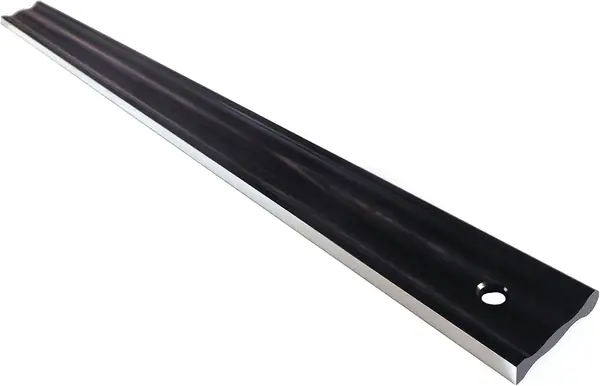
Taytools SE24 24-inch anodized aluminum straight edge with contoured grip and hang hole

Checking board flatness

Shop Score 95/100
Length
24 inches
Material
Anodized aluminum
Straightness Tolerance
Within 0.001 inch over full length
Weight
1.5 lb
View on Amazon

One thousandth of an inch over the full 24 inches is the claim Taytools prints for this bar, and that number is why it stays on our bench. A marking ruler can drift a little and you may never notice; a bar you lay on a hand-planed panel to look for a hollow has one job, and the answer it gives either means something or wastes your afternoon. We set ours on a known-flat machine table and then against a freshly jointed edge, and it read flat both times.

What we like most is how usable that accuracy turns out to be. The contoured cross section gives your fingers somewhere to sit, so you can hold the bar down with one hand and slide a feeler gauge along it with the other, and the 1.5-pound aluminum body is light enough to lift off the bench every few minutes without thinking about it — which is more than we can say for a quarter-inch steel bar.

It behaves like the reference tool it is. There's a hang hole at one end, the edge you trust is machined flat rather than printed on, and the bar is sold as a reference rather than a rule, so the graduated rulers among our picks are what we pick up when a dimension has to be pulled. Twenty-four inches covers a jointer table, a planer bed, a glue-up, or the stiles of a door; it won't span a sheet of plywood, and that's the moment the 48-inch Kapro takes over.

Ours hangs on a nail at the end of the bench, and the habit it builds is the real return: checking a board instead of guessing at it.

Worth Noting

  • Costs more than a graduated ruler of similar reach
Our Verdict

Our default bench reference: a 24-inch aluminum bar guaranteed straight to 0.001 inch over its full length, light enough to handle with one hand.

Check Latest Price
2.

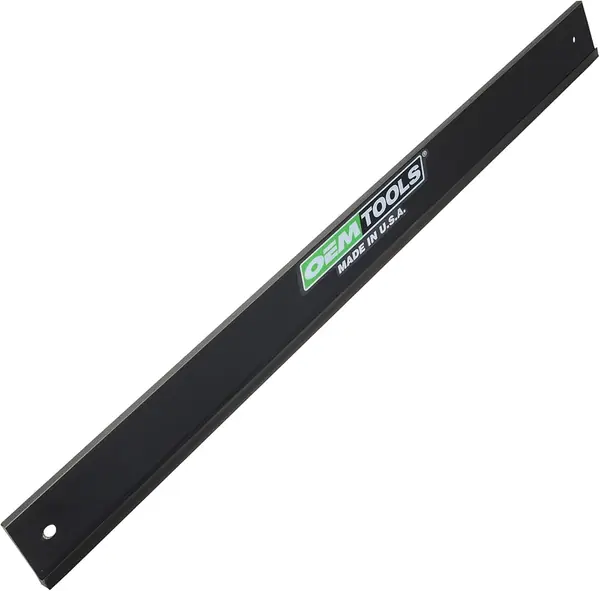
OEMTOOLS 24-Inch Steel Straight Edge Best Heavy-Duty

OEMTOOLS 24-inch cold rolled steel straight edge with black powder-coated finish and hang hole

Heavy machine checks

Shop Score 94/100
Length
24 inches
Material
1/4-inch cold rolled steel
Straightness Tolerance
±0.001 inch
Edge Protection
Reusable plastic cover
View on Amazon

Picking this up is the whole introduction: a quarter inch of cold rolled steel, 24 inches long, with the kind of heft that makes you set it down instead of dropping it. The mass isn't a side effect. On a machine table or an engine block, a heavy bar settles onto the surface and stays there while you run a feeler gauge around the edge, and a light bar skates.

The tolerance is listed at plus or minus 0.001 inch, and it comes with a reusable plastic cover for the machined edge. We like that more than it probably sounds — a straight edge is only as good as its edge, and a cover means the bar can live in a toolbox drawer between jobs instead of hanging alone on a wall. The powder coat wipes clean and there's a hang hole at one end.

Straightness is the one thing to check on arrival. Some of these arrive bent along the spine, so lay yours on a flat reference before the return window closes, and keep the cover on when it isn't in use. Do that and you have a machinist straight edge heavy enough that nobody borrows it by accident.

Worth Noting

  • Quarter-inch steel is tiring to hold vertically
Our Verdict

Buy this if you want a straight edge with real mass behind it: a quarter inch of steel that settles onto a surface and stays put while you work around it.

Check Latest Price
3.

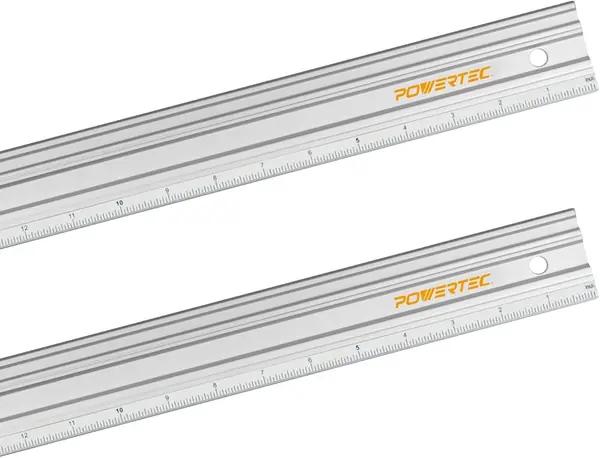
POWERTEC 18-Inch Aluminum Straight Edge 2-Pack Best Two-Pack

POWERTEC 18-inch ribbed aluminum straight edge pair with inch and metric scales

Two-station shops

Shop Score 93/100
Length
18 inches
Straightness Tolerance
Within 0.001 inch
Quantity
2 bars
Measuring Surface Width
5/16 inch
View on Amazon

Two bars, not one, is the reason this set earns a place. Eighteen inches is the size that lives at the machine — long enough to bridge a jointer table or run down a glue-up, short enough to keep beside the vise instead of behind the door. A second bar means one stays at the jointer and one stays at the bench, and you stop carrying the same tool back and forth across the shop.

Each bar has the thick, ribbed profile of the reference bars in this group, which is more useful than it sounds: the bar stands on its own on a table, so you can set it down and reach for a feeler gauge with both hands. The precision lives in a 5/16-inch measuring surface machined flat to a claimed 0.001 inch, and the two sides carry inch and metric scales.

Eighteen inches turned out to be the compromise we like for a small shop. It covers a jointer bed, a planer table, and any panel you can carry to the bench, and it's short enough to steer with one hand while you mark. It tells you nothing about a 4x8 sheet, so if sheet goods are the work, plan on a longer bar — that's the gap the Kapro fills.

Worth Noting

  • 18-inch length is too short for full 4x8 sheet goods
Our Verdict

The pair makes sense for a shop with two stations: two 18-inch bars, each ribbed enough to stand on its own while you check a jointer table.

Check Latest Price
4.

Kapro 308 48-Inch Straight Edge Ruler Best for Long Layout

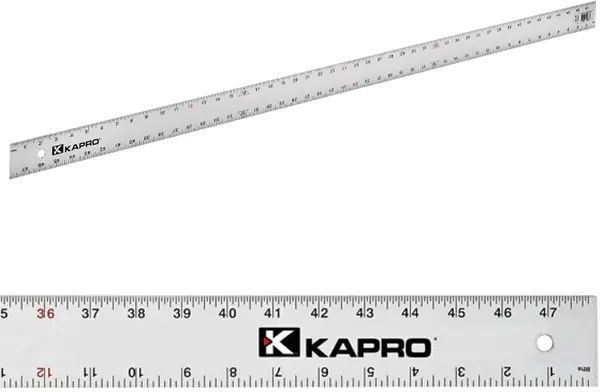
Kapro 308 48-inch anodized aluminum straight edge ruler with printed inch scales

Sheet-goods layout

Shop Score 92/100
Length
48 inches
Material
Anodized aluminum
Graduations
1/8 inch and 1/16 inch
Width
2-1/16 inches
View on Amazon

Forty-eight inches is the length at which a straight edge stops being a bench tool and becomes a layout tool. Lay this along a sheet of plywood and you have a full-length edge to run a marking knife or a utility blade against; lay it on a run of cabinet stiles and you can check the whole run without moving it.

Kapro builds it like a contractor's tool rather than a machinist's, and for layout that's the right call. The blade is anodized aluminum, 2-1/16 inches wide, and rigid enough that the flex is negligible over the full length. Two scales run along the edges, 1/8 inch on one side and 1/16 on the other, and the printing gets a wear-resistant UV-cured coating we're glad to see on a bar that will be dragged across plywood all day. At a pound and a half it steers with one hand.

This is a layout and cutting edge first: you're buying the reach and the two scales, not a certified tolerance. Where a board's flatness is the question, the machined bars in this guide answer it and this one doesn't. What the Kapro does better than anything else here is cover ground — a full sheet, a long rip line, a built-in shelf run — with numbers you can read from either side.

Worth Noting

  • Graduations are printed rather than etched
  • 48-inch length needs wall space to store
Our Verdict

For sheet goods and long layout lines, this 48-inch aluminum ruler gives you the reach and two readable scales at a modest price.

Check Latest Price
5.

Mr. Pen 4-Piece Stainless Ruler Set Best Budget

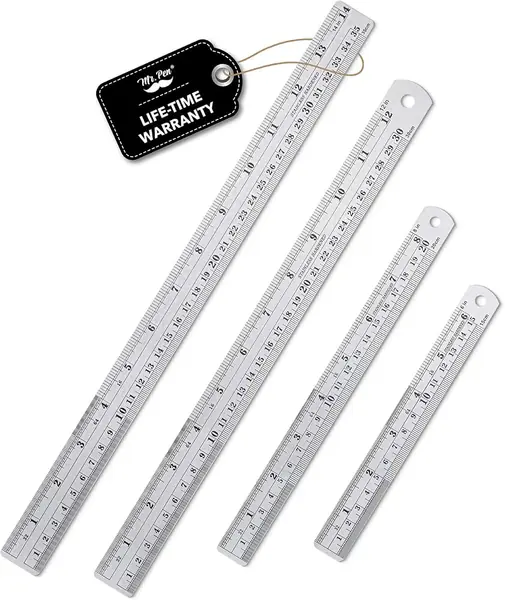
Mr. Pen four-piece stainless steel ruler set in 6 8 12 and 14 inch lengths

Marking and layout

Shop Score 91/100
Material
Stainless steel
Graduations
1/64 inch
Lengths
6, 8, 12, and 14 inches
Thickness
0.9 mm
View on Amazon

Four stainless rulers — 6, 8, 12, and 14 inches — each in its own sleeve, for less than a single machined bar costs. That's the pitch, and it's a good one for a small shop: these are the rulers that live in a drawer, get picked up for a pencil line, and don't make you anxious about the edge.

The steel is 0.9 mm thick with etched markings down to 1/64 inch and a conversion table on the back, and the reading is genuinely easy — the figures carry enough contrast to find at a glance. We've used the 14-inch more than any other size for marking across a board and as a guide for a marking knife, and the graduations have held up without rubbing away.

One thing to know before you buy: the numbers start about an eighth of an inch in from each end, so you can't butt the ruler against a shoulder and read a dimension straight off. Measure from the 1-inch mark and subtract when the end has to act as a stop. Once you're in that habit, the set does what a drawer ruler should.

The 6-inch lives in our apron pocket, and it gets picked up ten times before the machined bar comes off its nail.

Worth Noting

  • Thin 0.9 mm steel flexes under pressure
Our Verdict

A drawer full of stainless rulers for the price of one good bar is a fair trade in a small shop, as long as you don't ask them to check flatness.

Check Latest Price
6.

ZZTX 4-Piece Stainless Ruler Set Best for Everyday Measuring

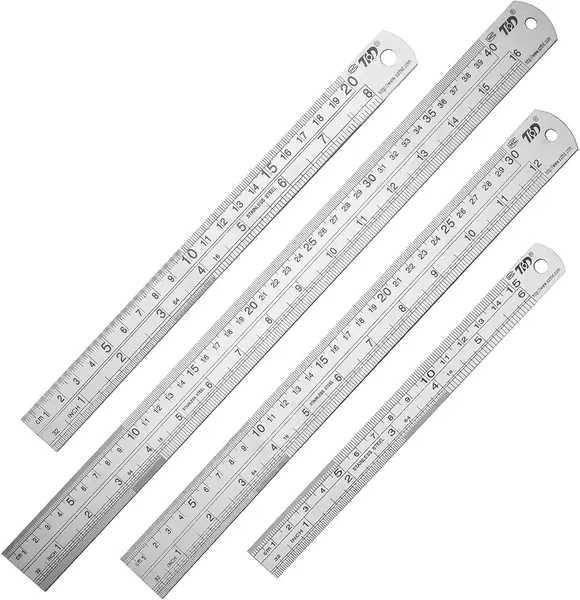
ZZTX four-piece stainless steel ruler set with hang holes in four lengths

Everyday measuring

Shop Score 90/100
Graduations
1/16 inch
Lengths
6, 8, 12, and 16 inches
Thickness
0.9 mm
Scales
Inch and metric
View on Amazon

The markings on these start right at the end of the bar, inches and centimeters beginning together at zero, so you can butt the ruler against a stop and read a dimension directly instead of doing arithmetic in your head. That one detail is why we treat this set as the better layout ruler of the two budget sets here.

Four sizes — 6, 8, 12, and 16 inches — in 0.9 mm stainless, square at one end and rounded with a hang hole at the other. The 16-inch is the useful one: it spans a 12-inch board with overhang to hold while you mark, and it still drops into a drawer. Inch graduations run to 1/16, with a metric scale alongside.

We treat this as a marking set, not a reference bar — 0.9 mm of steel isn't what you lay on a panel to find a hollow, and it flexes if you lean on it. The edges are the thing we noticed. They come cut sharp, and some sets arrive with burrs that catch on a board, so run a careful finger along each edge and stone down anything that grabs before it scratches a finished face.

Worth Noting

  • Thin 0.9 mm steel flexes and cannot serve as a reference straightedge
  • Sharp cut edges and occasional burrs need stoning before use
Our Verdict

With markings that start at the end of the bar, this four-size set measures directly and covers everything a marking ruler needs to do.

Check Latest Price

How We Chose and Tested These Straight Edges

We built the shortlist from spec sheets, favoring bars that stated a straightness figure over the full length, then filtered by length, material, thickness, and price so the group covered bench checking, machine-shop steel, and scale-bearing layout rulers instead of six versions of the same thing. Bars with a vague claim and no number still went in — we wanted to see whether they held up beside the ones that committed to a figure.

Fifteen bars and rulers came through the shop over four months. Every one was checked for burrs and sharp cut edges before it went near a hand or a finished surface, then laid across glued-up panels and a table saw's cast top to see whether light showed under the middle or the ends. We slid a feeler gauge underneath to find where the gap opened up, ran the thicker steel against an engine block, and stretched the long bars across plywood on sawhorses for layout.

We pressed each bar in the middle with a finger to see whether it flexed or held its own shape, and noted how much surface actually registered on the work — a narrow edge rocks on a crowned board, a wide one sits. Graduations were read under shop light to find where glare bit, and we checked whether the scale started at the end or a quarter-inch in. The short, light rulers got used one-handed for marking knives; the heavy ones stayed put hands-free. Sets and two-packs were split between bench and saw, and the bars that came with a cover or sleeve came out of four months in better shape than the bare ones.

How to Choose a Straight Edge for Woodworking

Reference Bar or Graduated Ruler?

The two jobs get sold as one, and they aren't. A machinist straight edge is judged on a machined edge and a stated tolerance; the numbers, if there are any, are a bonus. A graduated ruler is judged on its scale, its readability, and whether the markings start at the end.

If you buy one tool, buy the reference bar. You can mark a line with a pencil and any straight object, but you can't check a panel for twist without something true. Keep a cheap ruler for numbers, and keep the knife away from the machined edge.

Match the Length to the Check

Eighteen inches handles a jointer bed, a planer table, and most panel checks at the bench. Twenty-four inches is the usual bench reference and long enough for machine setup and glue-ups. Forty-eight inches is layout territory: sheet goods, a run of cabinet stiles, a long rip line.

Longer is not automatically better — a 4-foot bar is awkward to hold flat with one hand and awkward to store — and a 24-inch bar tells you nothing about a 4x8 sheet. Measure the longest thing you plan to check and buy for that.

What a Straightness Tolerance Tells You

A number is worth more than an adjective. Within 0.001 inch over the full length is a claim you can compare across tools; precision ground, with no figure attached, is not. A tolerance also describes an edge in good condition, so treat the working edge as the precision surface it is — one ding and the number no longer applies to your bar.

That is why we favor bars that arrive with a hang hole, a protective cover, or a fitted sleeve. The accessory isn't decoration; it is the thing that keeps the claim honest after a year of shop use.

Weight and Profile Decide How You'll Use It

Aluminum bars around a pound and a half are easy to hold against a panel and easy to lift off the bench a dozen times an hour. A quarter-inch steel bar is a different tool: it settles on a horizontal surface and stays there under its own weight, which is exactly what you want when both hands are busy with a feeler gauge and a nuisance when you're holding it up against a cabinet.

A thick, ribbed, or contoured profile lets the bar stand on its own and gives your fingers somewhere to sit. On a long bar, that contour is also what keeps the thing from bowing when you press down to hold it flat.

Scales, Ends, and Edges

Fine graduations are only useful if they start where you need them. A scale that begins an eighth of an inch in from the end means you can't butt the ruler against a stop and read directly; you measure from the first inch and subtract. Check whether the ends are square or rounded, since a square end registers against a shoulder and a rounded one does not.

Last, expect budget stainless to arrive with a burr or a sharp arris. A few passes with a fine stone along the long edges saves you a scratched finish and a nicked finger.

Frequently Asked Questions

Final Verdict

Start with the Taytools SE24. It's the one bar here with a straightness figure you can hold it to over its full length, and at 1.5 pounds it's light enough to keep in your hand while you work around a board instead of setting it down between checks.

If your work runs heavier — machine tables, engine blocks, a bar that gets lent out — the OEMTOOLS steel edge is the upgrade, provided you check it against a flat reference the day it arrives. And if the job is a sheet of plywood, buy the 48-inch Kapro and consider the question settled.