↑↓ navigate ↵ open Esc close All results →

Best Setup Blocks for Woodworking

You can eyeball a router bit height, run a test cut, and still come up a hair shallow — and on a groove that runs the length of a board, a hair is enough to scrap the piece. A setup block is a bar machined to a known thickness, so you set the bit off a number you trust instead of a ruler held against a cutter.

We tested 14 sets over eight months on a router table, a table saw, and a drill press, calipering every bar against its nominal size. Piece count didn't separate them; coverage did — whether the ladder reached the shallow 1/16- and 1/8-inch bars that grooves actually call for, and whether the ends carried a step for checking a finished cut.

Aluminum will nick against a carbide edge; brass holds its size better but tends to come in smaller, pricier sets, and both made the list. What else separated them was smaller: markings that read from more than one face, bars long enough to bridge a cutter recess, and a case that keeps the little ones from rattling loose.

Our Top Picks

The Best Setup Blocks for Woodworking

1.

EANOSIC 15-Piece Setup Block Set Best Overall
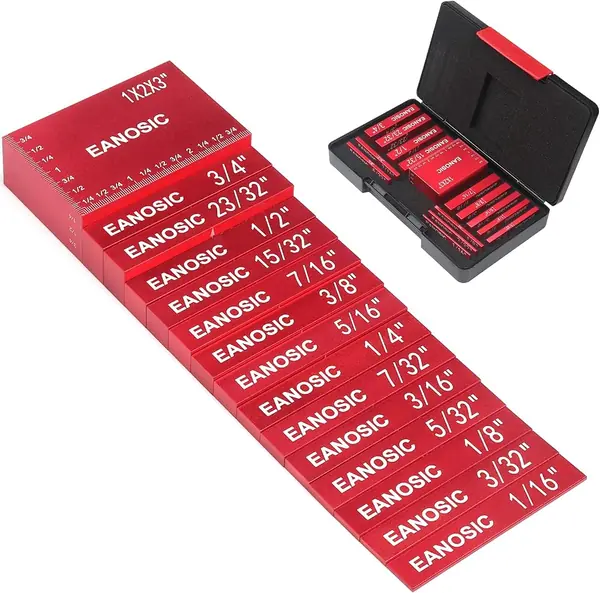
EANOSIC 15-piece aluminum setup block set with laser-engraved size markings and a storage case

Everyday shop setups

Shop Score 96/100
Sizes Included
1/16" to 3/4", plus 1x2x3" block
Material
Aluminum alloy
Markings
Laser engraved on four faces
Bar Length
3 inches
View on Amazon

Fifteen pieces sounds like a marketing number until you read the ladder: 1/16 inch, then 1/32-inch steps up through 1/4 inch, then 5/16, 3/8, 7/16, 15/32, 1/2, 23/32, and 3/4, plus a 1x2x3-inch block. That coverage is what made this our default recommendation. Nearly every height you set on a router table or a dado stack lands inside that range, and the fine steps mean you rarely have to stack three bars to reach a number.

The bars are 3 inches long, and that extra half inch over the brass sets here matters more than it sounds: a longer bar bridges the recess around a router bit and still rests flat on the table on both sides. Sizes are laser etched on all four faces, so a bar dropped on the bench tells you what it is without being picked up. At 1.87 pounds the whole set carries to a job site easily and still sits heavy enough not to skate across a cast iron top.

Our complaint is the box. The blow-mold case is the flimsiest thing in the kit, with a lid that flexes when you close it — this is a shelf case, not a toolbox case. The other gap is in the ladder itself: there's no 9/32, 9/16, or 5/8 bar, so those heights come from stacking, which works fine and is part of why the set lands where it does on price.

Worth Noting

  • Flimsy blow-mold case with a flexing lid
  • Missing 9/32 and 9/16 sizes
Our Verdict

With fifteen bars, a 1-2-3 block, and 1/32-inch steps through the small sizes, this is the set we tell most woodworkers to buy first.

Check Latest Price
2.

Eleon Blockcision 16-Piece Setup Block Set Best Marked Bars

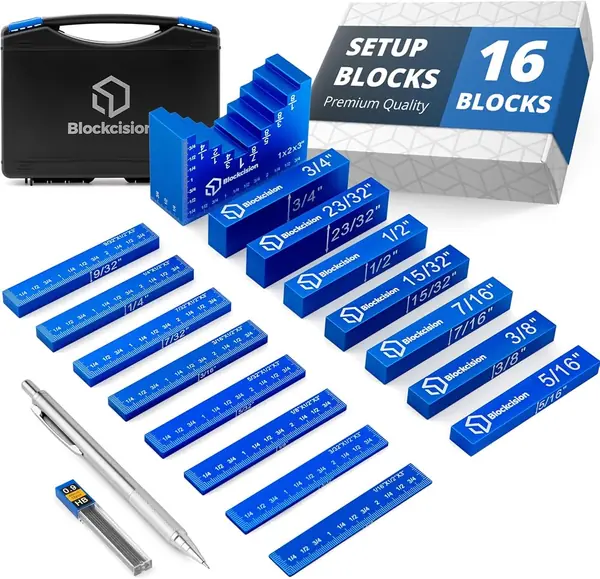
Eleon Blockcision 16-piece blue aluminum setup block set with ruler-marked bars and molded case

Quick visual checks

Shop Score 95/100
Sizes Included
Includes a 9/32 inch bar
Markings
Ruler-marked bars
Case
Molded, one slot per bar
Blocks
16, including multi-height spacer
View on Amazon

Ruler markings on every bar are the reason this set made the list. Instead of a single stamped size, each bar carries graduations you can lay against a cut or a stack and read directly. For checking a groove after the fact — did that dado come out at 3/8 or a hair over — that beats setting a rule alongside the bar and squinting at two scales at once.

Sixteen blocks come in the box, including a stepped multi-height spacer and a 9/32 bar that most sets here jump straight over on the way from 1/4 to 5/16. The white lettering on blue aluminum reads easily in a dim shop, and the molded case holds each bar in its own slot — nothing shifts when you carry it by the handle, which is more than we can say for the blow-mold boxes on the cheaper sets.

Eleon covers the set with a limited lifetime warranty, which is unusual at this price. The mechanical pen in the box is the sort of extra that ends up in a drawer; ignore it and judge the bars, which are cleanly machined and marked on more than one face so you can read a size from either side of the stack.

Worth Noting

  • Costs more than cheaper setup block sets
  • Included mechanical pen feels like throwaway filler
Our Verdict

We reach for this one to double-check a setting — ruler markings on every bar make the number visible without a second tool.

Check Latest Price
3.

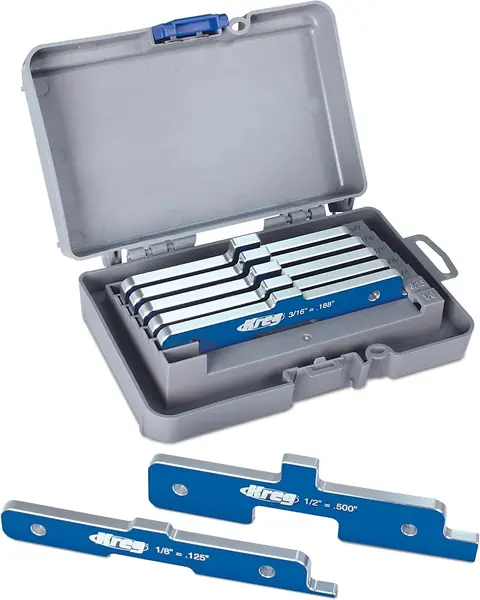
Kreg PRS3400 Precision Router Table Set Up Bars Best for Router Tables

Kreg PRS3400 seven-piece aluminum router table setup bars with stepped ends in a storage case

Router table work

Shop Score 94/100
Material
Aluminum
Bars
7
Step Design
Top, bottom, and end steps
View on Amazon

Three machined steps on each bar do three separate jobs, and that geometry is what puts this set at the top of the price range here. The concave step underneath sets bit height over the recess in a router plate. The step on top checks the depth of a cut you've already made. The step on the end measures the distance from bit to fence.

In a router table that gets a new bit every twenty minutes, that saves real time — you aren't building a stack of four bars and hoping it stays put while you tighten the lock. It's also the easiest set here to explain to someone who has never used a setup bar, because the step shows you where the bar belongs.

Seven bars is the catch. The block sets here hand you fourteen or fifteen heights; this hands you seven, and you stack for everything in between. That's the trade — fewer sizes, better geometry, and a premium at the register. If your work is mostly table saw blade height, an aluminum ladder covers more ground for less money and you'll never miss the steps.

Worth Noting

  • Only seven bars means constant stacking
Our Verdict

We think it's worth the premium if your router table changes bits all day; for general saw work the bigger aluminum ladders cover more for less.

Check Latest Price
4.

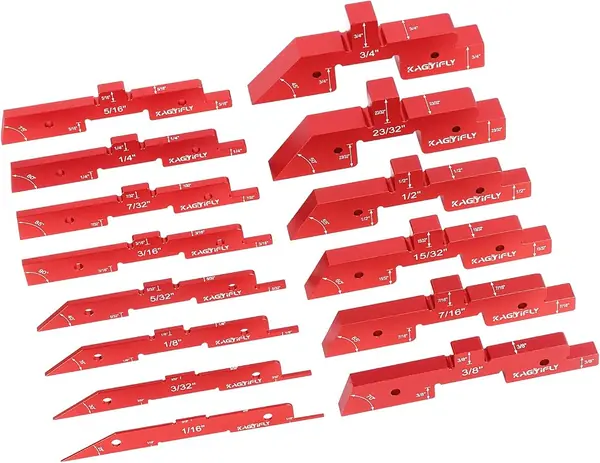
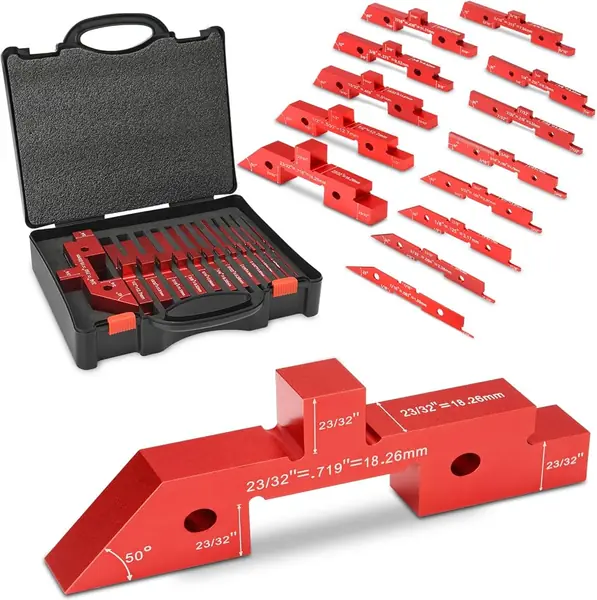
KAGYIFLY 14-Piece Setup Block Set Best with Angle Reference

KAGYIFLY 14-piece aluminum setup block set with angle-cut ends and storage case

Angle-heavy work

Shop Score 93/100
Sizes Included
1/8" to 1/2"
Material
Anodized aluminum alloy
Pieces
14
Angle Reference
Machined into one end
View on Amazon

Each bar carries an angle reference on one end, which is the feature that separates this set from every other straight gauge here. Height, depth, fence distance, and angle on one tool is a genuine convenience if you cut chamfers and miters as often as you set blade height.

Fourteen bars, marked from 1/8 to 1/2 inch, anodized with etched labels that hold their contrast. The wide faces sat flat on the cast iron when we tried them, which is the first thing we check with a new block — a bar that rocks is a bar you can't trust for a shallow cut. The case is a small foam-lined box that keeps them separated and easy to grab.

The angle function is also where our enthusiasm cools. It takes over a face that would otherwise be dead flat for stacking, and in most shops the angle checks are the rarer job. Cut miters weekly and it's money well spent; set bit height every day and you're paying a premium for a feature that spends its life in the case.

Worth Noting

  • Angle ends use up a flat face
  • Starts at 1/8 inch, not 1/16
Our Verdict

Our pick for shops where miters and chamfers are routine, though the angle ends cost you a flat face most height setups would rather have.

Check Latest Price
5.

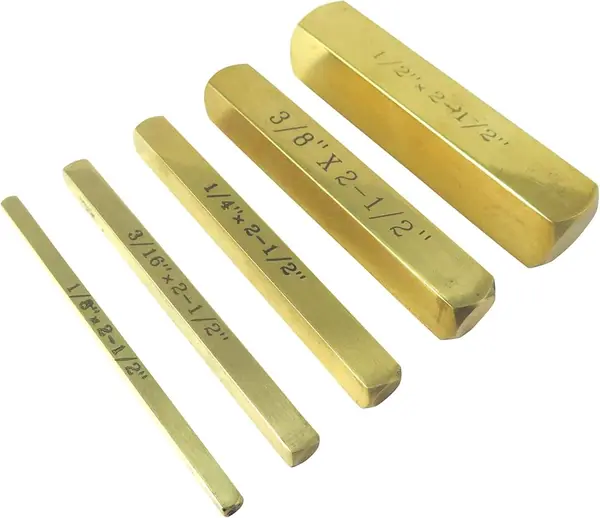
Taytools 506005 Brass Setup Bar Set Best Brass Set

Taytools five-piece solid brass setup bar gauge block set with etched sizes and small case

Router bit setups

Shop Score 92/100
Sizes Included
1/8" to 1/2"
Material
Solid brass
Pieces
5
Markings
Sizes etched into the metal
View on Amazon

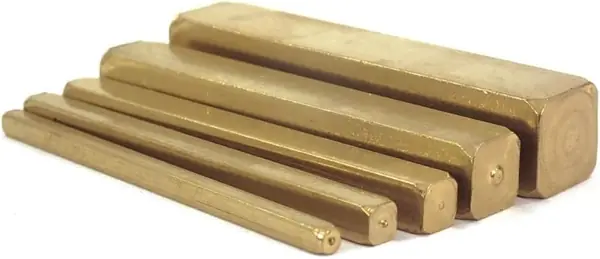
Brass is the whole argument. A brass bar is softer than the carbide on a router bit or a saw blade, so sliding one against a cutter is more likely to ding the gauge than the edge you paid for. That matters more every year, as a single good compression bit costs more than the entire set.

Five bars — 1/8, 3/16, 1/4, 3/8, and 1/2 inch — two and a half inches long, with the sizes etched into the metal so you aren't guessing. They're heavy for their size the way brass always is, and that weight is exactly why they stay put on a cast iron top while you set a fence against them.

Five sizes means stacking for anything in between: 5/16 is the 1/8 and 3/16 bars together. The short length that makes them handy around a router bit leaves them perched when a deep cutter recess needs bridging, and around the router table, where the cut happens close to the surface, we never minded that at all.

Worth Noting

  • Five sizes means a lot of stacking
Our Verdict

We keep brass beside the router — it's soft enough to protect an expensive carbide bit, and five sizes stack to most depths.

Check Latest Price
6.

Comfylichi 14-Piece Setup Block Set Best Budget

Comfylichi 14-piece red aluminum setup block set with stepped bars and foam-lined case

Tight budgets

Shop Score 91/100
Sizes Included
1/16" to 1/2"
Material
Anodized aluminum alloy
Pieces
14
Design
Steps on top, bottom, and ends
View on Amazon

Fourteen stepped bars, angle marks on one side, an anodized finish, and a foam-lined case — a smaller outlay than the premium sets while doing nearly everything they do on paper. The steps run along the top, bottom, and ends, so one bar can set a height and check the depth of a finished cut.

A set at this price is one we verify rather than trust. Put calipers on the bars you reach for most — 1/4 and 3/8 do most of the work in our shop — and note any that sit off nominal, because the sizes you use without thinking are the ones that decide whether a groove fits the panel that goes in it.

The case is tight. The smallest bars sink into the foam and come out with a fingernail, which gets old fast. Set against that: steps for checking depth as well as setting it, a full ladder of sizes, and enough left in the budget for the caliper you should be buying alongside it.

Worth Noting

  • Smallest bars are hard to lift from foam
Our Verdict

We recommend it as a first set for occasional work, as long as you check the small bars with calipers before a fussy joint.

Check Latest Price
7.

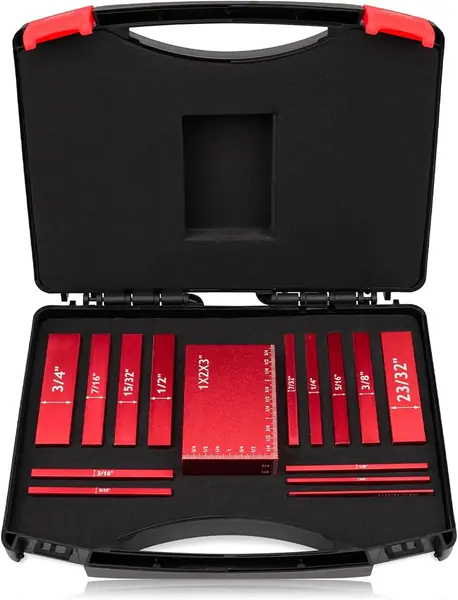
Aikyciu 15-Piece Setup Block Set

Aikyciu 15-piece aluminum setup block set in a hard-shell case with foam inserts

Complete starter kit

Shop Score 90/100
Sizes Included
1/16" to 3/4"
Bar Length
3 inches
Case
Hard shell with foam inserts
Blocks
15
View on Amazon

A hard-shell case with individual foam cutouts is the first thing you notice — every bar rides in its own slot and the lid closes with the set held flat. Inside are fifteen blocks: the 1/16-to-3/4-inch ladder plus a 1x2x3-inch reference block, all 3 inches long and etched with their sizes.

We set bit height and checked fence distance with these and found nothing to argue with. The etched sizes read cleanly, the faces sat flat on the table, and the case is a genuine upgrade over the boxes that come with cheaper sets. You get this coverage in a better box for less than the pick above.

What keeps it in this tier is mileage. The top pick has years of shop use behind it and this set doesn't yet, so we can't tell you how the finish holds up after a hundred setups. If you want the full ladder in a case that survives a truck bed, it's a sound buy at the price.

Worth Noting

  • Unproven long-term finish durability compared to established sets
Our Verdict

The same size ladder as our top pick in a better case; it needs more shop time behind it before it takes the top spot.

Check Latest Price
8.

Eapele Router Table Set Up Bars Best for Job Site Backups

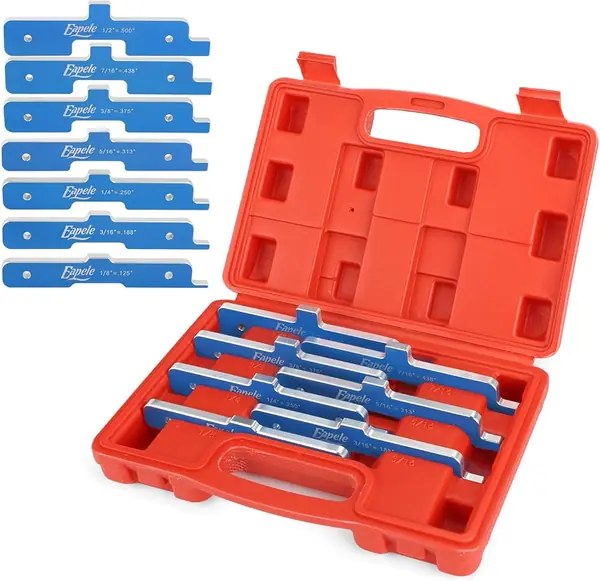
Eapele seven-piece aluminum router table setup bars with stepped ends and labeled case

Job site backups

Shop Score 89/100
Sizes Included
1/8" to 1/2"
Markings
Permanently marked sizes
Bars
7
Design
Steps on top, bottom, and ends
View on Amazon

It's built to the same seven-bar pattern as the Kreg set — a step on the top, a step on the bottom, a step on the end — for a fraction of the price. If the geometry made sense to you and the number on the premium set didn't, this is the version to look at.

Soft aluminum bars, sized 1/8 through 1/2 inch, each one permanently marked so you aren't trying to remember which is which. The case itself is labeled, which sounds trivial until you've spent five minutes digging through a bin of unlabeled bars looking for the 3/16. In a shop where the saw and router run on weekends, that's everything you need.

Where the savings show is consistency. For a second set that lives in a tool bag, or a first set on a tight budget, this is an easy yes. For daily production work, the sets with more sizes and tighter control are worth stepping up to.

Worth Noting

  • Seven bars cover a narrow range
Our Verdict

We see it as the budget route to the Kreg step design, best suited to weekend saws and a second set for the truck.

Check Latest Price
9.

Whiteside 9800 Brass Set Up Gauge Blocks

Whiteside 9800 five-piece solid brass setup gauge blocks in a small storage compartment

Compact brass kit

Shop Score 88/100
Sizes Included
1/8" to 1/2"
Material
Solid brass
Pieces
5
Bar Length
2-1/2 inches
View on Amazon

There are no size markings on these bars. Five pieces of brass, 1/8 to 1/2 inch, two and a half inches long, and nothing on them to say which is which once they're out of the package. A paint pen and ten minutes with a caliper solves it permanently, and it's the first thing we do with a set like this one.

We keep brass for router bits. These are machined flat, and the 1/2-inch bar is what we reach for when a panel bit needs half an inch of exposure and we want something soft against the carbide. The five sizes cover the common depths and stack for the rest, and the whole set weighs less than most of the aluminum boxes here.

Short bars are the trade. At 2-1/2 inches they sit down in the gap between blade and table on a table saw, which is exactly what you want, and they come up short when a big cutter recess needs bridging. Buy them for the router table and the saw, not for the setups where you need a 3-inch span.

Worth Noting

  • Bars can run under nominal size
Our Verdict

Our choice for a compact brass kit to keep by the router, once you label the bars yourself.

Check Latest Price

How We Tested the Setup Blocks

We started by pulling every setup block set we could find that came with a genuine size ladder rather than a few random bars, then sorted them by what the listings actually promised: material, size range, increments, step design, and whether a case was included. That narrowed the field to 14 sets, aluminum and brass, and we ran them for eight months on a router table, a table saw, and a drill press.

Out of the box, we noted surface condition as delivered — burrs, scratches, engraving you had to tilt into the light to read — and read every marking from the top, the side, and the end with sawdust on our fingers. Calipers went on each bar, three readings per face, and we laid the whole ladder out on the bench to see which shallow sizes were missing. A set that skipped the small increments lost ground no matter how many pieces it had.

In use, we set bit height and fence-to-cutter distance with each set, unplugged the machine, and spun the arbor by hand to check clearance before locking anything down. Then we made test cuts in scrap and measured the finished groove against the step. We watched whether a bar bridged the cutter recess in the router plate and sat flat instead of rocking, and we knocked a bar edge against a carbide bit to see how the aluminum dented compared with the brass.

Cases got turned upside down and shaken to see whether the smallest bars stayed in their slots, and every set rode around in a tool bag between sessions. At the end of eight months we re-calipered the bars, re-read the markings, and weighed what each set covered against what it cost.

How to Choose Setup Blocks for Your Shop

Verify the Sizes Before You Trust Them

Every set here claims precision, and none of the claims is worth much until you put calipers on the bars. Start with the smallest three or four in the set. Those are the ones that get dropped, and they're also the ones you use for shallow grooves and hinge mortises, where a few thousandths show up in the fit.

A bar that measures off isn't scrap — mark it and keep it for spacer duty. We treat the first five minutes with a new set as part of the purchase, and it's the cheap sets and the unmarked brass bars where that check pays off most.

Increments Matter More Than Piece Count

A fifteen-bar set that steps in 1/32 inch from 1/16 to 1/4 inch gives you every height in the range you use most; a five-bar brass set gives you five and expects you to stack. Both are legitimate tools, but they solve different problems.

Count the sizes below 1/4 inch before you buy, because that's where router bits, hinge gains, and shallow dados live. Stacking two accurate bars works fine as long as both sit flat — the arithmetic isn't the issue, the stability is.

Aluminum or Brass?

Aluminum is lighter and cheaper, and anodized bars make up most of this list. Brass costs more per bar and is softer than a carbide edge, which is why we keep a brass set next to the router: sliding a gauge against an expensive compression bit is far less nerve-wracking when the bar is the part that gives.

For table saw blade height, either material does the job. For fussy router work with bits you'd hate to chip, brass earns its premium.

Length, Footprint, and the Step

A bar has to bridge the recess in a router plate and still touch the table on both sides, which is why 3-inch bars are common and 2-1/2-inch brass bars are better kept to tighter openings. Thickness matters for a different reason: a 1/8-inch bar has a narrow footprint, so set it flat and keep your stack low rather than building a tower.

The stepped designs add a top step for checking a finished depth and an end step for fence-to-cutter distance. If you change bits constantly, that geometry saves more time than three extra sizes ever will.

Markings and the Case

Laser-etched sizes on two or four faces are worth having; printed labels wear off and missing labels mean measuring before every setup. A paint pen fixes an unmarked set in ten minutes, so treat bare brass as a small chore rather than a deal-breaker.

The case matters more than it should. Cheap blow-mold boxes crack, and foam that grips too hard turns a two-second reach into a wrestling match with a 1/16-inch bar. A labeled case with a slot per bar is the difference between a tool you use and a pile you dig through.

Frequently Asked Questions

Final Verdict

Our recommendation is the EANOSIC 15-piece set. It steps in 1/32 inch where the small sizes matter, includes a 1x2x3 block for tall setups, and its 3-inch bars bridge a router plate without teetering on one edge. It is the set that answers the most setups for the most woodworkers.

Two requirements change that answer. If you want to read a measurement straight off the bar instead of decoding a stamp, buy the Eleon Blockcision set — the ruler markings are the reason to pick it. If your work is almost all router table and the bit changes constantly, pay for the Kreg bars and their three machined steps.