↑↓ navigate ↵ open Esc close All results →

Best Protractors for Woodworking

What separates a dependable woodworking protractor from a frustrating one is not how accurately it reads an angle in the corner, but whether it carries that reading across the shop intact. A wall measures 88.5 degrees, yet pivot play, a creeping lock nut, or a scale misread from the wrong side of the head can turn a tight miter into an open gap at the saw.

Testing 14 models over six months — from seven-inch aluminum miter protractors to digital angle finders with folding rules — across hallway baseboard, crown molding jigs, and table saw blade tilts proved that durable etched markings and a rigid locking arm matter far more than a tenth of a degree on a spec sheet. Digital readouts speed up compound layouts until a coin cell dies mid-install, making a solid analog backup worth keeping in the toolbox.

Across trim and casing, machine setup, cabinet joinery, and scribing off out-of-square walls, the eight models ranked below kept their settings locked all the way to the blade.

Our Top Picks

The Best Protractors for Woodworking

1.

LEXIVON LX-230 Miter Saw Protractor Best Overall
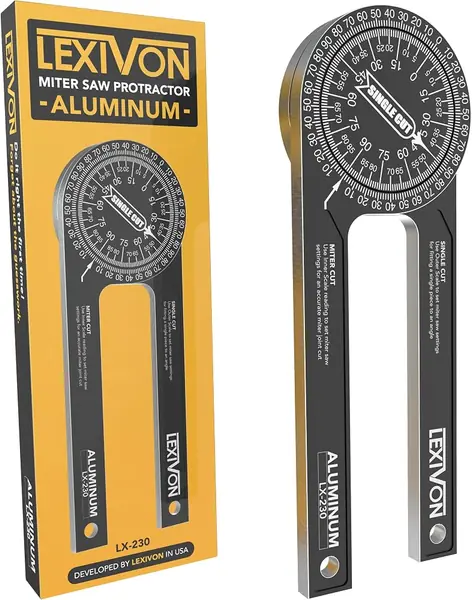
LEXIVON LX-230 aluminum miter saw protractor with laser-engraved dual scales

Trim and crown

Shop Score 96/100
Material
1/4-inch anodized aluminum
Scales
Miter cut and single cut
Pivot
Internal Teflon O-ring
Blade Length
7 inches
View on Amazon

Two scales sit on the head of this protractor, and they are why it holds the top spot here. One reads the corner in front of you; the other gives the number to set on the miter saw for a miter cut or a single cut, so there is no dividing by two and no test cut on scrap. Around a house where nothing is truly square, that shortcut is most of the job.

A 7-inch blade in 1/4-inch anodized aluminum gives it enough reach to span a corner and enough stiffness that pressing it flat doesn't bend your reading. The pivot turns on an internal Teflon O-ring — smooth, with just enough drag to hold an angle while you walk it to the saw. We also like that the laser-engraved markings don't depend on a battery, which matters for a tool that sits in a drawer for weeks between projects.

What it doesn't do: you read it by eye, so half a degree is a guess, and it has nothing to tell you about blade tilt or a fence angle — that is a digital job. For the miter-saw cuts most trim work comes down to, it is the fastest tool in this group, and it costs less than the digital picks while feeling considerably more substantial.

Worth Noting

  • Machined edges can arrive sharp
Our Verdict

We recommend it to anyone cutting trim or crown: two scales hand you the saw setting directly, and the aluminum body holds an angle without flexing.

Check Latest Price
2.

LEXIVON LX-DAF10 Digital Angle Finder Best Digital

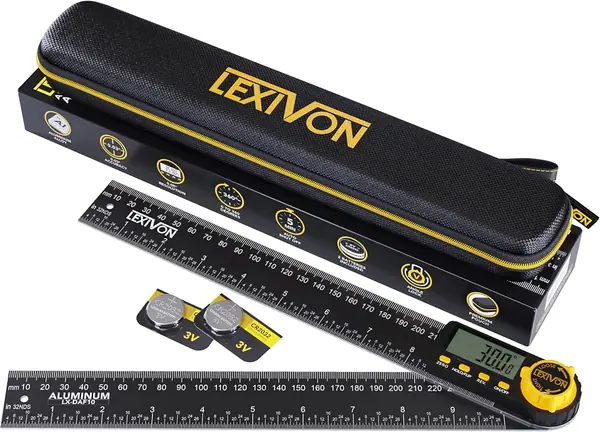
LEXIVON LX-DAF10 digital angle finder with XL LCD, aluminum rule, and zippered pouch

Machine setup

Shop Score 94/100
Range
360°
Accuracy
±0.3°
Resolution
0.05°
Rule Length
10 inches / 250 mm
View on Amazon

This is the most expensive tool on the page, and what the extra buys is a number instead of a scale. The head covers a full 360 degrees with 0.05-degree resolution on an extra-large LCD, so a reading is a glance rather than a squint, and a stated accuracy of plus or minus 0.3 degrees puts it among the most precise instruments in this group.

The buttons are what earn the price. ZERO recalibrates at any position, which lets you lay the rule on a saw table and read blade tilt as a relative angle; HOLD/FLIP freezes the number while you move the tool or flips it for an overhead look; and REVERSE handles inside, outside, and reverse angles without the arithmetic. A 10-inch anodized aluminum rule gives it more reach than the pocket-sized finders, and the angle lock knob holds the two legs where you put them.

We reach for it whenever a number has to be repeatable: a table saw blade, a fence, a picture frame where the angle is 37.3 and the cut has to match. For pure trim-corner work the LX-230 above is faster because it does the conversion for you; for machine setup, this is the one that earns its place at the top of the price range.

Worth Noting

  • Plastic housing and thin rules feel delicate
Our Verdict

Buy it if you set angles on machines: the 0.05-degree display, zero and reverse buttons, and a zippered pouch make repeatable saw settings easy.

Check Latest Price
3.

GemRed 82305 Digital Angle Finder Best Budget Digital

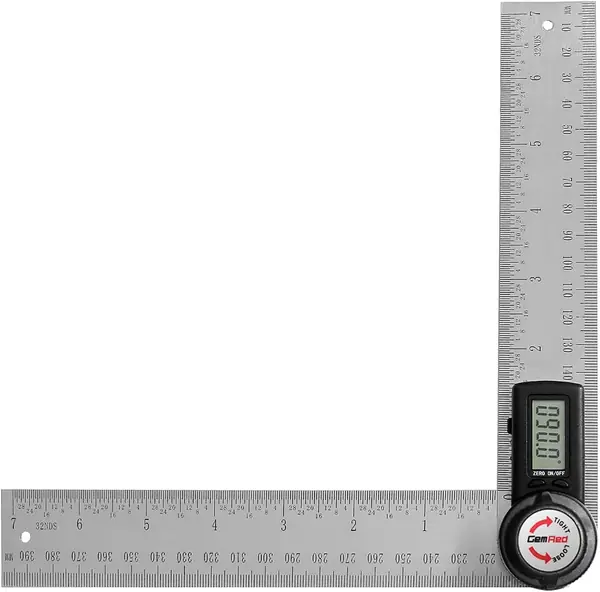
GemRed 82305 digital angle finder with folding stainless steel rules and black button head

Cabinets and trim

Shop Score 93/100
Accuracy
±0.3°
Battery
CR2032
Folded Length
About 7.5 inch/220mm
Ruler Material
Stainless steel
View on Amazon

Two stainless rules fold to about 7.5 inches, and the head between them reads to a stated plus or minus 0.3 degrees — for the least money of any digital angle finder here, that is a lot of measuring. We treat it as the digital tool to buy when you want a number but can't justify the premium models: baseboards, cabinet miters, and layout all land well inside its accuracy.

The rules are laser-etched in imperial and metric and the pivot locks so you can carry an angle to the saw. Two things to know before you order. There is no reverse-angle display, so when the tool reads across the outside of a corner you do the subtraction yourself. And the coin cell is the weak point: it can work loose in its holder and the display drains it, so keep a spare CR2032 in the drawer.

Worth Noting

  • No reverse-angle display to flip readings
Our Verdict

We point budget-minded woodworkers here: stainless rules, ±0.3-degree readings, and a folding body cover trim, cabinets, and layout.

Check Latest Price
4.

WEN ME512P Aluminum Protractor Best Compact

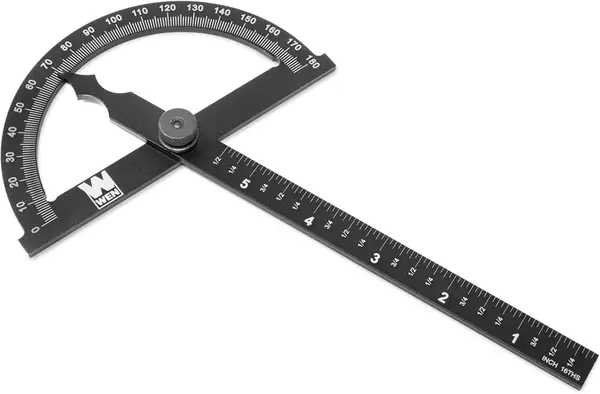
WEN ME512P adjustable aluminum protractor with laser-etched white-on-black degree scale

Quick bench checks

Shop Score 92/100
Range
0–180°
Material
Aluminum
Size
5.5 x 5.5 inches
Scale
5-1/2-inch rule in 1/16ths
View on Amazon

Five and a half inches square and made of aluminum, this is the protractor we leave out on the bench rather than filing away. It measures 0 to 180 degrees on a laser-etched scale, doubles as a 5-1/2-inch rule graduated in 1/16ths, and sets a bevel with the same arm. Small is the appeal: it drops into an apron pocket, and it is the least expensive tool we recommend here.

Two things to know. The thumb screw wants a firm turn — check that the arm holds your angle before you carry it to the saw — and a tool this small works best as the second protractor you grab for a quick check rather than the one you lay out a whole staircase with. As a compact, we think the trade is right: it measures true at 90 degrees, and the white-on-black markings are easy to pick out in shop light.

Worth Noting

  • Short 5-1/2-inch arm limits reach on wide trim
Our Verdict

We keep this one within reach for quick checks: aluminum, true at 90 degrees, and able to read or set any angle up to 180.

Check Latest Price
5.

Preciva Digital T-Bevel Protractor Best T-Bevel

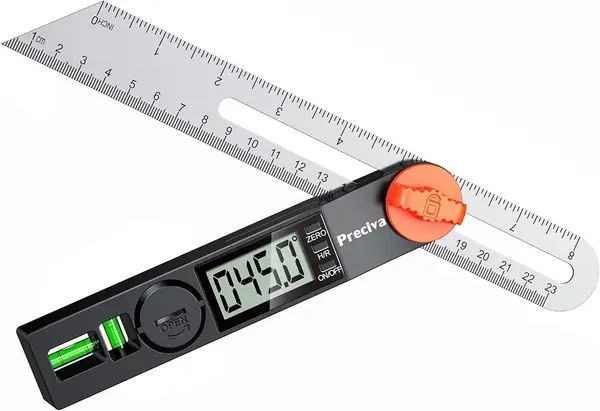
Preciva digital T-bevel protractor with metal blade, knob lock, and LCD readout

Copying odd angles

Shop Score 91/100
Range
0–338°
Accuracy
±0.3°
Vials
Horizontal and vertical
Blade Scales
230 mm and 8 in
View on Amazon

Loosen the knob, lay the blade along the joint, lock it, and read the angle on the screen — that is a sliding bevel and a digital protractor in one body, and it is the only tool here that both copies a shape and tells you its number. The blade carries 230 mm and 8-inch scale edges, horizontal and vertical bubbles let you check level and plumb in the same pass, and the head covers 0 to 338 degrees at a stated plus or minus 0.3.

Inside corners are where it stumbles: the housing sits proud of the blade, so the tool can't lie flush in a tight inside corner and the readout there is only as good as your eye. The fix is to use it as a bevel — lock the angle along the joint, carry it to the workpiece, and trace. The HOLD button and the 180-degree flip help when the display ends up facing the wall.

We recommend it to someone who wants one tool that transfers and reads rather than two. Zero it against a known square before a finished cut and it holds its own on trim, tile, and picture frames; treat the display as the convenience and the locked blade as the truth.

Worth Noting

  • Plastic housing feels light for the money
Our Verdict

For copying an angle off a wall and carrying it to the saw, this is our pick: the blade locks like a bevel and the screen reads the number.

Check Latest Price
6.

General Tools Stainless Protractor Angle Finder

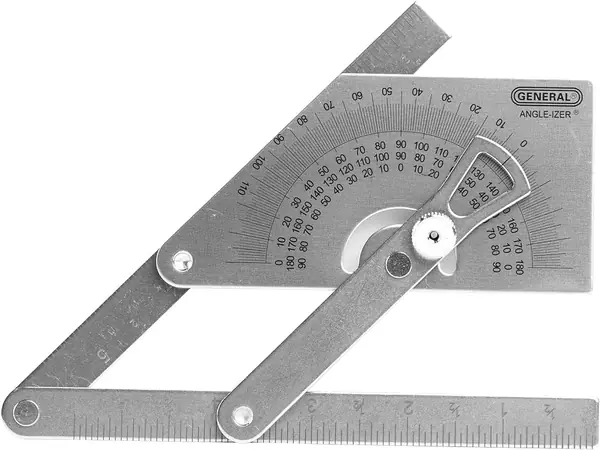
General Tools stainless steel angle finder protractor with locking nut for inside and outside angles

Cabinet joinery

Shop Score 90/100
Range
0–180°
Material
Stainless steel
Angles
Inside, outside, and slope
Locking
Nut on a four-piece body
View on Amazon

Four pieces, a locking nut, and a stainless body: this one is built to sit against a joint, lock the shape, and carry it to the blade. The graduations run 0 to 180 degrees in both directions, so you can read an inside or an outside corner without turning the tool around, and the locking nut is what turns a measurement into something you can walk across the shop.

We treat it as a transfer tool first and a measuring tool second. In cabinet work, where the joint's shape matters more than its number, that's the right order — clamp it, carry it, set the saw to the arm. The graduations are fine and dark, so mark from the locked arm rather than trusting a quick read in shade. Where a miter protractor can't straddle the joint, this is the tool we hand over.

Worth Noting

  • Fine, dark graduations are hard to read in shade
Our Verdict

Ours goes in the cabinet-work drawer: it locks inside, outside, and slope angles so a joint can be copied and carried to the blade.

Check Latest Price
7.

coobeast Digital Angle Finder with Laser

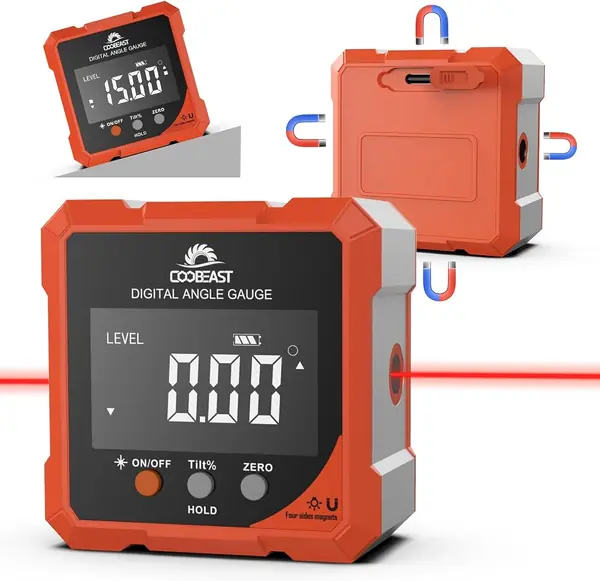
coobeast orange digital angle finder with four magnetic sides and dual laser lines

Blade tilt setup

Shop Score 89/100
Range
360°/4×90°
Laser
Class II, under 5 mW
Mounting
Magnets on four sides
Ingress Rating
IP54
View on Amazon

Four sides of magnets are the idea here, and that is the detail we appreciate most: set it against a table saw blade, a miter gauge, or a steel fence and it stays put while you adjust with both hands free. Palm-sized and orange, it reads tilt across 360 degrees in four quadrants, with the value flipping as you rotate.

It also projects laser lines and works as a small digital level, which is handy when a blade has to meet a line on the workpiece. The display is backlit and the housing is rated IP54, so sawdust and a splash aren't a concern in a shop. The grip depends on the surface, though — clean, thick steel holds it firmly, thin or painted metal less so — so give it a wiggle before you trust the number.

Where it stops: it can't be laid into a corner to read a joint, so trim and casing still want a protractor with arms. That's the trade for the magnets. Set on a miter gauge or a blade, it does something none of the analog tools here can — hold itself in place and show the tilt while both hands are on the adjustments.

We reach for it for machine setup and for anything that has to be level and square at once, and the USB charging means no coin-cell drawer. Buy it as a setup tool rather than your only angle tool, and it earns its place beside the analog picks.

Worth Noting

  • Magnet grip varies with the surface
Our Verdict

We reach for it when a blade or fence needs setting: four-sided magnets hold it in place while the display shows the tilt and your hands stay free.

Check Latest Price
8.

Saker Miter Saw Protractor Best for Trim and Casing

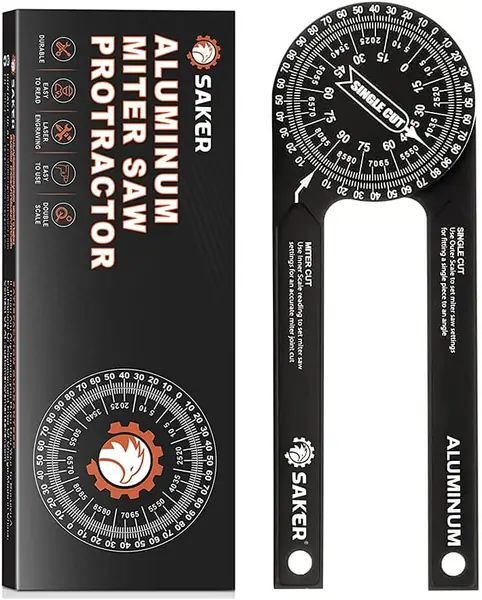
Saker 7-inch aluminum miter saw protractor with black O-shaped body and engraved scales

Trim and casing

Shop Score 88/100
Material
Aluminum alloy
Size
5.9 x 1.2 x 3.9 inches
Scales
Miter and single cut
Weight
6.3 oz
View on Amazon

Same job as our top pick, in a different body: a 7-inch head with laser-engraved scales that read inside and outside corners and hand you the miter setting directly. The O-shaped profile wraps the pivot in a continuous ring, which makes for a compact head that sits flat on a corner.

At 6.3 ounces and roughly 6 by 4 inches, it is the one that disappears into a nail bag, and the aluminum alloy body is light enough to hold against a soffit one-handed. The scales are engraved rather than printed, so handling doesn't rub them away.

The pivot is the real difference. It comes stiff, with more resistance than the Teflon ring on the LX-230, which keeps a reading from drifting on the way to the saw but makes fine setting slower — you push the arm rather than nudge it.

We rank it second among the miter protractors here: the same direct-read idea, smaller and stiffer, with a setting action that takes more patience. If you work out of a bag and want a corner tool that disappears until you need it, that trade is worth making.

Worth Noting

  • Stiff pivot slows fine adjustment
Our Verdict

We rank it as the smaller alternative to our top pick: the same direct-read scales, a stiffer pivot, and a body that drops into a tool bag.

Check Latest Price

How We Tested the Best Protractors for Woodworking

We started by sorting the category by how an angle actually gets to the saw: direct miter and single-cut scales, plain degrees, or a digital readout. From there we pulled listings that stated their scale resolution, rule length, and battery type, compared materials and head size, and set aside anything that couldn't say how the arm locked or what the scale was marked in.

Those 14 tools lived in the shop for six months. We ran baseboard around a hallway with two corners that were nowhere near square, cut crown on a jig, cased a door, and checked blade tilt at the table saw. To judge whether an arm holds a setting, we locked an angle, carried the tool across the shop, and re-read it at the blade; some crept two degrees, some didn't move at all.

For accuracy we compared each tool against a machinist square at 90 and 45 degrees, wiggled the pivot to find play, and on the digital units zeroed the rule closed, then checked it returned to zero after a dozen openings. We stuck the magnetic ones to a steel saw table and tilted it to see if they slid, and aimed the laser finders only at a shop wall.

Battery life got logged in sessions rather than hours, because that's how a dying coin cell announces itself — mid-cut. We read every scale at arm's length under shop lights and in dim light, checked whether the head cleared wide casing and the rule reached across the saw's table, and at the six-month mark looked for slop in the pivots and wear on the engraving. The stainless rule edges are sharp enough to mark wood, so we handled them accordingly.

How to Choose a Protractor for Woodworking

Direct-read scales, plain degrees, or a screen

A miter protractor does the arithmetic for you. Two scales on the same head give you the setting for a miter cut and for a single cut, so an 87-degree corner becomes a saw setting you dial in without a note pad. A plain degree protractor hands you the angle and leaves the conversion to you, which is fine for joinery and slow for trim; a digital finder reads to a tenth of a degree but has no idea what your miter saw does with the number.

We prioritize direct-read scales for anyone cutting trim, casing, or crown, and a plain or digital read for joinery, layout, and machine setup. If you do both, the second tool costs less than one miscut in a piece of hardwood.

Does the arm hold the angle you set?

An angle you can't carry is a number you can't use. The locking nut, thumb screw, or ring pivot is what lets you clamp a reading, walk it to the saw, and set the fence before it drifts. Loose is worse than stiff here: the stiff pivot on the Saker is a nuisance to fine-tune, but it doesn't slip on the way to the blade.

Test it before you trust it. Set the tool to 45 degrees, lock it, and press the arm against a board. If the reading moves, the lock is the problem, and no amount of care at the saw will fix it.

Analog or digital, and what a battery costs you

Digital angle finders win on machine setup. A 0.05-degree display, a zero button for reading blade tilt relative to the table, and a hold button for when the screen faces the wall solve problems no analog scale can. Analog wins at a corner, where the tool has to straddle a joint and the transfer matters more than the number.

Battery is the practical difference. Coin cells are cheap, but a loose holder or a display that drains one will strand you mid-project, so keep a spare and prefer a model that shuts itself off. Our top pick has no battery at all, which is part of why it's the one we leave in the toolbox.

Reach, head size, and the corners you actually have

Arm length is a real limit. A 5-1/2-inch protractor handles a picture frame or a cabinet face, a 7-inch miter protractor spans casing and crown, and a 10-inch rule reaches across a wider joint. Measure the widest corner you expect to work before you buy short.

The trap is the inside corner. A head that sits proud of its blade won't lie flush where two walls meet, so those angles want a bevel or two straightedges bridged across the corner. Check the tool against the actual joint, not against the picture on the box.

Material and the long haul

Aluminum plate around 1/4-inch doesn't flex, doesn't rust, and survives a tool bag; stainless rules stay crisp, but the housing around them is often plastic, which is where a digital tool feels its price. None of these are instruments to drop off a ladder.

A pouch or a drawer divider is cheap insurance for anything with a display, and a light wipe of oil on a steel arm keeps an old protractor reading for years.

Frequently Asked Questions

Final Verdict

Start with the LEXIVON LX-230. It costs less than the digital picks, needs no battery, and its two scales hand you a miter-saw setting without the division that turns a short trim job into an afternoon.

If your work is mostly machine setup — a table saw blade, a fence, a number that has to repeat — the LEXIVON LX-DAF10 is the better tool and worth the premium. And if you copy angles rather than read them, the General Tools stainless protractor does that job for less.