↑↓ navigate ↵ open Esc close All results →

Best Sliding T-Bevels of 2026

A sliding T-bevel has a single job that turns surprisingly difficult in practice: lift an existing angle off a wall, stair stringer, or cabinet carcass and hold it dead still on the walk back to the saw. Cheap bevels fail quietly — a weak lock lets the blade creep by a degree or two between layout and the cut, and the gap only surfaces during assembly.

Six months of testing 14 T-bevels across trim, framing, furniture joints, and cramped corners reinforced one rule early: set a bevel directly to the work rather than trusting an etched scale on the blade as a precision protractor. Holding power at the locking screw, dead-flat blade steel, generous knuckle clearance around the pivot, and even a built-in handle vial separate tools that keep their angle from frustrating knockoffs.

Whether transferring wide framing pitches or sneaking into tight cabinet corners, locking torque matters far more than handle cosmetics.

Our Top Picks

The Best Sliding T-Bevels

1.

Shinwa SB-8 Sliding T-Bevel Best Overall
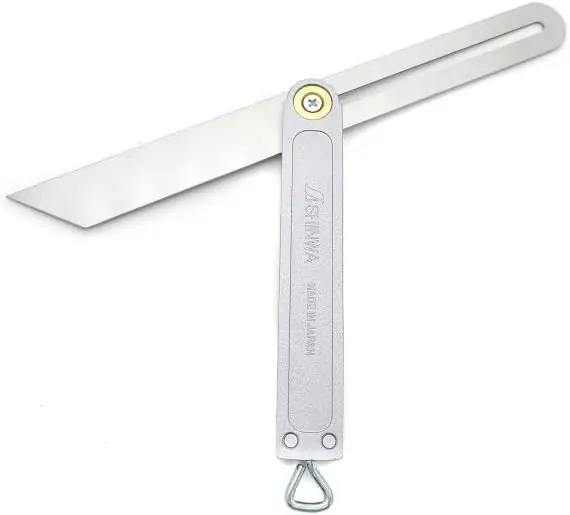
Shinwa SB-8 sliding T-bevel with silver anodized aluminum base and stainless blade

Everyday shop layout

Shop Score 92/100
Blade
8 in. (200 mm) stainless, milled
Weight
4.8 oz
Lock
Thumbscrew at handle end
Base
5 in. anodized aluminum
View on Amazon

The thumbscrew on the Shinwa SB-8 sits at the tail of the base instead of beside the pivot, and that one change is why it's our top pick. With the screw out at the end, your fingers have somewhere to go while the blade lies flat on the work, and you can flip the tool to use either face. We could lock an angle without the blade skating out from under us — which is not something we can say for every bevel here.

The blade is milled rather than stamped: 8 inches long, an inch wide, stainless. The base is a 5-inch bar of anodized aluminum. Milling is a small thing you can feel, because the edges come out straight and the faces flat enough to trust against a straightedge. At 4.8 ounces there's enough heft that the tool stays put while you hold the stock with one hand and mark with the other.

Locking is the part we kept coming back to. It takes very little screw pressure to hold a setting, so you aren't fighting the tool while your other hand keeps the stock registered against a corner. Set it once and it holds through a run of parts, which is the whole job.

What you give up is finish and any pretense of tradition. The body is plain anodized aluminum, with no wood or brass anywhere on it, and it costs the most of the bevels here. We're comfortable with both: the money goes into the joint and the blade, and that's where a bevel either works or doesn't.

Worth Noting

  • Worth checking the blade and faces for flatness on arrival
Our Verdict

We recommend it as the best all-around bevel here: the tail-end screw holds an angle without pinching your fingers, and the milled blade stays flat along a long layout.

Check Latest Price
2.

Johnson Level & Tool B75 T-Bevel Best Budget

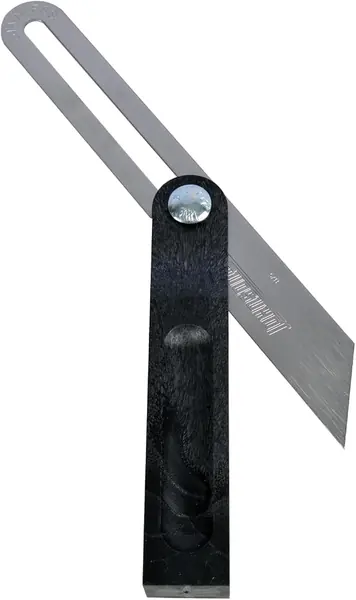
Johnson B75 sliding T-bevel with silver stainless blade and black Structo-Cast handle

Budget first bevel

Shop Score 91/100
Blade
9 in. stainless
Handle
Structo-Cast plastic
Weight
2.08 oz
Angle Range
0 to 360 degrees
View on Amazon

The Johnson B75 is the bevel to buy when you need one tool rather than a collection. It's a 9-inch stainless blade in a molded Structo-Cast handle with a hand grip, and it sweeps the full 0 to 360 degrees, so there's no angle in a house it can't copy. The wing nut does what a lock is supposed to do: set an angle, snug it by hand, and the blade stays where you left it.

Two details we like more than we expected. The blade slides down into the handle until the tool is about the length of a pencil, so it rides in an apron pocket without poking you, and at 2 ounces you forget it's there. The molded grip also keeps your thumb from creeping up onto the blade when your hands are sweaty. That's why we treat it as the second bevel: leave it set at 45 degrees for miters while a better one does the layout, and you stop re-setting the same angle all afternoon.

Worth Noting

  • Plastic handle suits weekend work better than daily trade use
Our Verdict

For the money, we haven't used a bevel that holds an angle more reliably — buy it as a first bevel or as a spare you won't mind lending out.

Check Latest Price
3.

Swanson TS149 9-Inch Sliding T-Bevel Best Traditional Wooden Bevel

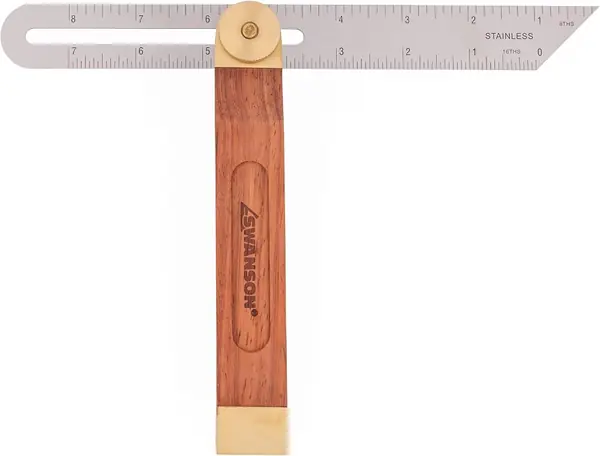
Swanson TS149 sliding T-bevel with hardwood handle, brass-bound ends and etched stainless blade

Furniture and trim

Shop Score 90/100
Blade
9 in. etched stainless
Handle
Hardwood with brass-bound ends
Lock
Brass thumbscrew
Scales
1/8 in. and 1/16 in.
View on Amazon

Brass plates cap both ends of the Swanson TS149's hardwood handle, and they aren't decoration — they're what keeps the wood from splitting when you crank the thumbscrew down. It's the traditional wooden bevel pattern: hardwood stock, brass at both ends and at the pivot, and a 9-inch blade. It's also the best-looking tool in this guide.

The blade is stainless and etched with 1/8-inch and 1/16-inch scales rather than printed, so the markings sit in the metal and don't rub away where your thumb rides. That detail matters more than it sounds. A printed scale goes soft exactly where you read it most, and then you're setting angles by eye and hoping.

We like it best for furniture and finish carpentry, where you take an angle off a plan and mark it on stock that will show. The lock is the part to watch: it can loosen as you scribe the same angle across several pieces, so snug it between marks and check the blade against the last line you drew. Want a bevel that holds without fussing at all? The Shinwa SB-8 is the surer bet.

Worth Noting

  • Proud brass plates can keep stock from sitting flat
Our Verdict

We like it best for furniture and finish work, and for anyone who wants a wooden bevel that looks right on the bench.

Check Latest Price
4.

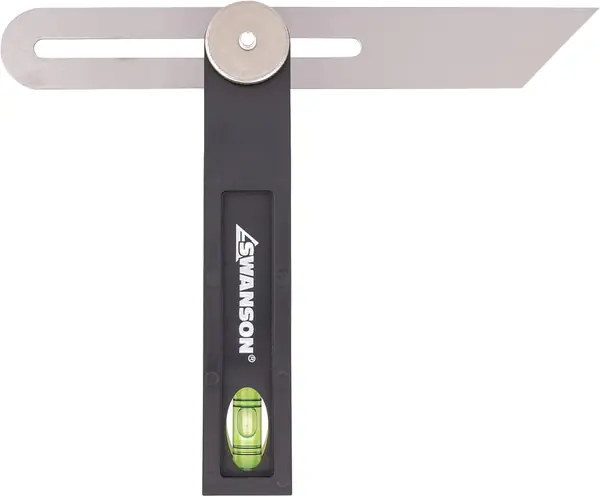
Swanson TS150 8-Inch Sliding T-Bevel Best with a Level Vial

Swanson TS150 sliding T-bevel with stainless blade and black composite handle with level vial

Framing and remodel

Shop Score 89/100
Blade
8 in. stainless
Handle
Heavy-duty composite
Weight
4.48 oz
Level Vial
Two-ring, handle-mounted
View on Amazon

A bevel normally tells you nothing about plumb. The Swanson TS150 builds a two-ring level vial into the handle, so before you copy a corner you can check that the thing you're copying is actually vertical, and the twin rings give you a reference from either direction. That's the feature that earns it a place in this guide, and it's the bevel we reach for on remodel work, where the walls are usually the problem.

The rest is sensible. An 8-inch stainless blade, a heavy-duty composite handle, and a knob big enough to turn with a gloved hand. The handle is the practical part: composite takes a drop onto a floor without splitting the way a wooden stock can, which is why this one travels well. It weighs 4.48 ounces, light enough to carry all day and substantial enough not to feel like a toy.

It isn't the bevel for someone who wants brass and hardwood on the bench. The handle is plain, and the 8-inch blade gives up an inch of reach to the 9-inch tools here. On a job site that trade runs the right way: you get the vial, and a tool you don't have to baby in a bucket of offcuts.

Worth Noting

  • Eight-inch blade offers less reach than 9-inch bevels
  • Plain composite handle lacks brass and hardwood finish
Our Verdict

Our pick for framing and remodel work: the built-in vial checks plumb and level, and the composite handle survives being dropped off a ladder.

Check Latest Price
5.

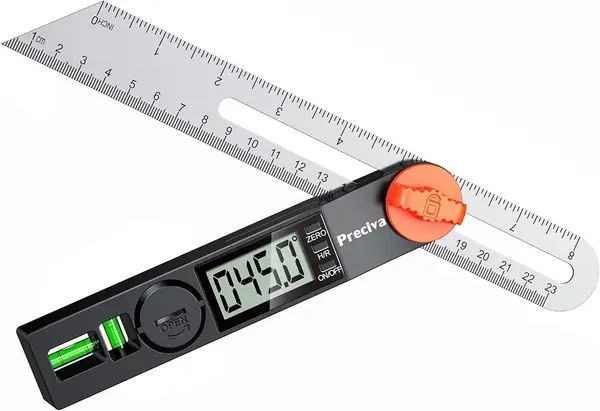
Preciva Digital T-Bevel Gauge Best for Repeated Odd Angles

Preciva digital T-bevel with LCD display, stainless blade and black plastic locking knob

Repeated odd angles

Shop Score 88/100
Angle Range
0 to 338 degrees
Levels
Horizontal and vertical bubbles
Display
LCD with hold and reverse
Stated Accuracy
±0.3 degrees
View on Amazon

The Preciva's plastic body stands a little proud of the blade, so it won't sit flush in a true inside corner — the one job a plain wooden bevel does without thinking about it. Everywhere else the digital readout earns its keep: set the blade on the work and the screen gives you the angle in degrees instead of a line you have to carry across the shop.

We found the buttons do real work. HOLD freezes a reading while you move the tool, the reverse button hands you the supplementary angle without any subtraction, and closing the blade and zeroing it resets the reference. For a run of repeated cuts at an awkward angle, that's faster than any manual gauge here, and it's why the Preciva stays in the guide.

Two things worth knowing. The stated accuracy is plus or minus 0.3 degrees, so check it against a square before you trust it on finish work. And the housing carries a battery and an LCD, neither of which a wooden bevel ever asks you to think about.

Worth Noting

  • Mostly plastic body feels less durable than metal
Our Verdict

We think it earns its place for outside angles and repeated cuts, where the readout saves arithmetic — just don't expect it to sit flat in an inside corner.

Check Latest Price
6.

Spear & Jackson CSB9 Sliding Bevel Best for Traditional Hand Work

Spear and Jackson CSB9 sliding bevel with rosewood-stained hardwood handle and brass end plates

Traditional hand work

Shop Score 87/100
Blade
9 in. spring steel
Handle
Rosewood-stained hardwood
Weight
6.7 oz
Fittings
Brass end plates
View on Amazon

The blade on the Spear & Jackson CSB9 is spring steel, not stainless, and that's the first thing to know about it. Spring steel is tough and springy and has been the blade on traditional wooden bevels for a very long time; it also rusts if you leave it damp, so it wants a wipe of oil now and then. On a bench tool that lives indoors, that's a small chore.

The stock is rosewood-stained hardwood with brass end plates top and bottom, 162 mm long, and the whole thing weighs 6.7 ounces — noticeably more tool in the hand than the plastic-bodied bevels here. The thumb nut takes the blade firmly with a short turn, and the fit is better than the price suggests, with the brass sitting where it should.

That's what sells it for us. This is a bevel for someone who wants the traditional wooden tool, marks with a knife as often as a pencil, and treats a light oiling as part of owning it. If keeping steel dry sounds like a nuisance, the stainless-bladed bevels here are the easier choice.

Worth Noting

  • Non-stainless blade needs oiling to stay clean
Our Verdict

A beautifully made wooden bevel at a fair price — we recommend it to hand-tool woodworkers who want the classic look and don't mind looking after steel.

Check Latest Price
7.

Shinwa 62596 Freedom Scoya

Shinwa 62596 Freedom Scoya bevel with slim stainless steel body and brass locking screw

Tight-space layout

Shop Score 86/100
Body
SUS420J2 stainless steel
Screw
Brass
Length
250 mm (9.8 in.)
Thickness
5.5 mm (0.2 in.)
View on Amazon

At 250 mm long and 5.5 mm thick, the Freedom Scoya is the slimmest bevel in this guide. That thinness is the whole point: it slips between a blade and a fence, into a drawer, or along the inside of a small box where a hardwood bevel with brass plates can't follow.

The body is stainless steel — SUS420J2, with a brass screw — and the finish is what struck us first: flat faces, crisp edges, tight joints. There's no scale on it, and none is claimed. This one compares and transfers angles; it doesn't tell you the number.

In the hand it's small but not toy-like, and folded up it takes less room than a pencil. This is the bevel that lives in an apron pocket and comes out for the little job rather than the long layout.

We keep it for jigs, drawers and anything where the workpiece is smaller than the tool. Buy it as your only bevel and you'll want more reach before long; buy it as the second one and it handles the marks the nine-inch tools can't get to.

Worth Noting

  • Knurled knob takes a firm pinch to tighten
Our Verdict

It's the slimmest bevel in this guide, and the one we keep for boxes, drawers and small work where a full-size gauge won't fit.

Check Latest Price

How We Tested Sliding T-Bevels

We started with research rather than a shopping cart: we read specs and owner reviews to find which parts actually fail — locks that drift under a light pass of the hand, blades that flex, wood handles that split after one drop on a shop floor. From there we ordered 14 bevels across the price range, from plastic-handled budget models to hardwood traditionalists and a digital angle gauge, and put them to work.

Testing ran six months, through a kitchen remodel, a deck framing job, a run of furniture and trim, and plenty of ordinary afternoons at the bench. Every bevel was used the way one actually gets used: set against an angle that already exists on the work, locked, carried across the shop, and marked on the piece that had to meet it.

Lock security got the most attention. We set each bevel against a mitered corner, marked the joint, carried it back, and compared the fresh mark against the original angle twenty times per tool. We noted where the thumbscrew sat and whether our knuckles cleared the work on a narrow stile, and checked blade flatness against a straightedge and reach across wide trim.

Handles were dropped from bench height onto concrete and checked for splits and slop at the pivot, and scales were read under shop light and checked for wear after handling. We compared handle vials against a known level, ran digital readouts through hold and reverse and into inside corners, and weighed each bevel in an apron pocket. Throughout, they stayed layout tools — used to mark and check angles and to set a saw to the angle they showed, never as a blade guide or a pry bar.

How to Choose a Sliding T-Bevel

Start With the Lock, Not the Handle

Every bevel here locks with a thumbscrew, and the difference is where that screw sits. On most, it's beside the pivot, right where your thumb wants to rest while the blade lies on the workpiece; on the Shinwa SB-8 it's out at the tail of the base, which keeps fingers clear and lets you flip the tool to either face.

Whichever you choose, tighten with the blade resting on the stock rather than in mid-air, and look for a screw you can snug by hand. A lock that needs a death grip to hold is a lock you'll stop trusting halfway through a job.

Blade Length and Reach

Nine inches is the size to start with: the blade spans a cabinet side or a door stile, so you can register the stock on one edge and mark at the other. Eight-inch blades do the same work on smaller pieces and take up less room on a bench.

Thickness is the other half of the question, because it decides where the tool can go. The Freedom Scoya is 5.5 mm thick and slides between a blade and a fence, while a hardwood bevel with brass end plates is closer to an inch across and belongs in open layout work. Doors and casings, favor reach; boxes and drawers, favor thin.

Handle Material Matters More Than You Think

Hardwood with brass end plates is the traditional answer and still a good one: the brass caps keep the stock from splitting under screw pressure, and the tool feels right in the hand. Wood dents if it lands on concrete, though, and the brass can stand slightly proud of the wood.

Composite and aluminum shrug off drops and stay flat. Plastic is the budget answer and honest about it — a plastic-bodied bevel is a weekend tool that will do the job for years if it lives in a drawer rather than a pouch. We treat wood and metal as buy-once and plastic as buy-spare.

Etched, Printed or No Scale at All

Some blades carry 1/8-inch and 1/16-inch scales; some carry nothing. Etched markings sit in the metal and survive years of pencil and knife work, while printed scales wear away where your thumb rides — the detail nobody mentions until the numbers go soft.

A scale lets you set an angle by number and read one back; a plain blade only transfers an angle from one piece to another. Both are legitimate. Pay for the scale if you set angles from a drawing; skip it if you always copy from the work in front of you.

Do You Need a Digital Bevel Gauge?

Digital models read the angle in degrees, which saves arithmetic on odd shapes and lets you note a setting for next time. The trade-off is built in: the electronics live in a housing that stands proud of the blade, so a digital bevel can't sit flush in an inside corner, and you're adding a battery to a tool that otherwise needs none.

If most of your angles are outside corners, repeated cuts or somebody else's layout, the readout is a real convenience. For inside corners and trim, a plain bevel still wins.

Frequently Asked Questions

Final Verdict

For most woodworkers the Shinwa SB-8 is the bevel to buy. The tail-mounted screw holds an angle with light pressure, the milled stainless blade stays straight across a cabinet side, and nothing else here locks as confidently.

If you want a spare to leave set at 45 degrees, or you're equipping a first toolbox, the Johnson B75 does the same job for a fraction of the money. For site work, where corners are never square and tools get dropped, the Swanson TS150's vial and composite handle make more sense than either.