↑↓ navigate ↵ open Esc close All results →

Best Digital Angle Gauges of 2026

A saw blade that looks dead square against a combination square can still sit a quarter-degree off—an error that only announces itself when a mitered picture frame refuses to close. Zeroing a digital angle gauge on the cast-iron table and sticking it to the blade turns guesswork into a crisp number, provided the reading settles quickly, stays legible under the guard, and clings firmly to steel.

Across four months of setting table saws, miter saws, jointer fences, and level wall shelves with 12 digital gauges, repeatability separated real shop tools from novelties. Any listing can claim tenth-of-a-degree resolution, yet checking how many magnetized faces actually gripped steel and whether each unit returned the exact same tenth twice exposed the weak links.

Covering dedicated saw-setup cubes, repeat-cut bevels, budget drawers, and portable tool bags, seven gauges proved accurate enough to cut to without double-checking with a protractor.

Our Top Picks

The Best Digital Angle Gauges

1.

Klein Tools 935DAG Digital Angle Gauge Best Overall
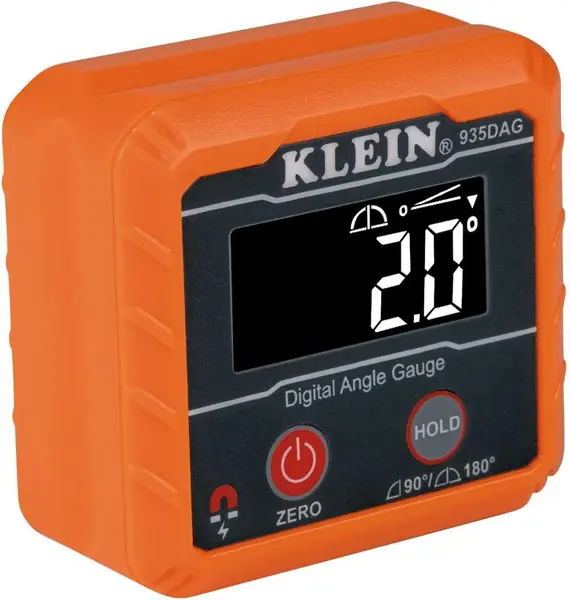
Klein Tools 935DAG digital angle gauge with magnetic base and reverse-contrast display

Saw blade setup

Shop Score 96/100
Weight
3.5 oz
Display
Reverse-contrast, auto-rotating
Measuring Range
0-90 and 0-180 degrees
In The Box
Soft case, batteries, manual
View on Amazon

A magnet is the first thing we judge on these, and the one in the 935DAG grabs a table saw blade and stays there while you crank the bevel wheel — no third hand, no watching a plastic cube skid down the plate. Zero it on the table, move it to the blade, and you're reading the angle between the two, which is the number you actually care about when the bench isn't level.

The rest of the design holds up. The reverse-contrast screen is legible in the shadow under a blade, where a plain LCD goes gray, and it flips itself when you turn the gauge upside down against a fence. At 3.5 ounces it vanishes into an apron pocket, and it arrives with a soft case and batteries — more than several picks here bother with.

V-groove edges along the base are the detail we didn't expect to lean on. They let it sit square on pipe and conduit, so the same tool that sets a blade angle in the shop also handles a handrail or a dust run. The range covers 0 to 90 and 0 to 180 degrees, and the buttons are few enough that the little manual stays in the case.

One habit worth forming: lay it on the flat of the blade plate rather than up near the teeth, where a thin-kerf blade leaves too little steel for the base to sit square. That's the only technique this gauge asks of you.

Worth Noting

  • Display washes out in direct sunlight
Our Verdict

We recommend it to most woodworkers: the magnet holds a blade, the zero works off an out-of-level bench, and the screen stays readable in the shadow of the saw.

Check Latest Price
2.

Wixey WR300 Digital Angle Gauge Best for Table Saw Setup

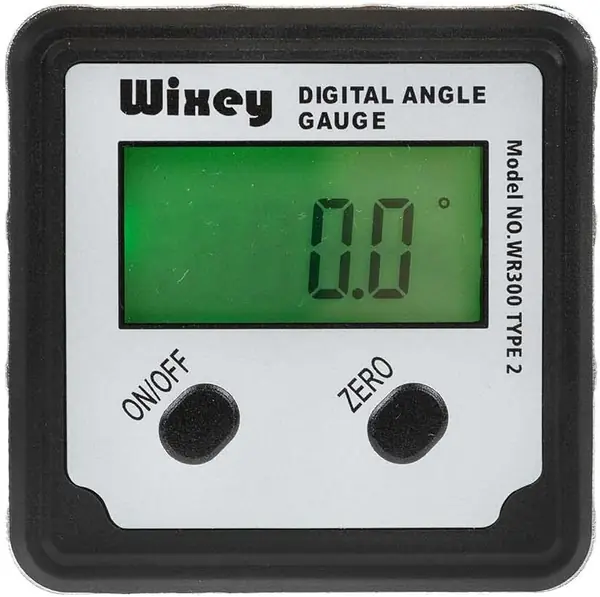
Wixey WR300 digital angle gauge with backlit LCD and magnetic base

Table saw work

Shop Score 95/100
Weight
3.21 oz
Display
Backlit LCD
Accuracy
±0.2 degrees
Resolution
0.1 degree
View on Amazon

Two numbers sell the Wixey before you ever switch it on: plus or minus 0.2 degrees of accuracy, and a 0.1-degree resolution. That's finer than a bevel handwheel will let you work, and we like seeing it stated plainly on a tool whose whole job is measurement.

The backlight is what we appreciate most in use. Shops are lit for the work, not for the instrument, and a lit display stays readable when you're crouched beside the saw looking up at the underside of the table. The magnetic base clamps to the blade or the fence and peels off cleanly, which sounds like a small thing until you're working one-handed.

If your angle work is one table saw and one miter saw, this is where we point you. The Klein earns the top spot on range and grip, but the Wixey states its accuracy, lights its display, and weighs a hair less in the pocket.

Worth Noting

  • Readings can take a moment to settle
Our Verdict

Our pick when the only thing you measure is a saw blade: stated plus or minus 0.2-degree accuracy, a backlit display, and a magnet that holds a fence or a plate.

Check Latest Price
3.

Klein Tools 935DAGL Digital Level Angle Finder Best for Repeat Angles

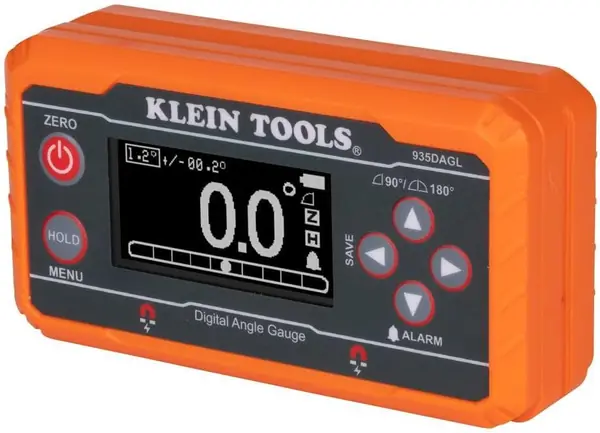
Klein Tools 935DAGL digital level and angle finder with bullseye display

Repeat angle cuts

Shop Score 94/100
Weight
5.92 oz
Ranges
0-90 and 0-180 degrees, plus dual-axis bullseye
Target Alarm
Audible alarm and color-changing LCD
Pitch Presets
1/8-Inch, 1/4-Inch, 3/8-Inch and 1/2-Inch per foot
View on Amazon

Cut a dozen miter joints at the same angle and you stop trusting your eye against the bevel scale. This is the gauge for that afternoon: program the angle, and it beeps and flashes when the blade arrives, so you watch the blade instead of the screen.

It also reads two axes at once. Bullseye mode shows lean in both directions on a countertop, a machine bed or a pan, and the pitch presets cover 1/8-Inch, 1/4-Inch, 3/8-Inch and 1/2-Inch per foot if you're setting drainage or a roof slope without doing the arithmetic.

What we keep coming back to is how little thinking it asks for: set a target, adjust until the light changes, cut, repeat. It's the only gauge here that turns one good angle into a repeatable one, and if you build in batches that convenience justifies its place at the top of the price range.

Worth Noting

  • Costs the most of any gauge here
Our Verdict

Buy this one if you cut the same angle all afternoon; programming a target and letting it beep frees your eyes for the blade.

Check Latest Price
4.

Trend DLB Digital Level Box Best Budget

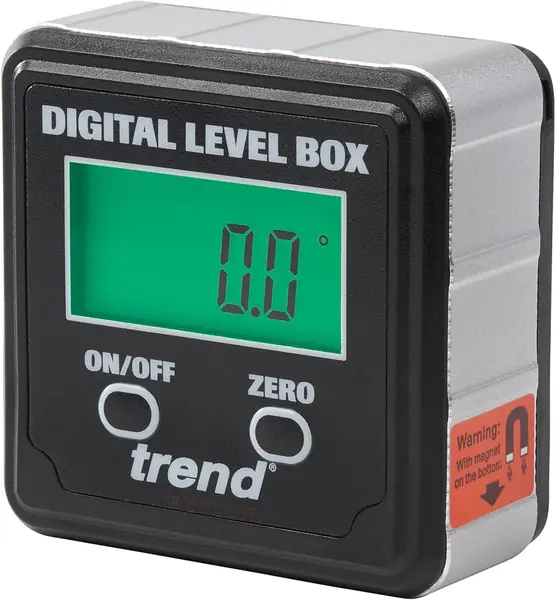
Trend DLB digital level box with backlit rotating display and magnetic base

First-time buyers

Shop Score 93/100
Weight
6 oz
Display
Backlit LCD with auto-rotating orientation
Base
Magnetic
Zero Function
Sets a relative reference on any surface
View on Amazon

The Trend is the cheapest way into a tool that will genuinely change your cuts, and at this price we expected something toy-like. What's in the box is a small cube with a backlit screen that reorients itself, arrow indicators that tell you which way to move the blade, and a zero function — the same workflow the expensive gauges use, minus the extras.

Shop life suits it. The magnetic base holds a blade or a fence, the display is bright enough for a dim corner of the garage, and the zero resets against any surface when the bench isn't flat. Ours lives in the top drawer next to the tape measure, which is about the highest compliment a small tool gets around here.

Worth Noting

  • No published accuracy rating
Our Verdict

The one we hand a beginner: bright auto-rotating display, a zero that works, and a magnetic base, for about as little as a gauge costs here.

Check Latest Price
5.

GemRed DAG-V1 Digital Angle Gauge

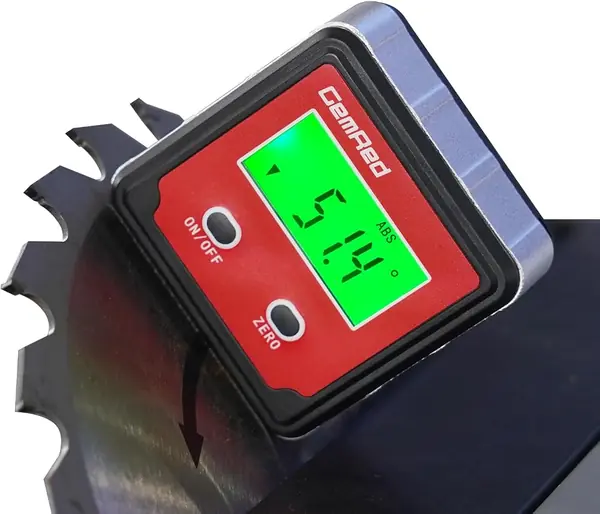
GemRed digital angle gauge with green backlight in an aluminum housing

Tool bag backup

Shop Score 92/100
Weight
2.47 oz
Accuracy
±0.2 degrees
Resolution
0.1 degree
Measuring Range
0 to 360 degrees (4 x 90)
View on Amazon

It's a two-inch cube that weighs about as much as a deck of cards, and GemRed publishes the numbers that matter: plus or minus 0.2 degrees of accuracy at 0.1-degree resolution, on an aluminum frame instead of plastic. That's the same accuracy claim the Wixey makes, which is a lot of measuring tool for the least money in this guide.

We like it as the second gauge — the one that stays in the tool bag for a job site or a friend's garage. The range runs a full 0 to 360 degrees in four quadrants, so it can be flipped and zeroed in any orientation without you rethinking what's on the screen.

The base is where it gives ground: the magnets sit in the bottom face only, so it hangs onto a blade lying flat and wants a second hand when you stand it on edge against a fence. For the money we can live with that, and the aluminum body takes the knocks of a drawer or a bag without complaint.

Worth Noting

  • Magnets only in the base
Our Verdict

The cheapest accurate gauge here, and the one we leave in the tool bag for job sites.

Check Latest Price
6.

Stead & Fast Digital Angle Finder Best for Job Site Work

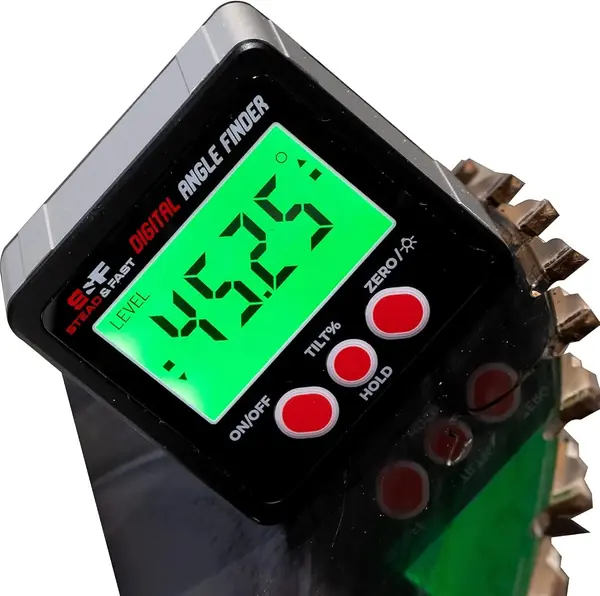
Stead & Fast digital angle finder with backlit LCD and protective case

Job site work

Shop Score 90/100
Display
Backlit LCD, auto-inverting
Accuracy
±0.2 degrees
Rating
IP54 dust and splash resistant
Battery
2 AAA, up to 120 hours
View on Amazon

Hold is the button we didn't know we wanted. Press it and the gauge freezes the number, so you can tuck it under a low shelf or behind a machine, pull it out, and read the angle where the light is better.

The rest of the package suits work outside a shop. It's rated IP54 for dust and splashes, it runs on two AAA cells instead of a coin cell you have to hunt for, and it ships with a case, batteries and a small screwdriver in the box.

We take it over the budget pair when the gauge rides in a truck or a bag: the sealing, the hold button and the case justify the step up, and the accuracy figure is printed rather than implied. It's the pick for someone who measures on ladders and decks as often as at a bench.

Worth Noting

  • Backlight doesn't work on every unit
Our Verdict

We pick it for work away from the bench: the hold button freezes a reading you can't see, and IP54 sealing survives a truck bed.

Check Latest Price
7.

XUNTOP Digital Angle Finder with Laser Best for Hanging and Leveling

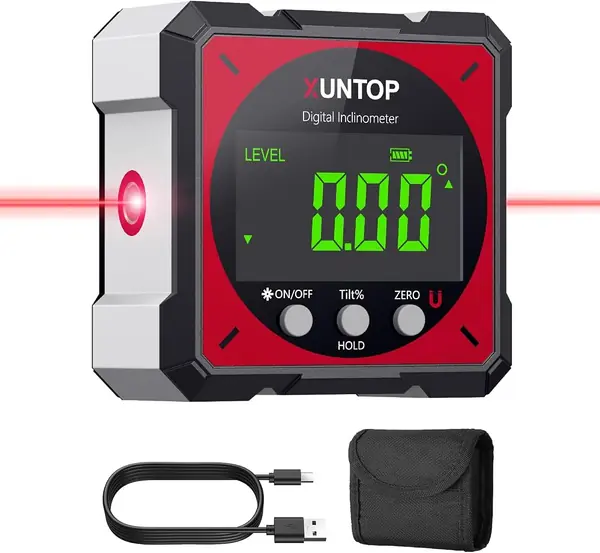
XUNTOP digital angle finder in red with dual laser lines and USB-C charging

Hanging and leveling

Shop Score 89/100
Rating
IP54
Battery
Internal rechargeable, USB-C
Laser
Two lines, Class 2
Magnets
Four sides
View on Amazon

Two laser lines come out of the front of this one, which tells you what it's really for: running a line across a wall for shelves or a picture rail while the display reads the tilt. As a saw gauge it's the weakest thing here; as a level for a room it's the handiest.

The hardware is more interesting than most of the budget picks. There are magnets on all four sides, so it clings to a steel door frame or a saw fence whichever way you turn it, and the housing is rated IP54 against dust and splashes.

It's a 2.4-inch cube with a backlight and a display that adjusts to orientation, and it charges over USB-C from the same cable as your phone, which keeps one more charger out of the bag.

So: buy it if you hang as much as you cut, because the lasers replace a second tool in the bag. If the saw is the whole job, this is money spent on lines you won't project, and the Trend handles the angle work for less.

Worth Noting

  • Internal battery can't be swapped mid-job
Our Verdict

Buy it for the lasers, not the angles — it lays out a shelf line and reads tilt, but the saw is better served by a simpler gauge.

Check Latest Price

How We Tested Digital Angle Gauges

We started with every gauge we could find that promised accuracy to a tenth of a degree, then filtered for the things that decide whether one lives in a drawer or in your hand: magnets, a backlit display, a zero function, and a battery you can replace or recharge without hunting down a proprietary charger. That left 12, which went into rotation for four months alongside the squares and protractors they were meant to replace.

Each gauge ran the same rounds. We set a table saw and a miter saw to 90 and 45 degrees, zeroing on the saw top first and then reading against the blade, and we checked a jointer fence and hung shelves with the ones small enough to fit in a corner. Every time, we unplugged the saw before reaching anywhere near the blade to seat or lift a gauge. Between setups we watched how fast the number settled after the tool touched steel, whether it drifted while we stood there, and whether a second placement on the same blade returned the same tenth.

Magnet hold got tested by sticking each gauge to the side of a steel fence and tipping it — we counted the faces that grabbed and noted which ones slid. Readability was judged in a dim garage, in direct sun through an open door, and under a blade where the housing blocks half the screen. We weighed each one, carried it in a shirt pocket for a day, and checked whether the edges of the housing were machined square enough to register flat.

Battery life was run down to auto-off, and we logged what came in each box — case, batteries, cable, manual — against what we had to supply ourselves. For the gauges that hold a target angle, we cut two pieces at the same setting and checked the joint. Value came down to the least expensive gauge that still repeated itself.

How to Choose a Digital Angle Gauge

Accuracy Specs vs. What a Saw Needs

Most gauges here claim plus or minus 0.2 degrees with 0.1-degree resolution, and a few publish no figure at all. For woodworking, either number is finer than a bevel handwheel lets you work, so we treat the printed accuracy as a tiebreaker between two tools that otherwise feel equal rather than as the reason to pay more.

What matters more is the zero. You're measuring the angle between the table and the blade, not an absolute attitude, so a gauge that zeroes reliably on any surface and holds that reading will beat a more precise one that drifts. Look for a zero function and a display that settles quickly.

Where the Magnets Are

A magnet in the base is table stakes. What separates these picks is whether the sides are magnetic too, and whether the base carries V-grooves. Base-only models hold a blade lying flat and want a second hand when you stand them on edge against a fence; four-sided models cling in any orientation, which is the difference between a two-hand job and a one-hand job.

If your work is a table saw and a miter saw, base magnets are enough and you can save the money. The V-groove is worth having if you also bend conduit or level pipe, since it keeps the housing square on a round surface.

A Display You Can Read in Your Shop

Backlight is the feature people pay for and the one that can disappoint: a lit screen is wonderful in a dim garage and useless in direct sun. Think about the light you actually work in. Most of us are under a blade in shadow, which is exactly where a backlit, reverse-contrast or auto-rotating display earns its keep.

One thing to check on arrival is that the readout flips when you turn the gauge upside down against a fence. Craning sideways to read a number is how a bevel gets set wrong.

Zero, Hold and Target Angles

For one-off setups, zero plus a clear display is the whole tool. The extras start paying when you repeat yourself: a hold button freezes a number you can't see from where you're standing, which is what you want inside a cabinet or under a machine.

If you cut the same angle all afternoon — a run of cabinet miters, a batch of frames — a gauge that accepts a target angle and beeps when you reach it is worth the step up in price. You adjust the blade instead of reading a screen, and your eyes stay where the cut is.

Size, Batteries and the Case

Most of these run on AAA or AA cells, one charges over USB-C, and all of them shut themselves off eventually. Prefer a standard cell if the gauge lives in a cold truck, where you can drop in a fresh battery; prefer the rechargeable if it lives near a charger anyway.

Footprint matters in one specific way: a smaller cube sits on a narrow blade plate or inside a cabinet, while a larger one is easier to read without picking it up. Whichever you choose, a case is worth having on a tool that rides in a bag with chisels.

Frequently Asked Questions

Final Verdict

For most shops the answer is the Klein 935DAG. It grips a blade hard enough to stay put while you turn the bevel wheel, zeros against a table that isn't level, and shows a display you can read in the shadow under the saw, all at a middle-of-the-road price.

Buy the Wixey instead if a saw blade is the only thing you'll ever measure and you want the accuracy printed on the box, or the Trend if you're outfitting a first shop and want to spend as little as possible.