↑↓ navigate ↵ open Esc close All results →

Best Digital Levels for Woodworking of 2026

A bubble vial only answers whether a surface is level or plumb, forcing you to squint at the gap between line and edge. On stair stringers, sloped deck framing, or drainage runs, a digital level reads out exact pitch—0.4 degrees off, 12.6 degrees of slope, or a 43.2-degree miter—handling the angles where standard vials stop helping.

Nine months of using 12 digital levels across pocket cubes, 10-inch torpedoes, and 48-inch rails on saw blades, cabinet runs, and wall framing showed why stated accuracy and display resolution are not the same spec. A screen that shows 0.1-degree increments can still drift farther than its confident readout implies.

Weak magnets that slide down steel studs and sluggish displays slow down layout just as much as loose tolerances, so all three formats here are ranked by how fast they settle and how consistently they repeat once referenced.

Our Top Picks

The Best Digital Levels for Woodworking

1.

Klein Tools 935DAG Digital Angle Gauge and Level Best Overall
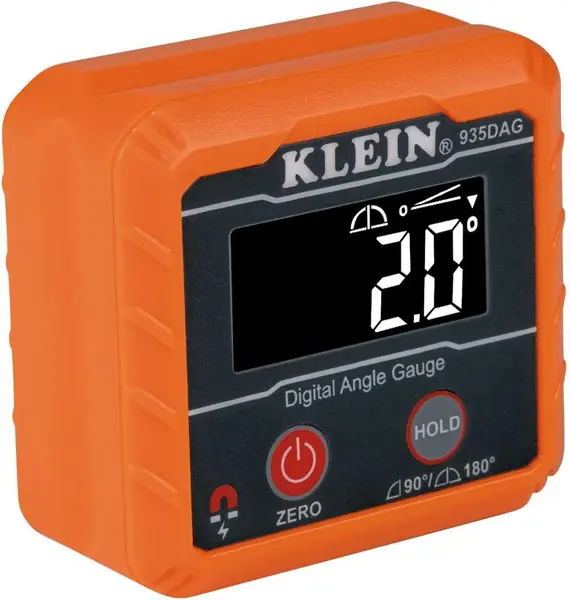
Klein Tools 935DAG digital electronic level and angle gauge with magnetic base

Saw blade setup

Shop Score 96/100
Weight
3.5 oz
Display
Reverse contrast, auto-rotating
Base
Magnetic with V-groove edges
Measurement Range
0 to 90 and 0 to 180 degrees
View on Amazon

Set it on a table saw top that isn't quite level, press the zero button, and the saw becomes your reference instead of the bench. That trick is why the Klein 935DAG is the first digital level we hand a woodworker: it measures 0 to 90 and 0 to 180 degrees, and zeroing on any surface turns an uneven bench into a usable datum.

The magnetic base with V-groove edges is the part we appreciate most. It grabs a miter saw blade, a fence, or a length of conduit and stays there while you turn an adjustment with both hands, and the display rotates when you flip the tool so you never read it upside down. At 3.5 ounces and about 2-1/2 inches square, it disappears into an apron pocket and comes back out for jigs, drill press tables, and fence angles. Batteries, a soft case, and the manual come in the box, so you can use it the day it arrives.

What it won't do is check a long run. The reference face is shorter than your palm, so it reads the angle at a spot rather than the flatness of a wall or a stair stringer; that's a job for the 10-inch 2PM torpedo or a 48-inch level. For everything that clamps, tilts, or gets set, this is the one we reach for, and every other gauge here has to justify itself against it.

Worth Noting

  • Display can wash out in direct sun
Our Verdict

The one we recommend first: two angle ranges, a zero function that turns any bench into a reference, and a magnet that holds it on a blade while you adjust.

Check Latest Price
2.

Trend DLB Digital Level Box and Angle Finder Best Budget

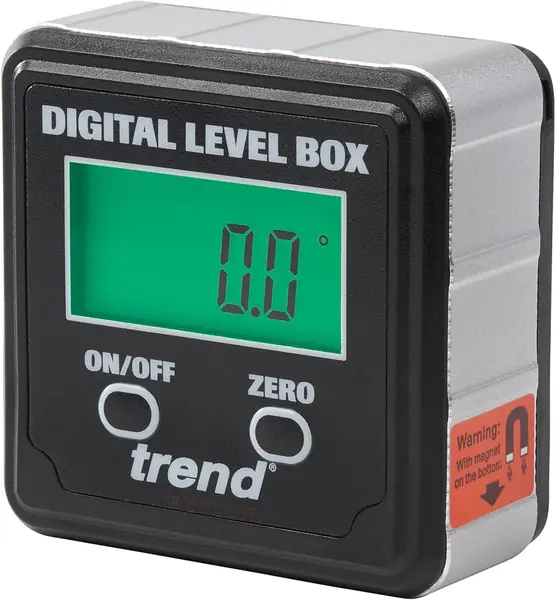
Trend DLB digital level box with backlit LCD and magnetic base

Budget blade setup

Shop Score 94/100
Weight
6 oz
Display
Backlit LCD, auto-orienting
Mounting
Magnetic base
Zero Function
Sets a reference on any surface
View on Amazon

This is the least expensive tool on our list, and it handles the job most of us bought a digital level for: setting a table saw or miter saw blade and getting the same number twice. The backlit LCD auto-orients, the magnetic base holds it to a cast iron top, and the zero function means an unlevel bench doesn't throw the reading. We set a blade against it, checked the saw's bevel scale, and moved on — no menus, no fuss.

What you give up is the extras the pricier gauges carry: a second axis, a target-angle alarm, a frame you can lay across a run. Trend builds this one for tight spaces, so it slides between a blade and a throat plate where a long level can't go, and at 6 ounces it lives in a shop apron without complaint. For a hobbyist squaring a blade to 90 or 45, none of that comes up. If you bend conduit, check plumb posts, or want an alarm when you reach the angle, the Klein picks do more.

Worth Noting

  • No accuracy figure published
Our Verdict

Our budget pick: it sets a blade to 45 or 90 and repeats the number, which is what most shop work actually asks for.

Check Latest Price
3.

2PM Tools L300 10-Inch Digital Torpedo Level Best Digital Torpedo Level

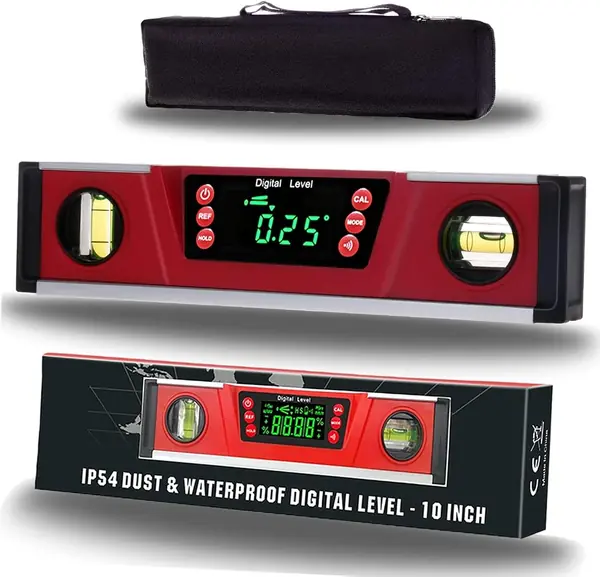
2PM Tools 10-inch digital torpedo level in red aluminum with green LED display

Framing and slope

Shop Score 93/100
Protection
IP54 dust and splash resistant
Length
10 inches
Accuracy
±0.1° at 0° and 90°
Readout Modes
Degrees, in/ft, mm/m, percent
View on Amazon

Ten inches of aluminum with the electronics in the middle, the L300 is what to reach for when a cube is too small for the surface you're checking. The frame gives you a straight edge to lay along a rail, a sill, or a stair stringer, and the readout turns that edge into a number.

It's also the only compact model here that publishes an accuracy figure: ±0.1° at 0° and 90°, ±0.2° between them, with a resolution of 0.01° at the two cardinal angles. It reads in degrees, pitch in inches per foot, millimeters per meter, and percent slope, so the same tool sets a saw blade and checks the fall on a drain line. A zero button resets the reference on any surface, a hold button freezes a number you can't see from where you're crouched, and IP54 covers dust and splashes — it is not a level to leave out in the rain.

What sold us is the combination of a real reference edge and a readout that stays legible in a dim shop. It won't do the two-axis bullseye work the Klein 935DAGL handles, but for framing, decks, and short slopes it doesn't need to.

Worth Noting

  • Too long to carry in an apron pocket
Our Verdict

We like it as the short level that gives you a real edge plus a number: tight accuracy, four readout modes, and enough length to check a slope.

Check Latest Price
4.

Klein Tools 935DAGL Digital Level with Programmable Angles Best for Plumb and Pitch

Klein Tools 935DAGL digital level with dual-axis bullseye display and case

Plumb and pitch

Shop Score 92/100
Weight
5.92 oz
Ranges
0-90 and 0-180 degrees plus dual-axis bullseye
Angle Alert
Audible alarm and color-changing display
Pitch Presets
1/8, 1/4, 3/8, 1/2 inch per foot
View on Amazon

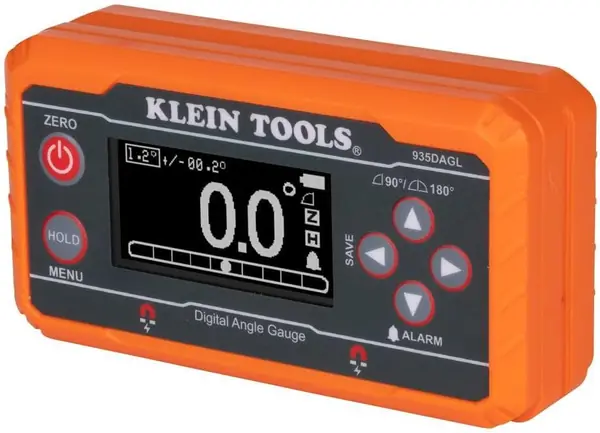
The bullseye is what separates the 935DAGL from every other cube here: instead of a single tilt, it shows the X and Y axes at once. That's the most useful thing about it — a drill press table, a bench, or a post that has to be right in two directions gets one glance instead of two setups — and it's what the extra money over the 935DAG buys.

The programmable angles earn their keep too. It holds the common pitches — 1/8, 1/4, 3/8, and 1/2 inch per foot — plus any target you set, and when the tool reaches it the LCD changes color and an alarm sounds. That keeps your eyes on the workpiece and the adjustment screw instead of the screen, which is the difference between hitting a slope in one pass and chasing it.

The auto-rotating display reads clearly at arm's length in low light, and the ranges cover 0 to 90 and 0 to 180 degrees as well, so it doubles as a plain angle gauge when you don't need the bullseye. Batteries, a soft case, and the manual come in the box.

Worth Noting

  • Bulkier in a pocket than the other cubes
Our Verdict

For anything that has to be right in two directions — a post, a bench, a drill press table — this is the gauge we reach for, and the target alarm is why.

Check Latest Price
5.

M-D Building Products SmartTool 48-Inch Digital Level Best Value Full-Size

M-D Building SmartTool 48-inch digital level in yellow aluminum with carry case

Grade and slope

Shop Score 91/100
Length
48 inches
Accuracy
1/10 degree
Readouts
Degrees, percent slope, in/ft
Battery Life
500 hours
View on Amazon

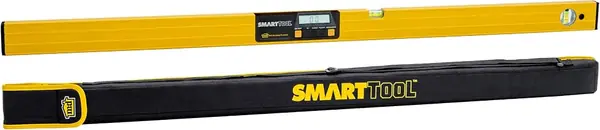
Calibrate it before you trust it. The SmartTool's routine has you reference the electronics against the vials rather than pressing a zero button, and the first time through it takes a few minutes with the manual open. Skip that step and the level hands you a confident number that's wrong — the kind of mistake you find out about when the siding doesn't close.

Once it's set, this is a lot of level for the money: 48 inches of aluminum that reads degrees, percent slope, and inches per foot to a tenth of a degree. We like it for long work — a deck frame, a stair stringer, a slab — where you want one number for the whole run instead of a series of spot checks. The hold button carries a reading back to your cut list, the audible beep lets you level a post on your own, and the 500-hour battery rating is the kind of spec you stop thinking about.

Set against the Stabila, you give up the washable housing and the second electronics module; set against a 10-inch torpedo, you gain the ability to read a slope across four feet instead of sampling one spot. The aluminum frame and acrylic block vials take a knock without drama. For a crew that needs one good long level without paying premium money, that's the balance this one strikes.

Worth Noting

  • Initial vial calibration takes several minutes with manual
  • Lacks a washable housing and second electronics module
Our Verdict

A long level with a digital readout that won't wreck the budget; calibrate it once and it handles grade, slope, and long runs.

Check Latest Price
6.

Stabila Tech Level 196 Electronic Level, 48-Inch Best Full-Size

Stabila Tech Level 196 electronic spirit level in black aluminum, 48 inches

Long-run site work

Shop Score 90/100
Weight
2.4 lb
Protection
IP65 dust and water rated
Length
48 inches
Readout Modes
Five, including degrees, percent, mm/m
View on Amazon

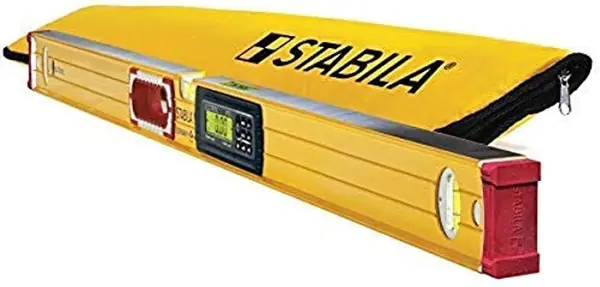
Two electronic modules in a rigid aluminum frame, 48 inches of working edge, and a readout that settles almost immediately — the Tech Level is built for people who check level and slope all day rather than once a weekend.

The feature list earns its place on site. It reads in five modes, including degrees to one or two decimals, percent, feet and inches in fractions or decimals, and millimeters per meter, and the display flips and lights up when you're working in a dark basement. Three different audible signals let you align a run without looking at the screen, and the IP65 housing can be washed off at the end of the day — drywall dust, mud, concrete splash, all of it.

Whether it earns the premium depends on how often it leaves the truck. On daily commercial work the speed and the washable housing pay for themselves, and the display stays legible in conditions where a bubble is not. At 2.4 pounds it weighs what a 48-inch aluminum level weighs, which is to say you notice it on the stairs and nowhere else. For a homeowner checking a deck once a summer, the M-D measures the same things for a lot less.

Worth Noting

  • Calibration runs off the bubble vials
Our Verdict

Daily site work is where this earns its price: fast, washable, and readable in the dark, with five readout modes for grade and slope.

Check Latest Price
7.

Bosch GAM 220 MF Digital Angle Finder Best for Trim and Miters

Bosch GAM 220 MF digital angle finder with folding legs and illuminated display

Trim and miters

Shop Score 89/100
Weight
2.4 lb
Protection
IP54 housing
Miter Range
0 to 220 degrees
Leg Extension
Extends to 16 inches
View on Amazon

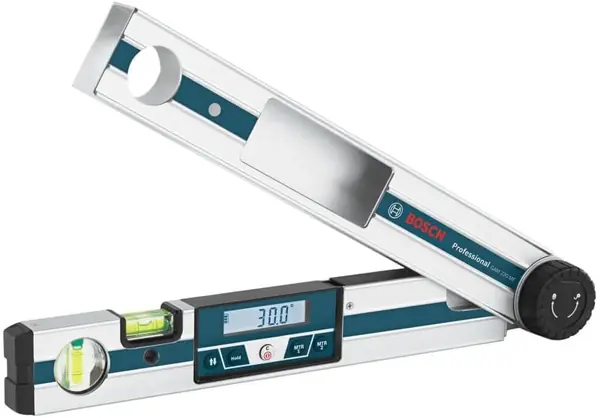
What the GAM 220 MF isn't is a running level: the readout comes from its two legs, so it measures the angle between surfaces — a room corner, an existing miter, a stair — rather than telling you a shelf is out as you slide it along.

What it does, nothing else here matches. Measure a corner, press a button, and it works out the miter to set on the saw, including compound cuts for crown, with an input range of 0 to 220 degrees. That removes the arithmetic and the scrap test cuts that go with it.

The legs extend to 16 inches for reaching across a casing or into a corner, angle memory holds a reading while you walk to the saw, and the housing is rated IP54 for dust and splash. At 2.4 pounds and 17 inches closed, it's a toolbag item, not a pocket one.

For trim work the arithmetic is what you're paying for. Measure the corner, read the miter, set the saw, and skip the test cut. If your work is machine setup and checking whether things are level, the cubes and the long levels here do that better.

Worth Noting

  • Measures surface angles rather than acting as running level
  • Too bulky at 2.4 pounds and 17 inches for pockets
Our Verdict

The tool for measuring angles that already exist — corners, casings, stairs — with the miter and compound-cut math built in.

Check Latest Price
8.

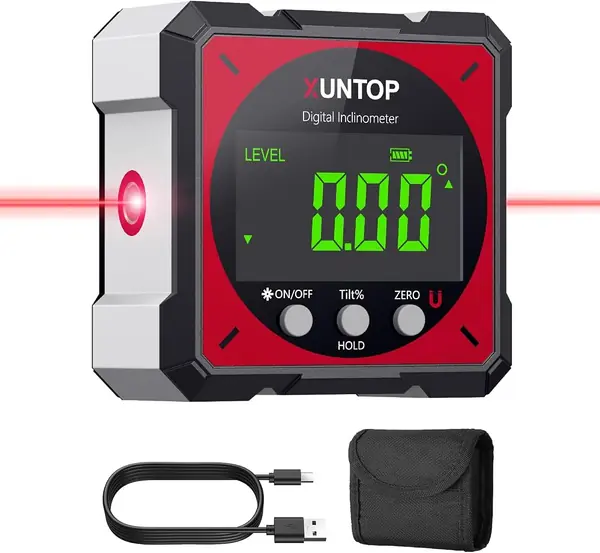
XUNTOP Digital Angle Finder with Dual Laser Best for Hanging and Alignment

XUNTOP red digital angle finder cube with dual lasers and USB-C charging

Hanging and alignment

Shop Score 88/100
Protection
IP54 dust and splash resistant
Size
2.4 by 2.4 inches
Laser
Dual Class 2 lines under 1 mW
Charging
USB-C rechargeable battery
View on Amazon

It charges over USB-C from an internal battery, which means one cable covers it and your phone. For a tool that lives in a bag and comes out twice a month, that's a bigger convenience than it sounds.

The two laser lines are what make it more than an angle gauge. Set it on a wall or a steel stud, sight the lines, and you can lay out a row of shelves or a picture rail without a second person holding a level. They're Class 2, under 1 mW, so treat them as a layout guide rather than a substitute for measuring.

Magnets on all four faces let it stick to a steel stud, a saw table, or a duct at whatever orientation the job needs, and the aluminum body is rated IP54 for dust and splashes. A carry bag and a USB-C cable come with it, and the 2.4-inch cube fits in a pocket or a tool pouch.

Where it fits is layout: shelves, rails, cabinets, anything that needs a line and a number more than a calibrated reference. It isn't the tool we hand someone setting up a saw for joinery, and it isn't priced like one. If you hang things for a living, the lasers alone justify keeping it in the bag.

Worth Noting

  • Rechargeable cell means no spare to swap in
Our Verdict

Our pick for hanging and layout: two laser lines, magnets on every face, and USB-C charging in a package that fits a pocket.

Check Latest Price

How We Chose and Tested the Best Digital Levels

We started from spec sheets rather than reviews, pulling every digital level in the three formats that matter — cube, 10-inch torpedo, and 48-inch rail — and setting aside anything without a published accuracy figure. That left 12 units, used for nine months on real work: hanging upper cabinets, framing a small deck, setting a fence line so it drained, dialing in miter and table saw blades, and bending conduit.

Accuracy came first. We zeroed each level on a benchtop we'd deliberately shimmed out of level, then moved it around and checked whether the reference held. We compared readings against a machined square, then dropped every unit from waist height onto a bench top and re-checked calibration — nobody wants to do it, but it's the test that matters. Magnetic hold got its own pass: we stuck each one to a steel stud, a length of black pipe, and a saw blade, watched for slide and rotation, and noted how the V-groove seated on round stock. The angle finders we opened to full leg extension for trim and miter work.

On site we timed how long the number took to settle after a tilt, read the display in a dim basement and under a bright window, and watched how the target-angle alerts behaved — the beeps and color changes that let you stop hunting for a figure. We logged battery type and runtime, weighed each unit for pocket or toolbox carry, and judged fit and finish: housing seams, button feel, whether the case was worth keeping. Value came down to whether the extra spend bought accuracy you could see on the display. The one laser-equipped model is Class 2, under 1 mW, and we kept its beam away from eyes and never pointed it at anyone.

How to Choose a Digital Level

Cube, Torpedo, or Full-Length

The body decides what the tool can tell you. A cube — the kind usually sold as an angle gauge or angle finder — has a reference face about the size of a coaster, so it measures the angle at one spot: ideal for a saw blade, a jig, or a drill press table. A 10-inch torpedo adds a straight edge for short runs, and a 48-inch electronic level gives you a reference long enough to read grade across a deck or a stair.

Buy the cube first if you're setting up machines; add length when you start checking surfaces instead of blades. And read 'compact' carefully — in a listing it means the tool fits a pouch, not that it can span a four-foot wall.

What the Accuracy Numbers Mean

Two figures get quoted and they aren't the same thing. Accuracy is how close the reading is to the truth; look for a stated figure like ±0.1° at 0° and 90°, which is what our torpedo pick claims. Resolution is how finely the screen divides the number — 0.01° looks impressive and promises nothing on its own.

Plenty of good gauges publish no accuracy figure at all, which is fine when you zero them on the work and use them for setup. If you're cutting joinery to a number, buy the stated accuracy.

Zero, Hold, and Target Angles

Zeroing is what makes a digital level useful in a real shop: press it on a bench that's out by two degrees and the tool treats that surface as 0°, so every reading after it is relative to your saw instead of to gravity. A hold button freezes a reading you can't see from where you're crouched.

Target-angle alerts go further — the gauge beeps, lights up, or changes color when you reach the number you set, so you can watch the blade instead of the screen. If you adjust blades alone, pay for the alert.

Reading the Display Where You Work

Backlighting helps in a basement and does nothing in direct sun, where a reverse-contrast screen can wash out to a gray rectangle. Auto-rotation matters more than most shoppers expect, because you mount these tools sideways on a blade or a fence and shouldn't have to tilt your head to read them.

Think about where the tool will live — under a bench, on a roof, in a driveway — and pick the display for that, not for the showroom. A hand shading the screen solves most outdoor problems.

Frequently Asked Questions

Final Verdict

Start with the Klein 935DAG. Two angle ranges, a zero function that works on any bench, and a magnetic V-groove base cover the work most woodworkers actually do — blades, jigs, fences, machine tables — and it does it for less than most of the field here.

Go elsewhere for a specific job: the Trend DLB if the budget is tight, the 2PM torpedo when you need a short reference edge, and the Stabila if the level rides in a truck and gets checked against grade every day. For measuring angles that already exist on a house, the Bosch does what none of the others can.