↑↓ navigate ↵ open Esc close All results →

Best Digital Micrometers of 2026

Buying a digital micrometer by counting decimal places on the screen is a common trap—even a poorly machined frame will happily display five digits it cannot hold. The number that defines what you actually bought is the published accuracy tolerance, which often sits buried while display resolution gets bold print.

Checking tenon thickness, turned spindles, and machined metal parts over seven months with 12 digital micrometers across a woodworking bench, lathe, and garage confirmed two practical patterns. A smooth ratchet stop matters far more than an extra display digit, and carbide-tipped measuring faces justify their cost the moment you measure steel regularly.

Different frame sizes, measurement ranges, and price tiers suit everything from fine joinery and round stock to a dedicated station beside the lathe. Across all seven models, a published accuracy tolerance you can verify against a gauge block pairs with a spindle feel that repeats cleanly every time you close it.

Our Top Picks

The Best Digital Micrometers

1.

iGaging Digital Electronic Micrometer Best Overall
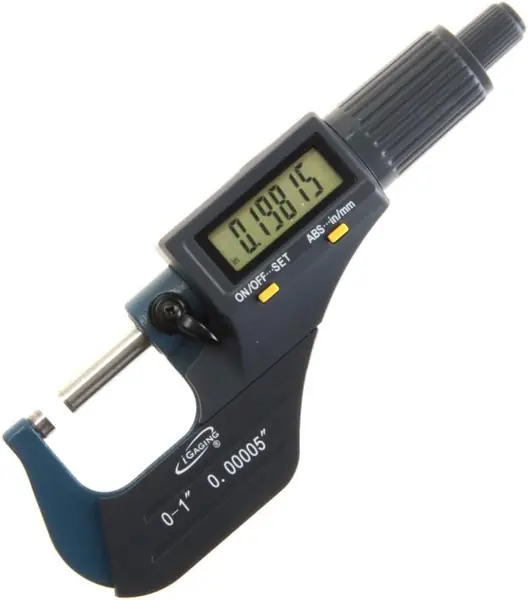
iGaging digital electronic micrometer with a large LCD screen and inch metric readout

Fine woodworking joinery

Shop Score 89/100
Measuring Range
0-1 in
Display
Large LCD
Measurement Modes
Absolute and incremental
Included Components
Case and battery
View on Amazon

We keep a caliper within arm's reach for most shop work, and the moment it stops being enough is always the same one: a tenon cheek or a planer knife's projection where two readings in a row disagree. The iGaging settles that argument. The LCD is big enough to read with the tool still closed on the work, the digits are high-contrast, and the inch/metric button sits where your thumb already is.

Our judgment on this one is simple: it's the safest default in the group. Accuracy, function, ease of use, and value all come out strong for it, with none of the electronic flakiness that follows a couple of the cheaper picks. Absolute and incremental modes are more useful than they sound — zero on a known thickness and read the difference, or hold a reference while you work through a stack of parts that should match. The hard case and the battery come in the box, so there's nothing else to buy.

What it won't do is measure anything but outside dimensions — no inside jaws, no depth rod — and one inch of range is the honest limit. That covers stock under an inch, tenon cheeks, shims, bit shanks, and blade kerf, which is most of what a woodworker measures. For that window, it's the one we keep closest to the bench.

Worth Noting

  • Plastic thimble knob feels light under the fingers
Our Verdict

This is the one we reach for: big readable digits, inch and metric on one button, and the steadiest accuracy and function record here. Buy it if you want one micrometer that simply works.

Check Latest Price
2.

REXBETI Outside Micrometer Best Value

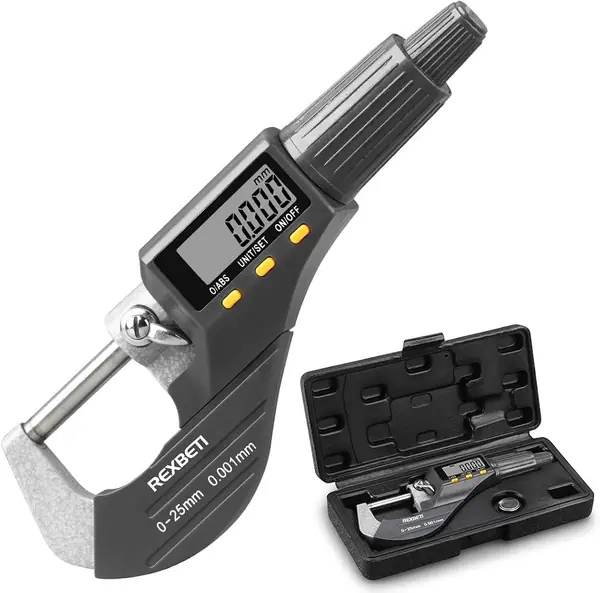
REXBETI outside micrometer with carbide-tipped faces stored in a hard protective case

Budget-conscious shops

Shop Score 88/100
Measuring Range
0-1"/0-25mm
Resolution
0.00005"/0.001mm
Accuracy
±0.0001 in
Measuring Faces
Carbide-tipped
View on Amazon

On paper the REXBETI reads like a typo in your favor: 0-1"/0-25mm range, 0.00005"/0.001mm resolution, ±0.0001 in accuracy, carbide-tipped faces, a ratchet stop, a hard case, and a spare CR1632 in the box. We think it's the best value in this guide, and if you want the tightest tolerance printed on the packaging without paying a premium, this is where to look.

Two details earn their keep in a woodshop. The carbide tips shrug off contact with metal and stay flat longer, which matters if you check the same chisels and plane irons week after week. The ratchet stop is the other one: it clicks at a set force, so you and the next person in the shop get the same number off the same part instead of one of you squeezing harder.

Electronics are where the risk sits. A micrometer's frame and spindle can last decades; the readout is the part that quits, and this model has a mixed history on that score, with units that stop reading and a few that drift out of adjustment. Buy from a seller with an easy return window, keep the spare cell in the case, and check it against a known size — a feeler gauge leaf or a dowel pin — a few times in the first month. If it holds, you got a lot of micrometer for the money.

Worth Noting

  • Uses the less common CR1632 cell
Our Verdict

We think this is the value pick: carbide faces, a ratchet stop, a hard case, and a spare battery, with a tighter accuracy figure than anything else in the same money.

Check Latest Price
3.

WEN 10725 Digital Micrometer Best for Round Stock

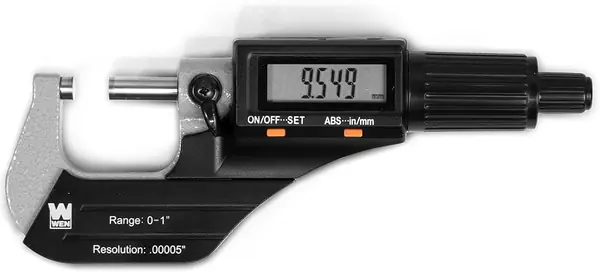
WEN 10725 digital micrometer with LCD readout and a 4.5 mm ball bearing tip

Round stock

Shop Score 85/100
Measuring Range
0-1 in (0-25 mm)
Resolution
.00005 in / .001 mm
Accuracy
±0.0001 in
Ball Bearing Tip
4.5 mm
View on Amazon

A flat anvil touches a round surface along a line, and a reading taken on a line is a reading you argue with. WEN's answer is a 4.5 mm ball bearing tip that pops on in place of the standard face, so dowels, drill rod, turned handles, and anything with a curve sit against a point of contact instead. It stores in the case and swaps on in seconds.

The rest is a conventional 0-1 in (0-25 mm) micrometer: ±0.0001 in accuracy, .00005 in / .001 mm resolution, a carbide-tipped anvil, and a 6.5 mm spindle for reaching into a shallow recess. The ratchet and thimble split quick and fine adjustment the way we like — spin the thimble to close in, finish on the ratchet for a consistent squeeze. Hardened stainless body, hard case, 6.88 ounces in the hand.

There's less long-term history behind this one than behind our top pick, and durability is the single thing we can't speak to; everything else we can judge, we like. For a woodworker turning knobs, pegs, and dowel joints, the ball tip is the difference between a measurement and an estimate, and nothing else in this guide solves that problem.

Worth Noting

  • Ball tip is a small part to misplace
Our Verdict

The ball bearing tip is the reason to buy this one: it seats on round stock and uneven surfaces that flat anvils slide off, and the rest of the tool is accurate and fairly priced.

Check Latest Price
4.

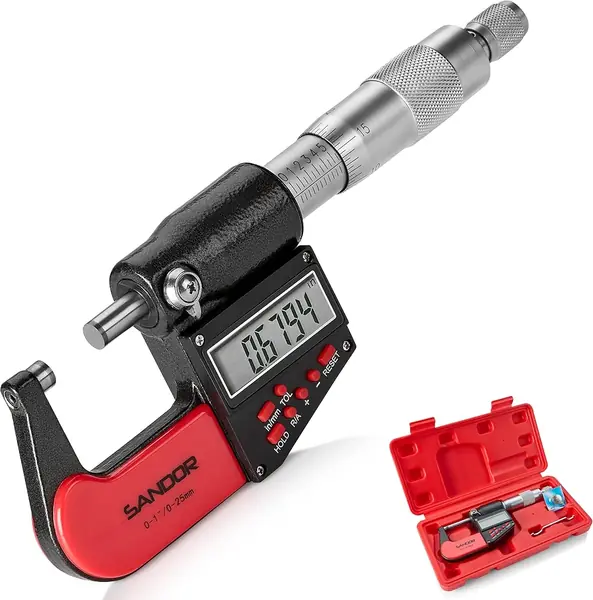
Sandor Tools SR132 Digital Micrometer Best for Machinist Work

Sandor Tools SR132 digital micrometer in red and black with a hard shell case

Precision metalwork

Shop Score 84/100
Measuring Range
0-1"/0-25mm
Resolution
0.00005"/0.001 mm
Accuracy
±0.002 mm
Material
Hardened stainless steel
View on Amazon

This is the priciest micrometer here by a wide margin, so the fair question is whether the money buys anything you can feel. Partly it does: the frame is hardened and ground stainless steel rather than a coated or plastic-bodied assembly, and it has the dense, settled feel we want in a shop instrument.

The numbers are the tightest in this group — ±0.002 mm accuracy, 0.00005 in / 0.001 mm resolution over 0-1 in / 0-25 mm, a hard carbide tip, and a ratchet stop. Zero-set and calibration are straightforward: close on the anvils, press zero, and check against a standard when you want to be sure. Inch or metric, one button. The hard shell case and the red-and-black finish are the sort of details that survive life in a toolbox.

Two design choices are worth knowing before you buy. The spindle lock is a switch rather than a rotating dial — quicker to flick, less gradual than a lock you can tighten down. A thimble that binds instead of turning smoothly can happen too, so exercise both in the first week; on a tool at this price, that's the one place it should feel perfect.

We rate it the pick for metalworking, inspection work, and anyone measuring to tenths every day, because the tolerance and the frame are exactly what the extra money buys. For wood, that difference never shows up in a joint, so we point woodworkers to the WEN or the iGaging instead.

Worth Noting

  • Spindle lock is a switch rather than a dial
Our Verdict

The most expensive micrometer here, and the only one rated to ±0.002 mm on a hardened, ground stainless frame — worth it if you measure metal to tenths all day.

Check Latest Price
5.

Beslands Digital Outside Micrometer

Beslands digital outside micrometer with hardened stainless spindle and LCD display

Second bench tool

Shop Score 83/100
Measuring Range
0-25 mm (0-1 in)
Resolution
0.001 mm (0.00005 in)
Accuracy
±0.003 mm
Spindle Diameter
6.5 mm
View on Amazon

Buy the Beslands as the second micrometer — the one that lives in the shop cart, the truck, or the drawer you actually reach into — and it earns its place. A hardened stainless spindle, a 6.5 mm face diameter, and 0.001 mm / 0.00005 in resolution put it in the same working class as the picks above; the ±0.003 mm accuracy rating is a step looser but still far finer than a wood joint needs.

The control scheme is one we could run half asleep: on/off, zero, inch/metric, and a long press to step through preset zero points for relative measurement, which is genuinely handy when you're comparing a batch of parts to a master. Auto-off after five minutes protects the CR2032, the LCD is easy on the eyes, and the body feels solid in the hand.

The risk is the usual one for inexpensive electronics: units that stop turning on after a while, and the occasional ratchet that's defective out of the box. Buy where returns are easy and put it through a few measurements against a known size before a deadline job depends on it. As a hobbyist's only micrometer or a second bench tool, the Beslands is a trade we're comfortable making.

Worth Noting

  • Looser accuracy than the top picks
Our Verdict

A capable spare for the bench cart: hardened stainless spindle, 6.5 mm faces, and 0.001 mm resolution, for only a little more than the cheapest picks.

Check Latest Price
6.

HDLNKAK Digital Outside Micrometer

HDLNKAK digital outside micrometer in blue with carbide-tipped measuring faces

Second micrometer

Shop Score 82/100
Measuring Range
0-1 in (0-25 mm)
Resolution
0.00005 in / 0.001 mm
Measuring Faces
Carbide-tipped
Battery
CR2032
View on Amazon

Carbide-tipped faces, 0.00005 in / 0.001 mm resolution, inch/metric switching, a locking device, coarse and fine adjustment, and a five-minute auto-off — the HDLNKAK's feature list reads like the premium picks, minus the track record. On the bench that translates into readings fine enough for shim stock and a lock that lets you wiggle a part without losing the number.

The honest caveat is time. This is a recent design with a short history, so we treat it as a promising second micrometer rather than the one you build a process around. In the hand, the body mixes aluminum, plastic, and stainless steel, the LCD is legible across a bench, and the blue finish is a welcome change from another black tool in the drawer.

Where it fits is the spare, the travel box, or the bench of someone who wants a fine readout without paying for a name. Measure something you already know the size of when it arrives, then use it for stock thickness and tenon cheeks and save the certified work for a tool with a tolerance printed on it.

Worth Noting

  • No accuracy tolerance published in the listing
Our Verdict

Everything the pricier picks offer — carbide faces, 0.00005 in resolution, a locking device — in a blue body, from a brand with much less history behind it.

Check Latest Price
7.

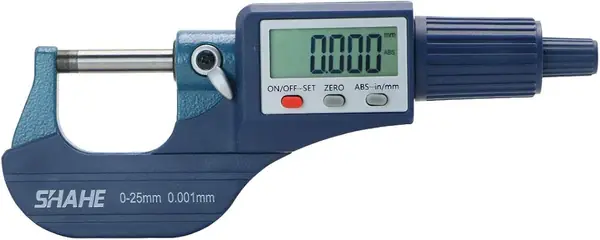
SHAHE 5202 Digital Micrometer Best for Everyday Bench Work

SHAHE 5202 digital micrometer with large LCD display and inch metric readout

Everyday bench work

Shop Score 81/100
Measuring Range
0-25 mm / 0-1 in
Resolution
0.001 mm / 0.00005 in
Accuracy
±0.003 mm
Display
Large LCD
View on Amazon

The thing we value most here is repeatability: close the SHAHE on the same part five times and you get the same number, which is the whole game with a micrometer. It also shuts itself off after a few idle minutes so the CR2032 isn't flat the next time you pick it up, and the digits are large enough to read without leaning in.

The specification is conventional: 0-25 mm / 0-1 in range, 0.001 mm / 0.00005 in resolution, ±0.003 mm accuracy, inch/metric switching, absolute and relative modes, and a hardened stainless spindle with a lock. The body is ABS plastic, which keeps the cost down and shows in the finish.

Zero drift is our reservation. Readings that stop coming back to zero do happen with this one, and that kind of fault shows itself in the first few uses rather than the fiftieth — so zero it, measure something you know the size of, and repeat. If the SHAHE comes back clean, it's a competent micrometer for everyday bench work; if it doesn't, send it back.

Worth Noting

  • Battery cover needs a small plastic tool
Our Verdict

Reads in both units, repeats well, and shuts itself off — a reasonable bench micrometer as long as you check it against a known size instead of trusting it out of the box.

Check Latest Price

How We Tested Digital Micrometers

We started with spec sheets rather than product photos, because the two things that decide a micrometer — a published accuracy tolerance in both inches and millimeters, and a range that fits the work — are easy to bury. Anything that advertised resolution without an accuracy figure was set aside. The group we bought ran from budget bench tools to hardened-stainless machinist models, with carbide and hardened-steel faces both represented.

That left 12 micrometers, which we used for seven months on a home woodworking bench, at a metal lathe turning aluminum round stock, and at a garage bench measuring shim stock and drill shanks. Each one was checked against a certified gauge block at the bottom, middle, and top of its range, and we closed every tool on the same block ten times in a row to see how far the readings wandered.

We worked the ratchet stop and the friction thimble both ways — light three-click pressure, then a firmer twist — and logged which ones drifted when we pushed. Each was tried on a tenon shoulder and between a chuck and a turned shoulder to see whether the frame and spindle actually reached. Faces got inspected under a loupe before and after, with brass and steel run across them all season.

Meters were zeroed at the start of every session, and we noted which ones needed it again after a weekend in a drawer, how legible the display was in direct sun and under a shop light, and how long each coin cell lasted. We switched inch to metric mid-measurement, used absolute and incremental modes to batch identical parts, and checked whether the barrel graduations could carry a measurement if the battery quit. Everything was stored with the spindle backed off, and spare cells stayed in a locked drawer.

How to Choose a Digital Micrometer

Accuracy and Resolution Are Not the Same Thing

Resolution is the last digit the display will show; accuracy is how close that digit actually is. A 0.00005 in resolution with a ±0.0001 in tolerance is an honest tool; a fine resolution with no stated tolerance is just a display, which is the case with at least one pick here.

For woodworking, anything inside ±0.001 in is finer than a joint needs — glue lines and seasonal movement are larger variables than that. Pay for a tighter tolerance only when you're measuring metal, shims, or bearings. Several picks here publish ±0.003 mm, and the SANDOR goes to ±0.002 mm, the tightest in this group.

Range, Frame, and Getting Into Tight Spots

Nearly every hobby shop needs exactly one range: 0-1 in / 0-25 mm. Within it, the spindle size decides what you can reach — the Beslands, WEN, and SHAHE all list a 6.5 mm spindle, which slips into a shallow counterbore or a narrow slot where a caliper's jaws simply won't go.

Above an inch, a 1-2 in micrometer is a separate purchase, and for stock thickness in the middle of a board a caliper remains the cheaper answer. Buy the range that matches the parts you actually make rather than the biggest number you can find.

Measuring Force and Why the Ratchet Matters

A micrometer's reading depends on how hard you close it, and two people with the same tool can disagree by a thousandth without a consistent stop. A ratchet stop clicks at a set force; a friction thimble slips at one. Either works — what matters is that you close on that mechanism every time, not on the frame.

This is the difference between a tool that repeats and one that argues with you. The iGaging, REXBETI, WEN, and SANDOR all use a ratchet stop, which is a large part of why they read consistently from one measurement to the next.

Faces, Wear, and Care

Measuring faces are ground flat and parallel, and they stay that way only if you keep them clean. Carbide tips resist wear from steel and stay flat longer; hardened steel is fine on wood, plastic, and the light metals a woodworker runs into.

Wipe the faces before you close them, back the spindle off a turn or two before the tool goes in its case, and never spin the thimble home hard. A nick or a burr on an anvil shows up as a reading that changes every single time you take it.

Zero-Set, Modes, and the Battery

Zero-set is the feature you'll use most: close the faces, press zero, and the tool reads differences instead of absolutes, which is how you compare a batch of parts or check a tenon against a sample. Absolute mode holds that reference through the auto-off; relative mode is the one that resets.

Batteries are the recurring cost. Most of these run on a CR2032, the REXBETI on a CR1632, so keep a spare in the case. Expect the electronics, not the frame or the spindle, to be what finally ends the tool's life.

Frequently Asked Questions

Final Verdict

On a bench that sees more wood than metal, the iGaging is the micrometer we hand to people. Big readable digits, one-button inch/metric switching, and an accuracy and function record as clean as anything in this guide make it the safe buy whether you're checking tenon cheeks or a planer knife's projection.

Add the WEN if you also measure dowels, pegs, and turned parts — the ball tip earns its keep there. And if your work is metal, shims, or anything you have to certify, the SANDOR's ±0.002 mm tolerance on a hardened ground frame is the one reason in this guide to spend considerably more.