↑↓ navigate ↵ open Esc close All results →

Best Pinless Moisture Meters for Wood of 2026

Assuming a rough-sawn plank is ready for the planer because its surface feels dry is an easy way to invite cup and twist a week after milling. Pinless moisture meters check lumber without leaving twin pin holes behind, though their electromagnetic field yields a relative reading that tapers off deeper in the board—meaning two calibrated units can display slightly different numbers on the same walnut slab.

Checking 11 meters over six months against air-dried walnut, prefinished flooring, patched drywall ceilings, and firewood showed that sensing depth beats display size every time. Because a board's outer shell gives up water long before its core, colored warning bands and audible alarms only help when they align accurately with the underlying percentage.

None of these non-destructive meters replaces a laboratory oven-dry test, yet all six tell you in seconds whether stock is stable enough to mill or still moving.

Our Top Picks

The Best Pinless Moisture Meters for Wood

1.

General Tools MMD7NP Pinless Moisture Meter Best Overall
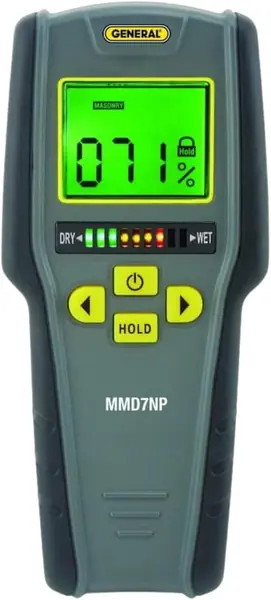
General Tools MMD7NP handheld pinless moisture meter with backlit LCD and rubber side grips

Lumber moisture readings

Shop Score 93/100
Battery
9V alkaline
Weight
4 oz
Sensing Depth
Up to 3/4 inch (19 mm)
Wood Range
0 to 53% softwood, 0 to 35% hardwood
View on Amazon

A percentage scale rather than a traffic light is what earned this General Tools meter the top spot. It is built around 0 to 53% for softwood and 0 to 35% for hardwood, so the figure on the screen is in the same units as the number on a flooring spec or a lumber tag. The sensor pad reads up to 3/4 inch below the surface and leaves nothing behind, which is why it goes straight onto a planed face or a laid floor. We also appreciate the hold function: press it and the reading freezes while you lift the meter to eye level.

What we noticed in use is how little setup there is. It auto-calibrates, there is no species list to scroll, and the mode button simply switches between the two wood ranges or between drywall and masonry. That simplicity is also the limit: hardwood and softwood are broad buckets, and hickory and basswood are not the same material, so we read this meter as a careful trend line rather than a certificate. Readings on one spot can shift between passes, which is the nature of a pad sensor and true of every meter here.

The three-color bar and the audible out-of-range alarm do the work when you are scanning a wall or a stack of boards in a hurry, and the 2-inch backlit screen stays legible in a dim basement. At 4 ounces it is the lightest meter in this group, which matters when you are holding it against a ceiling. If what you want is a fast wet-or-dry verdict with a noise to go with it, the Klein below is the livelier tool; for picking stock to mill, this is the one we keep coming back to.

Worth Noting

  • Hardwood and softwood settings only, no species correction
Our Verdict

We recommend the MMD7NP to anyone who wants a real wood moisture percentage on hardwood or softwood without laying a pin to a finished board.

Check Latest Price
2.

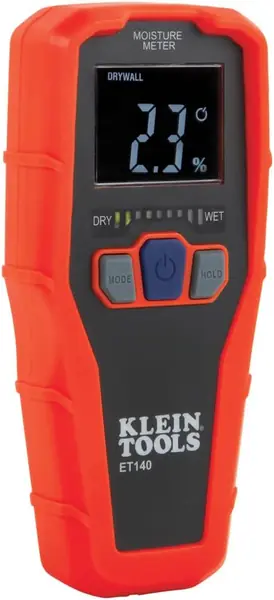
Klein Tools ET140 Pinless Moisture Meter Best for Fast Scanning

Klein Tools ET140 pinless moisture meter with reverse-contrast display and nine-bar LED graph

Fast wet-area scanning

Shop Score 92/100
Weight
7 oz
Sensing Depth
Up to 3/4 inch (19 mm)
Display
Reverse-contrast LCD with nine-LED bar
Material Modes
Drywall, masonry, hardwood, softwood
View on Amazon

The ET140 costs about what our top pick does, but it is not trying to do the same job. Klein builds it around relative moisture content in drywall, masonry, hardwood and softwood, and reports it through a reverse-contrast display plus a nine-bar LED graph that fills as the material gets wetter. That is a job-site answer, wet here and dry there, and the four mode settings keep the same motion working whether you are on a wall or a walnut plank.

Where it wins is speed. You slide the pad along a surface and the bars climb, and the audible alert rises with them, so you can keep your eyes on the material instead of the screen. We like the nine-bar graph for that reason: a full bar and a rising tone tell you more on the move than a number that is still settling. The 3/4-inch sensing depth matches the rest of this group, and the 6-inch body slots into a tool bag without complaint.

The trade-off is the scale itself. Klein reports relative moisture, so this is a meter for answering whether something is wet and where it is wettest, rather than whether a board has reached the percentage you want before glue-up. For drywall, subfloor and a woodpile that is exactly the question worth asking. For stock headed for the jointer, it is not.

Worth Noting

  • Battery drains even when switched off
Our Verdict

For finding where the water is, in a wall or across a stack of boards, we reach for the ET140, and its audible alert means we do not have to watch the screen.

Check Latest Price
3.

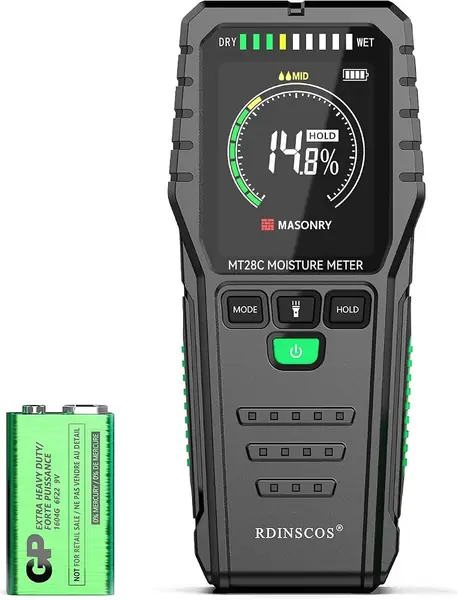
RDINSCOS Pinless Moisture Meter Best Budget

RDINSCOS red and green pinless moisture meter with three-color LCD screen and hold button

Budget-conscious woodworkers

Shop Score 91/100
Battery
9V (included)
Weight
7 oz
Sensing Depth
Up to 0.75 inch
Display
Three-color LCD with audible alarm
View on Amazon

At the bottom of this group's price range sits a meter that does most of what the expensive ones do. The sensor pad reaches about 3/4 inch down, readings land on a three-color LCD, and there is an audible alarm for the wet end plus a hold button for keeping a number on screen. It runs on the 9-volt cell that comes in the box. For checking a few boards before a project, that is the whole job for a moisture tester.

Working with it takes a little discipline. The pad wants a flat, steady hold for two or three seconds, and metal near the surface such as a steel stud, a pipe or a nail will pull the reading off. We found it most useful as a comparator: read the suspicious spot, read a known-dry spot, and trust the difference more than either figure on its own.

Its own instructions are candid that the readings are for reference rather than a species-corrected percentage, which is the honest way to use it. The color band and the number together tell you where to look next, not what a kiln schedule should say. If you need a percentage to write down, the General Tools is the meter for that; if you need to know whether the deck boards are dry enough to stain this weekend, this one answers.

Worth Noting

  • Needs a flat, steady hold for a few seconds
Our Verdict

If you check moisture a few times a month rather than every day, this is the cheapest pinless meter we are comfortable recommending.

Check Latest Price
4.

Povlen MT510-Y Pinless Moisture Meter Best for Mixed Materials

Povlen MT510-Y black and orange pinless moisture meter with color LCD and four modes

Mixed-material jobs

Shop Score 90/100
Battery
3 AAA (included)
Weight
5.6 oz
Material Modes
Softwood, hardwood, wall, masonry
Stated Accuracy
±4%
View on Amazon

The button we keep pressing on the MT510-Y is the one that locks a reading. Lift the meter off the wall, look at the frozen number, write it down, move on. That is a small thing that turns a scan into a record, and it is why this one ended up in our bag for work that moved between framing and drywall.

The rest of the package suits mixed material work: softwood, hardwood, wall and masonry modes on a single button, a color LCD with an analog bar that fills as things get wetter, and visual plus audible alerts. It runs on three AAA cells instead of a 9-volt, which is the battery more of us have in a drawer, and a low-battery indicator with auto power-off keeps it from dying mid-scan. At 5.6 ounces it sits nicely in the hand for a long walkthrough.

Where it gives ground is precision. Povlen states accuracy of plus or minus 4%, which is a broad answer for a woodworker chasing a specific figure before glue-up. We call it the best-equipped meter here for someone who checks walls as often as lumber, and the wrong one if your work is all furniture and you want a percentage to log.

Worth Noting

  • Softwood and hardwood settings, no species list
Our Verdict

Four material modes, a lock button and AAA batteries make the MT510-Y the easiest of these meters to move between a board and a wall.

Check Latest Price
5.

LASELION MS03 Pin and Pinless Moisture Meter Best If You Also Want Pins

LASELION MS03 black two-in-one pin and pinless moisture meter with LCD and flashlight

Pin and pinless work

Shop Score 89/100
Battery
3 AAA
Wood Range
0 to 75% wood, 0 to 25% building materials
Stated Accuracy
±4%RH
Modes
Pin and pinless
View on Amazon

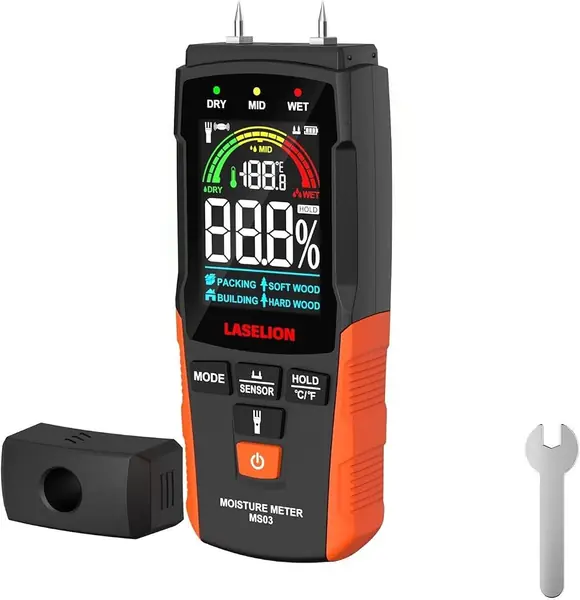
Laselion's own instructions say the pinless mode is for quickly locating moisture and that the pins are for accuracy, which is more candor than most dual-mode listings offer, and it is how we use the tool. Run the pad over a panel or a plank to find the damp end, then push the pins in to confirm it. Both readings come from one handheld body that runs on three AAA cells.

The pinless side is non-destructive, so it is safe on a finished face while you are hunting, and the pins cover a stated 0 to 75% in wood, a wider wood range than the dedicated pinless meters here claim. There is a hold function, a flashlight for cabinets and crawlspaces, and auto power-off. Those are small conveniences that matter when the corner you are checking has no light in it.

What you give up is a number from the pad that you can stand behind. On furniture-grade stock we found ourselves reaching for the pins every time, which defeats the purpose if the board is already finished. So it suits a shop that works rough lumber and painted walls in the same week, and it is the wrong pick if non-destructive measurement is the whole reason you are shopping.

Worth Noting

  • Pinless mode is a locator, not a measuring scale
  • Pins leave marks on finished surfaces
Our Verdict

Buy the MS03 for the pins and treat its pinless side as a quick locator; as a two-in-one for about what a single-mode meter costs, that is a fair trade.

Check Latest Price
6.

Proster Pinless Moisture Meter Best for General Scanning

Proster black pinless moisture meter with backlit color LCD and three-color LED alarm

General scanning

Shop Score 88/100
Battery
9V (included)
Sensing Depth
Up to 3/4 inch (19 mm)
Wood Range
5 to 75%
Wall Range
5 to 70%
View on Amazon

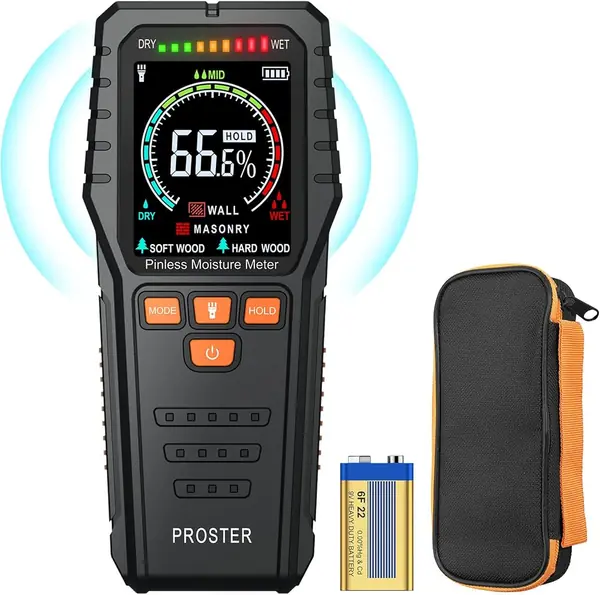
Proster states a 5 to 75% range for wood and 5 to 70% for walls and masonry, the widest spread on this page, and it puts the figures on a backlit color LCD with a three-color LED bar and an audible alarm behind them. Sensing depth is the familiar 3/4 inch, a 9-volt battery comes in the box, and a storage bag is included, which is a genuinely useful addition for a tool that lives in a truck.

We like the wide range and the color screen, but a wide range is not the same thing as accuracy, and we have much less experience to draw on here than with the other picks. What the design does offer is sensible: a mode button for switching materials, an alarm loud enough to hear across a room, and simple operation with no menu to learn. Treat it as a scanner for finding where the problem is rather than a meter for signing off on a floor.

Practical touches add up for the role it fits. The bag keeps the pad off whatever is rattling beside it in a toolbox, the screen works in a dim basement, and the battery is the common 9-volt. Left in a truck as a second opinion, that is a reasonable way to spend midrange money.

Worth Noting

  • Better treated as a problem scanner than a precision floor meter
  • Wide stated range does not guarantee measurement accuracy
Our Verdict

A broad 5 to 75% wood range and a storage bag make this an easy second meter for the truck, though we have far less to go on with it than with our top picks.

Check Latest Price

How We Tested Pinless Moisture Meters

We began by pulling every pinless meter we could find that published a sensing depth, a set of wood or material modes, and some indication of accuracy, then set aside the ones that hid those numbers or repeated another unit's feature set at a steeper price. Eleven meters made the cut, and we used them for six months.

Testing happened where these tools actually live: a shop lumber rack, a flooring install, a ceiling patched after an upstairs leak, a deck, and a woodpile. At each spot we took three readings without moving the pad, to see whether the number held, then walked a grid across the board and watched how fast readings climbed near a wet end. To check accuracy rather than mere agreement, we cut samples from suspect boards, weighed them, dried them out, and weighed them again.

We pressed each pad against veneered cabinet doors and prefinished flooring, then checked under a shop light for scuffs. We stacked boards and read the same plank from both faces to see whether a number reflected the core or only the shell, and we locked readings with the hold function while reaching over our heads. Displays got read in a dim basement and in direct sun at arm's length, and every alarm and color band was compared against the percentage on screen. We noted battery type and auto-off, counted swaps, and judged one-handed grip and steady contact on a vertical wall.

Finally, meters rode in tool bags, got set down hard on concrete, and were read side by side on the same boards until a pattern emerged — which one we reached for, and which ones we quietly stopped picking up.

How to Choose a Pinless Moisture Meter for Wood

Percent Moisture or a Relative Reading?

The first fork is what the display means. Some meters, like our General Tools top pick, are scaled in actual wood moisture — 0 to 53% for softwood and 0 to 35% for hardwood — so the reading matches the units on a kiln schedule or a flooring spec. Others, including the Klein ET140, report relative moisture: wetter or drier, rising or falling.

If you need to match a number to a specification, buy the first kind. If you are hunting a leak, sorting firewood or checking whether a wall dried out, the relative meters are quicker and the alarm does the interpreting for you.

The Reading Stops at the Surface

Almost every meter here senses about 3/4 inch down. On a two-inch slab that means you are reading the shell, and the shell is exactly what dries first, which is why a board can read beautifully on the face you checked and still be damp in the middle. Check both faces, re-check after planing or jointing, and on thick stock confirm with a pin meter before you commit a piece to a project.

The same trap runs through building work: a dry face on a wall does not prove the framing behind it is dry. The pad only sees the material directly under it.

Species Settings Are Broader Than They Sound

Hardwood and softwood are buckets, not calibrations. A meter set to hardwood applies one average to oak, walnut and maple alike, and the stated tolerance, plus or minus 4% on the Povlen for instance, is wider than the difference you are often trying to detect. Use the wood setting as a rough correction rather than an answer.

The reliable technique is comparison: read a known-dry offcut of the same species, read your workpiece, and trust the gap more than the absolute figure. That is also how you spot a meter that is drifting.

The Details That Decide Which One You Grab

Weight, batteries and whether the screen holds still matter more day to day than one more mode. The General Tools is 4 ounces; the Klein is 7 and runs on a 9-volt. A lock or hold button, which the Povlen and the RDINSCOS both have, lets you lift the moisture tester to read it instead of crouching against a wall.

Whatever you carry, keep the pad flat and still on the surface for a couple of seconds. A hovering sensor gives a wandering number, and metal studs, pipes and nails will pull any of these meters off true.

What the Extra Money Buys

The step up in this group buys wood-specific scales, more material modes and a larger body of use behind the design, not dramatically better accuracy, since even the most expensive meters here are screening tools. Weekly checks make that worth paying for. Twice a season, the budget RDINSCOS answers the same questions.

Frequently Asked Questions

Final Verdict

We put the General Tools MMD7NP at the top of this list for one reason: it hands you a wood moisture percentage on hardwood or softwood rather than a relative wet-dry verdict, and it does it without marking the board. If instead your work is finished surfaces and fast triage — drywall, subfloor, a stack of firewood — the Klein ET140 is quicker to read and its rising alarm saves you watching the screen.

Buyers on a tight budget should start with the RDINSCOS, the least expensive meter here and still genuinely useful for the occasional check.