↑↓ navigate ↵ open Esc close All results →

Best Mechanical Carpenter Pencils for Woodworking of 2026

Traditional flat wooden pencils trade layout speed for constant whittling with a utility knife, while a mechanical carpenter pencil with an elongated nib keeps a consistent line all afternoon and reaches deep into hardware holes a stub cannot touch. The catch is that a mechanical barrel is only practical when its sharpener rides on the tool and refills use standard 2.8 mm leads stocked at any hardware store.

Fourteen individual pencils and multi-pencil sets went through six months of framing, cabinet installs, decking, and overhead marking on dark OSB. Under heavy pressure on rough lumber, clip retention, lead snap resistance, and high-visibility lead colors on wet or dark stock quickly separated shop-ready barrels from fragile ones.

Depending on whether a job calls for six pencils in a belt holster or one slim barrel in a shirt pocket, the six options below favor clear, durable marks on real jobsite stock over desk-drawer polish.

Our Top Picks

The Best Mechanical Carpenter Pencils for Woodworking

1.

Nicpro 6-Pack Carpenter Pencil Set Best Overall
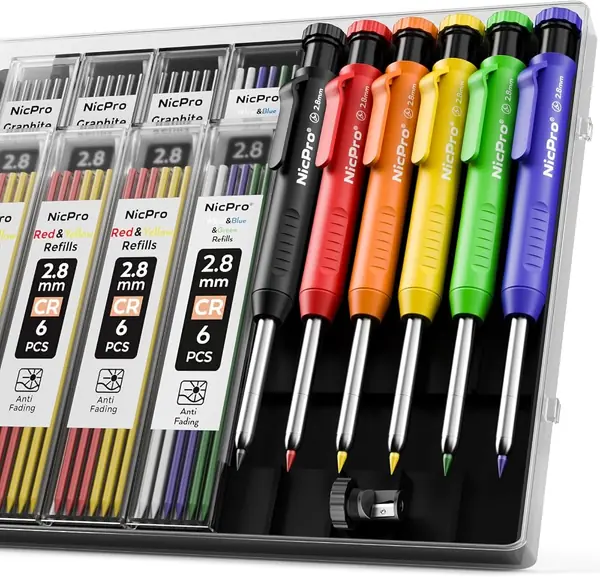
Nicpro mechanical carpenter pencil set with six color-coded pencils sharpener and refill storage box

Building a kit

Shop Score 97/100
Lead Size
2.8 mm
Tip Reach
45 mm
Lead Colors
Six, including black, red, and yellow
Kit Contents
6 pencils, 54 refills, sharpener, storage box
View on Amazon

The box holds six pencils, 54 refills in six colors, a small sharpener, and a tray that keeps the refills sorted. It's the set we point to for someone who owns a couple of flat carpenter pencils and keeps losing them: one pencil for the bench, one for the tool bag, one for the truck, and enough lead that refilling stops being an errand.

What we like most is the nib. At 45 mm it reaches the bottom of a drilled hole and the inside corner of a rabbet where a flat pencil gives up, and the 2.8 mm lead is thick enough that a mark on framing lumber survives a saw cut. On sheet goods and face frames, where most of our marks land, that reach is the difference between measuring twice and guessing once.

The sharpener screws into the cap, which is the arrangement we prefer: it can't be left on the bench, and a point takes a few turns to renew. Six lead colors is more than most woodworkers need, though red and yellow earn their place on dark stock and on pressure-treated lumber that swallows graphite.

Build is where the set is merely good. The shaft is metal and the grip is plastic, and the plastic is the part that looks used first; nothing has failed on us, but the housings feel lighter than the metal-bodied Tracer. With 54 refills in the box, that's a trade we're happy to make.

Worth Noting

  • Plastic grips feel lighter than metal-bodied picks
Our Verdict

This is the set we recommend to most woodworkers: six 2.8 mm pencils, 54 refills, and a 45 mm nib that handles shop and site.

Check Latest Price
2.

Pica-Dry Longlife 3030 Best Single Pencil

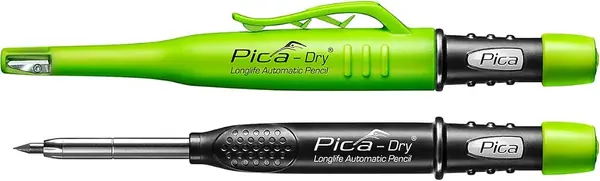
Pica-Dry 3030 green automatic carpenter pencil with pocket clip and retractable rectangular lead

One-pencil carry

Shop Score 96/100
Weight
0.71 oz
Sharpener
Built into the barrel
Refill Access
Loads from the back of the barrel
Lead Cross-Section
2 x 5 mm rectangular
View on Amazon

The lead in the Pica-Dry isn't round. It's a 2 x 5 mm graphite bar, and that shape is why the pencil has a following: one edge lays a wide, dark line across a stud, and the same bar turned a quarter turn gives a line fine enough to work to, with no stop at the sharpener in between.

The rest of the pencil is built around keeping that lead available. The tip retracts, a cap covers it, the sharpener is set into the barrel, and the whole thing weighs 0.71 ounce — the figure that matters most if the pencil rides in a shirt pocket rather than a tool bag.

We reach for the Pica when we want one pencil and nothing else. It feels like a pen in the pocket rather than a tool, which is exactly the point, and the retraction means the lead isn't being chipped against keys and screws all day. The cap is the part that annoys us: it works loose, and once a sheath has loosened the pencil can drop out of it.

One pencil in the box, and refills load from the back of the barrel when you get to them. The rectangular bar is the whole argument for this pencil, and it either suits how you mark or it doesn't.

Worth Noting

  • Rectangular refills fit Pica pencils only
Our Verdict

We choose the Pica when we want one good pencil in a pocket: the 2 x 5 mm lead makes wide and fine lines without a sharpening stop.

Check Latest Price
3.

Tracer AMK1 Deep Hole Pencil Best for Deep Holes

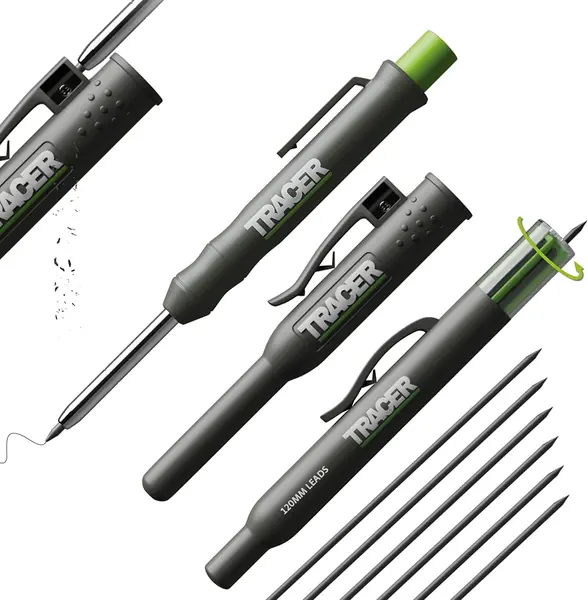
Tracer deep hole construction pencil with black site holster and spare lead dispenser

Deep-hole marking

Shop Score 95/100
Body
Metal
Lead
2B graphite
Holster
Site holder with built-in sharpener
Maximum Reach
5.7 inches
View on Amazon

Five and seven-tenths inches of reach is the number that sells the Tracer, and it's why we keep one in the bag. The lead pushes out of a needle-nose tip until it can touch the far side of a hole, so a mark through a stud or a wall cavity stops being a guess. For anchor layout and cabinet installs, that changes the job.

The rest of the kit is aimed at the same site work: a metal body, a holster that clips to a belt or pocket, a sharpener built into the holster, and a dispenser that feeds spare leads one at a time instead of loose sticks rattling in a pouch. The dispenser is the piece we didn't expect to care about and now do.

What we appreciate is the retraction. The lead sits inside the tip until you push it out, so the pencil travels at full length and only reaches deep when a hole demands it. The extension is also the thing to be careful with: a lead working inches from the barrel rewards a light hand, so extend only as far as the hole requires and let the point make the mark.

Worth Noting

  • Clips on pencil and holster break first
  • Thin grip for long marking sessions
Our Verdict

Our pick for marks that live inside a hole: the Tracer's lead extends to 5.7 inches and the holster carries its own sharpener.

Check Latest Price
4.

Hultafors Dry Marker HDM Best Holster Design

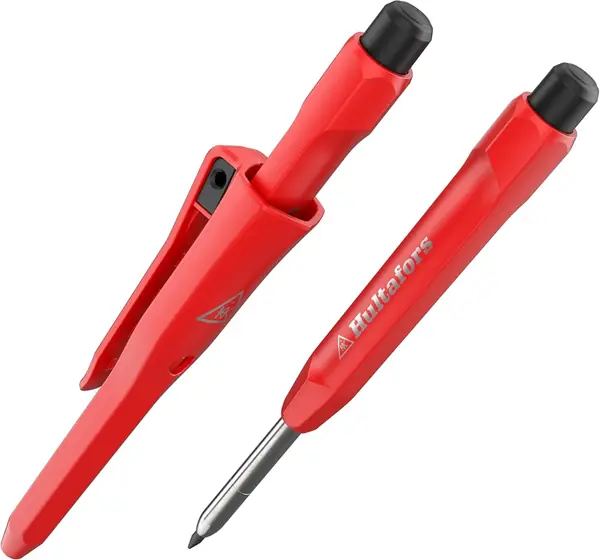
Hultafors Dry Marker HDM pencil in black holster with built-in sharpener

Holster carry

Shop Score 94/100
Weight
0.64 oz
Sharpener
Built into the holster
Refill
10-lead dispenser, sold separately
Lead Diameter
2.8 mm
View on Amazon

Hultafors puts the sharpener in the holster rather than on the pencil. The lead sharpens against the holder without the pencil coming out of it, which on a ladder is the difference between a fresh point and a blunt lead you keep using because climbing down is worse.

We like the Hultafors for how little it asks of you. The marker weighs 0.64 ounce and sits still in the hand, both parts have roll stops so nothing takes off across a bench, and a hole at the base of the holster lets dust and moisture fall away instead of packing around the lead. That last detail is the one we came to appreciate most.

The lead is a plain 2.8 mm round, which draws a finer line than a rectangular bar and slips into trim joints a fat carpenter pencil can't enter. Thin lead has a limit: press hard into drywall or across a knot and the point can snap, so mark with the tip rather than leaning on the barrel.

Refills arrive as a ten-lead dispenser that ejects one at a time, with a graphite version and a mixed chalk option, and they're bought separately. That's the shape of the system: one slim marker, a holster that keeps it sharp, and a small ongoing supply cost.

Worth Noting

  • Pencil loosens in the holster over time
Our Verdict

We like the Hultafors for anyone who sharpens constantly: the holster does it, the drain hole keeps grit out, and the pencil is slim enough to forget.

Check Latest Price
5.

STAGEEK 4-Piece Carpenter Pencil Set Best for Color-Coded Marking

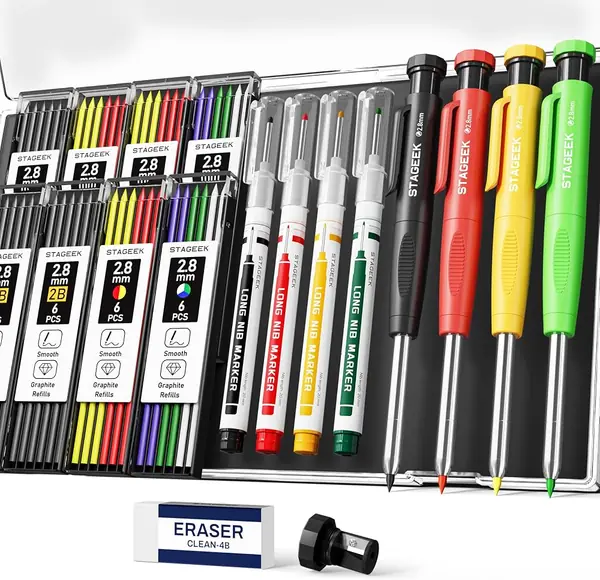
STAGEEK four-piece mechanical carpenter pencil set with colored refills and storage case

Color-coded marking

Shop Score 93/100
Lead Size
2.8 mm
Tip Reach
45 mm
Refills
52 in six colors
Included
Built-in sharpener and storage case
View on Amazon

Six lead colors is why we look at the STAGEEK set: black for layout on light stock, red for white-faced melamine and gray flooring, yellow for dark or pressure-treated lumber, plus white, green and blue for the odd job where contrast is the whole problem.

The pencils are the 45 mm long-nib pattern, with the sharpener built into the cap and a clip on the barrel. The nib does what a long nib should: it marks the bottom of a hole, the inside face of a mortise, the corner where a square won't sit flat. And 52 refills mean the set keeps working long after the first lead is gone.

Where we part company with the packaging is the extras. The set also includes long-nib marker pens for glass, metal and plastic, and those are the least proven part of it — the pencils are the reason the set works, so treat the markers as a bonus rather than the reason to buy.

Four pencils in one case is more than a solo woodworker needs, and the case takes up more room in a bag than a single pencil and a handful of refills. That's the shape of the set: it's built to sit on a shop shelf and be grabbed from, not to disappear into a pocket.

Worth Noting

  • Pocket clips are the first part to fail
Our Verdict

We reach for the STAGEEK set when color does the work: six lead colors and 52 refills, with a long nib for tight corners.

Check Latest Price
6.

MECHEER 2-Pack Carpenter Pencils Best for Tight Budgets

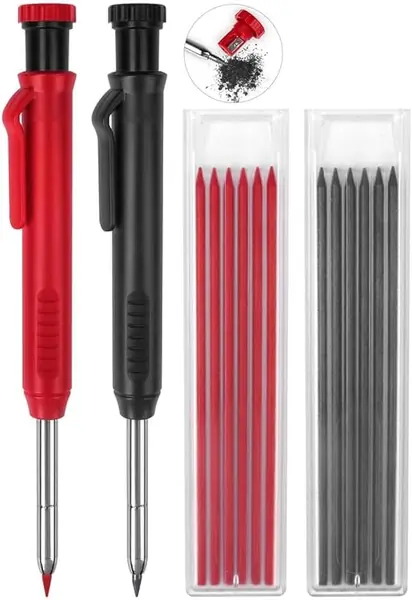
MECHEER two-pack mechanical carpenter pencils with black and red refills

Tight budgets

Shop Score 91/100
Lead Size
2.8 mm
Tip Reach
45 mm
Refills
12, six black graphite and six red wax
Pack
2 pencils
View on Amazon

The MECHEER pair costs less than anything else here and marks as cleanly as the pricier sets. Two pencils, 12 refills, a 45 mm nib and a cap sharpener: everything the job needs and nothing that shows off.

The nib is the same 45 mm long pattern the more expensive sets use, so the reach into holes and inside corners is the same, and the sharpener set into the cap renews a point in a few turns. For a pencil that lives in an apron and gets used hard, that's the whole specification.

The two refill colors don't behave alike. Black is graphite and lays a normal dark line; red is a wax, lighter and brighter, which we like on dark stock and not for a line you plan to cut to. Load the black for joinery and the red for rough marking where you just need to see it.

The body is the compromise. Plastic, light in the hand, and it feels like the money went into the lead and the nib rather than the housing. Treated as a shop pencil rather than one that rides in a nail bag, it's honest value.

Worth Noting

  • Cap sharpener works loose with use
  • Body feels light next to metal picks
Our Verdict

Our budget pick: two 45 mm-nib pencils with 12 refills, and the black lead marks as cleanly as the pricier sets here.

Check Latest Price

How We Tested Mechanical Carpenter Pencils

We started with what carpenters reorder: a pencil that takes a standard refill, a sharpener that stays on the tool, and a carry method that survives a belt. That filtered the field quickly — anything with a proprietary lead or a sharpener that lived loose in a box didn't make the cut. Fourteen pencils and sets then moved into tool belts and shop aprons for six months.

They got used where marking actually happens, not on a bench. We laid out deck framing, marked cabinet parts, snapped lines on damp pressure-treated boards, and did a long stretch of overhead and upside-down marking on dark OSB, where a faint line costs you a cut.

Along the way we pushed each nib into 3/4-inch drilled holes to see how much reach it bought us in a tight corner, and bore down hard on rough lumber to check whether the lead crept backward or snapped. We sharpened mid-layout with gloves on to see if the sharpener was still where we left it, and noted whether it sat on the barrel or on the holster. Refills were counted and priced by the pack, including how many colors came in a set, and clips, caps, and holsters got dropped onto concrete from belt height.

Build quality settled the rest. Six months in, we looked at which clips had sprung, which caps no longer seated, and which holsters were splitting at the seam — and at how legibly each pencil still marked wet, dark, and rough stock.

How to Choose a Mechanical Carpenter Pencil

Lead Size and Shape Come First

Start with what the pencil feeds. The standard is 2.8 mm round: thick enough not to snap under a square, common enough that refills sit on the shelf at any hardware store. The Pica-Dry uses a 2 x 5 mm rectangular bar instead, which gives a broad face and a fine edge from one stick — a real advantage and a real commitment, since only Pica's refills fit it.

Before you buy a set, confirm the refill is a standard size or order spares with the pencil. Hardness matters too: 2B lays a dark line, while H and 2H hold a finer point on dense stock. Match the lead to the work and the rest of the pencil matters much less.

Put the Sharpener on the Tool

A loose sharpener is a sharpener you lose, and a pencil you can't point is a pencil you stop carrying. Cap-mounted sharpeners, as on the Nicpro and MECHEER pencils, keep the point renewable in a few turns without a knife.

Hultafors goes further and builds the sharpener into the holster, so the pencil sharpens without being taken out of it — the better arrangement if much of your marking happens on a ladder. Either way, favor a design where the sharpener is attached to something.

Reach Is the Feature You Forget Until You Need It

Most marks land on a face, where any of these pencils works. The marks that go wrong are inside a drilled hole, a mortise, or the corner of a rabbet, where a flat carpenter pencil can't fit and a short mechanical pencil bottoms out. A 45 mm nib handles most of it; the Tracer extends its lead to 5.7 inches for the rest.

Reach costs control. Extend only as far as the hole requires and let the point make the mark rather than pressing the barrel.

Decide How It Rides

Three carry systems turn up here: a pocket clip, a belt holster, and a sheath that swallows the pencil point-down. All three work when new. Clips are the part that fails first on a job site, and a holster can lose its grip on the pencil after months of use.

If the pencil is central to your day, put the holster on your belt and treat the clip as backup rather than the primary plan — a construction pencil you have to hunt for is one you stop reaching for.

Weigh One Pencil Against a Set

A single premium pencil is a pleasure and easy to lose. A set costs a little more up front and covers the bench, the bag and the truck, with spares already in the box.

We lean toward a set for anyone working in more than one place and toward a single pencil for someone who wants one good tool in a pocket. Neither choice is wrong, but buying six pencils without checking what the refills cost is.

Frequently Asked Questions

Final Verdict

The Nicpro set is what we hand most woodworkers, and the reason is simple: six 2.8 mm pencils, a 45 mm nib and 54 refills in one box, so a pencil is wherever you left one and the refills are already there.

If you want a single pencil in a pocket and nothing else, the Pica-Dry is the better tool, with a rectangular lead that marks wide or fine. And if your layout runs through drilled holes, the Tracer's 5.7 inches of reach settles it.