↑↓ navigate ↵ open Esc close All results →

Best Carpenter Pencils for Woodworking of 2026

A crumbling lead or fat wooden tip shows up at the worst moment — halfway through a layout, saw ready to run, leaving a line wider than the kerf you are trying to split. Even a small layout tool has to hold a crisp mark, reach into deep joinery holes, sit comfortably at an angle, and survive rattling around the bottom of a tool pouch.

During four months of marking plywood, framing lumber, and dark walnut across shop builds, 16 mechanical, flat wooden, and chisel-cartridge pencils proved how widely feed mechanisms and sharpeners vary. Slipping chucks under heavy pressure, short nibs that miss recessed marks, and refill packs priced higher than the original pencil quickly ruled out weaker designs.

Whether you prefer a long-nosed mechanical holder with a built-in sharpener or a classic flat stick that sharpens in seconds, the five pencils ranked below keep a dependable line without constant stops at the bench.

Our Top Picks

The Best Carpenter Pencils for Woodworking

1.

Nicpro 6-Pack Mechanical Carpenter Pencils Best Overall
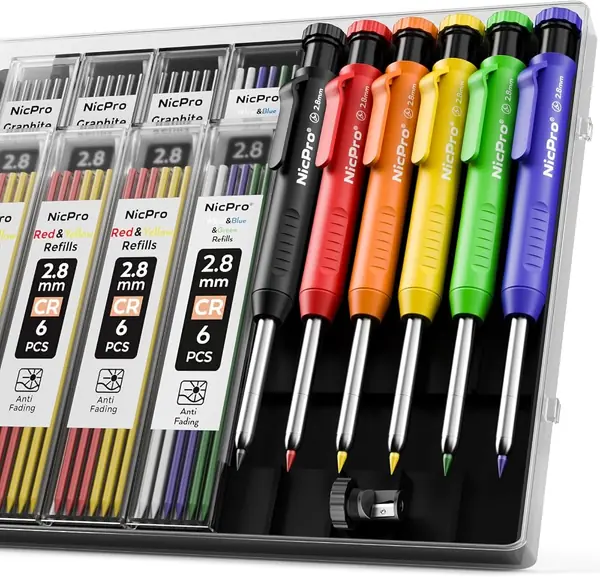
Nicpro mechanical carpenter pencil set with six colored pencils, refills and storage case

Whole-shop marking kit

Shop Score 96/100
Refills Included
54
Lead Size
2.8 millimeters
Tip Length
45 mm
Pencils In Set
6
View on Amazon

Open the box and the arithmetic of the Nicpro set is obvious: six mechanical carpenter pencils, 54 spare 2.8 mm leads in six colors, and a sharpener screwed into the top of every pencil so it cannot wander off between jobs. Instead of one pencil you nurse along, you get a set to scatter — one in the apron, one in the truck, one at the bench — which is how most of us actually work.

What earns it the top spot is not the count but the range of marks it covers. Layout is mostly small decisions made fast: which face is the reference, where the line lands, whether you will still see the mark after the board is planed. Having red, yellow, green, and blue within arm's reach settles the visibility question on dark or treated stock, and the 45 mm tip reaches into a drilled hole or a deep notch where a flat pencil's body bottoms out. We recommend it first because it handles both jobs without a second purchase.

Sharpening takes some getting used to. You unscrew the cap, twist the lead against the blade inside, and screw it back, which is slower than one pass with a utility knife. In return you get a pencil that never shortens in your hand, a point fine enough for trim and joinery work, and refills that load from the front without tools. The 2.8 mm lead also takes a firm line without folding at normal marking pressure.

Set against the single-pencil picks here, this is the set for someone equipping a shop rather than upgrading one pocket. The Pica is the better pencil; the Nicpro is the better purchase.

Worth Noting

  • Lead can crack inside after a hard drop
Our Verdict

Six pencils, six lead colors, and 54 refills in one case — that's why we recommend the Nicpro set first for a woodworking shop that needs a mark everywhere at once.

Check Latest Price
2.

Pica-Dry 3030 Automatic Pencil Best Single-Pencil Upgrade

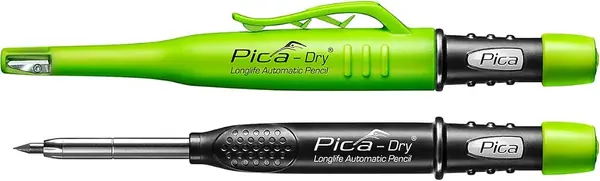
Green Pica-Dry 3030 automatic carpenter pencil with pocket clip and cap sharpener

Pocket everyday carry

Shop Score 95/100
Length
5.91 inches
Sharpener
Built into the cap
Lead Hardness
2B
Lead Cross-Section
2 x 5 mm rectangular
View on Amazon

A rectangular 2 x 5 mm lead is the whole idea behind the Pica-Dry. Instead of a round point that touches a square at one spot, you get a flat face that lies against the edge, so the mark lands where the straightedge is rather than a hair off it. That is a small thing that shows up on every cabinet side and trim cut you lay out.

The pressure mechanism is the part we did not expect to like as much as we do. One click advances and locks the lead, and the sealed barrel keeps sawdust and damp out of the feed — which matters, because a pencil that rides in a tool bag gets rained on and dropped in shavings far more often than it gets handled like an instrument. At 0.71 ounces and just under six inches, it disappears into a shirt pocket until you reach for it.

Sharpening is the compromise. The blade sits in the base of the pencil, so you twist the lead against it at an angle that takes a few tries to get used to after years of pointing a pencil away from your hand; a spin on a sanding block works faster when you are at the bench. What the money buys is one good pencil instead of a drawer of cheap ones: a dust-proof feed, a refill that loads from the back, and 2B lead that darkens a line without pressing hard.

Worth Noting

  • Point cap is easy to lose
  • Pocket clip can give way over time
Our Verdict

If you want one pencil you'll keep track of, the Pica-Dry's sealed feed and cap sharpener justify the premium over a set.

Check Latest Price
3.

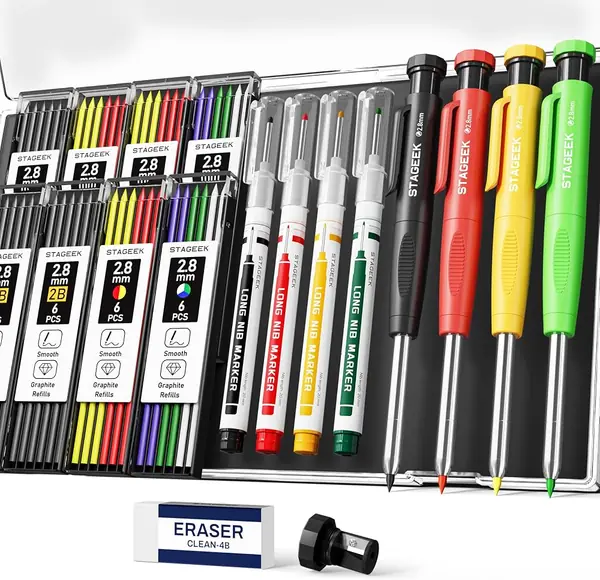
STAGEEK 4-Piece Mechanical Carpenter Pencil Set Best for Deep Holes

STAGEEK four-piece mechanical carpenter pencil set with long nibs and storage case

Deep hole marking

Shop Score 94/100
Refills Included
52
Lead Size
2.8 millimeters
Tip Length
45 mm
Pencils In Set
4
View on Amazon

Marking the center of a hole through a stud, or a line at the bottom of a notch you already cut, is where a flat pencil gives up: the body lands on the wood and the point never reaches the spot you need. The STAGEEK set is built around that problem, with a 45 mm nib on each of its four pencils and three long-nibbed marker pens for surfaces graphite will not touch.

The rest of the kit is generous. Fifty-two 2.8 mm refills in six colors, a sharpener built into each cap, and a storage case that keeps the refills sorted — the case is what keeps the set usable after a month in a toolbox, since loose leads migrate to the bottom of everything. Red and yellow are the leads we go through fastest, because they read on the stained, dark, and composite stock where black vanishes.

Value is what puts this one above the other multi-pencil sets: deep-hole reach, six lead colors, and an organized case for about the same money, with pencils that feel no cheaper in the hand than the Nicpro. The three long-nibbed marker pens are the bonus nobody asks for and everybody uses, since glass, metal, and tile take a marker line where a graphite point just skates.

Worth Noting

  • Pocket clips can snap off early
Our Verdict

We reach for the STAGEEK set when a mark has to go inside a hole or a notch, where its 45 mm nib does what a flat pencil can't.

Check Latest Price
4.

IRWIN 66400 Carpenter Pencil 6-Pack Best Traditional Wooden Pencil

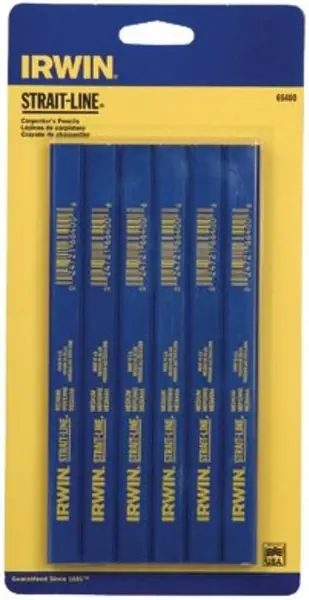
Six IRWIN oval wooden carpenter pencils with medium lead in a multi-color pack

Traditional layout work

Shop Score 93/100
Pencils Included
6
Lead
Medium, broad
Body Shape
Oval
View on Amazon

Oval and flat is still the shape that makes sense on a job site, and the IRWIN 66400 shows why: the pencil cannot roll off a sloped board, the broad lead sharpens to a chisel that hugs a square, and there is no mechanism to jam, no cap to lose, and no clip to break. We keep the six-pack around for exactly that reason — it is the pencil we hand someone who has never thought about pencils.

The trade is upkeep. The medium lead is dark and lays a wide, readable line on rough lumber, but it goes blunt quickly, and no sharpener comes in the box, so you are carrying a utility knife or a dedicated carpenter pencil sharpener. A knife gives you the most controllable point of anything here, because you can shape a long taper for a corner or a chisel for an edge — it just takes a few passes on a fresh pencil and a little practice before the point lands where you want it.

Buying six solves the real problem with wooden pencils, which is that each sharpening makes them shorter until they vanish into a pouch. Keep one in each bag and the cost per pencil stops mattering. They mark clean and dark on wet or green lumber, too, which is more than some mechanical leads manage when the wood is damp.

Worth Noting

  • Ships unsharpened, so you need a knife
  • Wood body shortens with every sharpening
Our Verdict

We hand the IRWIN oval pencil to anyone who wants a mark they can trust with nothing to jam, break, or lose.

Check Latest Price
5.

Swanson AlwaysSharp Refillable Carpenter Pencil Best No-Sharpening Pencil

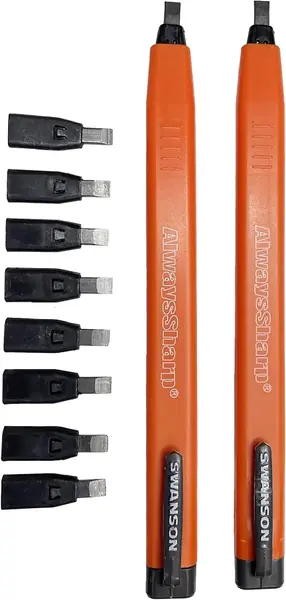
Swanson AlwaysSharp refillable carpenter pencil two-pack in blue with spare graphite tips

No-sharpening layout work

Shop Score 92/100
Refills Included
8
Pencils Included
2
Point
Chisel graphite cartridge
Sharpening
None required
View on Amazon

The AlwaysSharp answers the chore that interrupts every layout job: stopping to find a knife or a sharpener. Its graphite cartridge is cut to a chisel point and stays the same length until you swap it, and the two-pack arrives with eight spare cartridges that slide in from the barrel.

The chisel is what makes the marks useful against a square. Pull it one way and it leaves a thin line tight to the edge; roll it and you get a broader mark for framing. The body never shortens either, so the balance point stays where it started and the pencil does not end up as a stub at the bottom of a pouch.

Where our enthusiasm cools is the housing. It is a light plastic barrel that feels like the least expensive thing in the drawer, and it takes black graphite only — no red or yellow lead for dark stock. For framing, decking, and layout on light lumber we still reach for it before anything else here; on finished dark wood we do not.

Worth Noting

  • Cap can pop off and spill cartridges
  • Loose tip fit can blur a fine line
Our Verdict

We suggest the AlwaysSharp for framing and decking layout, where a chisel point that never needs sharpening saves real time.

Check Latest Price

How We Chose and Tested Carpenter Pencils

To build the shortlist, we started with the formats woodworkers actually reach for — mechanical with a long replaceable nib, flat wooden, and chisel cartridge — then compared published lead widths, refill counts, sharpener design, clip and cap construction, and the price of a refill pack against the price of the pencil itself. Customer reviews from working carpenters narrowed the field. We ended up buying 16 pencils across those formats and put them to work for four months.

They lived in a tool pouch and an apron pocket. We used them through a run of shop cabinets, a deck frame, and sheet after sheet of plywood, marking at the angle you actually stand at rather than straight down.

Each pencil was pressed hard into framing lumber to see whether the lead fed smoothly or slid back into the barrel, and we noted how the body settled into the hand, whether the nose was slim enough to see around, and whether the pencil stayed put when set down on a sloped bench. For reach, we marked through drilled holes and into tight inside corners to check that the point landed where we aimed it, not just that it got there.

We also counted things. Every sharpening stop during a layout session got tallied, along with how much of the point crumbled between stops. Pencils were dropped on concrete, carried loose in a pouch of chisels, and clipped to a pocket and pulled off again dozens of times to see what bent first. Marks went down on dark walnut, wet pressure-treated lumber, and rough framing so we could compare visibility, and we noted how easy each body was to spot in a pile of shavings. Finally, we weighed what each pencil shipped with against what refills cost down the road — a pencil that runs dry in a month is not a bargain.

How to Choose a Carpenter Pencil for Woodworking

Wooden or Mechanical: Match the Pencil to Your Day

Both kinds leave the same graphite mark; they fail differently. A flat wooden pencil sharpens to any point you can whittle and costs little enough to own by the half dozen, but it wears down until it disappears in a pouch. A mechanical construction pencil holds a 2.8 mm lead, keeps its full length, and gives you a repeatable point from a built-in sharpener — at the cost of a cap, a clip, and a feed mechanism that can each go wrong.

If your pencil lives in one bag and gets sharpened once a day, wood is the simpler tool. If it rides clipped to you for eight hours, spend for the mechanical and treat the clip as a wear item.

Lead Width and the Line It Leaves

Mechanical carpenter pencils run 2.8 mm lead, and that thickness is why they work: the lead takes a firm line without folding, and it still shapes to a point fine enough for trim. A flat wooden pencil's broad lead does the same job in a different package — chisel it for a line that hugs a square, taper it for a corner.

The trap is trading width for the look of precision. A narrow drafting lead does not mark more accurately; it makes a fainter line that disappears against grain. We prefer a lead you can see from a standing position over one that measures finely and vanishes.

Sharpening: Cap, Knife, or Not at All

Three systems, three habits. A sharpener built into the cap or the base keeps a point on you at all times and makes shavings you can blow off the work; it is slower than a knife, and the cap is one more piece to lose. A utility knife or a dedicated sharpener gives a wooden pencil the best point available, provided you are carrying a blade. Cartridge pencils skip the question entirely — the Swanson AlwaysSharp never needs sharpening — but you are limited to the point the maker supplies.

Reach, Color, and the Material Under the Mark

A flat pencil bottoms out on the wood before its point reaches the bottom of a drilled hole or a deep notch, which is why long-nib designs exist: 45 mm of reach puts the point where the mark has to go. Color decides as much as shape. Black graphite disappears on dark stain, composite decking, and wet pressure-treated lumber, while red or yellow lead reads immediately. Buy a set with a couple of colors and match the lead to the board before you cut.

Clips, Caps, and Keeping Track of It

The lead is rarely what fails first. Look at the parts that hold the pencil: the pocket clip, the cap over the sharpener, the sleeve it slides into. Caps work loose, clips snap, and a pencil without a clip is one you set down and never pick up again. A holster or a case with slots solves most of it, and so does owning more than one — a multi-pencil set distributes the loss.

Frequently Asked Questions

Final Verdict

We recommend the Nicpro six-pack as the default buy for a woodworking shop. Six pencils, six lead colors, and 54 refills in one case mean a dull point never stops your layout, and a red or yellow lead is always within reach when black disappears on dark stock.

If you prefer one good pencil to managing a set, the Pica-Dry 3030 earns its premium with a sealed feed and a sharpener in the cap. And if you want the traditional flat pencil, the IRWIN six-pack still marks as cleanly as anything here — you just need a knife to keep it pointed.