↑↓ navigate ↵ open Esc close All results →

Best Digital Calipers for Woodworking of 2026

Relying on a pocket tape measure or squinting at a steel rule for tenon shoulders and dado widths invites loose joinery. Stepping up to a digital caliper turns eyeball estimates into repeatable numbers, though a shelf full of lookalike stainless models all claiming identical precision makes it easy to buy a sloppy slide with a sticky thumb wheel.

Running 14 digital calipers over four months through table saw fence setups, freshly planed stock, test-fitted dados, tenon cheeks, and turned blanks checked only after the lathe came to a full stop exposed real build differences. Reading fractions to their finest step, squeezing jaws to check frame flex, and working in fine sawdust quickly sorted rigid tools from flexing imports.

Between budget 6-inch shop calipers and 12-inch models built for wide boards, the seven units ranked here woke up reliably when picked up and returned identical measurements pass after pass.

Our Top Picks

The Best Digital Calipers for Woodworking

1.

iGaging EZCal IP54 Digital Caliper (6-Inch) Best Overall
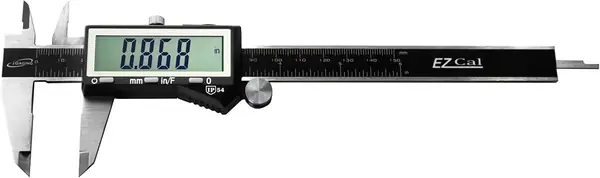
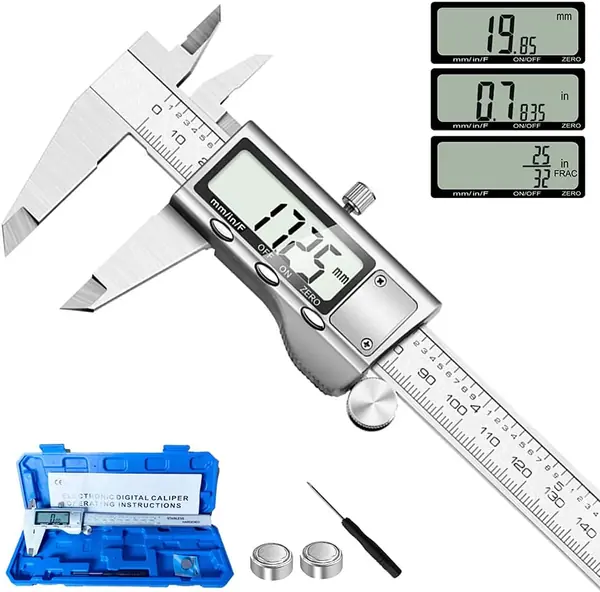
iGaging EZCal IP54 stainless digital caliper with large LCD screen and hard case

Stock and joinery

Shop Score 95/100
Accuracy
±0.001 in / 0.03 mm
Measuring Range
0-6 in / 150 mm
Display
13 x 38 mm LCD
Fraction Resolution
1/128 in
View on Amazon

Fractions are how woodworking plans talk, and this caliper answers in kind: press the mode button and the display steps from decimal inches to metric to fractions as fine as 1/128 inch. Checking a tenon cheek, you read a hair over 7/16 rather than 0.4375, and the next cut gets easier to judge. That single feature is most of why it sits at the top of this list.

The frame backs it up. Hardened, lapped stainless does not deflect when you press the jaws onto a piece of white oak, and plus or minus 0.001 inch is far finer than the tolerances wood actually holds, so what you are really buying is the rigidity. We also liked the 13 by 38 mm screen, which stays readable at arm's length with the shop lights behind you. After a few weeks of steady use the slide still moved smoothly and the zero came back with a nudge of the thumb.

IP54 sealing is the sleeper feature in a woodshop: sawdust brushes off, and a splash from a water-based finish will not end the tool. The coin cell is the usual weak spot. It ships with a spare, and we keep that spare in the lid, because auto-off does not stop every draw. If the screen is dead when you open the case, you are swapping a cell, not shopping for a new caliper.

Six inches of jaw covers most furniture work: stock thickness, tenon cheeks, dowel diameters, and mortise depth as far as the depth rod reaches. The VINCA below does nearly the same job for less with a two-year warranty behind it, and the iGaging earns its premium with the finer fraction steps and the bigger screen. Our advice is to buy this one, check the zero against a known thickness before you trust a stack of cuts to it, and add the 12-inch HARDELL if your measuring regularly runs longer.

Worth Noting

  • Case feels cheaper than the caliper it holds
Our Verdict

We reach for this one first: fraction readings to 1/128 inch, plus or minus 0.001 inch accuracy, and a stainless frame that does not flex when you press the jaws.

Check Latest Price
2.

VINCA DCLA-0605 Digital Caliper (6-Inch) Best Value

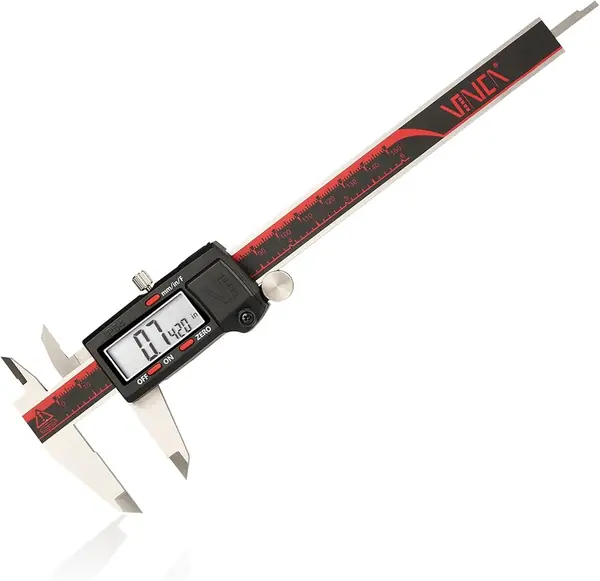
VINCA DCLA-0605 stainless steel digital caliper with red and black body and large LCD

First shop caliper

Shop Score 94/100
Accuracy
±0.001 in / 0.03 mm
Measuring Range
0-6 in / 150 mm
Fraction Resolution
1/128 in
Warranty
2 years
View on Amazon

Close to the iGaging on paper and cheaper by a noticeable margin, the VINCA is the caliper we point a new woodworker toward. Same inch-metric-fraction stepping, a comparable 13 by 38 mm screen, IP54 sealing, and a two-year warranty that nothing else on this list matches. As a value case it is hard to argue with.

In the hand it feels like a tool rather than a shell. The stainless body has enough mass to sit steady on the bench, the thumb roller moves the jaw in small increments so you can creep up on a fit, and the lock screw holds a reading while you walk the number to the saw. Watch one thing: the roller turns easily enough that the jaw can drift if you measure by feel alone, so lock it before you read the screen.

The display is generous for the money and readable at arm's length, and the package includes a hard case so the jaws are not rattling around a drawer of screwdrivers. For a first shop caliper, or a second one that lives at the saw where you actually cut, this is the sensible buy.

Worth Noting

  • Cell can be flat when you next open the case
Our Verdict

We hand this to anyone building a first shop: fraction readings, IP54 sealing, and the longest warranty here for less than the picks above it.

Check Latest Price
3.

HARDELL Digital Caliper (12-Inch) Best for Long Stock

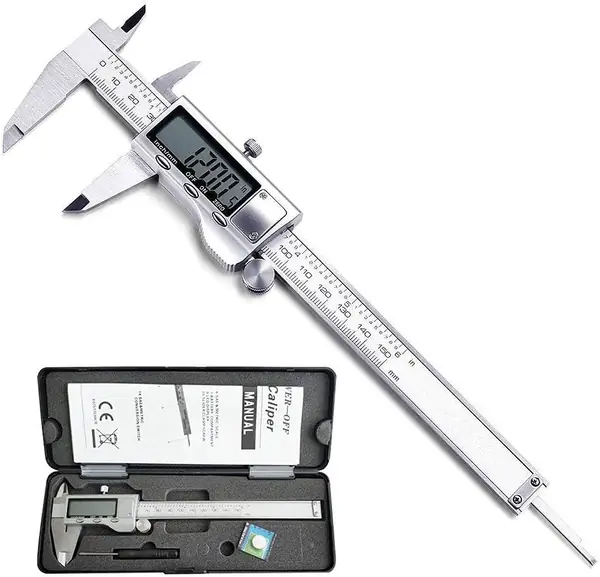
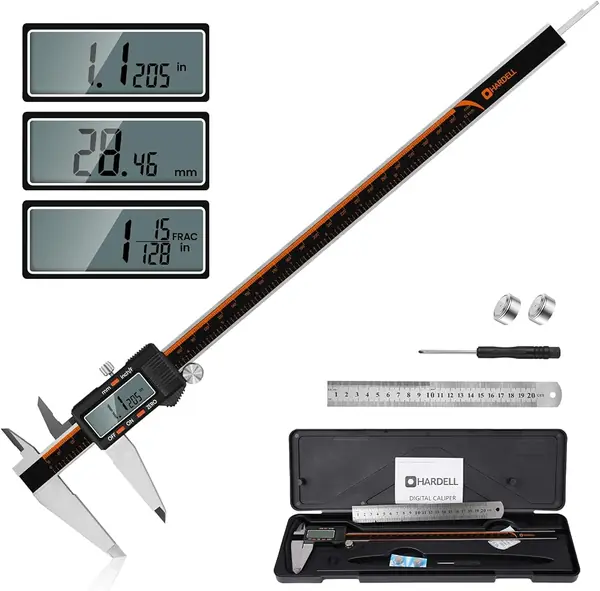
HARDELL 12-inch stainless steel digital caliper with oversized LCD and hard storage case

Long stock checks

Shop Score 93/100
Accuracy
±0.0015 in / 0.04 mm
Measuring Range
0-12 in / 300 mm
Resolution
0.0005 in / 0.01 mm
Display
14 x 40 mm LCD
View on Amazon

Six-inch jaws run out the first time you want the width of a glued-up panel or the length of a drawer side. This 12-inch HARDELL covers that ground: the same four measurements, the same inch-metric-fraction button, on a beam long enough to reach across a ten-inch rail without hunting for a tape.

The 14 by 40 mm display is the largest here, which matters because you are often reading it at the far end of a big panel. Resolution is 0.0005 inch and stated accuracy is plus or minus 0.0015, a step coarser than the six-inch picks and still several times finer than a woodshop works to. It arrives with two spare cells, a small screwdriver, a steel rule, and a hard case worth keeping.

A one-year warranty covers the tool, and the included steel rule is more useful than it sounds as a quick sanity check against the caliper's own reading. For casework, panels, and long rails, this is the caliper that keeps you off the tape measure.

Worth Noting

  • Beam is long enough to be clumsy
  • Battery life trails the smaller picks
Our Verdict

When a measurement runs past six inches this is the caliper we pick up: fraction readings, the biggest screen here, and jaws that span a full panel.

Check Latest Price
4.

Jiavarry Digital Caliper (6-Inch) Best Budget

Jiavarry stainless steel digital caliper with large LCD screen and hard case

Toolbox backup

Shop Score 92/100
Accuracy
±0.001 in / 0.02 mm
Measuring Range
0-6 in / 150 mm
Resolution
0.0005 in / 0.01 mm
Weight
12 oz
View on Amazon

It weighs 12 ounces against the iGaging's 1.76, and the heft is the point. A caliper with mass sits still on the bench, does not skitter when you set it down, and feels machined rather than molded. We did not expect that at the bottom of the price range.

It reads inches, millimeters, and fractions, zeroes at any point on the beam, and shuts itself off after five idle minutes. The jaws and beam are stainless, the finish is tidier than the price suggests, and the kit includes two spare cells and a hard case. Slide feel is good for the money, not the glassy glide of the pricier picks but smooth enough to creep up on a fit with the thumb roller.

What you trade for the price is time. Expect a few good years rather than a hand-me-down tool, because the electronics in this class are what eventually give out, not the stainless. As a second caliper for a toolbox, or a first one you plan to upgrade later, that is a fair trade.

Worth Noting

  • Sharp machined corners catch on your hands
  • Cells drain even when it sits idle
Our Verdict

The budget pick we actually like: a heavy stainless body, fraction readings, spare cells, and a case for the least money here.

Check Latest Price
5.

Kynup Digital Caliper (6-Inch)

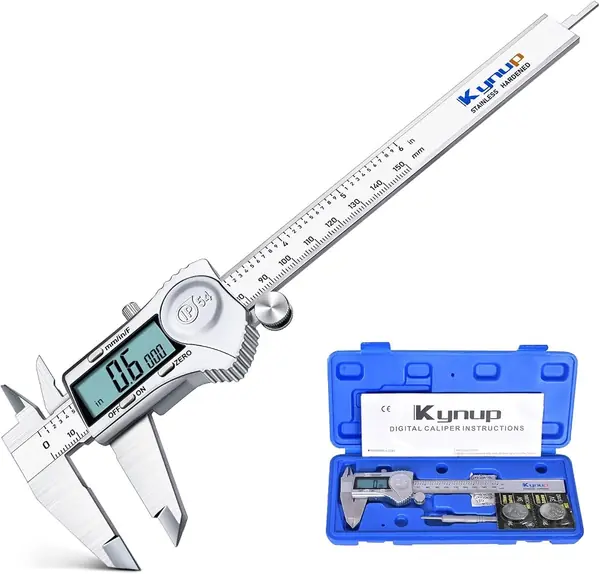
Kynup stainless steel digital caliper with hard case and spare button cells

Budget first caliper

Shop Score 91/100
Accuracy
±0.001 in / 0.02 mm
Measuring Range
0-6 in / 150 mm
Protection Rating
IP54
What's In The Case
Hard case, screwdriver, three cells
View on Amazon

The Kynup arrives as a kit rather than a bare tool: stainless body, inch-metric-fraction conversion, IP54 splash protection, a hard case, a mini screwdriver, and three button cells so two spares live in the lid. On paper it reads like the VINCA for less money, and the specification sheet is the first thing that recommends it.

We have had less bench time with this one than with the picks above it, so take it as a specification-and-kit recommendation rather than a seasoned one. What we can say is that the fundamentals are all present, from plus or minus 0.001 inch accuracy and 0.0005 inch resolution to the sealed body and the spare cells, and nothing in the design asks you to make excuses for it. As a first caliper on a tight budget, the risk is low.

Three things to check once it is in your hand: that the jaw returns to zero when you close it, that the thumb roller does not drift under light pressure, and that the fraction mode steps in the increments you actually use. Any caliper in this class is either a good one or a Monday build, and those checks tell you which you got.

Worth Noting

  • Needs out-of-the-box zero and drift checks
  • Less bench time than higher-ranked picks
Our Verdict

We see this as a low-risk first caliper: stainless jaws, IP54 sealing, fraction readings, and a case, with the same specs as picks that cost more.

Check Latest Price
6.

LOUISWARE Stainless Digital Caliper (6-Inch) Best for Everyday Bench Measuring

LOUISWARE polished stainless digital caliper with large LCD and hard case

Everyday bench measuring

Shop Score 90/100
Accuracy
±0.001 in / 0.02 mm
Measuring Range
0-6 in / 150 mm
Resolution
0.0005 in / 0.01 mm
Protection Rating
IP54
View on Amazon

Out of the box this is the most finished-feeling caliper in the group: polished stainless, a knurled thumb roller, a locking screw, a hard case, two cells, and a small screwdriver for the battery door. Nothing about it looks like a budget instrument.

It is sealed to IP54 and rated for 0 to 40 degrees Celsius, roughly the range a garage shop lives in. The LCD is large and clear, the buttons respond on the first press, and there is a conversion table printed on the back, a small thing we used more than we expected when checking a drawer front against a metric plan.

Accuracy is stated at plus or minus 0.001 inch and the readings held consistent across repeated passes on the same board. The arguments you will see about calipers in this price class usually come down to half a thousandth on a gauge block, which is far smaller than anything a wood joint cares about. For stock, joinery, and turned blanks it is accurate enough that you stop thinking about it.

It earns its place on fit and finish rather than on features. Choose it if the caliper is going to live in the open on a bench and you want one that looks and feels the part, choose the iGaging if the fraction display is the main event, or choose the VINCA if the warranty matters more.

Worth Noting

  • Dead cells and loose battery doors on arrival
Our Verdict

We like it for how it feels and how it is kitted: polished stainless, IP54 sealing, two cells, and a case, with accuracy finer than wood needs.

Check Latest Price
7.

werka Digital Caliper (6-Inch) Best for Bench and Toolbox

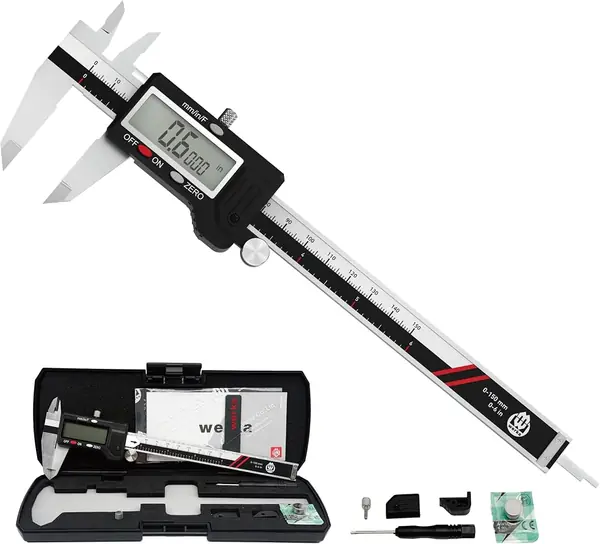
werka stainless steel digital caliper in a foam-lined hard case with batteries

Bench and toolbox

Shop Score 89/100
Accuracy
±0.001 in / 0.02 mm
Measuring Range
0-6 in / 150 mm
Case
Hard case with foam insert
Conversion Modes
Inch, fraction, millimeter
View on Amazon

The case is the first thing you notice. It is a hard box with a foam insert that cradles the caliper by its beam so the jaws touch nothing, which is the difference between a tool that still measures true after a year in a toolbox and one that does not.

Inside sits a stainless six-inch caliper reading inch, fraction, and metric, listed at 0.001 inch accuracy, with a thumb roller, a locking screw, auto-off, and a low-battery warning. The LCD is bright, the buttons give a solid click instead of a mush, and two LR44 cells come in the box.

We rate it just below the VINCA and the iGaging, and the reason is arithmetic: it costs about what the iGaging costs without adding a feature the iGaging lacks. What it does add is the case and a tight, clean assembly. If you want one caliper that lives in its box between jobs and comes out reading the same, that trade is worth making.

Worth Noting

  • Adds no measurement features over similarly priced rivals
Our Verdict

We recommend it for the box as much as for the caliper: foam holds the jaws off the case and the tool inside reads fractions and holds zero.

Check Latest Price

How We Tested the Best Digital Calipers for Woodworking

We started by gathering every digital caliper a woodworker might realistically buy—6-inch and 12-inch models, stainless-steel bodies, fraction readouts, hard cases—then filtered by price so the cheapest picks got the same bench time as the rest. Anything that read only in millimeters came off the list. We bought all 14 at retail, unboxed them on the bench, and checked that each one zeroed cleanly before it earned a place in the rotation.

The next four months looked like a normal shop schedule. We used the calipers to check tenon cheeks and dado widths, to set a table saw fence, to run the depth rod into mortises, and to measure planed stock after every pass. Turned blanks got measured only after we switched the lathe off and let the piece come to a full stop, and the jaws and depth rod stayed clear of cutters and blade guards while we adjusted a setup. For each caliper we took the same hardwood offcut five times in a row, watching how far the numbers drifted and whether the zero held between sessions.

Build quality got a hands-on check: we closed the jaws on a maple scrap and squeezed the beam to feel where it flexed, then re-read the number to see if it moved. We rolled the thumb wheel one-handed with sawdust on our fingers, set the lock screw and looked for creep, and read the display at arm's length under shop lights. Battery life was tested by leaving the calipers in their cases for weeks at a stretch to see which ones woke up and which needed a cell. We also buried them in router-table dust, splashed the sealed ones, and watched for jaw slop and wear over the full four months.

How to Choose Digital Calipers for Woodworking

Start With the Measurements You Actually Make

Stock thickness, tenon cheeks, mortise depth, dowel diameters: furniture work happens inside six inches almost all the time, and a six-inch caliper reaches every one of those. The tape measure comes out for panels and carcass widths, where a thousandth of an inch is beside the point. If you regularly check drawer sides, rails, or glued-up panels, a twelve-inch model earns its extra bulk; if not, the long beam is weight you carry for nothing.

The depth rod deserves a thought too, because it is the same length as the range. A six-inch caliper measures a mortise about six inches deep and no more, which is fine for casework and short of what you need on a deep hollow form.

Accuracy and Rigidity: Why Stainless Wins

Stated accuracy across these picks runs from plus or minus 0.001 inch to plus or minus 0.0015, and every one of them is finer than wood holds from one season to the next. What separates them is rigidity. A stainless beam and lapped jaws stay square under thumb pressure; a plastic body flexes, and a jaw that flexes reads differently every time you squeeze it. That is why we do not recommend plastic calipers for a shop, even as a spare.

Resolution is a different figure from accuracy. A 0.0005 inch display means the number moves in half-thousandths, not that the tool is that trustworthy, so read the accuracy figure and the build material before the last digit on the screen.

Fractions Are the Feature Woodworkers Underrate

Most project plans in the U.S. are written in fractions, and a caliper that displays them saves you from translating 0.4375 into something you can set a marking gauge to. Look for fraction steps of 1/64 inch at minimum; the better picks here go to 1/128. On a tenon, that finer step is the difference between a hair over and a number you can act on.

Press the mode button to step through decimal inches, fractions, and millimeters. All three matter, because hardware and sheet goods are often metric even when your plans are not.

Batteries Decide Whether You Reach for It

Every caliper here runs on button cells, and auto-off does not stop all drain. A tool that sits for a month can be flat the moment you need it, and that happens at the worst possible point in a glue-up. The practical answer is a spare cell taped inside the case and a glance at the screen when you open the lid.

Rechargeable models exist and end the coin-cell hunt, but they add a charging routine and sit higher in price. A spare LR44 is cheap; a dead caliper mid-assembly costs you the joint.

Sealing, Storage, and the Lock Screw

Look for a hardened stainless body, a knurled thumb roller, and a locking screw. The lock is what holds a reading while you walk to the saw, and it is the first thing to use when a jaw wants to drift under light thumb pressure.

IP54 sealing matters in a shop that makes dust and keeps a damp finish rag on the bench. It will not survive a dunk, but it shrugs off chips and splashes. Take the case seriously as well: a foam insert that holds the caliper by its beam keeps the jaws off everything else, which is how a caliper stays accurate between projects.

Frequently Asked Questions

Final Verdict

Our default for a woodshop is the iGaging EZCal: fractions to 1/128 inch, plus or minus 0.001 inch accuracy, a hardened stainless frame, and IP54 sealing, which is the combination that covers stock, joinery, and turning without a second tool.

If the budget is the constraint, the VINCA does the same job with a two-year warranty behind it. And if a measurement ever runs past six inches, whether a panel, a rail, or a drawer side, the 12-inch HARDELL is the one to add.