↑↓ navigate ↵ open Esc close All results →

Best Digital Calipers of 2026

A caliper that drifts off zero is worse than none at all—it makes you second-guess every cut, every fit, every hole you drill. A good digital caliper should feel solid, hold its zero through shop dust, and show a number you can read without squinting.

We tested 12 digital calipers over eight months in the woodshop, at the 3D printer, and around the garage. My own bench caliper spent a winter next to a bag of potting soil, so we checked zero after every session, not just on day one. We weighed accuracy and resolution against price, because a caliper that promises more precision than its build delivers is a false economy.

The display matters more than shoppers expect: fractions help in the woodshop, a backlight earns its keep in a dim garage, and auto-off can save a battery or annoy you mid-measurement. We kept spare button cells out of reach of kids and pets and noted which kits included them. What follows are the calipers we’d trust on our own benches, not the longest feature lists.

Our Top Picks

The Best Digital Calipers

1.

iGaging EZCal IP54 6-Inch Best Overall
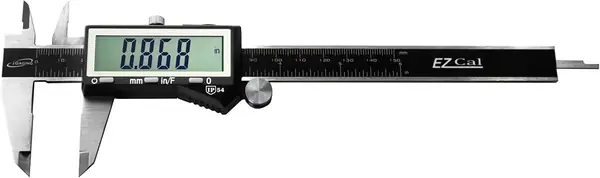
iGaging EZCal IP54 stainless digital caliper with LCD readout and thumb roller

Woodworking and DIY

Shop Score 94/100
Range
0-6 in / 0-150 mm
Accuracy
±0.001 in / 0.02 mm
Resolution
0.0005" / 0.01 mm / 1/128"
Protection
IP54 dust and splash resistant
View on Amazon

Fractions are why this one lives on the bench. Tap the unit button and the EZCal reads 3/4 inch instead of 0.750, which is the number you want when you are setting a bit or checking a rail against a plan drawn in sixteenths. We expected to use metric most of the time; we keep coming back to the fraction readout, and it has quietly taken over from the tape measure for anything under six inches.

The body is hardened stainless with a knurled thumb roller and a lock screw, and once the slide has broken in it moves evenly with no slop at the jaw. Readings settle the instant you stop rolling, and closing the jaws brings the display back to zero, which is the habit that separates a trustworthy instrument from a decorative one. Resolution runs to 0.0005 inch, 0.01 mm, or 1/128 inch, and the stated accuracy is plus or minus 0.001 inch.

IP54 sealing is the other reason it suits a working shop. Dust and the odd splash do not end the party, so it can sit out on the bench instead of going back in its case between cuts. The auto-off saves the button cell, and a spare rides in the box with the instructions.

Against the rest of this group, the EZCal sits midrange on price with the widest useful feature set — fraction readout, sealing, and stainless at once. The Starrett has the finer slide and the Fowler has the certificate, but neither will tell you a board is three-quarters thick. If your measurements end up in a spreadsheet, the Absolute Origin is the one to look at instead.

Worth Noting

  • Slide arrives tight and needs a break-in
Our Verdict

We reach for the EZCal because it reads in fractions, shrugs off shop dust, and comes back to zero every time we close the jaws — the best all-round choice here for woodworking.

Check Latest Price
2.

Starrett EC799A-6/150 Best Premium

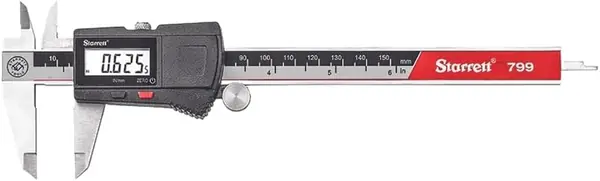
Starrett EC799A-6 stainless electronic caliper with LCD display and thumb wheel

Daily precision measuring

Shop Score 93/100
Range
0-6 in / 150 mm
Accuracy
±0.001 in / ±0.02 mm
Resolution
0.0005 in / 0.01 mm
Body
Hardened stainless steel, 11.2 oz
View on Amazon

Nothing on the Starrett's spec list explains what it costs. Range is the usual 0 to 6 inches, accuracy is plus or minus 0.001 inch, resolution is 0.0005 inch, and it switches between inch and metric at the push of a button. What you are paying for is the fit: hardened stainless measuring surfaces, a slide with no discernible play, and a fine-adjustment thumb wheel that lets you creep up on a dimension instead of hunting for it.

The difference is obvious in the hand, and it is why we kept reaching for it while other calipers sat on the bench. A light turn of the fine-adjust wheel moves the jaw in small increments, which matters when you are fitting a tenon or checking a bearing seat and a nudge overshoots the number you were aiming at. It also holds its last reading through the 30-minute auto-off, so it wakes up showing where you left it.

What the premium does not buy is a finer number — the EZCal and the Fowler resolve the same 0.0005 inch for far less. It buys feel and the expectation of a long working life, and those hardened jaws are what the money is actually for. Whether that is worth it depends on how often the tool leaves its case.

Worth Noting

  • Premium price for the same 0.0005-inch resolution
Our Verdict

We recommend the Starrett to anyone who measures daily: its slide and fine-adjust thumb wheel feel like the best in this group, and the premium price reflects exactly that.

Check Latest Price
3.

Fowler Xtra-Value Cal 54-101-150-2 Best with Certificate

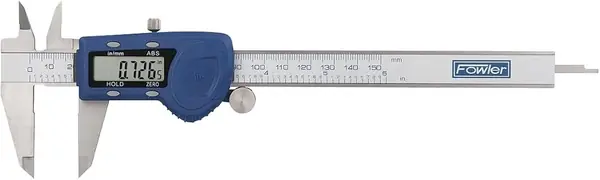
Fowler Xtra-Value Cal stainless digital caliper in fitted case with batteries

Documented shop inspection

Shop Score 92/100
Range
0-6 in / 150 mm
Accuracy
±0.001 in / 0.02 mm
Resolution
0.0005 in / 0.01 mm
In The Case
NIST certificate, two batteries, fitted case
View on Amazon

Open the Fowler's case and there is a piece of paper we did not expect to find with a caliper: a NIST test certificate. That sheet is the reason this one earns a place in the roundup. In a shop that has to show a customer that a part was measured with a traceable instrument, the certificate is the difference between a tool and a documented tool.

The rest is conventional and well executed — 0 to 6 inches, plus or minus 0.001 inch, resolution of 0.0005 inch, a hardened stainless frame, a knurled lock screw, and a thumb roller that moves the jaw smoothly. The display switches between inch and metric and adds a hold function plus absolute and incremental modes; the incremental setting is genuinely useful when you are comparing a stack of parts against one reference.

Weight is where it gives something up. At 13.6 ounces it is the heaviest caliper in this group, and holding it at eye level through a long inspection run gets tiring. What you get in exchange is a solidity we noticed immediately: it sits flat on the bench, does not skate, and the lock screw holds a setting without the jaw creeping. When a certificate has to travel with the number, this is the pick.

Worth Noting

  • Heaviest caliper here at 13.6 ounces
Our Verdict

We point anyone who has to document a measurement toward the Fowler: it arrives with a NIST certificate, a fitted case, and a slide that repeats.

Check Latest Price
4.

iGaging Absolute Origin 6-Inch Best for Data Logging

iGaging Absolute Origin stainless digital caliper with SPC output port and case

Logging and CAD work

Shop Score 91/100
Range
0-6 in / 150 mm
Accuracy
0.001 in
Protection
IP54
Data Output
SPC/USB port
View on Amazon

Most calipers forget where they started the moment the display sleeps. The Absolute Origin does not: its zero reference survives a power-off, so you can pick it up after lunch, slide the jaw open, and read an absolute dimension rather than whatever you last zeroed against. That sounds like a small thing until you have zeroed on a shoulder and then cannot work out why the number is off by half an inch.

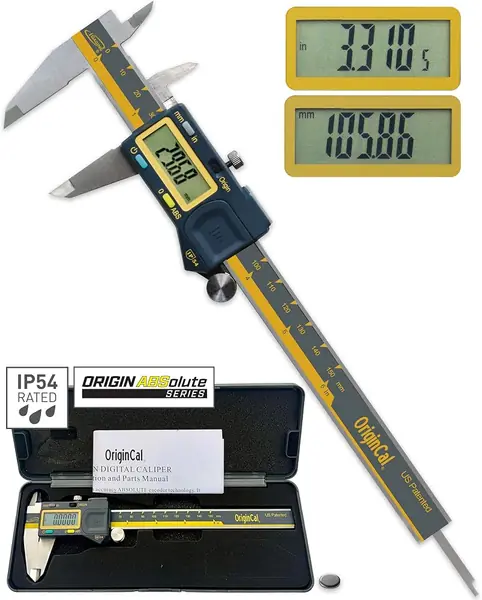
The SPC/USB port is the other half of the argument. Readings go straight into a spreadsheet or a CAD model rather than onto the back of a cut list, and we like it for building a table of part thicknesses instead of trusting our handwriting. For anyone measuring a run of parts, that alone justifies the step up from the EZCal.

The rest of the package is sensible: IP54 sealing, a hardened stainless body with a lapped slide, a case, and a battery. iGaging also lists the Absolute Origin in 8- and 12-inch versions, so the same electronics can follow you into deeper work when a 6-inch jaw stops reaching.

One thing we watch: a caliper of this class can start drifting after months of shop use, so close the jaws and re-zero at the start of a session — a two-second habit rather than a scrapped cut. Set against the EZCal, the Absolute Origin trades the fraction readout for data output, and if woodworking in sixteenths is your day, that trade runs the wrong way.

Worth Noting

  • Data cable sold separately
Our Verdict

We like the Absolute Origin for anyone who records numbers: it keeps its zero through a power-off and sends readings out through an SPC port into whatever you are logging them in.

Check Latest Price
5.

HARDELL Rechargeable 6-Inch Best Rechargeable

HARDELL rechargeable digital caliper with backlit LCD and metal body

Heavy shop use

Shop Score 90/100
Range
0-6 in
Accuracy
±0.001 in / 0.02 mm
Resolution
0.0005 in
Power
USB-C rechargeable with backlit LCD
View on Amazon

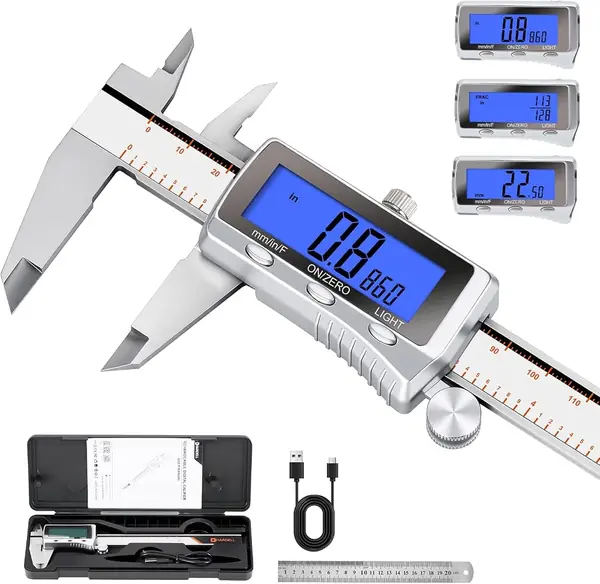
A dead button cell is the most common reason a caliper gets abandoned in a drawer, and this is the one we keep charged. It tops up over USB-C, and the spec sheet promises months of use per charge, which we have not owned it long enough to confirm. What we can tell you is that the charging habit replaces the shopping habit.

The backlight is the feature we did not expect to care about. Press the light button and the display stays legible under a bench or in a garage lit by one weak bulb, which describes most garages. The body is metal, screen housing included, and it has the heft of a tool rather than the rattle of a plastic one.

Readings come in inch, metric, and fractions, resolution runs to 0.0005 inch, and the range is 0 to 6 inches at plus or minus 0.001 inch — the same numbers as calipers that cost more. The trade is simple: nothing to buy at the hardware store, and no long history yet on the cell sealed inside.

Worth Noting

  • No battery gauge to warn you
Our Verdict

The rechargeable HARDELL is what we hand someone whose caliper is always dead: USB-C top-ups, a backlit screen, and a metal body at midrange money.

Check Latest Price
6.

Kynup Digital Caliper 6-Inch Best Budget

Kynup stainless digital caliper with oversized LCD and protective case

Tight budgets

Shop Score 89/100
Range
0-6 in / 150 mm
Accuracy
±0.001 in / 0.02 mm
In The Case
Hard case, three button cells, mini screwdriver
Display
Oversized LCD with inch, metric, and fraction
View on Amazon

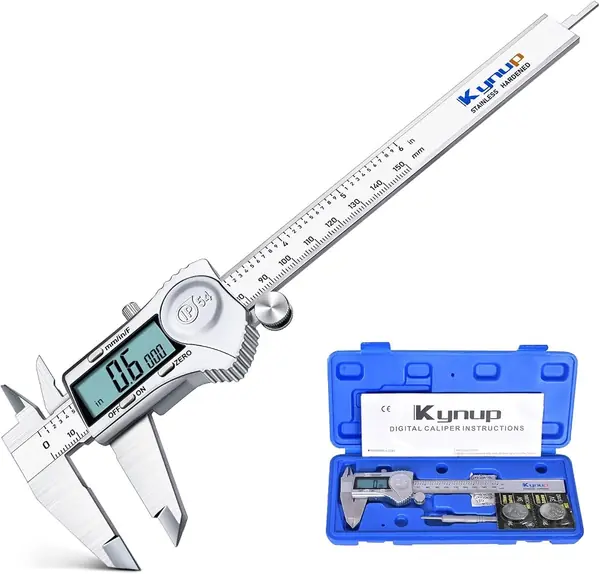
At the bottom of this group's price range sits a caliper that does not look or feel like the cheap one. The Kynup is a stainless-bodied 6-inch tool with an oversized LCD, inch, metric, and fraction modes, a knurled thumb roller, a lock screw, and a hard case with three button cells and a mini screwdriver tucked inside.

We like it for what it does not do: it does not flex, it does not make you squint, and it does not cost much. The digits are big enough to read from a step back, which sounds like a small mercy until your eyes are tired and the light is bad. Stated accuracy is plus or minus 0.001 inch, the same claim the mid-priced picks make.

The habit worth forming is storage. The display wakes whenever the roller moves, so a caliper rattling loose in a drawer will drain its cells between jobs; keep it in the case and the batteries last the way they should. For stock thickness, router bit shanks, and dowel diameters, it does the job the expensive picks do.

Worth Noting

  • Case latch is flimsy and pops open
  • Some units fail within the first year
Our Verdict

The Kynup is the one we suggest when the budget is tight: stainless, fractions on the display, and accuracy claims that match calipers at twice the price.

Check Latest Price
7.

HARDELL Stainless Caliper Kit

HARDELL stainless digital caliper with case, spare batteries, and ruler

A second caliper

Shop Score 88/100
Range
0-6 in
Accuracy
±0.02 mm / 0.001 in
Resolution
0.01 mm
In The Case
Case, two batteries, screwdriver, stainless ruler
View on Amazon

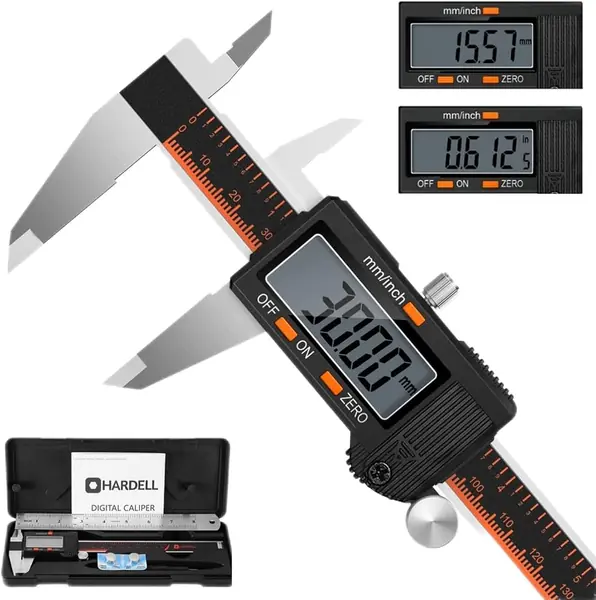
Five things come out of this box: the caliper, a case, two batteries, a mini screwdriver, and a small stainless ruler. The ruler is the piece we ended up using most — it lives in an apron pocket and comes out when a measurement only has to be close.

The caliper is a conventional stainless four-mode tool: 0 to 6 inches at plus or minus 0.02 mm, resolution of 0.01 mm, inch and metric on one button, auto-off, and a large LCD. The slide moves evenly and the lock screw holds a reading while you turn the tool toward the light.

Where it loses to the Kynup is the fraction display, and where it loses to the rechargeable HARDELL is the charging. What it does better than either is arrive complete: a spare cell, a screwdriver sized for the battery door, and a case mean it can go into a toolbox without a shopping list. As a second caliper for a truck or a job box, that completeness counts for more than any single line on the spec sheet.

Worth Noting

  • Spare battery works loose in the case
Our Verdict

We keep the HARDELL kit as the second-caliper option: it arrives with a case, two batteries, a screwdriver, and a steel ruler that earns its place on the bench.

Check Latest Price

How We Tested Digital Calipers

We started with a long list of 6-inch calipers and filtered by range, stated accuracy and resolution, body material, dust and splash rating, data output, and what came in the case. We included names long associated with metrology alongside budget newcomers, then bought 12 units and used them for eight months in a home woodshop, at a 3D-printing bench, and around the garage and jewelry bench.

Each caliper was checked against a known gauge block at the start and then after every work session, so we could see whether the jaws returned to zero after weeks of sawdust, pocket carry, and the occasional knock. We measured the same brass rod, aluminum plate, and printed bracket with every unit, comparing the readouts and noting which displays were easy to read under dim shop light, which fraction modes actually helped, and whether a backlight washed out the digits.

We also lived with the details: how the thumb roller felt, whether the lock screw held a measurement, how much slop was in the slide, and how long the battery lasted with auto-off enabled. We recorded battery type, noted which kits included spares, and kept those spare button cells in a closed drawer out of reach of children and pets. For the rechargeable and data-output models, we topped them up over USB-C and logged readings to a spreadsheet to see how the connection held up.

At the end, we rechecked zero and compared the wear on each body—loose jaws, scratched displays, cases that had cracked. The picks are the ones that stayed consistent and readable after eight months, not just the ones that felt good on day one.

How to Choose Digital Calipers

Six Inches Covers Most Shop Work

Every pick here is a 6-inch caliper, which is the size that measures board thickness, tenon cheeks, dowel diameters, and mortise depth without getting in the way. A 6-inch electronic caliper opens to 150 mm, and the depth rod reaches about the same distance off the end of the beam.

If you build casework or turn, step up: iGaging lists the Absolute Origin in 8- and 12-inch sizes, and Starrett sells 8- and 12-inch versions of the same electronic caliper. Buy the 6-inch first and add a long one when a project actually demands the reach.

Accuracy and Resolution: What the Numbers Promise

Every metal caliper here claims ±0.001 in / 0.02 mm with 0.0005 in / 0.01 mm resolution. The plastic ones sold for pocket change usually claim ±0.01 in with 0.1 mm resolution — ten times coarser. That is fine for sorting screws and too coarse for joinery that has to close.

What a spec sheet cannot tell you is whether the tool repeats. Close the jaws, zero it, then open and close three times and watch the display. If it returns to zero every time you have a usable instrument; if it wanders, the printed accuracy is fiction. That check is the first thing we do with a new caliper, and it is worth more than any figure on the box.

The Display: Fractions, Backlight, and Bad Light

For woodworking, a fraction readout earns its keep: 3/4 inch is easier to act on than 0.750, and plans and bits are still sold in fractions. Not every caliper has one — the Kynup and the iGaging EZCal switch to fractions, while the Starrett and the Fowler give you inch and metric only.

Backlighting matters more than you expect if the bench light is behind you. The rechargeable HARDELL has it, and anyone who has tilted a caliper toward a window to read the last digit knows why that counts.

Body, Slide, and Battery: Where the Money Goes

A stainless frame, a knurled thumb roller, and a lock screw are the baseline. Money above that buys a lapped slide, a fine-adjustment wheel like the Starrett's, IP54 sealing against dust and splashes, and a case worth keeping. The trap is the title: 'stainless steel' appears on calipers whose slides still grind, so judge the thumb roller and the lock screw — those are the parts that decide whether a reading holds while you move your hand.

Power is the other quiet decision. Coin cells (LR44 or CR2032) are cheap and available, but they drain in a drawer unless the caliper auto-offs properly, and a spare in the case is the difference between measuring today and driving to the store. USB-C charging, as on the HARDELL, removes the whole ritual at the cost of a battery you cannot swap on a Sunday.

Frequently Asked Questions

Final Verdict

The iGaging EZCal is the caliper we recommend to most woodworkers. Fraction readout, IP54 sealing, and a stainless slide for midrange money, plus jaws that come back to zero every time you close them — that combination is what a bench tool actually needs.

Spend up to the Fowler if a certificate has to travel with the measurement, or the Starrett if the caliper is in your hand eight hours a day and the slide feel is worth the premium. On a tight budget, the Kynup measures the same dimensions for less; just keep it in its case.