↑↓ navigate ↵ open Esc close All results →

Best Dial Calipers of 2026

Unlike digital calipers that blank out on a cold morning or lose zero after a light knock, a mechanical dial caliper never asks for a battery and shows its reading directly on a needle. What separates a trustworthy bench caliper from a frustrating one rarely shows in a product photo: a covered rack that keeps wood chips out of the gear teeth, smooth slide travel without gritty catches, and a bezel that turns and locks cleanly for zeroing anywhere.

Over nine months of checking 12 stainless-steel 6-inch calipers against a known standard before touching stock, bench lighting revealed an unexpected flaw. Polished dial faces wash out under overhead lights at the exact angle you read them, while choosing between fractional and decimal graduations changes how quickly you translate measurements at the saw.

Across daily cabinet work, student benches, fractional woodworking layouts, and entry-level toolboxes, the eight models below delivered repeatable readings without needing a single coin cell.

Our Top Picks

The Best Dial Calipers

1.

Mitutoyo 505-742J Dial Caliper Best Overall
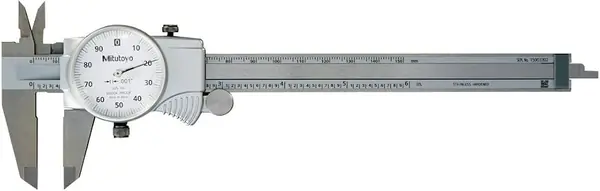
Mitutoyo 505-742J stainless steel dial caliper with white dial and fitted case

Precision shop work

Shop Score 93/100
Measuring Range
0-6 inches
Accuracy
0.001 inch
Material
Stainless steel
Dial Travel
0.1 inch per revolution
View on Amazon

A full turn of the Mitutoyo 505-742J's dial covers 0.1 inch, so every sweep is one tenth and the needle does not leave you counting revolutions in your head. That layout is why it is our top pick: it turns a measurement into a glance. The 0.001-inch graduations are crisp against the white face, and the satin chrome finish keeps glare down under shop lights.

The mechanical package is just as convincing. The stainless steel beam and jaws feel tight without binding, the thumb roller moves the jaw in small controlled increments, and separate locks for the bezel and slide hold a reading while you write it down. We also like the shock protection and fitted case, which matter if the caliper lives in a toolbox rather than on a bench.

Against the cheaper picks here, the Mitutoyo is the one we trust for a measurement that has to be right the first time. The Accusize gets you the same range and thousandth-inch resolution for less, and the Starrett 3202-6 has a heavier feel, but neither matches the Mitutoyo's combination of smooth travel and clear, repeatable zeroing in our view. For furniture work that last bit of refinement is a luxury; for joinery, tool setup, and occasional metalwork, it is the reason to spend.

Worth Noting

  • Premium price may deter occasional users
Our Verdict

We recommend the Mitutoyo 505-742J to anyone who wants the surest mechanical reading in this group: its smooth slide, crisp dial, and separate jaw and bezel locks make precise work feel routine.

Check Latest Price
2.

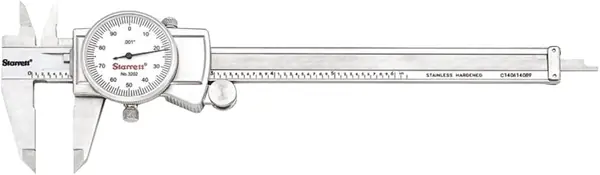
Starrett 3202-6 Dial Caliper Best Heavy-Duty Alternative

Starrett 3202-6 stainless steel dial caliper with white face and fitted case

Heavy daily use

Shop Score 92/100
Measuring Range
0-6 inches
Accuracy
±0.001 inch
Material
Stainless steel
Graduation
0.001 inch
View on Amazon

What we noticed first about the Starrett 3202-6 is the heft: its stainless steel body feels like a small machinist's square, and the sliding jaw moves with a positive gear feel. On a crowded bench that solidity is reassuring, and the knife-edge jaws reach into narrow spots without feeling fragile.

The dial is the other half of the story. The adjustable bezel lets you zero the needle where you want it, the white face is easy to scan, and the lock screws hold both bezel and jaw. We think this is the pick for someone who wants a traditional, heavily built caliper and does not mind paying for the Starrett name. It is not as silky as the Mitutoyo, but it feels built to survive a working shop.

For general woodworking, the Accusize does the same measuring for a lot less, and the Fowler has a more protected rack for a dusty shop. The Starrett's appeal is tactile: the weight, the gear feel, the sense that you are holding a tool rather than a gadget. If that matters to you, the premium is money well spent. It is the caliper we hand to someone who wants an heirloom feel without an heirloom fuss.

Worth Noting

  • Not made in the USA despite the brand
Our Verdict

We reach for the Starrett 3202-6 when a caliper has to feel substantial and stay put on a busy bench; its heavy stainless build and clear dial justify the premium.

Check Latest Price
3.

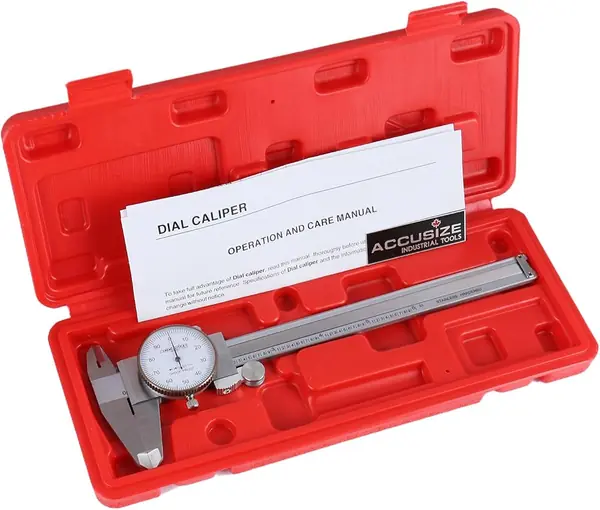
Accusize P920-S216 Dial Caliper Best Value

Accusize P920-S216 stainless steel dial caliper with satin chrome finish

Home woodshops

Shop Score 91/100
Measuring Range
0-6 inches
Accuracy
±0.001 inch
Material
Stainless steel
Resolution
0.001 inch
View on Amazon

The Accusize P920-S216 is the value pick we point to when someone wants precise measurement without premium-brand money. It lists 0.001-inch resolution and ±0.001-inch accuracy, the same headline numbers as calipers costing much more, and the hardened, ground measuring faces and satin chrome finish make it feel more serious than its price tier suggests.

In hand, the slide is tight and smooth, the thumb adjustment moves in fine steps, and the clamp holds a setting with little effort. The dial is clear and the bezel rotates for zeroing. We like that combination for furniture work and jig setup, where you often measure the same joint or bit height over and over and want the reading to stay put while you make a cut. The carrying case is basic, but it keeps the jaws out of a drawer's grit.

It is not as glassy as the Mitutoyo, and the fit and finish are more workmanlike than jewel-like, but those are fair trade-offs at this level. For a home woodshop or a garage machinist who needs a reliable 6-inch dial caliper without treating it like an heirloom, the Accusize does the job with money left for materials.

Worth Noting

  • Fit and finish feel workmanlike rather than premium
  • Includes only a basic carrying case
Our Verdict

We think the Accusize P920-S216 is the smart spend for a home woodshop: it lists the same thousandth-inch precision as the premium picks, with a clear dial and a midrange price.

Check Latest Price
4.

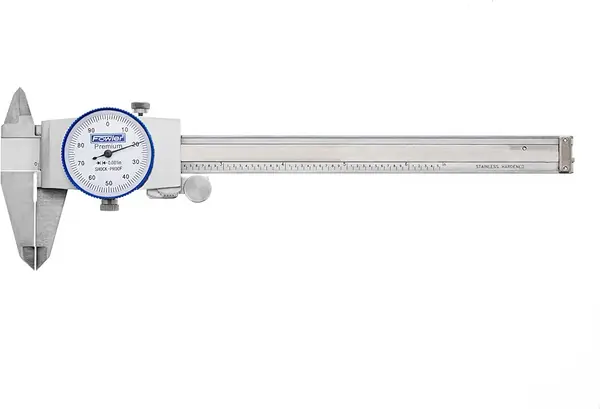
Fowler 52-008-706-0 Dial Caliper Best for Student Shops

Fowler 52-008-706-0 stainless steel dial caliper with white dial and case

Student workshops

Shop Score 90/100
Measuring Range
0-6 inches
Accuracy
±0.001 inch
Rack
Covered
Dial Graduations
0.001 inch
View on Amazon

The feature that sold us on the Fowler 52-008-706-0 is the covered rack. In a shop that makes sawdust or grinds metal, exposed gear teeth collect grit; the cover keeps the rack cleaner, and the dual pinion drive is designed to reduce wear. That is the kind of practical detail that matters more after a year of use than another line on a spec sheet.

The rest is a solid traditional caliper: stainless steel beam and jaws, a thumb roller, a knurled lock, and a white dial with 0.001-inch graduations. The adjustable dial lets you set zero, the depth rod is built in, and the one-year warranty is a sensible safety net for a tool that may pass through several hands. The knurled lock is easy to find with a thumb.

We think the Fowler is the right choice for a shared or teaching shop because it balances accuracy with protection against shop debris. The dial is easy to read and the covered rack gives the tool a margin against careless handling. For a bench where several people use the same caliper, that protection is worth as much as another decimal place.

Worth Noting

  • Slide feel trails premium calipers
Our Verdict

We recommend the Fowler 52-008-706-0 for a shared or teaching shop because the covered rack and solid stainless body stand up to handling, while the dial stays easy to read.

Check Latest Price
5.

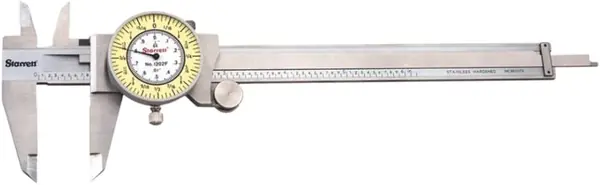
Starrett 1202F-6 Dial Caliper Best Fractional Dial for Woodworking

Starrett 1202F-6 fractional dial caliper with white face and fitted case

Woodworking fractions

Shop Score 89/100
Measuring Range
0-6 inches
Accuracy
0.002 inches
Material
Hardened stainless steel
Dial
Fractional inch
View on Amazon

The 1202F's reason to exist is the dial. It reads in fractions, so a 1-1/2-inch board or a 1-17/64-inch tenon does not require a conversion detour in your head. For woodworking, that is not a gimmick; it is a faster interface, especially when you are fitting joints and sneaking up on a dimension by eye and feel.

The rest of the tool is classic Starrett: hardened stainless steel, a large white face, a thumb roller, and lock screws for the bezel and jaw. The depth rod is built in, and the fitted case protects the dial between uses. We like the size of the dial for shop light and older eyes, and the fractional markings are easy to scan without leaning in.

This is a specialist, not an all-purpose machinist caliper. If your work is mostly decimal inches and thousandth-inch fits, the Mitutoyo or Accusize is the better instrument. But for furniture, cabinets, and layout where the answer is often a fraction, the 1202F removes a small, repeated friction that you feel every time you pick it up. It is the caliper we keep near the bench for trim and casework.

Worth Noting

  • Fractional dial is less suited to decimal-inch machining
Our Verdict

We like the Starrett 1202F-6 for woodworkers who think in fractions; its large fractional dial makes measurements faster and clearer than converting decimals in your head.

Check Latest Price
6.

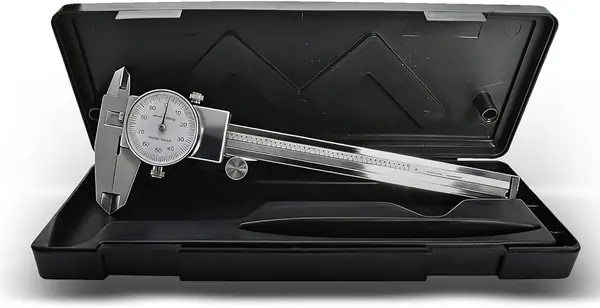
findmall 6-Inch Dial Caliper Best Budget

findmall six-inch stainless steel dial caliper with plastic storage case

Entry-level measuring

Shop Score 88/100
Measuring Range
0-6 inches
Accuracy
±0.001 inch
Resolution
0.0005 inch
Functions
Outside, inside, depth, step
View on Amazon

The findmall caliper's headline is a 0.0005-inch resolution, which is finer than its ±0.001-inch accuracy and unusually fine for this price tier. We treat the resolution as the maker's claim rather than a guarantee, but the rest of the package is what matters: stainless steel construction, a glass-covered dial, a rotating bezel, and jaws for outside, inside, depth, and step measurements.

The thumb roller makes it easy to position the jaws one-handed, the lock holds the slide, and the plastic case keeps it out of trouble in a drawer. The dial is legible, and the glass cover should resist the scratches that cloud plastic windows. For general measuring, it covers the basics without making you baby it. The 6-inch range is the standard size for a bench caliper.

We think it works best as a second caliper or a first caliper for rough shop work. It is not the one we reach for when a fit has to be exact, but it handles the everyday measuring that otherwise gets done with a tape and a squint. Keep it clean and zeroed and it will handle the rough measuring that a good caliper should not be risked on.

Worth Noting

  • Finish and jaw alignment can vary
Our Verdict

We see the findmall 6-Inch Dial Caliper as a low-cost way into stainless four-way measurement, with fine claimed resolution for general shop work.

Check Latest Price
7.

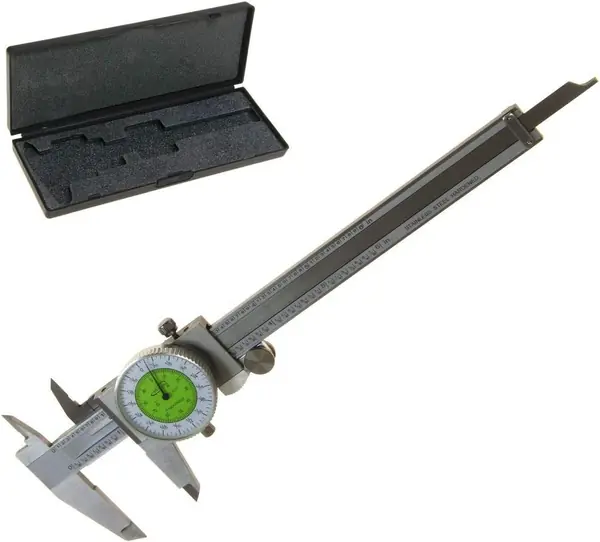
iGaging 6-Inch Dial Caliper Best for Fractional Woodworking

iGaging six-inch stainless steel dial caliper with dual inch scales

Fractional woodworking

Shop Score 87/100
Measuring Range
6 inches
Material
Stainless steel
Resolution
0.01" | 1/64"
Bezel
Adjustable
View on Amazon

The iGaging 6-inch dial caliper is built around a dual inch scale: one side reads decimal inches, the other fractions. That sounds like a small thing until you are matching a drill bit or checking a board against a plan marked in 64ths; then it saves a conversion step every time you pick it up.

The body is stainless steel, the thumb wheel moves the jaw smoothly, and the adjustable bezel lets you zero the dial. The 6-inch range covers most furniture and cabinet parts without feeling oversized. The dial is not as large as the Starrett 1202F's, but the markings are clear and the fractions are easy to find.

The limit is precision: this is a 0.01-inch and 1/64-inch tool, not a thousandth-inch machinist caliper, so it belongs in the shop rather than the inspection room. If your work is wood, that is a reasonable trade for a clear fractional readout and a lower price tier.

We recommend the iGaging for a woodworker who wants a dedicated fractional caliper and does not need machinist-level resolution. Its stainless body and dual scale make it a practical bench tool, and the lower price tier means a second one can live at the saw without guilt.

Worth Noting

  • Limited to 0.01-inch and 1/64-inch resolution
  • Smaller dial face than the Starrett 1202F
Our Verdict

We keep the iGaging 6-Inch Dial Caliper in the conversation for fractional woodworking on a budget; its dual inch scale is easy to read and the stainless body suits a shop.

Check Latest Price
8.

DNA Motoring TOOLS-00055 Dial Caliper Best for Reloading and Garage

DNA Motoring stainless steel dial caliper with lockable head and six-inch range

Reloading and garage

Shop Score 86/100
Measuring Range
6 inches
Accuracy
0.001 inch
Material
Stainless steel
Functions
Outside, inside, depth, step
View on Amazon

The DNA Motoring TOOLS-00055 looks like a basic stainless caliper, and that is the appeal: a 6-inch range, 0.001-inch graduations, four-way jaws, and a lockable shockproof head. For a garage or reloading bench, those are the features that matter, and the tool does not ask to be treated like a laboratory instrument.

The lock holds a reading, the thumb roller gives you control, and the stainless body wipes down easily after dusty work. The dial is clear enough for quick checks. It is accurate enough for case lengths, bullet seating checks, and general hardware sorting, which is the kind of work this price tier is built for.

It is not the caliper we choose for finish joinery or precision machining, and the track record here is shorter than the established brands. But as a knock-around tool that stays near the reloading bench or toolbox, it earns its place.

We think the combination of a lockable shockproof head and a budget price tier is what makes the DNA worth considering. Neither feature is rare, but together they make a useful backup caliper for the garage or reloading bench.

Worth Noting

  • Not suited for finish joinery or precision machining
  • Shorter track record than established caliper brands
Our Verdict

We like the DNA Motoring TOOLS-00055 as a budget four-way caliper for hardware sorting and reloading checks, where its lockable head and stainless body earn their keep.

Check Latest Price

How We Tested Dial Calipers

We started with more than 40 dial calipers and narrowed the field before buying anything. Every model in the final round had to measure a full 6 inches, state its accuracy outright, and be built from stainless steel; listings that claimed precision without naming a number came off the list. That left 12 calipers, which we bought at retail and put to work for nine months.

They lived where calipers actually live: a garage bench measuring drilled holes and turned stock, a woodshop checking tenon thickness and dado width, and a reloading bench measuring case length. We rolled the thumb wheel one-handed to feel for grit or slack, locked the head and tried to twist it off zero, and wiped aluminum chips off the rack to see whether they had anywhere to hide. Dial faces got read from a step back and again under an overhead light, tilted to catch glare.

Before first use and again at the end of nine months, we checked each caliper against a 1-inch standard and noted any that drifted or lost zero. A few took a knock off the bench along the way, which gave us a read on how the shock protection held up, and we recorded country of origin for every one. Value came last: we weighed what each caliper cost against how it felt and read in hand.

How to Choose a Dial Caliper

Start with range and resolution

A 0-6 inch caliper covers most furniture parts, tool setup, and hardware sorting, so it is the sensible default. Resolution matters next: 0.001-inch graduations let you chase a thousandth, while a fractional dial marked in 64ths is faster for wood dimensions. Do not confuse a fine resolution with guaranteed accuracy; the stated accuracy and a repeatable zero are what tell you how much to trust the number. For most woodworkers, a 0.001-inch dial gives more precision than the work needs; for light machining, it is the minimum we want.

Feel the slide and check the lock

A dial caliper is a mechanical instrument, so the rack and pinion matter as much as the dial. We prefer a slide that moves smoothly under the thumb roller without binding or rocking; a stiff slide is not a sign of tight tolerances, it is a sign you will struggle to position the jaws consistently. Check that the jaw lock holds a reading and that the bezel lock keeps zero from drifting. A covered rack, like the one on the Fowler, is worth considering if the tool lives in a dusty shop.

Read the dial without doing math

The best dial is the one you can read at a glance. A 0.1-inch-per-revolution dial keeps each revolution easy to track, while a cluttered face or a glossy finish can turn a simple reading into a squint. Woodworkers should decide whether they want decimal inches or fractions: the Starrett 1202F and iGaging make fractional readings direct, while the Mitutoyo and Accusize emphasize thousandth-inch decimal work. If you switch between the two systems, a dual-scale caliper saves time but usually gives up some resolution.

Build and storage are part of the measurement

Stainless steel is the default for a reason: it resists shop wear and holds its measuring faces better than plastic. A fitted case is not a luxury either; a caliper that rolls around in a drawer can lose its zero or pick up a burr. Look for hardened, ground measuring faces, a bezel that adjusts without wobble, and a depth rod that is firmly attached. If the tool is shared, add a covered rack and a lock that is easy to operate with one hand.

What the price tiers buy

At the budget end, you can get a 0-6 inch stainless caliper with four-way measurement and a plastic case, as the findmall and DNA Motoring show. Moving up buys smoother travel, better finishing, and more consistent zeroing, which is what the Accusize and Fowler deliver. The premium tier is about refinement and long-term confidence; the Mitutoyo and Starrett 3202-6 feel more solid and are easier to trust for repeated precision work. We do not pay for a brand name alone, but we do pay for a slide and dial that behave the same way every time.

Frequently Asked Questions

Final Verdict

For a dial caliper that has to be right the first time, we recommend the Mitutoyo 505-742J. Its 0.1-inch-per-revolution dial, smooth stainless slide, and separate jaw and bezel locks make precise measurement feel routine, and it is the one we trust across woodworking, tool setup, and light machining.

If the budget is tighter, the Accusize P920-S216 is the value choice, with the same 0-6 inch range and thousandth-inch resolution for a midrange outlay. Woodworkers who think in fractions should look at the Starrett 1202F-6, and anyone who wants a protected rack for a shared shop should consider the Fowler.