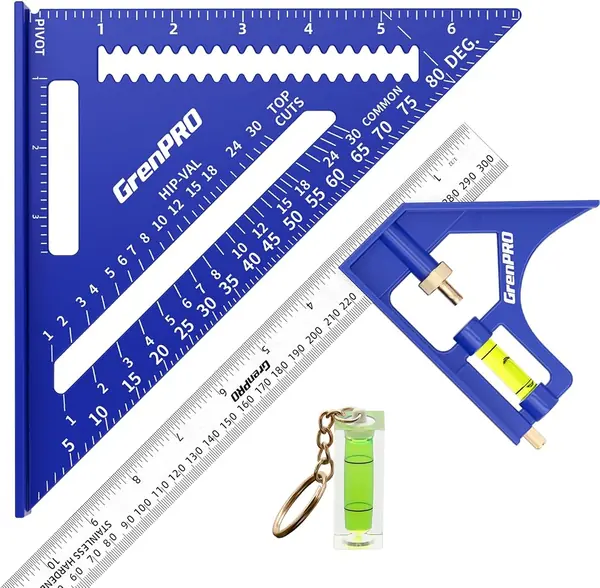
↑↓ navigate ↵ open Esc close All results →

Best Combination Squares of 2026

A combination square only needs to be off by a single degree to ruin a joint that looked clean on the workbench, leaving a drawer front noticeably crooked at assembly. Avoiding that error requires a head that arrives dead square, a locking nut that stays put, and etched graduations readable without squinting.

Running 12 combination squares through six months of layout, marking, and cutting highlighted details that spec sheets skip: how cleanly the head registers on an edge, how smoothly the lock tightens mid-mark, and whether extras like a level vial, scriber, or magnetic face actually help. A quick flip test settles any doubt—scribe a line, flip the square over, and scribe again; diverging lines expose an out-of-square tool immediately.

From 6-inch squares that slip into an apron pocket to 12-inch cast-iron bench models and matched two-piece sets, accurate layout starts with verified 90- and 45-degree references.

Our Top Picks

The Best Combination Squares

1.

Starrett 11H-12-4R Combination Square Best Overall
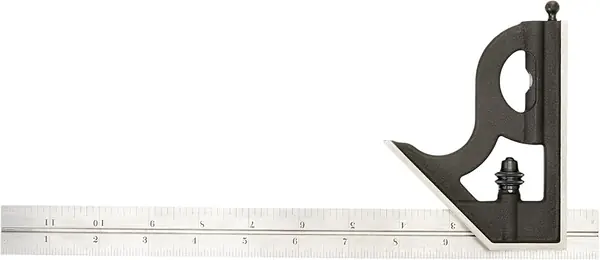
Starrett 11H-12-4R combination square with steel blade and cast-iron head

Precision furniture work

Shop Score 95/100
Head Material
Cast iron
Blade Length
12 inches
Weight
1.2 lb
Graduation Type
4R (8ths, 16ths, 32nds, 64ths)
View on Amazon

The 4R blade is the first thing we check on a premium square: 8ths, 16ths, 32nds, and 64ths give you the fine graduations for joinery layout, and the cast-iron head adds heft that makes the tool feel like a reference instrument rather than a carpenter's accessory. The satin-chrome finish wipes clean easily, and the reversible lock bolt is simple to reach with a thumb.

We keep this one for the cuts where a half-degree shows up at glue-up, and it is the square we trust for machine setup and fine furniture. The head has no play when the bolt is snug, and the blade stays where we set it through a run of marks. It is not the square we toss into a nail bag; the cast-iron head and fine graduations reward a clean bench.

A light coat of oil after humid shop sessions keeps the steel clean, which is the small maintenance a precision square asks for. The 12-inch blade is long enough for casework and still fits in a drawer. For a tool that will live on the bench, the heft is a feature, not a drawback.

Worth Noting

  • Premium price for occasional use
  • Fine 64th graduations need good light
Our Verdict

The Starrett is the one we trust for precision furniture work, with a cast-iron head and 4R blade that are the most accurate combination here.

Check Latest Price
2.

Irwin 1794469 Combination Square Best Value

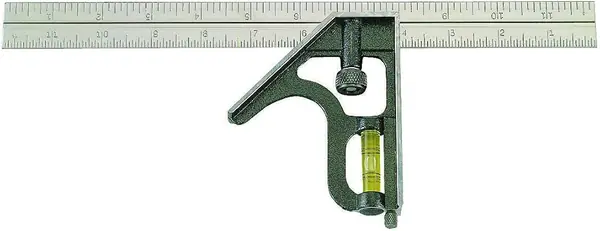
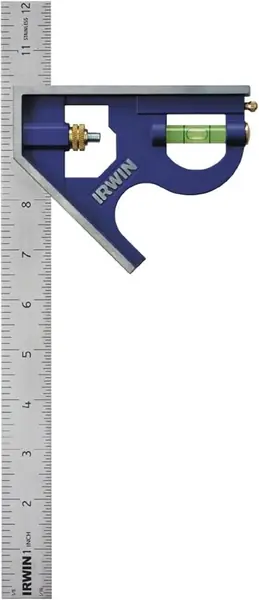
Irwin 1794469 metal combination square with blue cast zinc head and stainless blade

Everyday carpentry

Shop Score 94/100
Head Material
Cast zinc
Blade Length
12 inches
Weight
14.4 oz
Graduation Range
1/16 inch
View on Amazon

The Irwin 1794469 is the square we reach for when we're trimming out a room or marking deck joists, and its low price is why we don't baby it. It is the best value in this group for general carpentry, and it is the one we recommend first to a homeowner or trim carpenter who needs a reliable 12-inch square without premium money.

The cast zinc body has enough mass to feel steady in the hand, and the stainless blade shrugs off damp job-site air. The 1/16-inch graduations are the right level of detail for framing and trim, where a 64th is not the point. The thumb screw is the usual weak point at this price, so we set it firmly and recheck it before a run of cuts; the rest of the tool feels stout.

The Starrett is the precision choice; the Irwin is the one that lives in a job box and comes out for everyday layout. We like the built-in level for quick checks, and the scriber is handy for marking hinge locations. It is not a finish carpenter's reference square, but it does not pretend to be.

Worth Noting

  • Squareness should be checked on arrival
Our Verdict

We recommend the Irwin to anyone who needs a dependable 12-inch square for trim and deck work without paying for a precision instrument.

Check Latest Price
3.

Swanson TC130 6-Inch Combination Square Best 6-Inch

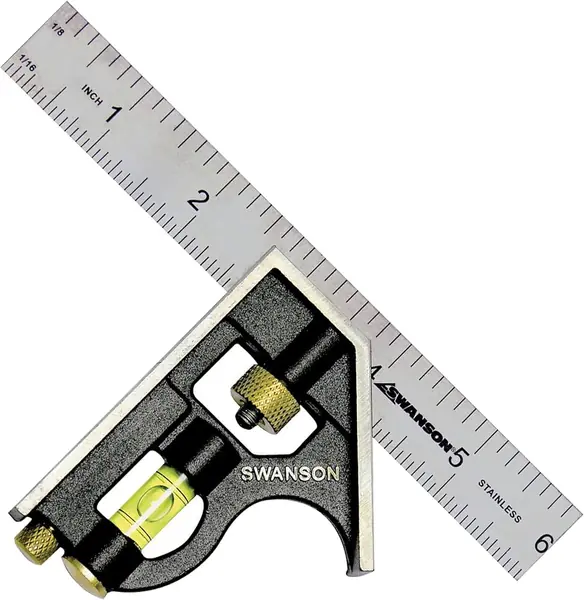
Swanson TC130 6-inch combination square with zinc head and stainless blade

Apron-pocket layout

Shop Score 92/100
Head Material
Die-cast zinc
Blade Length
6 inches
Graduations
1/8 and 1/16 inch
Vial Type
Acrylic block
View on Amazon

The 6-inch blade disappears into an apron pocket, which is why the Swanson TC130 is the square we don't leave on the bench. It still gives you a 90° and 45° face, a level, and a scriber. The die-cast zinc head is compact, and the stainless blade is marked in 1/8 and 1/16 inch.

We like it for quick marks and small joinery, and the acrylic block vial is a nice touch because it is more drop-resistant than the tube vials on cheaper squares. The brass bolt locks with little pressure, and the slide is smooth enough to adjust with one hand. It is the square we grab when we are working at the bench and do not want to clear space for a 12-inch blade.

It is not a replacement for a 12-inch square; for casework, the iGaging set or the Irwin is the better reach. But for small parts, pen turning, and checking a cut on the bench, the short blade is an advantage because it gets into places a longer square cannot. We keep it in the apron and reach for it constantly.

Worth Noting

  • Some units arrive out of square
Our Verdict

We keep the Swanson TC130 in the apron for quick marks and small joinery, as long as a 12-inch square handles the larger work.

Check Latest Price
4.

iGaging 6-Inch and 12-Inch Combination Square Set Best Set

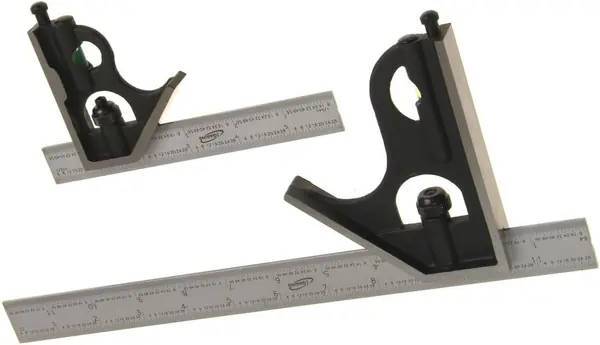
iGaging 6-inch and 12-inch combination square set with steel blades and storage case

Precision budget set

Shop Score 91/100
Included
Fitted case with foam insert
Blade Material
Hardened steel
Graduation Type
4R (8ths, 16ths, 32nds, 64ths)
Blade Lengths
6 and 12 inches
View on Amazon

Two blades and a fitted case are what make the iGaging set a set rather than a single square. You get a 6-inch and a 12-inch 4R square in that case, both with hardened satin-chrome blades and cast-iron heads. The 4R graduations go to 64ths, which is more detail than most home projects need but welcome for joinery.

The heads are machined well, and the blades have little wiggle in the frame compared with budget squares. The case is a real advantage: it keeps the pair together in a drawer and protects the edges from getting knocked around. The 6-inch square is small enough for an apron pocket, while the 12-inch handles casework and shelving.

We see this as the sweet spot between a hardware-store square and a Starrett. It gives you fine graduations, two sizes, and a fitted case for a midrange price, which is why it earns a place for a serious home shop. We do not treat it as a substitute for a calibrated reference, but for woodworking it is precise enough.

The case also gives you a place to keep the scriber and level from wandering off. For a two-square kit that stays together, this is the one we pick.

Worth Noting

  • Locking screw can loosen in use
Our Verdict

We choose the iGaging set when we want two precision 4R squares and a fitted case without stepping up to Starrett money.

Check Latest Price
5.

Johnson 400EM-S Combination Square Best Inch/Metric

Johnson 400EM-S 12-inch metal combination square with black cast zinc head

Inch and metric

Shop Score 90/100
Head Material
Cast zinc
Blade Length
12 inches
Graduations
1/8, 1/16, 1/32 inch and metric
Blade Material
Stainless steel
View on Amazon

The Johnson 400EM-S pairs an inch/metric blade with an auto-lock head, which is why it is the square we pick when a project mixes inches and millimeters. One side carries 1/8, 1/16, and 1/32 inch marks; the other carries metric. That dual scale is the reason it earns a spot; for drawer slides and European hardware, we don't have to convert in our head.

The stainless blade has permanently etched graduations, so they will not wear off with use. The cast zinc head is CNC machined, and the auto-lock blade assembly is easy to set with one hand. The built-in level and screw-in scriber cover the usual combination-square jobs, and the whole tool has a solid feel for the money.

For general carpentry and mixed-unit shop work, it is a lot of square for the price. The Starrett is the precision reference, and the Irwin is the simpler everyday choice, but neither gives you both inch and metric marks on one blade. The 12-inch blade is long enough for cabinet layout and short enough to keep in a drawer. We keep the Johnson in the drawer for hardware installation and cabinet work.

Worth Noting

  • Locking mechanism can fail under hard use
Our Verdict

We pick the Johnson 400EM-S for mixed inch and metric work, with a dual-scale blade and an auto-lock head that sets quickly.

Check Latest Price
6.

Arrow 6-Inch Combination Square Best Small Dual-Scale

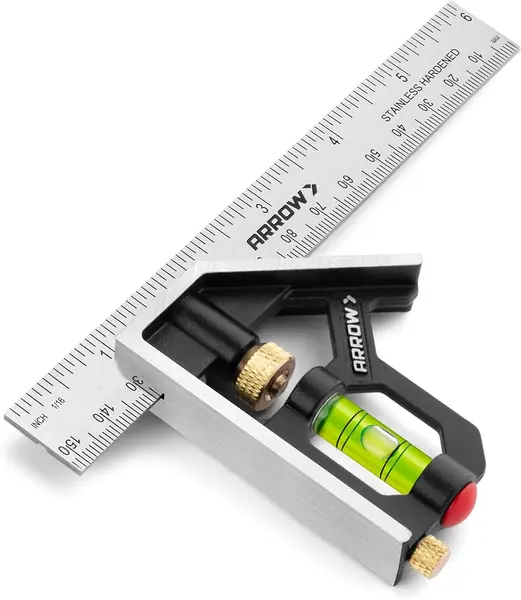
Arrow 6-inch combination square with black zinc alloy handle and stainless ruler

Small dual-scale work

Shop Score 89/100
Head Material
Zinc alloy
Blade Length
6 inches
Graduations
1/16 and 1/32 inch, SAE and metric
Included
Bubble level and scriber
View on Amazon

The 1/32-inch graduations are what make the Arrow 6-inch square more than a stocking stuffer. Most small squares stop at 16ths; this one gives you finer marks in both SAE and metric, which is useful when you are working on small parts and need a closer read.

The zinc alloy handle has a textured edge that gives your thumb something to push against, and the brass screw moves smoothly along the stainless blade. The copper draw pin at the bottom is a small detail that keeps the head secure. The bubble level is small but readable, and the scriber is handy for marking.

We like it for small parts, pen turning, and checking a cut on the bench; it is accurate enough for that work at a budget price. The dual scale and fine graduations make it a useful second square, and the low price means we don't mind it living in a drawer. For a small square, the fit and finish are better than we expected, and the thumb screw has a smooth action.

Worth Noting

  • Small size limits long layout
Our Verdict

We like the Arrow for detail work, where its fine 1/32-inch marks and dual scale make a small square more useful.

Check Latest Price
7.

Klein 935CSEL Combination Square

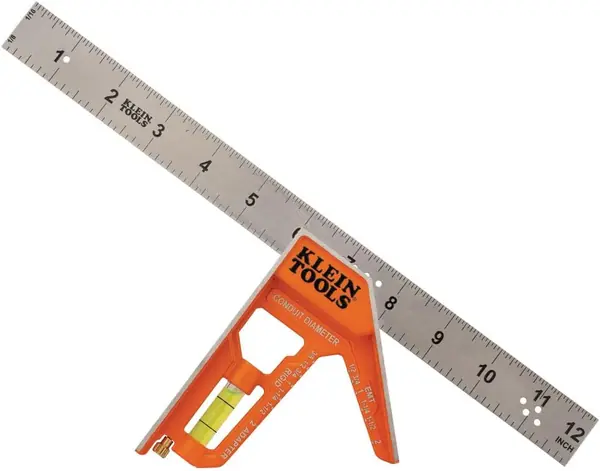
Klein 935CSEL electrician's combination square with orange aluminum body and stainless ruler

Electrical layout

Shop Score 88/100
Head Material
Aluminum
Blade Length
12 inches
Graduations
1/8 and 1/16 inch
Special Feature
Magnetic quick adjust and conduit template
View on Amazon

The magnetic head is the conversation starter on the Klein 935CSEL. There is no thumbscrew; rare-earth magnets hold the stainless blade to the aluminum body, and you slide it to the mark. The body has precision-machined 45° and 90° edges, and the double-sided ruler is marked in 1/8 and 1/16 inch.

The electrician-specific features are the reason to buy it: an etched conduit layout template on the blade, a panel schedule, and a bubble level. The magnetic hold makes it quick to remove the blade and use it as a straightedge, and the whole tool feels light in a pouch.

This is a specialist square, not a woodworking reference. The conduit template and panel schedule are genuinely useful on an electrical layout, and the magnetic adjustment is faster than a thumbscrew when you are setting boxes. It is not the square we reach for at the bench, but it is the one we want in an electrician's bag.

We don't make it our only square, but for an electrician's pouch it earns its place. The etched template turns a measurement into a mark in one step, which is the kind of shortcut a job site rewards.

Worth Noting

  • Magnetic hold can shift under pressure
Our Verdict

For electrical layout, the Klein 935CSEL is the square we reach for, with magnetic adjustment and an etched conduit template.

Check Latest Price
8.

GrenPRO Combination Square Set

GrenPRO combination square set with blue 12-inch square and 7-inch rafter square

Budget two-piece set

Shop Score 87/100
Head Material
Aluminum zinc alloy
Included
Scriber and bubble level
Blade Material
Stainless steel
Set Contents
7-inch rafter square and 12-inch combination square
View on Amazon

The extra 7-inch rafter square is what makes the GrenPRO set worth a look. You get that plus a 12-inch combination square, both in aluminum zinc alloy, with a scriber and a bubble level. The 12-inch square has a stainless blade and dual metric and inch markings, and the 7-inch rafter square covers quick angle checks.

The 12-inch combo does the layout work; the 7-inch rafter square is handy for quick angle checks and as a second straightedge. The textured edge and locking mechanism hold the blade steady for marking, and the blue finish makes the pair easy to spot in a toolbox.

The metal bodies feel solid for the price, and the included scriber and level mean you can start laying out without hunting for extras. The set is aimed at beginners and home gamers who want two useful squares without spending much. It is not a precision instrument, but it covers the basics.

We like it as a budget set for a beginner or a second kit. The pair works for rough layout and general carpentry, and the extra rafter square gives you a second tool in the same box. For a first set, it is a sensible place to start.

Worth Noting

  • Rough finish on ruler edges
Our Verdict

We see the GrenPRO set as a sensible budget start for a beginner who wants a 12-inch combination square and a 7-inch rafter square.

Check Latest Price

How We Tested Combination Squares

We started by pulling every combination square we could find that listed a graduation type and a head material, then filtered by blade length, head weight, and price so the shortlist covered 6-inch pocket squares, 12-inch bench squares, two-piece sets, and dual-scale blades. We bought 12 of them and used each one for six months, in a home shop during the week and on weekend job-site work.

Out of the box, each square got the line test: scribed against a known straight edge, head flipped, scribed again, with the gap between the two lines measured. We checked the 45-degree face the same way on miter cuts, then marked and cut joints to see whether the head drifted. The lock was opened and set hundreds of times — one-handed, with gloves on, mid-cut — and we noted any slip, wobble, or burr on the screw. We read graduations in dim garage light and direct sun, at 16ths and 32nds, and on the dual-scale blades in both inch and metric.

Durability came from real handling rather than a bench: squares rode loose in tool bags, slid off the bench onto concrete, and were rechecked for squareness afterward. We weighed each one and noted how a heavy cast-iron head sat steadier on vertical work but pulled at an apron pocket. Levels were compared against a machined bench level, scribers were dragged across hardwood and drywall, and magnetic heads were tested holding on steel studs and conduit. At the end we tallied what came in the box — case, scriber, level, spare blade — against what each one cost, since value here is usually about the kit, not the head alone.

How to Choose a Combination Square

Start with squareness and a lock you trust

Squareness is the whole job. A combo square that is a degree off will mark a joint that fits badly, no matter how nice the head looks. Check the 90° face against a known straightedge and flip the square over to see if the error doubles; then check the 45° face the same way. The lock matters just as much: a thumb screw that creeps turns a layout tool into a guess.

At the top of this group, the Starrett's cast-iron head and reversible lock bolt are the reference standard. The Irwin is the value pick for everyday carpentry, though it is worth checking on arrival. If you want a set that splits the difference, the iGaging pair gives you two sizes and a fitted case.

Match the blade length to the work

A 6-inch square lives in an apron pocket and gets into small assemblies; a 12-inch square is the general-purpose size for cabinets, trim, and shelving; a 16-inch blade gives you more reach for framing and large casework. The mistake is buying a 6-inch square as your only square, then trying to lay out a cabinet side with it.

The Swanson TC130 is the pocket pick here, and the Arrow 6-inch adds finer 1/32-inch marks and metric. For a first square, start with a 12-inch and add a 6-inch later. If you frame often, a 16-inch blade is worth the extra reach.

Read the graduations before you buy

Most combination squares mark 1/8 and 1/16 inch; some add 1/32 or 1/64, and a few add metric. Finer graduations help with joinery and hardware, but they also demand good light and a steady eye. If you mostly frame and trim, 1/16 is enough; if you build furniture or install European hardware, 1/32 or 64ths earn their keep.

The Johnson 400EM-S is the pick for mixed inch/metric work, while the Starrett's 4R blade goes down to 64ths. The Arrow is a small square with 1/32 marks in both SAE and metric, which is unusual at its price. Buy the coarsest scale that covers your work, not the finest one you can find.

Decide how much square you need

Cast iron gives you heft and stability; die-cast zinc is lighter and cheaper; aluminum is lighter still and can be strong enough for job-site use. A built-in level and scriber are handy, but they are secondary to a head that locks and faces that are square. Sets can be a good value if you want more than one size, but only if the individual squares are worth carrying.

The Starrett is the precision instrument, the iGaging set is the midrange two-square kit, and the Klein is a specialist for electrical layout. If you only need one square for general carpentry, the Irwin is the practical default. If you need two sizes and a case, the iGaging set is the better buy.

Frequently Asked Questions

Final Verdict

We recommend the Starrett 11H-12-4R for anyone who wants one square they can trust for fine furniture, joinery, and machine setup. Its cast-iron head and 4R blade are the most precise combination here, and the reversible lock bolt keeps the setting through a run of marks.

If you want a square for general carpentry and do not need 64ths, the Irwin is the better buy; it is the one we reach for on trim and deck work. For a two-size kit, the iGaging set is the midrange alternative. Start with the work you do most, then buy the square that matches it.