↑↓ navigate ↵ open Esc close All results →

Best 12-Inch Speed Squares of 2026

A speed square that sits off by even a single degree spoils an entire stack of rafters before the error shows up at the ridge. Before price or etched scales come into play, the 90- and 45-degree edges have to be genuinely true straight out of the package.

Working 14 squares—from structural foam and molded polymer to heavy die-cast aluminum—through a deck rebuild, a framed shed, and long runs of stair stringers over four months clarified where the extra length pays off. On 2x10s and 2x12s, a 12-inch body bridges the full stock without sighting across a gap the way a 7-inch square forces, though heavy cast metal starts pulling on a tool belt by mid-afternoon.

Every model selected kept its squareness and arm's-length readability after a full season, spanning standalone 12-inch framing squares and 7- and 12-inch combination sets.

Our Top Picks

The Best 12-Inch Speed Squares

1.

Swanson SW1201K Value Pack Best Overall
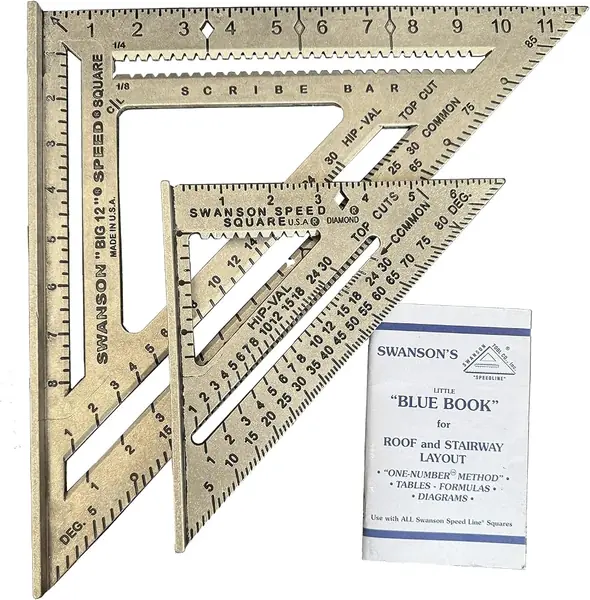
Swanson SW1201K pack with a 7-inch speed square and a 12-inch Big 12 die-cast aluminum square

Framing and rafters

Shop Score 96/100
Material
Die-cast aluminum alloy
Sizes Included
7 in. and 12 in.
Graduation Range
1/4 inch
Made In
USA
View on Amazon

Two squares arrive in the pack, and the bigger one is the full Big 12 rather than a cut-down version: common, hip, valley and jack rafter tables, stair layout scales, and a 12-inch blade that crosses a 2x12 in one pass. That combination is the reason we recommend it before any single square here. On a shed frame or a set of porch steps the 12-inch does the layout while the 7-inch stays in your apron for quick marks.

Both are die-cast from heavy-gauge aluminum alloy, and the difference shows up a few months into a tool bag: the recessed black markings do not wear away the way printed scales do, and the thickness keeps the edge from deflecting under a pencil. We also use the 12-inch as a saw guide for crosscuts on framing stock, where the lip catches the board and the saw shoe rides the blade.

The catch is the rafter table itself. It is dense, and the One-Number method takes an afternoon with a scrap 2x4 before the numbers mean anything. If you mostly cut 90s and 45s on decking, you will use about a third of what is stamped on the tool — not a reason to skip it, since the third you use is the third you need.

Worth Noting

  • No layout bar in the box
Our Verdict

We point first-time framers here: you get a true die-cast Big 12 with the rafter and stair scales plus a 7-inch square, for about what one aluminum square costs.

Check Latest Price
2.

Swanson Big 12 Speedlite Best for Siding and Trim

Swanson Big 12 Speedlite square in hi-viz orange composite with a 12-inch blade

Siding and trim

Shop Score 94/100
Material
High-impact structural foam
Blade Length
12 in.
Color
Hi-Viz orange
Weight
10.6 oz
View on Amazon

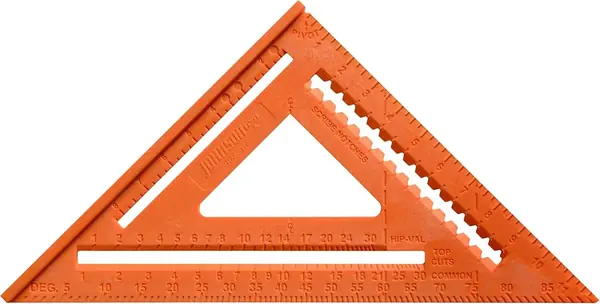
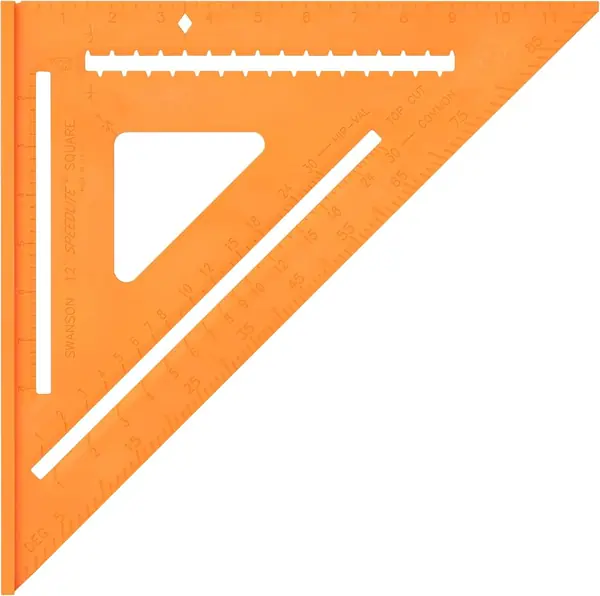
Aluminum is the right material for most framing, but it leaves a gray streak across prefinished siding and painted trim. The Speedlite is the same 12-inch triangle in high-impact structural foam, and that is the whole idea: slide it along a course of vinyl or a painted fascia board and it glides instead of gouging.

We keep it in the siding pouch rather than the framing bag. The diamond cutout knocks out a 3-1/2 inch stud-width seat cut in one motion, which saves a pencil step on every birdsmouth, and the hi-viz orange body is easy to spot on a deck buried in material.

Composite does not hold a machined edge the way a die-cast blade does, so we treat this as the second square in the kit and pick up aluminum when a frame has to be dead square — that division of labor is exactly what it is for. It also costs less than any aluminum square here, which makes adding it to a bag an easy call.

Worth Noting

  • Composite body lacks a machined metal edge
Our Verdict

For siding, trim and anything with a factory finish, we reach for this one: the composite body will not scuff what you are working on, and it weighs 10.6 ounces.

Check Latest Price
3.

Klein Tools 80211 Rafter Square Set Best for Working Carpenters

Klein Tools 80211 two-piece carpenter square set in orange metal, 7 and 12 inch

Daily professional use

Shop Score 93/100
Sizes Included
7 in. and 12 in.
Markings
Double laser-etched
Heel Edge
1-1/8 inch
Scribe Notches
1/4 inch
View on Amazon

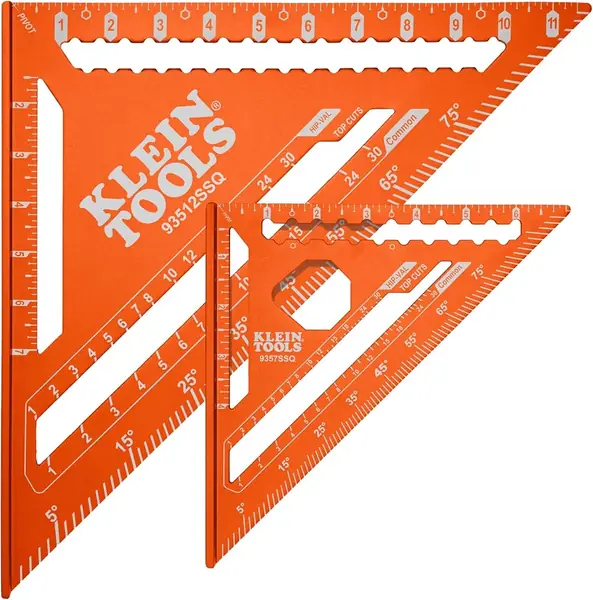
Double laser-etched markings are the flashiest thing about the Klein set, and they earn it the first time you lay out a cut in full sun, where printed scales wash out and these stay black and legible. The heel is the quieter advantage. At 1-1/8 inches deep it sits flat and wide against the stock, so the square holds its own line while you mark instead of tipping off the edge.

Both squares are metal, both carry 1/4-inch scribe notches that swallow a carpenter pencil, and the scales repeat on both faces. The 7-inch adds a pipe prop, which sounds like a gimmick until you are measuring conduit on a ladder and need a third hand.

What we like most is how little the pair asks of you. There is no learning curve, no fragile scale to protect, and nothing that needs its own case. If you build for a living, this is the set that survives being thrown in a truck; for a deck twice a decade, the Swanson pack covers the same ground with scales that read just as well.

Worth Noting

  • Highest-priced square set in this group
Our Verdict

A pair we recommend to anyone who uses a square every working day: the laser-etched markings stay readable in direct sun and the wide heel sits flat.

Check Latest Price
4.

Johnson Structo-Cast Rafter Square Best for the Tool Belt

Johnson Structo-Cast 12-inch carpenter square in bright orange molded plastic

Tool belt carry

Shop Score 92/100
Material
Structo-Cast molded plastic
Blade Length
12 in.
Weight
4.8 oz
Graduations
Permanent molded
View on Amazon

Four and eight-tenths ounces is light enough that the Johnson rides in a nail bag all day without dragging the strap down, and the fluorescent orange frame is easy to find when it lands in a pile of offcuts.

Light does not mean flimsy. The one-piece Structo-Cast frame takes a beating without the corners deforming, and the graduations are molded into the plastic rather than printed on top, so they are still there after a season of sliding across concrete. We keep coming back to it for stair stringers: the integrated distance and angle scales mark the cut lines in one pass, and the built-in markers for 1-1/2, 3 and 3-1/2 inch dimensions handle 2x4 layout without a tape.

Legibility in poor light is the trade-off. Molded plastic numbers are not as sharp as laser etching, and under a work light at dusk you will lean in closer than you would with the Klein set. Read it in daylight, or mark off the scale you can see and carry on.

Worth Noting

  • Molded plastic markings are harder to read in dim light
Our Verdict

The square we tuck into a tool belt: at 4.8 ounces it nearly disappears, and the stair layout scales are molded in permanently.

Check Latest Price
5.

Beslands Aluminum 12-Inch Rafter Square Best for Fine Layout Work

Beslands 12-inch aluminum carpenter square in black with laser-etched graduations

Fine layout work

Shop Score 91/100
Material
Aluminum alloy
Blade Length
12 in.
Graduation Range
1/8 inch
Protractor Scale
0-90 degrees
View on Amazon

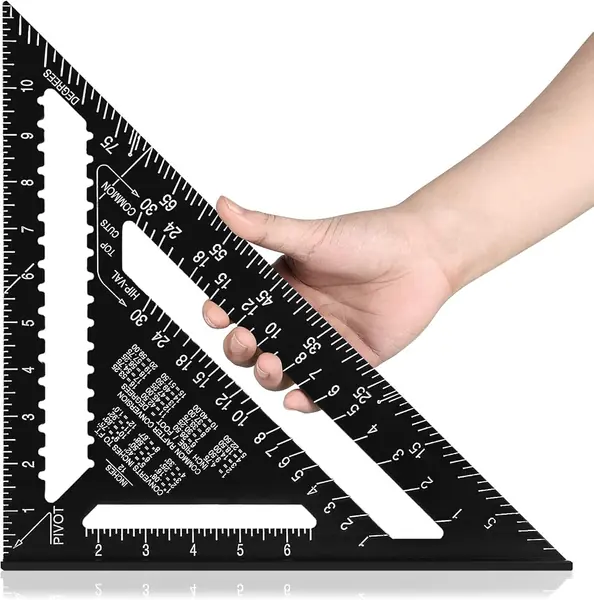
Graduations here run to 1/8 inch, half the interval of the scribe notches on most squares in this group, and the 17-inch hypotenuse lets the tool span wider stock than a plain 12-inch triangle. Laying out shelf pins, stair treads or a rafter with a pitch to hit, the finer scale saves you a step.

The body is aluminum alloy with laser-etched markings that do not wear off, a 0-90 degree protractor scale along the edge, and a conversion table printed on the back for switching between pitch and degrees. We like the lipped edge as a saw guide for short crosscuts: it registers on the board and gives the saw shoe something to ride.

Squareness is the thing to settle before the first cut. Any new square gets the flip test in our shop — mark a line, flip the tool over, and see whether the two lines coincide — and this one is worth checking because the edges are machined rather than hand-finished. Pass the test and it is a lot of layout tool for its price tier; fail it and send it back.

Worth Noting

  • Imperial markings only with no metric scale
Our Verdict

Finer layout is where this one earns its keep: a 1/8-inch scale and a 0-90 degree protractor, provided you check squareness before the first cut.

Check Latest Price
6.

ALLWIN 7-Inch and 12-Inch Rafter Square Set

ALLWIN two-piece carpenter square set in silver aluminum, 7 and 12 inch

Two-square starter kit

Shop Score 89/100
Material
Die-cast aluminum alloy
Sizes Included
7 in. and 12 in.
Color
Silver
Markings
Double-sided engraved
View on Amazon

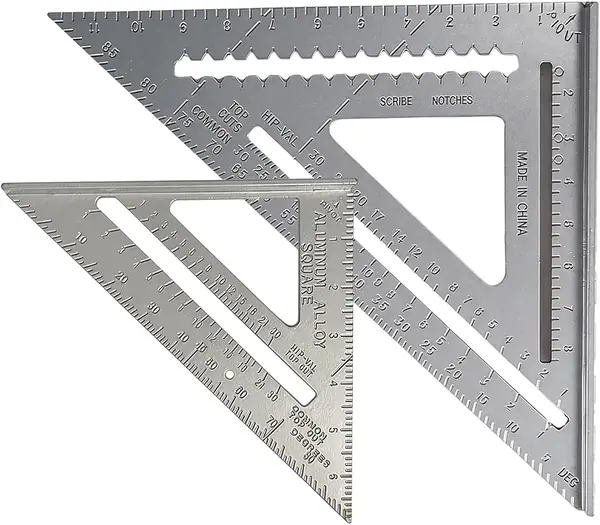
The 12-inch stays parked on the board for full-sheet layout while the 7-inch handles crosscuts at the miter saw, and that split is the honest argument for buying a pair instead of one square. At its price tier, this is the set we hand to someone who wants aluminum without stepping up to Klein.

Both squares are die-cast aluminum with frost-white engravings on both faces, so a scale reads whichever way up the square lands, and the corners are rounded and polished rather than left sharp. There is a hanging hole at the heel, which matters more in a small shop than it sounds.

We have not put this pair through a full framing season, so long-term edge holding is the open question. What we can say is that layout marks come out clean and repeatable, the scales have not dulled in a shop bag, and the light weight makes it the set that actually leaves the bench.

Worth Noting

  • Blade stock thinner than premium squares
Our Verdict

Both sizes in one buy: this aluminum pair handles full-sheet layout and quick crosscuts for less than the pro-grade sets here.

Check Latest Price

How We Tested the Best 12-Inch Speed Squares

We started with every 12-inch square we could find from the brands carpenters actually recommend, then filtered by blade material, marking method, and whether the tool came alone or as a 7- and 12-inch set. That narrowed the field to 14 squares, running from molded plastic and structural foam to die-cast aluminum. We bought them at retail like anyone else.

Every square got the same first test before it touched a saw. We butted the heel against a machined straightedge, scribed a line along the blade, flipped the square over, and scribed the same line again; any gap between the two lines is double the error. A sliver of light under the blade told the same story. Two squares never made it past this step.

The rest went into a four-month rotation: a deck rebuild, a shed framed from the sill up, stair stringers, and an afternoon of siding a garage. We laid out rafters on 2x10s and 2x12s to see whether the 12-inch blade actually reached across the stock, checked how deep each heel sat against the edge of the board, and carried every square in a tool belt for a full day to find out which ones we forgot we were wearing.

We marked with pencil and fine-tip pen on every scale to judge whether the graduations held up at arm's length, cut scribe lines in trim stock to test the notches, and dropped each square onto concrete from waist height three times, rechecking squareness after every fall. Value came last: we weighed what each one cost against how it survived and how often we reached for it.

How to Choose a 12-Inch Speed Square

Check squareness before anything else

Every claim on the package is worth less than one test: mark a line along the blade, flip the square over, and mark the same line from the other side. If the two lines coincide, the tool is square; if they split, you are holding a triangle that will fight you on every cut. We run that check on any square that arrives machined rather than hand-checked, and we run it while the return window is still open.

Nothing else compensates for an out-of-square blade — not etched markings, not a fine scale, not a brand name.

Aluminum, composite or molded plastic

Aluminum is the default for framing. It holds an edge, doubles as a saw guide, and shrugs off being dropped on a driveway. It also leaves a gray scuff on prefinished siding and painted trim, which is where composite earns its keep: the Swanson Speedlite weighs 10.6 ounces and slides along a finished face without marking it.

Molded plastic is the lightest and least expensive route — the Johnson square is 4.8 ounces with graduations molded in permanently — though the numbers are not as crisp as etched metal. Buy aluminum for the frame, composite for the finish.

Etched, recessed or printed markings

Etched and deeply recessed markings survive a tool bag; printed scales wipe away with solvent and wear thin at the edges. Outdoors, white-filled engraving against a dark body reads more clearly than black on bare metal, one reason the Klein set holds up in direct sun. Then look at the interval. Most squares here notch every 1/4 inch, while the Beslands graduates to 1/8 inch, which is finer than a framing pencil can hold. Match the interval to the work; neither is more accurate, one is simply finer.

What a 12-inch blade actually covers

A 12-inch square crosses a 2x12 and reaches the far side of sheet goods laid out on the floor, which a 7-inch square cannot do. The diagonal runs longer still: the Beslands measures 17 inches on the hypotenuse, enough to span wider stock for angled marks. On a 12-inch rafter square you also get rafter and stair tables along the body. If your work is 2x4 framing and trim, the small square does most of it and the 12-inch comes out for layout day.

One square or a set

Sets are usually the better buy. The Swanson pack and the Klein set both put a 12-inch and a 7-inch square in your hands, and having two means one can be set to a miter while the other stays registered on the board. We treat a pair as the default and buy a single only when a specific material calls for it — composite for siding, a spare plastic square for rough concrete work. If you already own a 7-inch, buy the 12-inch on its own.

Frequently Asked Questions

Final Verdict

The Swanson SW1201K is the one we point most people to. You get the 12-inch Big 12 — rafter tables, stair scales, die-cast aluminum — plus a 7-inch square that handles trim and quick marks, and the pair costs about what a single aluminum square does here. It is the most useful thing you can put in a tool bag for the money.

If a square is a tool you use every working day and you want markings that stay black in full sun, the Klein 80211 set is worth the step up. For siding and painted trim, buy the composite Speedlite and keep aluminum off the finish.