↑↓ navigate ↵ open Esc close All results →

Best Speed Squares of 2026

Every mark off a speed square assumes the heel and body sit at a dead-true 90 degrees. When a casting arrives slightly out of square or bends after a tumble off a sawhorse, that single degree of error multiplies across every rafter tail, stair stringer, and crosscut on the build.

Six months of marking rafters, stair stringers, and siding with 14 aluminum and composite squares — plus dropping each onto concrete to check durability — showed what actually helps on a job. Packed scale graduations mean little if low contrast hides the scribe marks in a dim garage at dusk, and a heavy plate left in the truck loses out to a balanced square light enough to ride in a belt pouch.

Heavy-duty framing squares, lighter composites for siding, and paired two-size sets for finish layout serve different trades, provided every edge checks true straight out of the packaging.

Our Top Picks

The Best Speed Squares

1.

Swanson Speed Square S0101 Best Overall
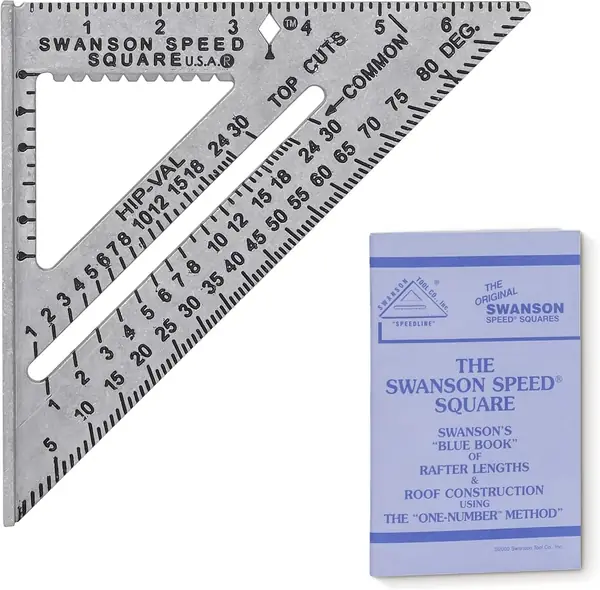
Blue aluminum Swanson Speed Square S0101 with black markings and Blue Book

All-around carpentry

Shop Score 97/100
Material
Heavy-gauge die-cast aluminum
Size
7 in.
Graduations
1/8 in.
Includes
Blue Book guide
View on Amazon

The original Speed Square is still the one we reach for first. The S0101 combines 45° and 90° edges, a 7/8-inch heel, and a 1/4-inch scribe bar in one 8-ounce aluminum body, and it comes with the Blue Book that explains rafter tables and common roof pitches. That package is why it is our top pick: it covers everyday framing and trim layout without asking you to learn a new tool.

The die-cast aluminum has a reassuring density in the hand. We like the matte finish on bright days because it keeps glare off the scale, and the heavy-gauge body stays put when we set it against a board and reach for a pencil. At 8 ounces it is not the lightest square here, but it is light enough to leave in a pouch and sturdy enough that it does not feel fussy on a job site.

The 7-inch size is the practical middle ground: long enough to mark across a 2x6 and short enough to keep in a belt. We found the 7/8-inch heel positive against sawn edges, and the scribe bar useful for pulling parallel lines without hunting for a tape. The Blue Book is a genuine bonus for roof and stair layout, especially if you only cut rafters occasionally. For framing, decks, and general shop layout, this is the square we hand to someone who wants one reliable tool.

Worth Noting

  • Only 1/8-inch graduations for fine cabinet layout
Our Verdict

For most woodworkers, the S0101 is the speed square we tell them to buy first: 7 inches of aluminum, a trusted corner, and a Blue Book for rafter layout.

Check Latest Price
2.

Irwin 1794463 Rafter Square Best Readability

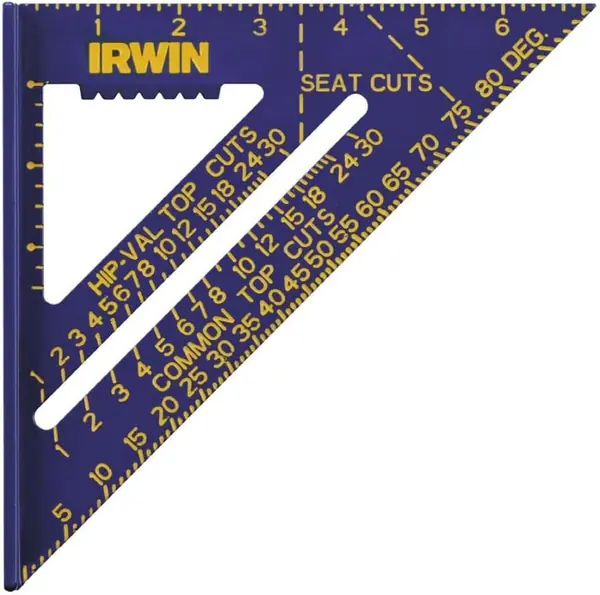
Blue aluminum Irwin 1794463 rafter square with high-contrast white markings

Low-light layout

Shop Score 96/100
Material
Aluminum
Size
7 in.
Graduations
1/16 in.
Markings
Permanent deep markings
View on Amazon

In a dim garage, the white-on-blue scale of the Irwin 1794463 is the easiest to pick out of this group. The contrast does more than look sharp: it lets you read the graduations from a standing position and find the 45° scale without tilting the square toward a light.

That readability earns it a runner-up spot for trim work and low-light shops. We also appreciate the 1/16-inch graduations, which are finer than the 1/8-inch scales on several squares here, and the markings are deep rather than surface-printed, which we prefer for wear. The aluminum body has a solid, no-nonsense feel, and the 7-inch size handles common 2x stock without crowding a tool belt.

Where it gives ground is reach: this is a single 7-inch square, so it will not span a wide stair stringer the way the Klein set can. If your work is mostly marking 90° and 45° cuts on dimensional lumber, that trade-off is easy to accept. We reach for it when the light is poor and the layout needs to be quick.

Worth Noting

  • Seven-inch size cannot span wide stair stringers
Our Verdict

We reach for the Irwin when the light is poor, because the high-contrast scale and fine graduations are easier to read at arm's length.

Check Latest Price
3.

DeWalt DWHT46031 Quick Square Best for Framing

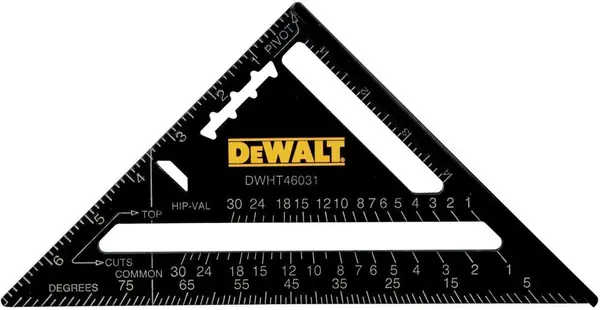
DeWalt DWHT46031 aluminum quick square with black and white markings

Jobsite framing

Shop Score 95/100
Material
Extra-thick extruded aluminum
Graduations
1/8 in.
Weight
4.59 oz
Width
7.3 in.
View on Amazon

The DWHT46031 makes its case the moment you pick it up. The extra-thick extruded aluminum body has a stiffer feel than the lighter squares in this group, and the 4.59-ounce weight is low enough that we forgot it was in a pouch between cuts.

We like that stiffness for saw guidance: a square that flexes under hand pressure is a square that lets the cut wander. The black-and-white markings are sharp and easy to read, and the 1/8-inch graduations are familiar if you came up on a standard framing square. The body is not as refined as the Swanson's matte finish, but it feels built for a tool bucket rather than a display shelf.

This is the pick for someone who wants a tough aluminum square and does not need a level vial or a second size. It will mark and guide the common cuts, then go back in the bag without complaint. For finish carpentry measured to 1/16 inch, the finer scales on the Irwin and Klein set are a better match.

Worth Noting

  • Coarser 1/8-inch graduations lack 1/16-inch finish marks
  • Includes one square without a level vial
Our Verdict

Our pick for straightforward framing pairs extra-thick aluminum with a light 4.59-ounce body, so it feels stiff without weighing down a belt.

Check Latest Price
4.

Johnson MACH-1 Rafter Square Best Feature-Packed

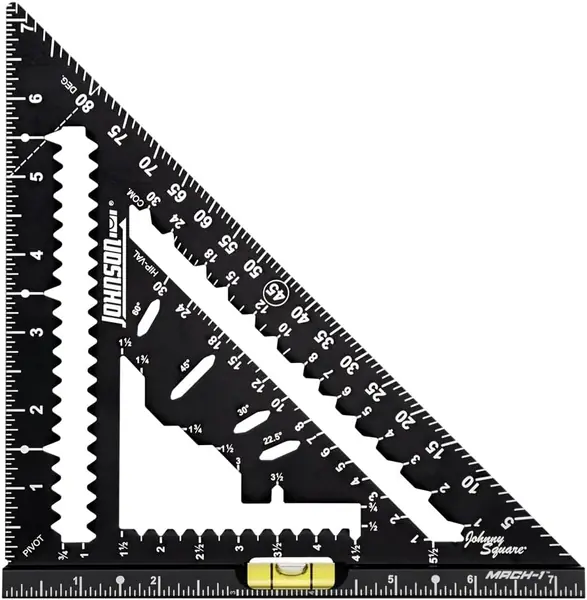
Black aluminum Johnson MACH-1 rafter square with built-in level vial

Complex angle layout

Shop Score 94/100
Material
Aluminum
Size
7-1/4 in.
Level Vial
Built-in with 320° visibility
Angle Slots
22.5°, 30°, 45° and 60°
View on Amazon

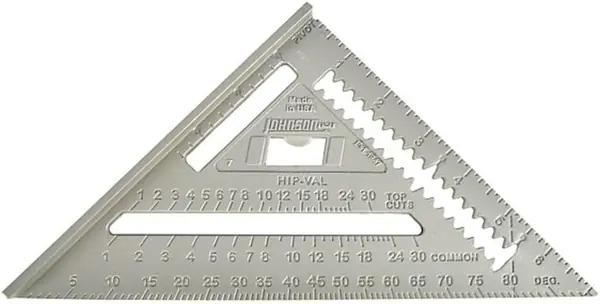
A level vial on a speed square sounds like a feature you will never use until you are setting a short run or checking a stair stringer without a torpedo level in reach. The MACH-1 puts one in the body with 320° of visibility, and we found it the kind of convenience that keeps the square in your hand instead of sending you back to the toolbox.

The feature density is the real story. The 1-inch heel stays seated on split or irregular stock, the Smart Mark cutouts handle common stud and joist dimensions, and the slots mark 22.5°, 30°, 45°, and 60° cuts. We also like the 7-1/4-inch size for a little extra reach, and the scale is legible once you learn the layout.

This is a premium square for someone who lays out roofs, stairs, and angles regularly and wants the reference marks built in. On those jobs, the extra scale earns its keep.

Worth Noting

  • Busy scale takes practice to read quickly
Our Verdict

This is the one we choose when you want a level vial and angle slots built into the square for stairs and roof layout.

Check Latest Price
5.

Klein 80211 Rafter Square Set Best Two-Size Set

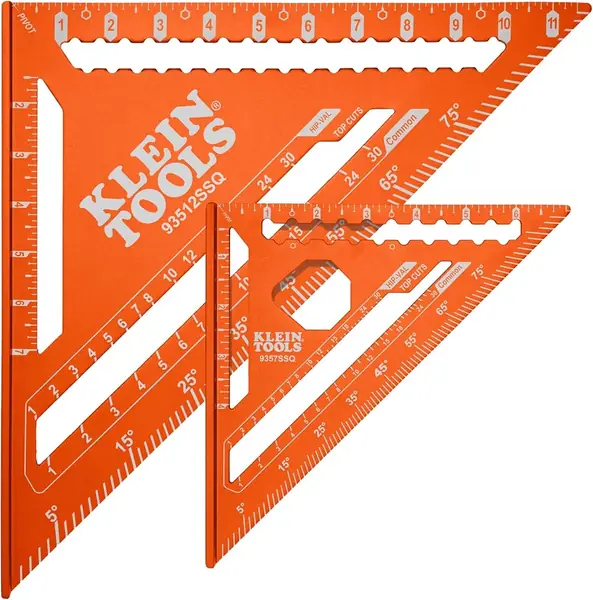
Orange two-piece Klein 80211 rafter square set with 7- and 12-inch squares

Two-size finish work

Shop Score 93/100
Material
Metal
Size
7 and 12 in.
Markings
Double laser-etched
Scribe Notches
1/4 in.
View on Amazon

The 12-inch half of the Klein 80211 set is the reason to buy it. It spans wider stock than a 7-inch square and gives you a longer straightedge for marking stair stringers, while the 7-inch partner handles common 2x cuts and fits a pouch.

Laser-etched markings on both faces are a practical upgrade: they stay legible in sunlight and resist the wear that turns painted numbers into guesswork. The 1/4-inch scribe notches are handy for evenly spaced pencil marks, and the 1-1/8-inch heel gives the small square a stable seat on the edge of a board. We also like the orange color, which makes the pair easy to find in a pile of tools.

The set makes sense for finish carpenters and anyone who regularly moves between 2x framing and wider trim. Having both sizes within reach is worth more than a single square with a longer scale.

We like the Klein set for the carpenter who moves between framing and trim, because the two squares solve two different reach problems without compromise. It is the set we grab when the work changes from studs to stringers.

Worth Noting

  • Overkill for buyers who never need 12-inch reach
Our Verdict

We like the Klein set for finish carpenters because the 12-inch square adds reach while the 7-inch still fits a pouch.

Check Latest Price
6.

Swanson Speedlite T0118 Best for Siding

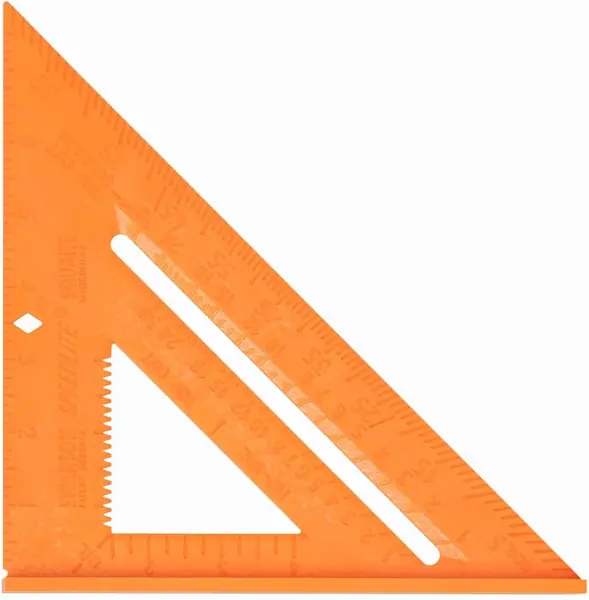
Hi-viz orange composite Swanson Speedlite T0118 square with beveled edge

Siding and trim

Shop Score 92/100
Material
High-impact structural composite
Size
8 in.
Graduations
1/8 in.
Weight
3.2 oz
View on Amazon

The Speedlite is the square we reach for when the work is siding, trim, or anything with a finished face. The high-impact composite body glides over the surface without leaving the gray streaks an aluminum square can, and the 8-inch reach is sized for siding cuts that a 7-inch square has to stretch to mark.

At 3.2 ounces it is the lightest square in this group, and the hi-viz orange body is easy to spot when it lands in grass or a pile of offcuts. We like the beveled edge for reading the scale and the 1/8-inch scribe notches for pulling parallel lines. It is not as crisp or as stiff as the aluminum picks, but those are the wrong priorities when you are trying not to mar a painted board.

This is a specialist, not the square we choose for framing a deck. Keep it for siding, fascia, and finish work, and pair it with an aluminum square for the heavier layout.

Worth Noting

  • Composite body can dent on rough jobsites
Our Verdict

Keep the Speedlite for siding and finished trim, where we prefer its light composite body and non-marring edges to a stiff aluminum square.

Check Latest Price
7.

Mr. Pen 7-Inch Rafter Square 2-Pack Best for Spare Shop Squares

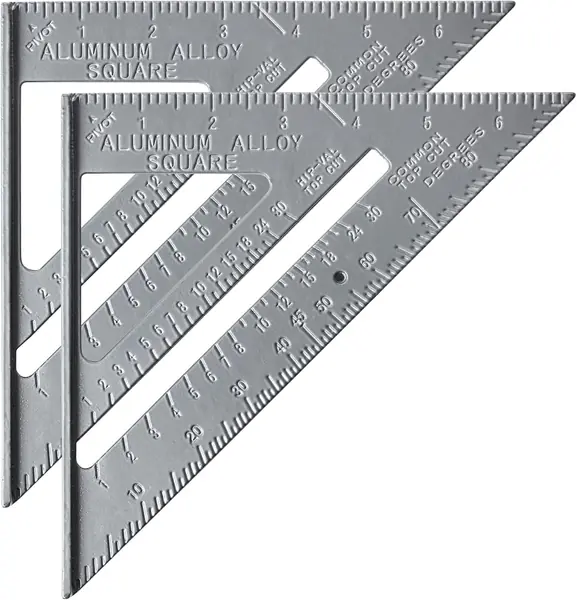
Pair of Mr. Pen aluminum 7-inch rafter squares with engraved markings

Spare shop squares

Shop Score 91/100
Material
Aluminum alloy
Size
7 in.
Graduations
1/8 in.
Pack Count
2
View on Amazon

Two squares for less than one of the premium picks changes how you use them. We keep one in the shop drawer and one in a tool bag, so there is less walking back to the bench when a quick 45° mark comes up.

The aluminum bodies are light and the engraved 1/8-inch graduations are easy enough to read for rough layout. We treat the pair as utility squares for deck boards, shed framing, and quick corner checks, where a spare within reach matters more than a polished finish.

This is the two-pack we hand to someone setting up a first shop or stocking a second toolbox. Both squares will mark and check common cuts, and having a spare means one can stay with the miter saw while the other travels.

Worth Noting

  • Thin body can flex under heavy hand pressure
  • Not accurate enough for fine joinery
Our Verdict

This two-pack makes sense for spare kits and rough layout, and we like having one square in the shop and one in the bag.

Check Latest Price
8.

Johnson Johnny Square RAS-1B

Silver aluminum Johnson Johnny Square RAS-1B with permanent graduations

Value shop layout

Shop Score 90/100
Material
Aluminum
Size
7 in.
Graduations
1/8 in.
Scribe Notches
3-1/2 and 5-1/2 in. boards
View on Amazon

The continuous scribe notches are what we notice first on the Johnny Square. They let you hook a pencil and pull repeat marks for 3-1/2- and 5-1/2-inch boards without walking a tape along the edge, which is the kind of small speed gain you feel on a run of shelves or deck boards.

The aluminum body has a solid feel at 7.84 ounces, and the 1/8-inch graduations are clear enough for framing and general shop work. We like the powder-coated finish for glare, and the 7-inch size is easy to keep in a pouch. It is a straightforward square that does not ask for much attention.

What it offers over a bare-bones square is layout help without a crowded face: the scribe notches and common board marks are there when you need them, and the rest of the scale stays familiar.

We recommend the Johnny Square as a value aluminum pick for shop work and light framing, especially if you mark repeated rips by hand. The scribe notches are the feature that keeps it in our rotation.

Worth Noting

  • Powder coat can chip after rough handling
Our Verdict

The Johnny Square is our value pick for shop layout thanks to continuous scribe notches and a light aluminum body.

Check Latest Price

How We Tested Speed Squares

We started with specs and owner reviews, then narrowed by material, shape, size, and price until 14 squares were in hand — aluminum, composite, single squares, and two-piece sets, so we could compare like for like. Testing ran six months, mostly on a garage bench and a shed build, with a few squares riding in a tool belt between jobs.

Accuracy came first. Each square was checked out of the box against a machinist's square and a known straightedge, then used to strike a line, flipped, and struck again — if the two lines met, the corner was true. We dropped each one onto concrete from bench height three times and rechecked it after every fall, because a bent heel can look fine and still cut crooked. Then we laid them on 2x4s, 2x6s, and 8-inch siding to see whether the reach matched the cut, and noted how much fence each one offered to register against the board's edge.

For readability, we marked in a dim garage lit by a single work light and judged whether the graduations held up in the glare. We used squares as circular-saw guides on plywood, workpiece clamped and the blade path kept clear of the square, and watched which heels stayed put and which crept. Scribe notches were tried on 1/4-inch stock, level vials checked against a bench level, and every square weighed, carried in a belt, and dragged across finished boards to see which ones left marks.

Value was the last pass, judged against the work each square is meant for: a light composite that stayed true earned more credit for trim than a stiff, heavy square that never left the truck. Anything not true out of the box or hard to read under a work light didn't make the list.

How to Choose a Speed Square

Start With a True Corner

A speed square is a reference tool, so the first question is not how many markings it has but whether the 90° corner is actually 90°. We check a new square by holding it against a known straight edge, scribing a line, flipping it, and scribing again; the two lines should overlap. A square that fails that test is not a bargain at any price. Aluminum and composite can both be accurate, but drops and bends are the enemy. If you drop one on concrete, check it before the next structural cut.

Match the Size to the Cut

Seven inches is the default for 2x4 and 2x6 layout, and it is the size that disappears into a tool belt. An 8-inch square such as the Swanson Speedlite gives you a little more reach for siding and trim, while a 12-inch square or a two-size set such as the Klein 80211 is the better tool for stair stringers and wide stock. The trap is buying a larger square for the reach and then leaving it in the truck because it no longer fits your pouch. If you work both small and large, a set makes more sense than forcing one square to do everything.

Prioritize Readability Over Scale Count

Contrast matters more than the number of scales. A high-contrast square like the Irwin 1794463 is easier to read in a dim garage than a busier square with more markings, and that saves time on every cut. Check whether the graduations are 1/8 or 1/16 inch, and whether inch marks appear on one side or both; the finer scale is worth it for trim and cabinetry, while 1/8 inch is enough for framing. Permanent etched or deep markings are preferable to painted ones, but the layout still has to be legible at a glance. More numbers on the face are not automatically better if they slow you down.

Choose Material for the Work

Aluminum is the default for framing because it is stiff and holds a machined corner, and a heavier body tends to stay put on a board. Composite squares such as the Speedlite are lighter and kinder to finished surfaces, but they can dent or scratch on a rough job site. We do not treat weight as a quality score: a 3.2-ounce composite square is the right tool for siding, while an 8-ounce aluminum square is the right tool for deck framing. Choose the material for the work, not for the spec sheet.

Pay for Features You Will Use

Scribe notches, a level vial, and printed rafter tables are useful only if they match your work. The Johnson Johnny Square's continuous scribe notches earn their keep on repeated rip marks, and the MACH-1's level vial and angle slots are worth the premium for stairs and roof layout. The Swanson Blue Book is a real help for occasional rafter work, while a plain 7-inch square is faster for everyday 90° and 45° cuts. We prefer one square with the features we use to a crowded face that slows every mark.

Frequently Asked Questions

Final Verdict

For most woodworkers, the Swanson S0101 is the speed square to buy first. It has the right 7-inch size, a stiff aluminum body, and the Blue Book that makes rafter layout less mysterious; those are the things we reach for on ordinary framing and shop cuts.

If low light is your daily condition, the Irwin 1794463 has the clearer scale. If your work regularly runs past 7 inches, the Klein set buys you a 12-inch square without giving up the small one.