↑↓ navigate ↵ open Esc close All results →

Best Vernier Calipers for Woodworking of 2026

A caliper displaying four decimal places means nothing if the jaws fail to return to zero after a dozen measurements. Beneath most searches for a shop caliper sits that exact concern: whether the reading tells the truth, turning a guess into a dimension a woodworker can mark, cut to, and verify on the next pass.

Measuring tenons, drill shanks, turned spindles, and printed brackets across six months with 14 analog and digital calipers brought one buying trap into focus: resolution is not accuracy. A budget digital screen showing extra digits measures no finer than a crisp vernier scale—it only prints more numbers. Keep one within arm's reach of a lathe or bench, and repeatability quickly outweighs a crowded display.

Fraction readouts help when working off imperial plans, though rounding makes decimal inches or millimeters safer for tight joinery. The lineup spans a classic analog vernier, a dependable starter digital model, and a compact toolbox caliper built to travel.

Our Top Picks

The Best Vernier Calipers for Woodworking

1.

Kynup Digital Caliper Best Overall
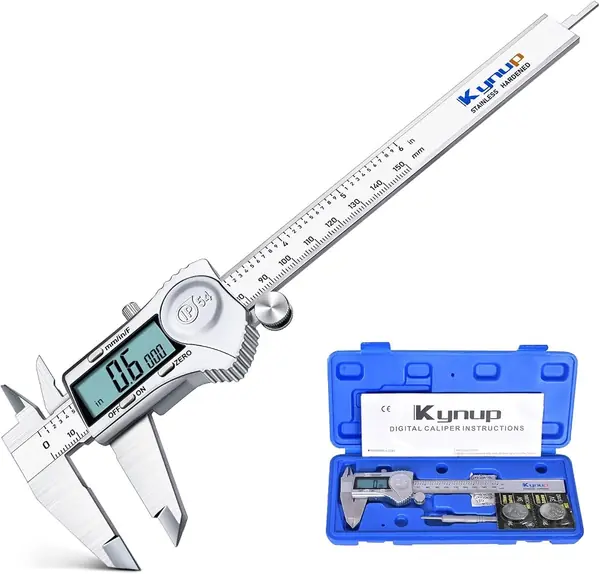
Silver Kynup stainless steel digital caliper with large LCD screen and hard case

Everyday shop measuring

Shop Score 93/100
Accuracy
±0.001 in / 0.02 mm
Measuring Range
0–6 in / 0–150 mm
Readout
Inch, fraction, millimeter
In The Case
Hard case, three button cells, screwdriver
View on Amazon

One button cycles the display through inches, fractions, and millimeters, and that is why this is the caliper we recommend first. A tenon checked in fractional inches, a hinge bore read in millimeters, and a drill bit sized in thousandths all come off the same tool without a conversion in your head. The screen is oversized and high-contrast, so a reading taken at arm's length is still legible without leaning over the work.

The frame is polished stainless with enough weight that the jaws don't flex when you close them on hard maple. A thumb roller moves the slide, the electronics shut down after a few idle minutes, and the kit is complete in a way budget calipers usually aren't: a hard case, three button cells with two kept as spares, and the small screwdriver for the battery door. Those are the parts people end up ordering separately two weeks later.

Set it beside the LOUISWARE and the difference is the readout — both are stainless digitals with a case and a spare cell, but only this one hands you fractions. Set it beside the Mitutoyo and the trade is speed against permanence: instant numbers in three units, or a graduated scale that never needs a cell.

Worth Noting

  • Cells drain between projects
  • Some units stop reading within a year
Our Verdict

Three units on one button, a stainless body, and a case with spare cells — this is the caliper we tell most woodworkers to buy first.

Check Latest Price
2.

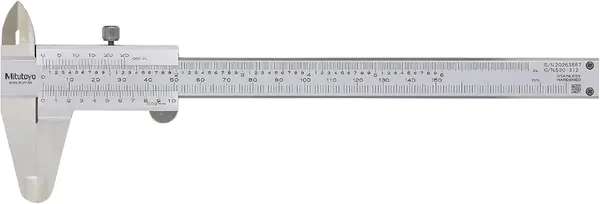
Mitutoyo 530-312 Vernier Caliper Best Analog

Mitutoyo 530-312 stainless steel vernier caliper with satin chrome finish and metric scale

Metric joinery work

Shop Score 92/100
Accuracy
±0.03 mm
Measuring Range
0–150 mm
Scale
Metric
Vernier Resolution
0.02 mm
View on Amazon

The most expensive tool here has no screen, no battery, and no buttons, and it is the one most likely to outlast everything else in the drawer. Mitutoyo's metric vernier is a machinist's instrument that suits woodworking better than it sounds on paper: hardened stainless with a satin chrome finish, 0.02 mm graduations, raised sliding surfaces that keep the beam from wearing the numbers, and a vernier face angled at 14 degrees to cut the parallax that makes cheap scales tiring.

What sold us is the play, or the lack of it. Close the jaws, reopen them, and the zero sits exactly where it was, with no perceptible slop in the slide — the difference between a caliper you trust and one you re-zero out of habit. The 40 mm jaws reach over a tenon shoulder and down into a mortise, and the tool is built to a federal accuracy specification that inexpensive calipers never mention.

One reading answers the resolution question: 0.02 mm is finer than a board will ever hold, so what you're buying is repeatability rather than decimals. Nothing to charge, nothing to drift, nothing to recalibrate — pick it up after a winter in the shop and the jaws still close on zero. For metric drawings and a tool you plan to keep, that is the whole argument.

Worth Noting

  • Metric-only scale means converting for inch work
  • Fine graduations need good light
Our Verdict

For metric work and a lifetime of it: 0.02 mm graduations, a slide with no play, and nothing to recharge — the analog we reach for when a measurement has to hold.

Check Latest Price
3.

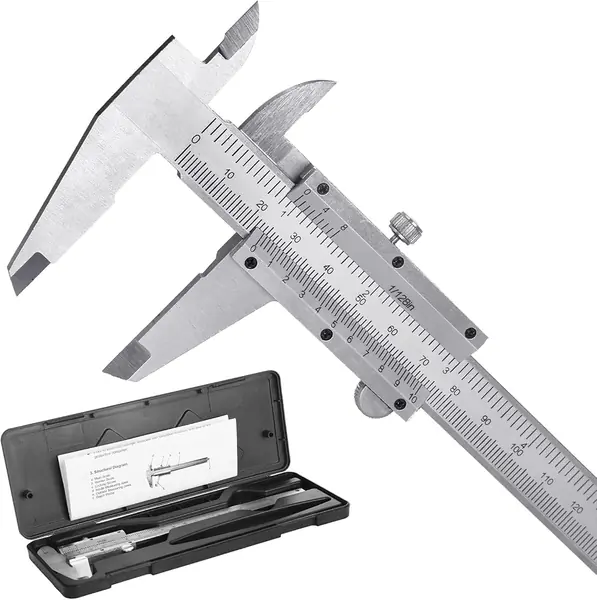
Vsvgmoq 6-Inch Vernier Caliper Best Budget Analog

Vsvgmoq six-inch metal vernier caliper with inch and metric scales and storage case

Inch-based hand work

Shop Score 91/100
Accuracy
0.02 mm / 1/128 in
Measuring Range
0–6 in / 150 mm
Includes
Storage case and instructions
Scales
Fractional inch and metric
View on Amazon

Graduations of 1/128 inch are finer than most woodworking needs and exactly right for the moment a plan says three-quarters and the stock measures a hair under. The inch scale is divided in the fractions you actually use, the metric side reads to 0.02 mm, and neither one asks for a battery. Zero it once with the jaws closed and the scale lines up cleanly, which is the whole calibration ritual on an analog tool.

The slide is the part we keep coming back to. It moves without grittiness, holds where you leave it, and the lock screw keeps a reading while you carry the tool back to the saw — none of which we expected at this end of the price range. The storage case is plain and closes properly, the sheet inside explains the vernier if you've never used one, and at 5.29 ounces the tool is light enough to ride in an apron pocket. As the least expensive caliper here, it's the obvious second caliper and the one that can live in a tool bag without a charger following it around.

Worth Noting

  • Manual vernier scale takes practice if you have never read one
Our Verdict

When your drawings are in fractional inches and you don't want a battery in the equation, this is the analog we point to.

Check Latest Price
4.

Jiavarry Digital Caliper Best Budget Digital

Jiavarry stainless steel digital caliper with large LCD screen and thumb roller

First shop caliper

Shop Score 90/100
Accuracy
±0.001 in / 0.02 mm
Measuring Range
0–6 in / 0–150 mm
Readout
Inch, fraction, millimeter
Resolution
0.0005 in / 0.01 mm
View on Amazon

Twelve ounces is a lot of stainless for a six-inch caliper, and we noticed the weight before anything else. It translates into a tool that feels solid in the hand, with jaws that close squarely and a beam that doesn't flex when you squeeze.

The Jiavarry's readout is the other half of the bargain. Resolution is 0.0005 inch, one button switches between inches, fractions, and millimeters, and the zero function resets anywhere on the scale so you can measure a shoulder as a difference instead of doing subtraction. Auto-off after five idle minutes, a large LCD, and four measurement modes cover everything from stock thickness to the depth of a stopped hole.

Two things show up in the hand rather than the readout: the jaw corners are sharp enough to catch on a finish you've just sanded, and the case doesn't survive a hot shop for long. Neither changes a measurement, and we can live with both. What you're paying for here is the display and the heft, and both deliver at a price that leaves room for a better caliper at the bench with this one in the truck.

Worth Noting

  • Battery life is short between changes
  • Some units quit within months
Our Verdict

Heavy stainless, a big readable screen, and a fine 0.0005-inch resolution make this the budget digital we recommend for a toolbox or a first shop.

Check Latest Price
5.

LOUISWARE Digital Caliper Best Step-Up Digital

Louisware stainless steel digital caliper with large LCD screen and protective case

Shared shop bench

Shop Score 89/100
Accuracy
±0.02 mm / ±0.001 in
Measuring Range
0–6 in / 150 mm
Includes
Case, spare battery, screwdriver
Resolution
0.01 mm / 0.0005 in
View on Amazon

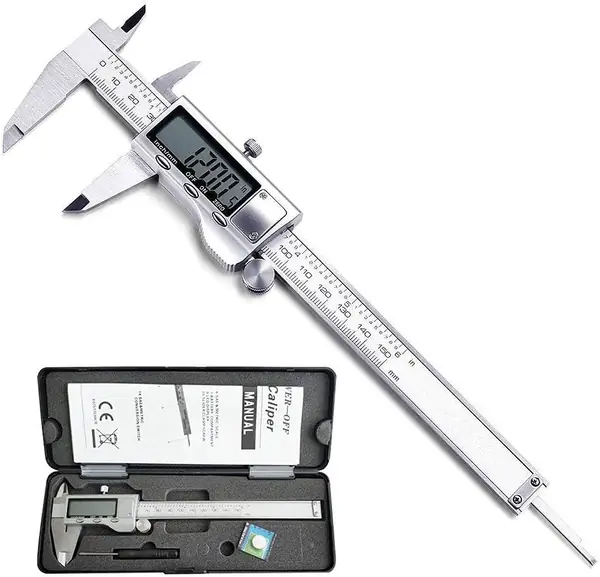
What we like is the tightness of it: metal everywhere you touch, plastic only at the display window, and a slide that feels machined rather than stamped. This is the closest thing to an instrument among the middle-priced digitals here — the buttons click positively, the locking screw bites, and the finish and case hold up better than the money suggests.

Resolution is 0.0005 inch with a claimed accuracy of ±0.001 inch, and one button moves between inches and millimeters. The zero function sets anywhere on the scale, the thumb roller moves the slide under a single finger, and the electronics shut off after four idle minutes — a shorter window than most, which is the right call for a tool that sits between uses. It arrives with a case, a spare cell, and the screwdriver for the door.

Close the jaws and zero it before the first real measurement, and check it against a drill shank or a gauge block if you have one; that habit serves any digital caliper and costs nothing. What earns it a place here is the feel — the tight slide, the positive buttons, the lock screw that holds a reading while you carry the tool across the shop. It's the one we hand to someone else in the shop without worrying about the door or the slide.

Worth Noting

  • No fractional-inch readout for imperial work
  • Installed cell can arrive dead
Our Verdict

A tight all-metal build, a locking screw, and a case with a spare cell make this the digital we trust in a shared shop.

Check Latest Price
6.

SK 6-Inch Digital Caliper Best for Toolbox and Site Work

SK stainless steel digital caliper with large LCD screen and spare battery

Toolbox and site work

Shop Score 81/100
Accuracy
±0.03 mm / ±0.001 in
Measuring Range
0–6 in / 150 mm
Readout
Millimeter, inch, fraction
Includes
Spare battery and screwdriver
View on Amazon

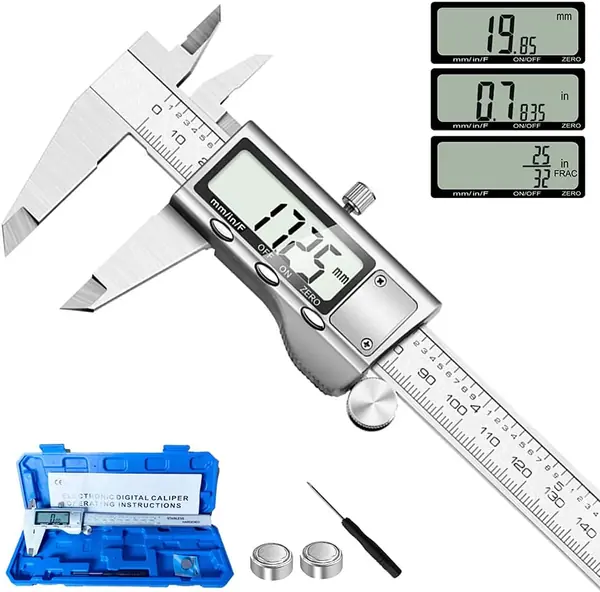
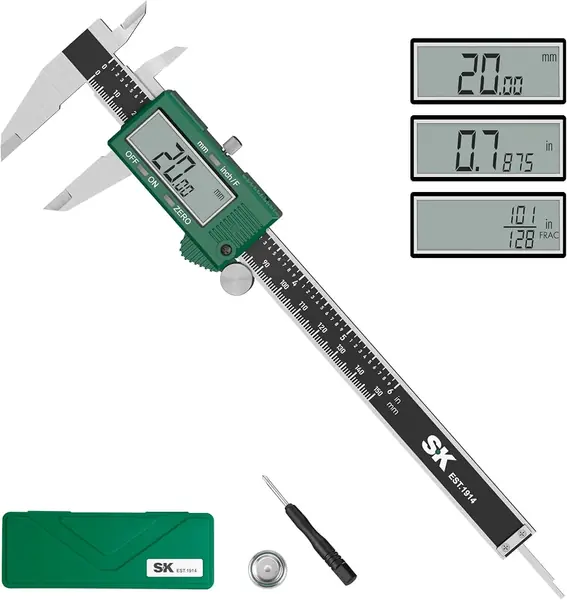
The battery door is held shut with a small screw, and a screwdriver ships in the box to open it. That sounds like nothing until a friction-fit cell door pops open in a bag and takes the battery with it; a fastened door is the kind of detail that comes from someone who has watched a caliper die in transit. That screw is the reason we like this one for a toolbox.

The claimed accuracy is ±0.03 mm, which is finer than wood cares about, and the display reads millimeters, inches, and fractions. All four standard measurements are covered, a thumb roller works with a locking screw, and the kit includes a spare cell and the screwdriver. The electronics power down on their own.

In the hand it behaves like a competent digital — crisp display, a roller that moves the slide under one finger, a lock screw that holds a reading while you walk, and no sense of anything improvised. We liked the completeness more than any single number. On a bench it would be measured against the Kynup's fractions and the Mitutoyo's feel; in a bag, against very little at all.

Worth Noting

  • Costs more than the budget digitals here
Our Verdict

For a caliper that rides in a toolbox, the screw-down door and the spare cell are why we pick this one over the cheaper digitals.

Check Latest Price

How We Tested Vernier Calipers in a Working Shop

We built the shortlist from spec sheets, machinist and woodworker forum threads, and the tools people actually keep within reach of the bench, then narrowed it to calipers that read in decimal inches, millimeters, and fractions, since that covers the three formats most drawings come in. Fourteen units came in, analog and digital, and they stayed in rotation for six months.

They lived where calipers live: on the bench beside the lathe, in the drawer under the drill press, in a toolbox that rode out to job sites, and in a garage that hit triple digits in July. We measured tenon cheeks, drill shanks, sheet goods, turned stock, and printed brackets, always with the machine stopped and the work at rest, and repeated each measurement to see whether the number held.

Between measurements we opened and closed the jaws dozens of times and checked whether zero came back, rocked the slider to feel for jaw play, and judged the slide by whether it moved under a thumb without slop. We carried readings across the shop on the lock screw, read graduations and displays at arm's length under shop light, timed the auto-off, and left units sitting for weeks to see whether the cell was still alive, keeping spare button cells in a closed drawer well out of reach of kids.

We also dropped them onto concrete from bench height, wiped them down with an oily rag, and took inventory of what shipped in the box, because a case, spare cell, and adjustment screwdriver are part of what you pay for.

How to Choose a Vernier Caliper

Analog or digital comes first

Everything else follows from this choice. A digital caliper measuring tool gives you a number, switches units with a button, and reads in bad light, but it depends on a cell; an analog vernier never needs one, never drifts, and makes you read a scale. If the tool lives in a drawer and comes out every few weeks, we lean analog — the Mitutoyo will be exactly where you left it. If you measure millimeters at the bench and fractions at the lumber pile, the Kynup's three-way button earns its battery.

Resolution is not accuracy

A 0.0005-inch display is a resolution, not a promise. The accuracy figure — ±0.02 to ±0.03 mm on the better tools here — is the maker's claim, and repeatability is what you actually get. Close the jaws, zero the tool, and check it against something known: a drill shank, a gauge block, a feeler gauge. Our picks all reset to zero; the ones worth owning come back to it after twenty openings. Wood moves more than any of these numbers, so buy for consistency, not for the extra digit.

Match the scale to your drawings

Metric and imperial plans amount to two different purchases. Fractional-inch scales read in halves, quarters, sixteenths, and thirty-seconds; some inexpensive inch calipers instead divide the inch into tenths, which is a machinist's habit and miserable at a bench. Metric verniers usually read to 0.02 mm, finer than any joint needs. Decide what your drawings use and buy that scale — and if you work in both, buy digital, where switching is a button instead of a second tool.

Jaws, reach, and the hardware in the box

Jaw depth matters more as the work gets smaller: the Mitutoyo's 40 mm jaws reach over a tenon shoulder and into a mortise, which shorter jaws will not. Look for a thumb roller that moves the slide under one finger and a lock screw that holds a reading while you walk to the saw. Then check what ships with it — a hard case, a spare cell, and a small screwdriver cost almost nothing at purchase and save an evening later. Several budget picks here skip at least one.

Frequently Asked Questions

Final Verdict

The Kynup is the caliper we point most woodworkers to first. One button covers inches, fractions, and millimeters, the stainless body has enough heft to close squarely, and the case already holds the spare cell that saves an evening later. If your drawings are metric and you want one instrument for the rest of your working life, the Mitutoyo 530-312 is worth the step up — no battery, no drift, no play. Outfitting a bench on a thin budget? The Vsvgmoq reads fractional inches for less than anything else here.