↑↓ navigate ↵ open Esc close All results →

Best Machinist Squares of 2026

A machinist square is only as good as its 90 degrees, and a surprising number arrive out of square. That's the worry we kept in mind: you want a reference tool that tells the truth about a tablesaw blade, a router fence, or a freshly cut joint, not one that adds error to every setup. The right square gives you a trustworthy inside and outside corner, a blade long enough for the check at hand, and a stock that sits flat or stands on its own.

We tested 12 machinist squares over eight months, from 2-inch models to 6-inch sets, checking each on a granite plate and then using it on a tablesaw, router table, and drill press — always unplugged before we checked a blade or fence. We looked at stated grade and tolerance, hardened versus stainless steel, wide-base versus flat stock, inner-corner notches, and whether graduations helped or cluttered the blade. Rust resistance, build quality, and value for money separated the keepers from the also-rans, and the picks below are the ones we'd trust on our own benches.

Our Top Picks

The Best Machinist Squares

1.

Groz 3-Piece Precision Steel Square Set Best Overall
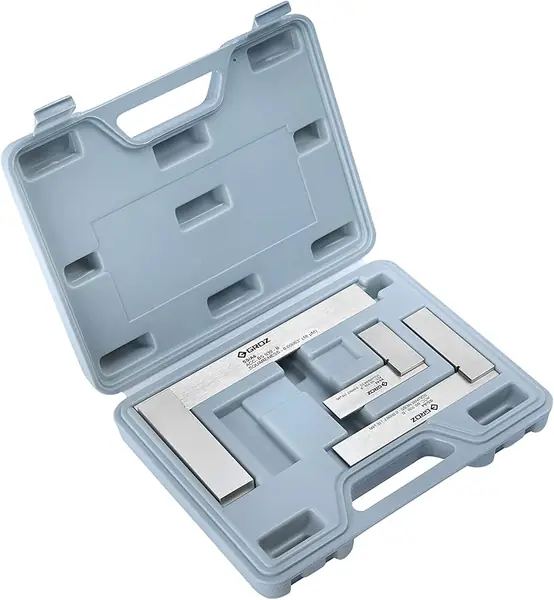
Groz three-piece steel machinist square set with 2 4 and 6 inch blades and case

Machine setup

Shop Score 91/100
Blade Sizes
2 in, 4 in, 6 in
Blade Fitting
Tapered self-locking rivets
Blade Material
Hardened spring steel
Stated Squareness
16 micron, BS 939 Grade B
View on Amazon

Sixteen microns, held to a published standard. That is the whole argument for this set, and it is a better one than any adjective on a box: BS 939 Grade B is a real specification, and it means the square you use to judge every other square in the shop has something behind it besides a seller's confidence. Three blades — 2, 4 and 6 inches — in hardened spring steel, ground and lapped on all edges and fixed to the stock with tapered self-locking rivets rather than a press fit you have to hope holds.

Of everything here, this is the set we treat as the standard. The 6-inch blade spans a miter slot or bridges a jointer fence, the 2-inch fits inside a dovetail, and the milled groove at the inner corner gives chips and burrs somewhere to sit so the blade lands flush. The base is heavy enough that the square stands upright on a machine table while you walk a fence up to it, which decides whether a setup takes one pass or three.

Expect two irritations. The blades ship under a thick, sticky rust preventative that needs solvent and a rag before the first check, and the ground corners are sharp enough to notice. Neither is a fault: hardened steel that is not stainless needs the coating, and sharp corners are what grinding leaves behind.

Where the work has to be defensible — a machine rebuild, a fixture, a paid commission — the certificate is the thing you are buying, and it is why this set lives in the top drawer while the cheaper ones ride in the toolbag.

Worth Noting

  • No 3-inch blade in the set
Our Verdict

This is the set we treat as the shop's standard: certified 16-micron squareness, a heavy base that sits steady, and three sizes that cover most checks.

Check Latest Price
2.

PEC Tools 4-Piece Machinist Square Set Best Four-Size Set

PEC Tools four-piece hardened tool steel machinist square set in a protective case

Four-size kit

Shop Score 89/100
Material
Hardened tool steel
Blade Sizes
2 in, 3 in, 4 in, 6 in
Corner Feature
Inner-corner debris notch
Stated Tolerance
±0.0006 in
View on Amazon

Four sizes in one case — 2, 3, 4 and 6 inches — each wrapped in VCI paper and each holding a stated tolerance of plus or minus 0.0006 inch. That 3-inch blade is why we reach for this set over the three-piece ones: it is the size that fits between a router fence and a small part, or inside a drawer box, where a 4-inch square will not sit flat and a 2-inch gives you nothing to grip.

The square is a solid one-piece tool with no moving parts, so there is no rivet to work loose and no joint to drift. All faces and edges are precision ground, inside and outside, which means flipping the square gives the same answer — the check that catches a blade set at 90 on one face and a whisker off on the other. A small notch at the inside corner keeps dust and swarf from holding the blade away from the work.

The number is the maker's claim rather than a laboratory's certificate, and for a woodworking shop or a hobby mill that is a distinction without much difference. Keep the VCI paper and the case, though: hardened tool steel spots in a humid garage, and the wrapper is doing real work between sessions.

Worth Noting

  • Case latch feels flimsy
Our Verdict

Our pick when you want four sizes in one case and a printed tolerance beside them: the handiest kit here for a shop that moves between wood and metal.

Check Latest Price
3.

Taytools 4-Inch Flat Stainless Square Best for Tight Spaces

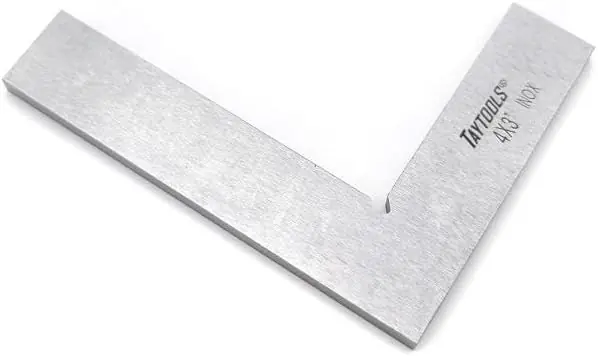
Taytools flat stainless steel machinist square with 4 by 3 inch blade

Tight corners

Shop Score 88/100
Material
Stainless steel
Standard
DIN 875/0
Blade Size
4 x 3 in
Thickness
0.22 in
View on Amazon

A wide-base square cannot get into a corner that is closed on two sides. This one can. It is a single flat blank of stainless steel, 4 inches by 3 and 0.22 inch thick, with every face and edge ground and lapped and a groove milled into the inner corner. Slide it into a cabinet corner, a drawer, or the gap between a fence and a blade and it lies flush, where a square with a stock would rock on its own base.

The claim is DIN 875/0, the tightest class in that standard, which is a bolder statement than the cheap sets here make. In the hand it feels like a piece of ground stock rather than a stamped tool — heavy for its size, square-edged, and flat enough that you can read a gap under it by eye.

We keep this beside a larger reference rather than instead of one, because the checks it makes possible are the ones the wide-base squares cannot make at all. Two things to watch. The steel will rust if it is left bare, whatever the stainless description suggests, so it wants a wipe of oil like any carbon square. And check both edges when it arrives — the outside edge is the one nobody tests, and it is the one that comes through off.

Worth Noting

  • Too small for large machine surfaces
Our Verdict

We keep this one for the checks a wide-base square cannot make: a thick flat blade that slides into a closed corner and lies flush on a machine table.

Check Latest Price
4.

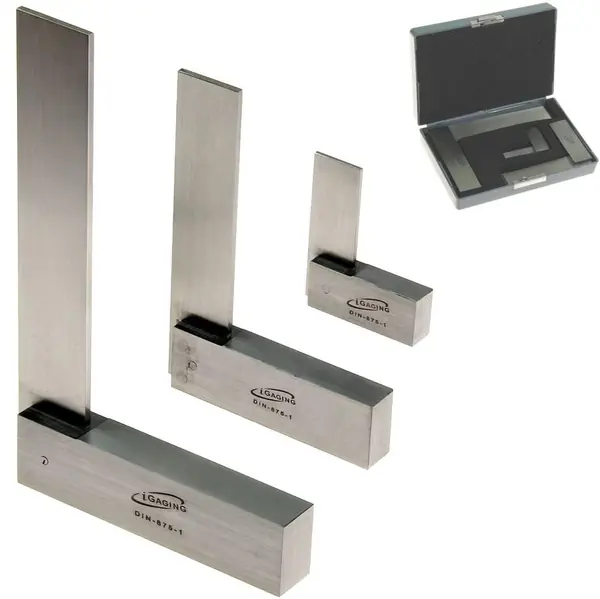
iGaging 3-Piece Machinist Square Set Best Midrange Set

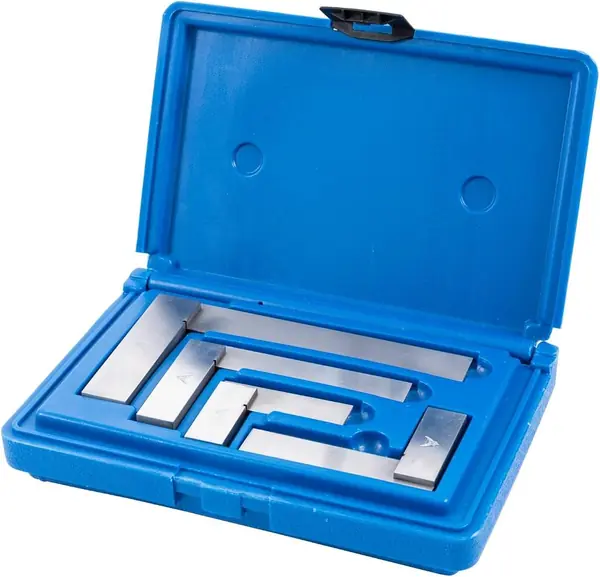
iGaging three-piece hardened steel machinist square set with storage case

Home shop

Shop Score 87/100
Blade Sizes
2 in, 4 in, 6 in
Included
Storage case
Graduations
None
Stated Accuracy
Within 0.001 in
View on Amazon

Two, four and six inches, hardened steel, every face and edge ground for straightness and parallelism, no graduations anywhere, and a fitted case. The stated accuracy is 0.001 inch. That is a looser figure than the certified sets print, and it is also comfortably tighter than anything a woodworking joint will ask of it.

We like this set as the middle of the road: it asks you to give up the certificate, not the machining. The blades are deliberately ungraduated, so you use them as a reference rather than a ruler, which is what an engineer square is for. The stock is heavy, the seating faces are flat, and the case is worth having if the squares live in a drawer with chisels and files.

Where it is thinnest is the paper trail: no grade behind the number, no individual certificate in the case, and less of a track record than the two sets above it. For a home shop that is a fair trade. Check the 6-inch blade against a known square the day it arrives, and the set will do everything a hobby shop asks.

Worth Noting

  • 0.001-inch claim is looser than certified sets
Our Verdict

We like this set for a home shop that wants three sizes and a stated tolerance without paying for a certificate it will never use.

Check Latest Price
5.

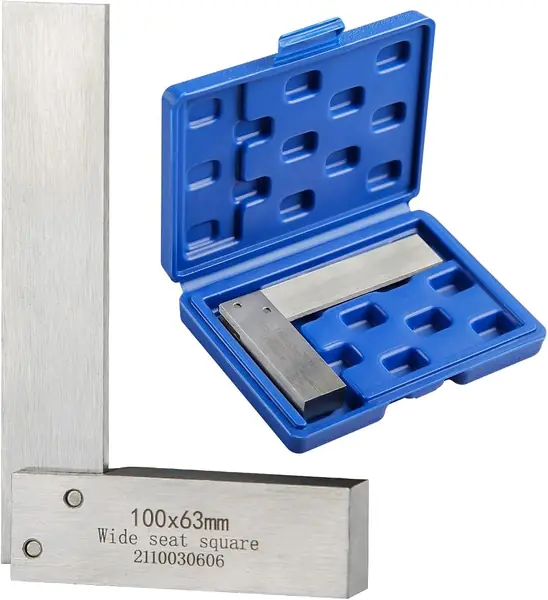
Boomgood 4-Inch Machinist Square

Boomgood 4-inch hardened steel machinist square with wide seat and case

Apron pocket

Shop Score 86/100
Material
Hardened steel
Standard
DIN 875 Grade 1
Included
Plastic case
Blade Size
4 x 2.5 in
View on Amazon

A 4-inch blade on a 2.5-inch beam, a notch at the inner corner, hardened steel, a plastic case. This is the square that ends up in an apron pocket and gets used a dozen times a day for the small checks that do not justify a walk back to the bench: is this corner closed, is this face flat, is this blade leaning.

It is sold to DIN 875 Grade 1, and the finish does not embarrass the claim — the base is ground flat, the edges are crisp, the seating face is smooth. It stands upright on a saw table on its own, which is most of what you want from a square this size, and the notch keeps a chip from propping the blade off the work.

Consistency is the catch. At this end of the market the unit you receive is a lottery: plenty come through dead on, plenty do not. Nothing about that is mysterious. It is what the money buys and what it costs.

We still keep one within reach, because a cheap square you have checked is more useful than no square at all, and the check takes ten seconds. Buy it as a second or third square, verify it against a good reference the day it lands, and if it fails, demote it to a straightedge and use the case for something else.

Worth Noting

  • Thin blade bends if you lean on it
Our Verdict

The least expensive square here, and one we are happy to keep in an apron, provided you check it against a known reference the day it arrives.

Check Latest Price
6.

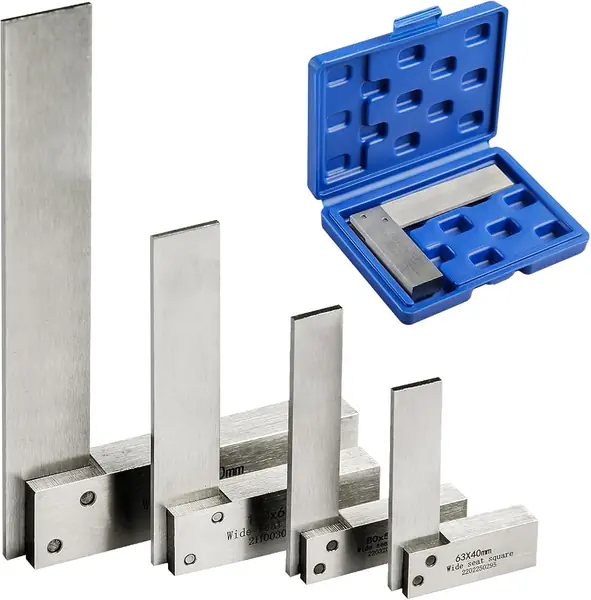
Boomgood 4-Piece Machinist Square Set

Boomgood four-piece hardened carbon steel machinist square set with plastic case

First set

Shop Score 85/100
Material
Hardened carbon steel
Blade Sizes
2 in, 3 in, 4 in, 6 in
Standard
DIN 875 Grade 1
Corner Feature
Inner-corner notch
View on Amazon

Four squares, four sizes, a plastic case and a coat of oil. For a first set on a tight budget we think this is worth the gamble, on one condition: nest all four against each other on a flat surface and hold the stack up to the light before you trust any of them. The odd one out shows a sliver of daylight immediately, and that five minutes is the whole difference between a useful set and four paperweights.

The specification reads well. Hardened carbon steel, beams and blades ground and lapped for straightness and parallelism, true right angles inside and outside, a DIN 875 Grade 1 claim, and a wide heavy base that stands the square up on the bench. Having 2, 3, 4 and 6 inches lets you match the square to the joint instead of making the joint fit the square.

Expect a scratch or two under the oil, and expect to keep them oiled — carbon steel in a humid shop will spot within weeks. At this end of the market it is a reasonable way to get four sizes onto the bench, and the two smallest are the ones that get the most use anyway.

Worth Noting

  • Accuracy varies across the four sizes
Our Verdict

We rate this as a starter set: four hardened squares for a small outlay, worth buying only if you check all four before you trust them.

Check Latest Price
7.

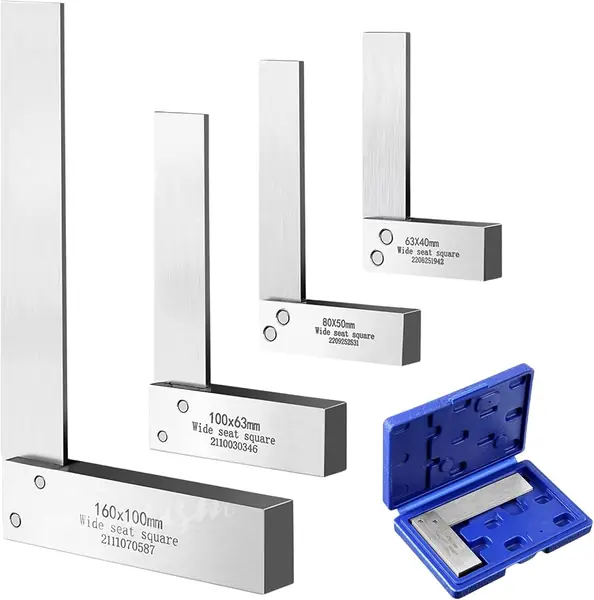
Lancisism 4-Piece Machinist Square Set Best for Layout Work

Lancisism four-piece engraved steel machinist square set with wide seats

Layout work

Shop Score 84/100
Material
Hardened alloy steel
Blade Sizes
2 in, 3 in, 4 in, 6 in
Standard
DIN 875 Grade 1
Markings
Engraved dimensions
View on Amazon

Numbers on a machinist square are unusual, and this set has them: each blade is engraved with dimensions and clear figures. That makes it half reference tool and half small rule, which is more useful than it sounds if your work is carpentry and layout rather than machine setup — marking a line at a set distance and checking that same corner square are the two things a square does all day.

The rest of the specification is familiar from this price band: hardened alloy steel, a heavy wide seat, a blade fixed with tapered self-locking rivets, a groove at the inner corner, four sizes from 2 to 6 inches, and a DIN 875 Grade 1 accuracy claim.

We treat this as a layout set and not a certification. The graduations are the part to trust least — an engraved scale can run progressively off along the blade, so measure anything critical with a rule and let the markings save you time rather than settle an argument. Check the 90s against a known square when the set arrives, as with any set at this end of the market, and it earns its place in a carpentry box.

Worth Noting

  • Engraved scale can drift and needs a rule for critical checks
  • Squareness should be verified against a known reference on arrival
Our Verdict

We reach for this set for layout and carpentry, where the engraved blade helps more than the claimed grade does.

Check Latest Price

How We Tested the Best Machinist Squares

We built the shortlist by filtering for a published grade or maker tolerance — DIN 875/0, DIN 875 Grade 1, BS 939 Grade B, or a number in thousandths — then comparing blade length, size coverage, wide-base versus flat stock, inside-and-outside squareness, and whether the inner corner had a relief notch. Price mattered only against the grade; a cheap square with no stated tolerance wasn't a bargain. We ended up with 12 units and spent eight months with them.

Each square arrived with a claimed grade or tolerance, so we checked the claim first: we set it on a granite surface plate, pressed a light behind the blade, and looked for a gap, then flipped it to the same spot and compared. We repeated the check on the inside and outside edges, ran a finger along the inner corner for burrs or swarf, and noted whether the stock was wide enough to stand on its own. We noted graduations, engraved or printed.

In the shop, we used each square to set a tablesaw blade to the miter slot, square a router fence, and check a drill press table — always with the machine unplugged or locked out, never running. We carried the smaller ones in an apron pocket, left a couple on a damp bench over a weekend to see how they handled rust, and rechecked them after a few months. We watched whether the square still met its tolerance, whether the corner notch cleared debris, and whether the wide base actually helped it stand for a setup.

Build quality showed up in rivet tightness, grind marks, and how the blade seated in the stock. Value for money came down to whether a square's published grade matched its performance, not how shiny it looked. The picks are the ones that stayed square and stayed useful.

How to Choose a Machinist Square

Start With the Grade, Not the Finish

DIN 875 runs Grades 0, 1 and 2, with 0 the tightest; BS 939 Grade B is the British equivalent; some makers skip grades and state a flat tolerance instead, such as the plus or minus 0.0006 inch printed on the PEC set or the 0.001 inch claimed by iGaging. Here is the trap: a set with DIN 875 Grade 1 molded into the case has not necessarily been checked to it, and a cheap set cannot absorb the cost of individual inspection. If the square's job is judging other tools, buy a published grade. If it is carpentry layout, a verified 0.001-inch square is already more than enough.

Match the Blade to the Check

Two inches fits inside a dovetail or a small closed corner. Four inches is the everyday workhorse for fence setup and joint assembly. Six inches spans a miter slot or reaches across a jointer fence. If you buy one square, buy the 4-inch. If you set up machines, add the 6-inch, because it bridges more of the table and reads a fence over its full height. The 3-inch blade that some sets include lives in the gap between them and gets used more than you expect in joinery, which is why the four-piece sets have an edge for mixed work.

Wide Base or Flat Blade

A wide-seat square stands upright on a machine table, registers against the edge of a part and leaves both hands free to walk a fence up to it. A flat square — a solid beveled blank with no stock — slides into a corner that is closed on two sides and lies flush against the surface you are inspecting. We keep both: the wide base for setup, the flat blade for joinery and inside corners. Neither replaces the other, and a flat square will not stand on its own while you adjust anything.

Look at the Inside Corner and the Grind

Two details separate a working square from a decorative one. First, a milled relief notch at the inside corner: it gives dust, burrs and swarf somewhere to sit so the blade seats flat, and on an unrelieved corner one chip is enough to throw a reading. Second, grinding and lapping on all faces and edges, inside and outside, so the square reads the same whichever way you flip it. Polished-only edges look better in photographs and check less.

Plan for Rust and for Storage

Hardened carbon steel spots in a humid shop, and a stainless label is worth less than an oil can. Wipe the blades with light oil after a session, keep the case, and keep any VCI paper the set arrived in — the PEC set ships wrapped in it. Store squares apart from files and chisels: a blade that has been rattled around a toolbox is a straightedge until you prove otherwise.

Frequently Asked Questions

Final Verdict

If you want one square that settles arguments, the Groz set is the one we point people to. A certified 16-micron claim against BS 939 Grade B means you can use it to judge every other square in the shop, and the 2-, 4- and 6-inch blades cover setup, layout and inspection without a second purchase.

Buy the PEC set instead if your work runs small and varied: the extra 3-inch blade earns its keep in joinery and router setups, and its plus or minus 0.0006 inch is close enough to the Groz that you will not notice in wood. If a square in the apron is all you are after, the little Boomgood is the way there for the least money — check it when it lands, then stop thinking about it.