↑↓ navigate ↵ open Esc close All results →

Best 3M Respirator Filters for Woodworking of 2026

Sanding a board never looks like the dangerous part of a project — until you walk back into the garage an hour later and the fine dust is still hanging in the air. The facepiece gets the attention, but the filter decides whether that dust stops at the pleats or rides into your lungs. The right one also lets you keep working: easy breathing through a long session, a low profile under a face shield, and a price that makes retiring it on schedule painless.

We tested 14 filters across six months of shop work, and the differences that decided it weren't the ones printed in big type on the box. A P100 catches more than a P95, but what actually matters is whether a filter is approved for the facepiece you already own and whether it mounts without an adapter you'll misplace by Tuesday. One July afternoon of sanding walnut in a closed garage taught me which ones turn into breathing through a straw. These are the filters we'd put on our own respirators.

Our Top Picks

The Best 3M Respirator Filters for Woodworking

1.

3M 2097 P100 Particulate + Odor Filters Best Overall
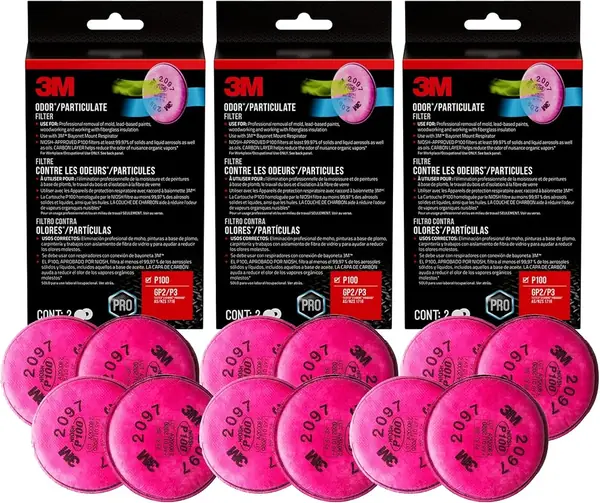
3M 2097 P100 particulate and odor filter pads for 3M bayonet facepieces

Sanding and finishing

Shop Score 99/100
Filter Class
P100, 99.97% efficiency
Compatible Facepieces
3M 6000, 6500 and 7500 Series
Pack Size
3 packs of 2 pairs
Odor Relief
Nuisance-level organic vapors
View on Amazon

Sanding and finishing tend to happen in the same afternoon in a small shop, and the 2097 is the filter that doesn't have to come off in between. It's a P100 pad with a thin odor layer bonded to the front, so it catches the fines coming off a random orbital sander and takes the edge off the solvent smell when you open a can of wipe-on finish an hour later.

The particulate rating is what matters most for wood dust, and this one sits at the top of the scale: NIOSH P100, rated for at least 99.97 percent filtration efficiency against oil and non-oil aerosols. Oak, walnut, MDF, the oily exotics — the rating covers all of it, and the shape stays clear of a face shield or a welding hood when you tip your head down to the work.

What we appreciate most is the breathing. A carbon cartridge can feel like work after a couple of hours; the 2097 is thin and light, and we stop noticing it long before the project is done. That's the whole point of a filter you're supposed to keep on from the first cut to the last coat.

Two things to square before ordering. The odor layer is nuisance level, which means it deals with the smell of a finish rather than the hazard of spraying one — if you're shooting lacquer or mixing epoxy in a closed garage, you want a cartridge approved for those vapors. And the approval covers the 6000, 6500 and 7500 series facepieces, so a 7000-series full facepiece needs the 2297 instead.

Worth Noting

  • Sold only as a three-pack of two pairs
Our Verdict

We keep the 2097 on our own half masks because one pair covers the dust and the finish smell of a shop day, and the P100 rating handles every wood dust we've met.

Check Latest Price
2.

3M 2091 P100 Particulate Filter Best for All-Day Sanding

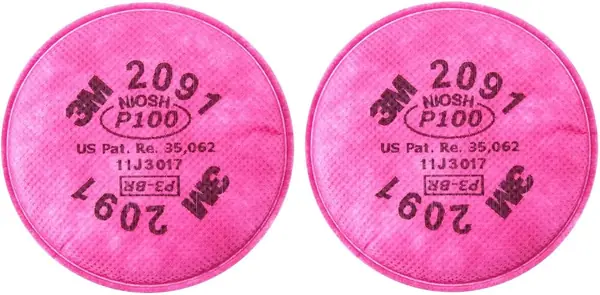
3M 2091 P100 particulate filter pads in pink for 3M half and full facepieces

Bare wood sanding

Shop Score 98/100
Filter Class
P100
Compatible Facepieces
3M bayonet half and full facepieces
Pack Size
3 pairs
Particulate Efficiency
99.97%
View on Amazon

Nothing on this filter is trying to do a second job. The 2091 is a P100 particulate pad — pink, light, and unobtrusive enough that you stop noticing it on the facepiece after the first board — and that single-purpose build is why it stays mounted on our sanding mask for weeks at a time.

We like it best for the work that fills most shop hours: thickness planing, routing, hand sanding, the slow passes on a belt sander. Rated at 99.97 percent particulate efficiency against oil and non-oil aerosols, it handles everything from kiln-dried maple to the oily exotics, and a welding hood closes over it without a fight. It's among the cheapest per pair here, and that changes the habit — the pads get swapped once the media loads up instead of being stretched until breathing gets hard.

What it doesn't have is an odor layer, and that's the trade against the 2097: sanding sealer, shellac, and the smell of a solvent rag come straight through. If your work stops at bare wood, that's a saving worth taking. Keep the 2097 for the days when the finish comes out.

Worth Noting

  • Lacks an odor or vapor layer for finishing solvents
Our Verdict

We reach for the 2091 when the day is nothing but dust: a light, inexpensive P100 pad that snaps on and stays out of the way, with no vapor layers to breathe through.

Check Latest Price
3.

3M 2297 P100 Advanced Filter Best for Easy Breathing

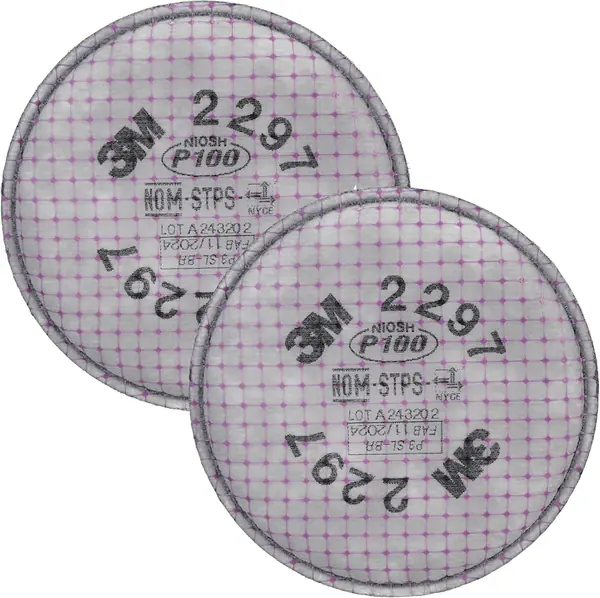
3M 2297 P100 advanced particulate filter pair in gray for 3M bayonet respirators

Long sanding sessions

Shop Score 97/100
Filter Class
P100
Compatible Facepieces
3M 5000 Series; 6000, 7000, FF-400 with bayonet
Pack Size
1 pair
Media Layers
3 layers
View on Amazon

If you've ever pulled a mask off between boards just to get a full breath, this is the filter aimed at you. 3M builds the 2297's media in three layers instead of the five used in its traditional P100 pads, and the payoff is airflow — the kind you notice twenty minutes into a routing session.

It's still a full P100, rated at 99.97 percent against oil and non-oil particulates, and it adds nuisance-level organic vapor relief on top, so a coat of oil-based polyurethane doesn't ride in the mask with you. The other thing we noticed early is the profile: it tucks close to a half mask, which makes it the pair we leave mounted when a face shield is up against our chin all afternoon.

Compatibility runs wider than the 2097's. 3M lists the 5000 series facepieces, the 6000, 7000 and FF-400 facepieces on the bayonet mount, and the 6000-series gas and vapor cartridges with the 502 adapter. If you own a full facepiece the 2097 doesn't cover, this one probably does.

Breathing resistance is the reason people take masks off, and that makes the 2297 the pair we hand to anyone who finds a half mask tiring. It won't suit a shop that buys filters in bulk boxes — that's what the 2097 is for — but for the woodworker who feels every long session in the chest, it's the more comfortable choice in this guide.

Worth Noting

  • One pair per box, so you order in multiples
Our Verdict

We hand the 2297 to anyone who finds a half mask exhausting: the three-layer media genuinely eases each breath, and it fits every bayonet facepiece the 2097 doesn't.

Check Latest Price
4.

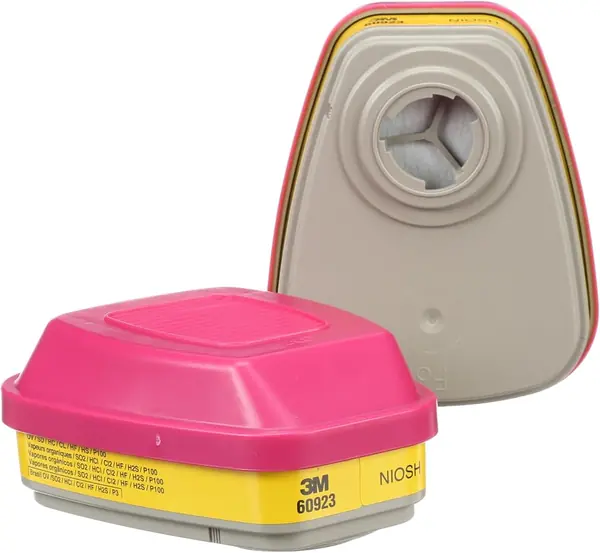
3M 60923 OV/AG/P100 Cartridge Best for Finishing and Solvent Work

3M 60923 P100 organic vapor and acid gas cartridges in magenta and yellow, one pair

Finishing work

Shop Score 96/100
Filter Class
P100 combination
Compatible Facepieces
3M 6000, 7000 and FF-400 Series
Pack Size
1 pair
Vapor Protection
Organic vapors and acid gases
View on Amazon

Wood dust is only half the air problem in a finishing shop, and the 60923 is the cartridge we fit when the other half shows up. Spray lacquer, wipe on a solvent stain, or mix epoxy in a closed garage and a particulate-only pad has nothing to offer; this one pairs a P100 filter with an organic vapor and acid gas cartridge, which is why it's our pick for anyone who finishes as much as they cut.

The dust side carries the same P100 rating as the pads in this guide. The vapor side covers organic vapors and acid gases, the classes that show up around lacquers, solvents, and resin work. It mounts on the 6000, 7000 and FF-400 facepieces with a quarter turn of the bayonet, and the swept-back body leaves a usable view of the work when you're leaning over a wet edge.

The carbon is the part that takes managing. Once a pair is out of its wrapper the clock runs whether you're wearing it or not, and the day solvent smell comes back through is the day it's spent. Write the date on the cartridge with a paint pen and you won't have to guess.

For a shop that only cuts and sands, the flat pads elsewhere in this guide are lighter and easier to breathe through, and there's no reason to carry the extra. Where a project moves from the saw to the spray gun in one afternoon, though, this is the pair that stays on.

Worth Noting

  • Two cartridges crowd the space under a face shield
Our Verdict

We fit the 60923 when a project moves from sanding to spraying, since it covers dust and solvent vapors in one pair instead of two.

Check Latest Price
5.

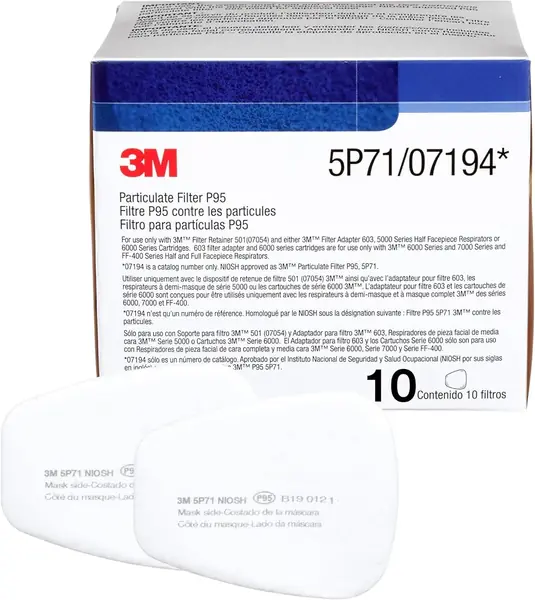
3M 5P71 P95 Prefilters Best Budget Option

3M 5P71 P95 particulate prefilters in white for 3M 5000 and 6000 Series respirators

Budget dust control

Shop Score 95/100
Filter Class
P95
Compatible Facepieces
3M 5000 Series or 6000 Series cartridges
Pack Size
5 pairs (10 filters)
Requires
3M 501 retainer or 603 adapter
View on Amazon

These are the cheapest way to keep dust out of a 3M mask, and the only pick here that can't do the job on its own. The 5P71 is a prefilter: it sits over a 6000-series gas and vapor cartridge with the 501 retainer clamping it down, or over the 603 filter holder when particulates are all you're after. Buy the pads without one of those parts and you have a stack of white discs and nothing to attach them to.

The rating is P95, 95 percent filtration against oil and non-oil particles, and there are ten pads in the box — five pairs. For sawdust, sanding dust, and the general haze of a home shop, that's plenty. It's the arrangement we like for finishing work in particular: the cartridge underneath keeps doing the expensive vapor job while the pad takes the dust and gets thrown away.

That's the appeal, and it's a real one. Buying filters this way costs a fraction of what cartridge pairs run, and the same 6000-series cartridge serves a whole project instead of being retired because its front face loaded up. Ten pads is a deep supply for a one-person shop, and it turns a filter change into nothing more than a filter change.

The catch is assembly. Three parts — cartridge, pad, retainer — have to be seated right, and a retainer that isn't clipped down leaves a gap no rating can rescue. Give it a tug every time you fit one. That extra step is what you accept in exchange for the price.

Worth Noting

  • P95 rating rather than P100
Our Verdict

We keep a box of 5P71 pads beside our 6000-series cartridges, because they take the dust and leave the expensive part in service.

Check Latest Price
6.

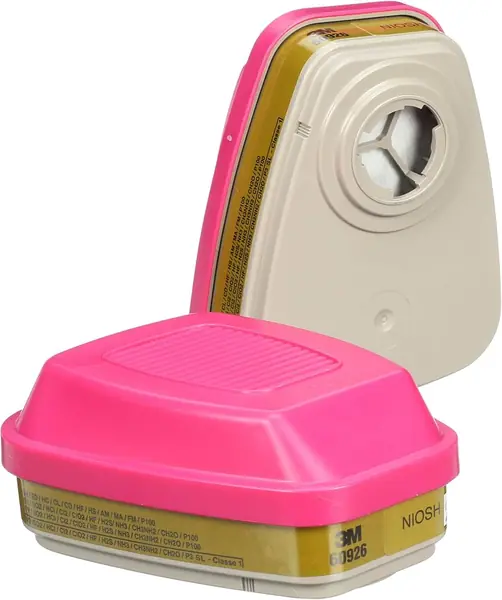
3M 60926 OV/AG/P100 Cartridge Best for Vapor-Heavy Shop Tasks

3M 60926 P100 organic vapor and acid gas cartridges for 3M bayonet facepieces

Vapor-heavy shop tasks

Shop Score 94/100
Filter Class
P100 combination
Compatible Facepieces
3M 6000, 7000 and FF-400 Series
Pack Size
1 pair
Vapor Protection
Organic vapors, acid gases, ammonia, formaldehyde
View on Amazon

Every filter here handles wood dust; this one also handles a vapor list long enough to cover most of what a small shop opens. Organic vapors, acid gases, ammonia, methylamine, formaldehyde — the 60926 is approved against all of them plus oil and non-oil particulates, which puts it a class apart from the dust pads and from the narrower vapor cartridges.

Our honest read is that most woodworkers don't need it. For sanding and routing a P100 pad is lighter, cheaper, and easier to breathe through. Where the 60926 earns its keep is the work that actually makes vapors: epoxy and resin, ammonia-heavy strippers, formaldehyde-bearing finishes, and any job where you aren't certain what's in the can.

It mounts like the rest of the 6000-series line, a quarter turn on the bayonet with the same fit on the 6000, 7000 and FF-400 facepieces, and the swept-back shape keeps your view of the work reasonably clear. On the facepiece it feels like what it is — two carbon cartridges rather than a pad.

One habit worth building: these carry a date, and a pair that has sat too long won't deliver what the approval promises. Check the date code when the box lands, while returning it is still simple, and keep spares sealed instead of open on a pegboard.

Worth Noting

  • Heaviest cartridge in this guide on the face
Our Verdict

We reserve the 60926 for epoxy, resin, and ammonia strippers; for everyday sanding a plain P100 pad beats it.

Check Latest Price
7.

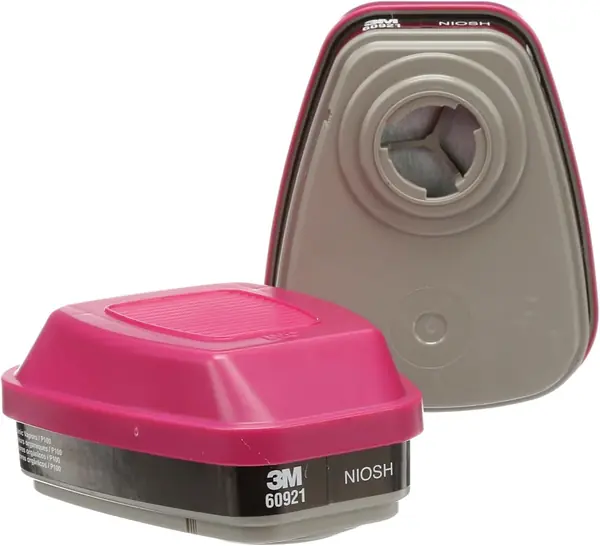
3M 60921 OV/P100 Cartridge Best for Stain and Lacquer

3M 60921 P100 organic vapor cartridges in magenta and black, one pair

Stain and lacquer

Shop Score 93/100
Filter Class
P100 combination
Compatible Facepieces
3M 6000, 7000 and FF-400 Series
Vapor Protection
Organic vapors
Dimensions
3.55 x 1.9 x 4.3 inches
View on Amazon

Plenty of shops only ever open one solvent at a time: a can of stain, a rattle can of lacquer, a wipe-down with mineral spirits. For that shop the 60921 covers the vapor side without the extra gas layers, and the same pair handles the sanding dust in front of the finish.

It's an organic vapor cartridge with a P100 particulate filter behind it, on the bayonet mount that fits the 6000, 7000 and FF-400 facepieces. The dust side carries the same 99.97 percent efficiency as the pads here, so it does real work on both the dust and the solvent side rather than one job and a nod to the other.

In use it's the cartridge that disappears on the mask. We noticed the breathing more than the weight — a P100 with carbon in it asks a little more than a flat pad, but not so much that we've cut a session short. It's also the pair we reach for when a project alternates between sanding and wiping on stain, since nothing has to come off the facepiece.

Our take: worth it if the solvents in your shop are stains and lacquers and nothing more. The 60923 in this guide covers acid gases on top of organic vapors and dust, and it costs less here, which is why we point new buyers there first. If you already own a pair of these and they suit your routine, there's no reason to change.

Worth Noting

  • Does not filter acid gases unlike the cheaper 60923
  • Slightly higher breathing resistance than a flat particulate pad
Our Verdict

We think this pair earns its place in a stain-and-lacquer shop, though the 60923 covers more vapors for less.

Check Latest Price

How We Tested Respirator Filters for Woodworking

We started with every current particulate and combination filter sold for woodworking, then cut anything without NIOSH approval as a particulate filter and anything that didn't name the facepiece models it's approved for. That left 14 filters, which we ran for six months.

Each one went to work in a home shop: sanding oak and walnut with a random-orbit sander, crosscutting MDF shelving on Saturday mornings, and wiping stain or spraying lacquer on weekend finishing jobs with the garage door half open. We wore the bulkier cartridges under a face shield at the lathe to see how much of the view they ate, and we ran a seal check on the facepiece every time it went on.

Between sessions we tracked when breathing started to feel like work, with one tester timing how long it took before pulling air through the filter got noticeably harder. We weighed filters before first use and again after heavy sanding days to see how quickly they loaded with dust, and we noted how the nuisance-odor versions handled lacquer thinner drifting across the shop — relief from the smell, not protection from the vapor, which only an approved combination cartridge gives you. Cost per pair came from the pack price, and we counted how many pairs a box really yields in a season of weekend work.

How to Choose 3M Respirator Filters for Woodworking

Fit the filter to your facepiece first

3M's respirators don't share a single mount. Bayonet facepieces in the 6000, 7000 and FF-400 series take the twist-on pads and cartridges; the 5000 series takes a 5P71 prefilter over a cartridge; and a 6000-series vapor cartridge carries a prefilter only with the 501 retainer clipped over it. Every product here names the models it's approved for, and that line is worth reading before the filtration rating.

The trap is assuming a 3M filter fits a 3M mask. Check the model number on your facepiece against the approved list. An unapproved pairing gives you no assured protection, whatever the filter is rated for.

P95 or P100? What the rating buys

P95 stops 95 percent of oil and non-oil particles; P100 stops at least 99.97 percent. For sawdust and the fines off a sander, either clears the air, and we think P95 is a fair trade in a hobby shop, especially at the price the 5P71 pads come in.

The case for P100 is what you're cutting. MDF, exotic dusts, and long sessions in a small shop produce a lot of the finest fraction, and on the pads here the extra margin costs very little per pair.

A dust pad, or a cartridge that also handles vapor?

Flat pads are lighter, cheaper, and easier to breathe through, which is why they suit sanding. Cartridges add carbon and are the right call if you spray lacquer or a conversion varnish, mix epoxy, or strip with something aggressive.

Watch the wording on the label. Nuisance-level odor relief takes the smell out of the air; an approved organic vapor cartridge protects against the vapor itself. If your finish work is real, buy the approval, not the comfort.

Breathing resistance and bulk are what you notice

Every filter here meets a rating; what separates them is the effort of the next breath and how much plastic sits between your eyes and the work. Media built in fewer layers breathes easier, and a flat pad stays out of the way of a face shield in a way two carbon cartridges never do.

If you work under a welding hood, put a premium on a low profile like the 2297's. If you work with solvents, accept the bulk as the cost of the chemistry.

Pack size, and what a spare is worth

Multi-pair boxes change how you use a filter: when a spare sits on the shelf, you swap a loaded pad instead of stretching it until breathing gets hard. Buy the supply and treat filters as the consumables they are.

A single-pair purchase suits anyone who wants to try a cartridge before committing to a box.

Frequently Asked Questions

Final Verdict

For most woodworkers, the 3M 2097 is the pair to buy: a P100 pad that handles every wood dust we've met, breathes easily enough to leave on, and takes the edge off a finish smell at the same time. If your sessions are pure dust and nothing else, the 2091 does the same work for less.

And the day a spray gun or an epoxy mix enters the shop, step up to the 60923 cartridge — that's the point where the filter has to cover vapors, not just dust.