↑↓ navigate ↵ open Esc close All results →

Best Dust Masks for Woodworking of 2026

The dust you can see piling up under the sander is the easy part. It's the fine dust that hangs in a garage shop long after the tool switches off — the particles small enough to travel deep into your lungs — that makes a mask worth more than thirty seconds of thought. One that fogs your safety glasses or slides off your nose halfway through a board isn't protecting you.

We tested 14 masks over six months of sanding, routing, and shop cleanup, and the lesson that stuck is that a leak beats a filter rating every time. Air sneaking past the nose clip instead of through the filter means a premium filter class buys you nothing — you feel it as a warm streak along your cheekbones or a sudden fog on your glasses. Fit and size decide more than the number on the box.

That's why the list runs from disposable N95s to reusable masks with replaceable filters. Someone sanding an hour a month and someone in the shop every weekend have different math on pack counts and cost per session, and a valve that keeps your glasses clear in July is worth paying for. What every pick shares is a seal that holds and air that moves when you do.

Our Top Picks

The Best Dust Masks for Woodworking

1.

3M 8511 N95 Cool Flow Respirator Best Overall
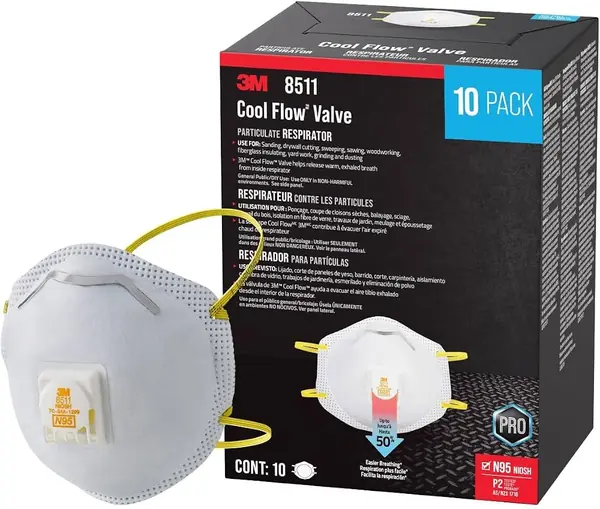
White 3M 8511 N95 respirator with Cool Flow valve and adjustable nose clip

General woodshop dust

Shop Score 94/100
Filter Class
NIOSH N95
Nose Clip
Adjustable M-noseclip
Pack Count
10 respirators
Exhalation Valve
Cool Flow valve
View on Amazon

The Cool Flow valve is the first thing we look for on a disposable mask, and the 8511 is the one we reach for when a sanding session stretches past a quick trim. The valve sends warm, moist exhaled air down and away from your face instead of letting it pool behind the mask, which is why this N95 stays bearable through a pile of boards. The NIOSH N95 rating covers the fine dust that hangs in the air after sawing, sanding, and routing, and the adjustable M-noseclip lets you shape the top edge around your nose.

What makes it our top pick is the balance. It filters like a proper N95, breathes more easily than a basic cup mask, and comes in a ten-pack that lets you keep a clean one on the shelf without treating it like a precious object. We compared it with the flat-fold Aura and the reusable GVS; the 8511 is the easiest one to hand to a helper or take to a job site because there is no filter cartridge to assemble. The two-strap headband holds the mask steady when you look down at the work, and the nose clip stays put once you pinch it.

The valve is a wearer-comfort feature, not source control: it filters what you breathe in, but it does not filter what you exhale. That matters in a shared shop where someone else is working close by, though it is not a concern for solo sanding. For most weekend woodworkers and small shops, the 8511 is the disposable we keep coming back to because it is easy to wear correctly and easy to replace when it gets loaded.

Worth Noting

  • Headbands run snug on larger faces
Our Verdict

For most woodworkers, we recommend the 3M 8511 because its NIOSH N95 filtration, Cool Flow valve, and disposable convenience make it easy to keep on through sanding and sawing.

Check Latest Price
2.

GVS SPR457 Elipse P100 Respirator Best Reusable for Heavy Dust

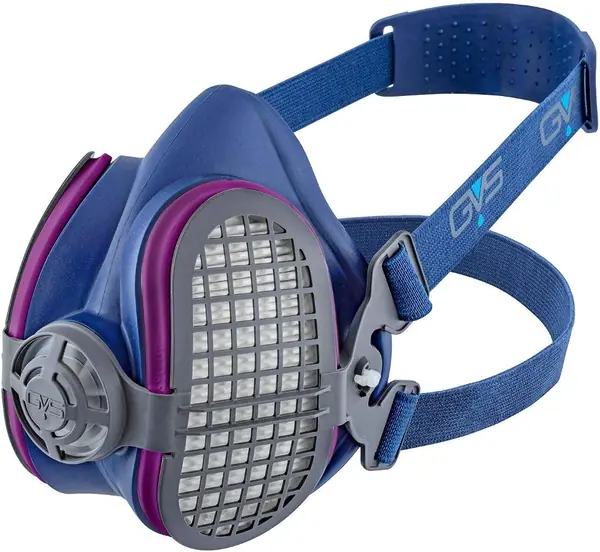
Blue GVS Elipse P100 half-mask respirator with low-profile filter pods

Heavy sanding

Shop Score 93/100
Filter Class
P100
Size
M/L
NIOSH Approval
TC-84A-6949
Included Filters
Replaceable filters included
View on Amazon

The low-profile filter pods are what make the Elipse feel different from a cup mask. They sit close to your cheeks instead of hanging off the front, so safety glasses and a face shield have room to work, and the soft elastomer body seals around the nose without a hard plastic edge digging in. The mask is NIOSH-approved P100, which gives you a higher particulate rating than an N95 for fine wood dust, and the exhalation valve sends breath down rather than into your eyewear.

We reach for the Elipse when a project means hours of sanding or routing rather than a few quick cuts. The P100 filters are replaceable, so the mask keeps working after the first cartridge loads up, and the low breathing resistance keeps it from feeling like a workout on hot days. It also fits under a welding hood or face shield without the filter pods catching on the edge, which is the detail that sold us on the shape.

The replacement filters are not as cheap as a box of disposables, but they are the reason this mask makes sense for a serious home shop. The hook-and-loop headband lets you set the tension once and leave it, and the soft body does not leave a hard seam across your cheeks after a long session. If you sand often and want one mask that stays comfortable under eye protection, the Elipse is the reusable pick we trust.

Worth Noting

  • Runs small for larger faces
Our Verdict

The GVS Elipse is our pick for woodworkers who sand often and want P100 filtration in a reusable mask that stays comfortable under a face shield.

Check Latest Price
3.

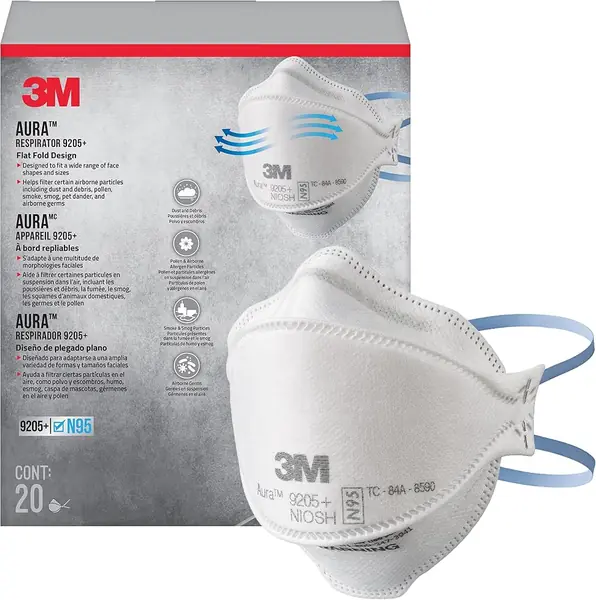
3M Aura 9205+ N95 Respirator Best Flat-Fold Disposable

White 3M Aura 9205+ N95 flat-fold respirator with adjustable nose clip

Glasses wearers

Shop Score 92/100
Filter Class
NIOSH N95
Nose Clip
Adjustable nose clip
Pack Count
20 respirators
Design
Three-panel flat-fold
View on Amazon

The three-panel shape is the reason the Aura feels less like a cup strapped to your face and more like a mask that folds around it. It collapses flat for storage, so it disappears into a toolbox drawer or apron pocket, and the soft inner panel sits against your cheeks without the hard rim of a molded cup. The adjustable nose clip takes a firm pinch, and the NIOSH N95 rating covers the dust from sanding, sawing, and routing.

We like the Aura for glasses wearers because the top panel and nose clip let you shape the mask around the bridge of your nose instead of fighting a rigid edge. It is lighter than the 8511 and does not have a valve, so it is the one we pack when we want a disposable that stays out of the way under a face shield. The 20-pack also makes it easy to keep a few in different spots around the shop.

It is not our top pick because the 8511's valve gives more relief on hot days, but the Aura is the one we reach for when storage and glasses matter more. The flat-fold design is still the better choice for quick jobs and for anyone who wants a low-profile N95 that stores flat. If you wear glasses and want a lighter disposable, the Aura earns its place.

Worth Noting

  • Straps run tight on larger heads
Our Verdict

We like the Aura for woodworkers who want a lighter, flat-fold N95 that packs flat and fits under safety glasses.

Check Latest Price
4.

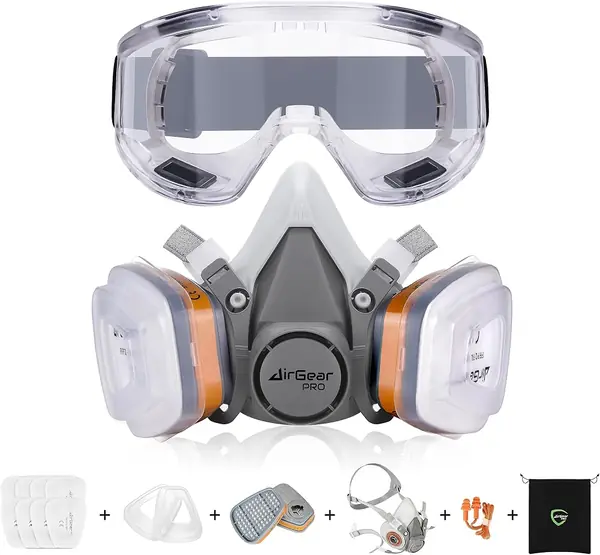
AirGearPro G-500 Reusable Respirator Best Reusable Kit for Occasional Projects

Gray AirGearPro G-500 reusable respirator mask with A1P2 filters

Occasional projects

Shop Score 91/100
Filter Class
A1P2
Weight
3.25 oz
Reusability
Reusable mask
Included Components
Respirator mask and filters
View on Amazon

The dual A1P2 filter system is the reason the G-500 earns a place here. It pairs an organic-vapor cartridge with a particulate layer, so it handles sanding dust and the fumes from wiping on a finish, and the filters are replaceable instead of built into a disposable shell. The mask is CE-certified, lightweight, and adjustable, and the A1P2 rating is a practical step up for a home shop that does both woodworking and painting.

We like the G-500 as the kit you keep on a shelf for occasional projects. The mask is light enough to wear through a staining session, the straps adjust without a lot of fuss, and the replaceable filters mean you are not throwing away the whole mask when the cartridge loads up. It is bulkier than the low-profile Elipse, so it is not the one we choose for a full day of overhead sanding.

Where the G-500 makes sense is a home shop that wants one reusable setup for sanding, finishing, and the occasional paint job. The filters are easy to swap, and the mask has enough adjustment to fit a range of adults. It is not the mask we choose for a production shop or a full day of sanding, but for weekend projects it is a sensible way to stop buying disposables.

Worth Noting

  • Not NIOSH-certified
Our Verdict

The G-500 earns our recommendation as a lower-cost reusable kit for occasional woodworking and painting at home.

Check Latest Price
5.

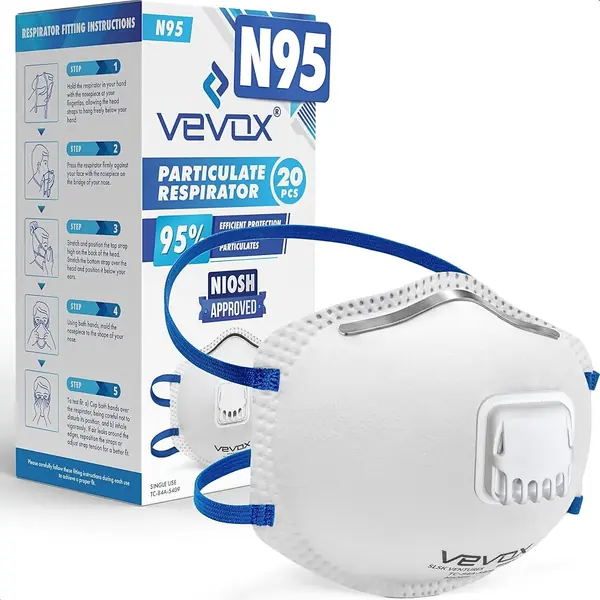
VEVOX N95 Valved Respirator

White VEVOX N95 valved respirator mask with elastic headbands

Backup shop mask

Shop Score 90/100
Filter Class
NIOSH N95
Nose Clip
Aluminum nose clip
Pack Count
20 masks
Exhalation Valve
Valved
View on Amazon

Twenty masks in one box is the reason the VEVOX caught our eye. For a shop where a mask gets left on the bench, stuffed in an apron, or handed to a helper, the larger pack means you are not rationing the good mask. The mask is NIOSH-approved N95, has a valved shell that makes exhaling easier, and uses an aluminum nose clip that you can shape to your face. We see it as a solid spare-mask buy rather than a replacement for our top pick.

The valve is the feature we appreciate most on warm days, because it keeps the inside of the mask from turning into a sauna during a long sanding pass. The four-layer filter and the NIOSH rating are the reasons it belongs in a woodshop, and the 20-pack is enough to keep one in the shop and one in the truck. It is a disposable mask with a shape-retaining shell, so it holds its form in a toolbox instead of collapsing like a flat-fold.

We keep the VEVOX as a backup because it is the box we don't mind leaving open on the bench. The aluminum nose clip is easy to adjust with gloves on, and the valve does not add much bulk. If you want a valved N95 in a bigger pack, it is a reasonable box to keep on the shelf.

Worth Noting

  • Fit can run large for smaller faces
Our Verdict

We see the VEVOX as a solid backup valved N95 for shop dust, with a larger pack than our top pick for keeping spares around the shop.

Check Latest Price

How We Tested Dust Masks in a Working Shop

The shortlist started with certification. We only considered masks with NIOSH approval or a clearly labeled filter class for wood dust, then narrowed by size range, pack count, whether there was an exhalation valve, and — on the reusable models — whether replacement filters were actually in stock and reasonably priced. Cost per mask mattered too, since a ten-pack and a reusable kit with included filters are very different purchases.

We tested 14 masks over six months in a garage shop and a basement workroom, on jobs that included sanding an oak tabletop to bare wood, cutting and routing MDF shelving, and cleaning up with a shop vac afterward. Testers wore them with safety glasses every session and with a face shield at the router, and we deliberately included narrow faces, wide faces, and beards.

Before each session we did a user seal check — palms over the filter, inhale, then exhale — and noted who felt air slipping past the nose clip. We watched for glasses fogging in the first five minutes as an early sign of an upward leak, then checked the seal again after an hour of steady sanding, when sweat and jaw movement tend to break it. Straps got a firm tug after every session to see whether the headband stretched or pulled loose.

We scored comfort at the one-hour mark rather than the first minute, and noted whether the nose clip stayed bent where we put it. Disposables were retired once they were soiled or noticeably harder to breathe through, never washed and reused, and valved models were logged as wearer protection only, not source control. Finally we compared cost per session across a month of weekend work, which is where pack counts and included filters separated the field.

How to Choose a Dust Mask for Woodworking

Certification and Filter Class

For wood dust, start with a NIOSH-approved N95, P95, or P100 respirator, or a complete reusable mask with a particulate filter. The N95 rating means at least 95 percent filtration of non-oil particles; P100 pushes that to 99.97 percent and is the better choice for fine sanding dust and long sessions. A mask labeled N95 without a NIOSH approval is not the same thing.

We treat NIOSH as the baseline for paid or heavy shop work because it is the certification you can verify. The 3M 8511 and Aura are both NIOSH N95, while the GVS Elipse is NIOSH P100; the AirGearPro G-500 is CE-certified A1P2, which covers particles and organic vapor but is not a NIOSH rating. For a home shop, that can be enough; for a workplace with a written respiratory program, stay with NIOSH.

Fit and Seal

A mask that leaks around the edges is not protecting you, no matter what the filter class says. Look for an adjustable nose clip and two headbands rather than ear loops, then take a minute to mold the clip over your nose and settle the straps above and below your ears. Facial hair, a loose strap, or a cup shape that presses instead of sealing will let dust bypass the filter.

We prefer to try one mask before buying a case, especially if you have a larger face or a prominent nose. The 3M 8511 runs snug, the GVS Elipse M/L is compact, and the Aura is a flat-fold that suits some face shapes better than a cup. A quick fit check in the shop is more useful than a higher rating that never seals.

Valve or No Valve

An exhalation valve is a comfort feature, not a filtration upgrade. It lets warm, moist air out of the mask so you do not overheat and your safety glasses are less likely to fog, which is why we like valved masks for long sanding sessions. The 3M 8511 and VEVOX both have one.

The trade-off is source control: a valve protects the wearer but does not filter exhaled breath, so it is not the best choice if you work close to someone else who needs protection from your dust. A non-valved mask such as the Aura is the safer shared-shop choice. For solo work, the valve is worth having.

Disposable or Reusable

Disposables are the simplest way to keep a clean mask ready: no cartridges, no cleaning, and no filter search. They make sense for occasional sanding and for guests in the shop. Reusable masks cost more up front, but a P100 half mask such as the GVS Elipse can be reused session after session if you replace the filters and keep the body clean.

We think the reusable route is worth it only if you can find the right replacement filters when the old ones load up, so check that before you commit. The G-500 uses replaceable A1P2 filters for dust and paint; the Elipse uses P100 particulate filters for wood dust. If you do not want to track filters, stay disposable.

Glasses, Face Shields, and Other PPE

If you wear safety glasses, the mask's top edge matters as much as its filter. A nose clip that molds to the bridge and a low-profile body give your glasses room to sit without the mask pushing them up. A valved mask also reduces fogging because exhaled air goes down instead of up across the lenses.

For face shields and welding hoods, we like the compact GVS Elipse because its filter pods sit close to the cheeks and layer more easily than a bulky cup mask. The Aura is a good flat-fold option under glasses, while the 8511's cup shape leaves more room in front of the mouth. Bring your glasses or shield when you try a mask, and check that the two pieces do not fight each other.

Frequently Asked Questions

Final Verdict

For most woodworkers, we recommend the 3M 8511. It gives you NIOSH N95 filtration, a valve that makes long sanding sessions easier, and a disposable format you can keep clean and ready without managing cartridges. It is the mask we hand to a helper and the one we keep in the shop for everyday cutting and sanding.

If you sand often and want P100 filtration with less waste, the GVS Elipse is the better long-term buy. If you want a flat-fold disposable that stores easily and leaves room for safety glasses, choose the Aura. The right answer depends on how much time you spend in the dust, not on which mask has the highest number on the box.