↑↓ navigate ↵ open Esc close All results →

Best Air Compressors for Woodworking of 2026

Shopping for a shop compressor on decibels alone often ends with a whisper-quiet tank that cannot keep up with a trim gun or sprayer. Tank gallons only buy a few extra seconds of stored air before the pump kicks back in—if recovery CFM falls short, the motor ends up cycling every four or five nails.

Pairing 10 compressors—from compact carry models to a full-height vertical—against trim nailers, a framing gun, and a spray gun over six months of garage, driveway, and bedroom trim work measured how long each motor actually rested between cycles. Just as often, swapping out cheap factory fittings for a tight coupler solved weak-pressure symptoms faster than any pump adjustment.

Every unit in this group can be wheeled or carried into place, hooked up, and started by one person, spanning quiet indoor trim jobs, punch-list travel, and stationary shop runs.

Our Top Picks

The Best Air Compressors for Woodworking

1.

California Air Tools 8010 Best Overall
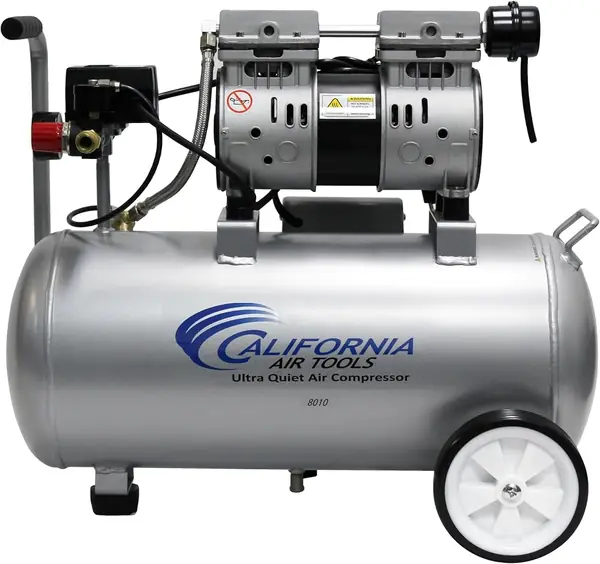
California Air Tools 8010 air compressor with silver eight-gallon steel tank and wheel kit

Home shop nailing

Shop Score 94/100
Tank Size
8 gallons
Weight
48 lb
Noise Level
60 dB
Airflow
3 CFM
View on Amazon

Sixty decibels is the number that earns the 8010 the top spot here. That's roughly the volume of a normal conversation, so the pump can cycle at your elbow in a basement or a spare-bedroom shop while you set casing, and nobody upstairs reaches for ear protection. The eight-gallon steel tank does the rest of the arguing: a run of brad or finish nails doesn't turn into a duet with the motor.

We like the proportions of this one as much as the sound of it. Three CFM of airflow and a 120 PSI ceiling cover nailers and staplers comfortably, the listed fill runs just under three minutes, and the wheel kit moves a 48-pound tank between bench, driveway, and storage without a lift. Quiet, capacity, and portability rarely come in the same package at this level, and that balance is what we keep coming back to.

One practical note before you order. A regulator or gauge can arrive damaged or reading off, so fill it to full pressure, shut it off, and leave it an hour before the return window closes. A slow leak is easy to catch that first week and miserable to find halfway through a project.

For nailers, staplers, and blowing dust off a bench, this is the compressor we hand a home woodworker first. Spray finishing is where it runs out of breath: three CFM and eight gallons will lay a coat on a small project but won't keep a conversion gun fed through a bookcase. For that work, look further down this list.

Worth Noting

  • Tall tank and low handle make stairs a chore
  • Long-term pump life is the open question
Our Verdict

We put the 8010 first for indoor woodworking: it runs at 60 dB, holds eight gallons of air, and rolls out of the way when the bench is clear.

Check Latest Price
2.

Makita MAC2400 Big Bore Best for All-Day Nailing

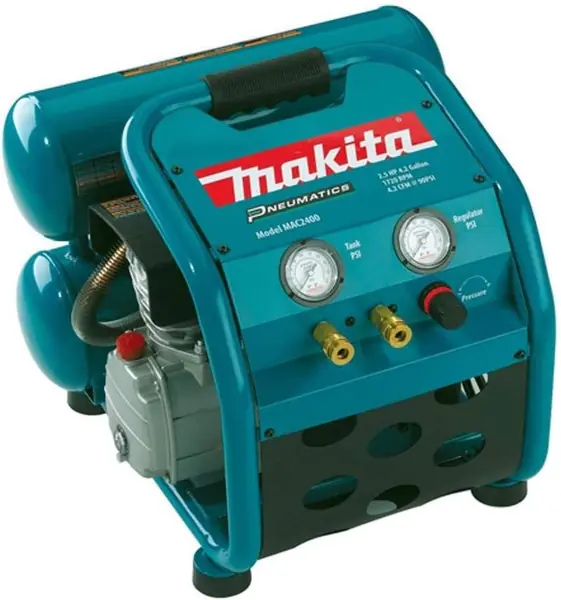
Makita MAC2400 Big Bore compressor with twin-stack steel tanks and roll cage

All-day nailing

Shop Score 93/100
Tank Size
4.2 gallons
Airflow At 90 PSI
4.2 CFM
Weight
77 lb
Noise Level
79 dB
View on Amazon

A cast-iron cylinder, an oil-lubricated pump, and 4.2 CFM at 90 PSI: the MAC2400 is built like the compressors that spend a decade in the back of a work van. Among the nailer-focused picks here, only the big vertical shop unit moves more air. It's the one we trust for a full day of nailing rather than an afternoon of trim.

That output is what you're paying for. Two trim guns, or a framing nailer and a stapler, can run without waiting on the tank, and the low-RPM motor keeps the pump cooler than the oil-free units do over a long session. The cast-iron cylinder can also be pulled for service, which is not something anyone can do with a sealed oil-free pump.

Noise lands at 79 dB — loud enough to want plugs during a long run, but quiet for this much air, and far easier on the ears than the 82 dB machines in this group. The low amp draw means fewer tripped breakers at startup, which matters in an older garage where the compressor shares a circuit with the lights.

We recommend it to someone whose nailing is the main event: siding, sheathing, a deck, a run of cabinets. Where it stops making sense is finish work in a furnished house, where 79 dB and a 4.2-gallon tank are both more than the job wants.

Worth Noting

  • 77 pounds rules out regular carrying
  • Small tank cycles often under load
Our Verdict

We steer anyone who nails most days to the MAC2400: 4.2 CFM and a serviceable cast-iron pump make it the longest-working pick here.

Check Latest Price
3.

Makita MAC210Q Quiet Series Best for Indoor Trim Work

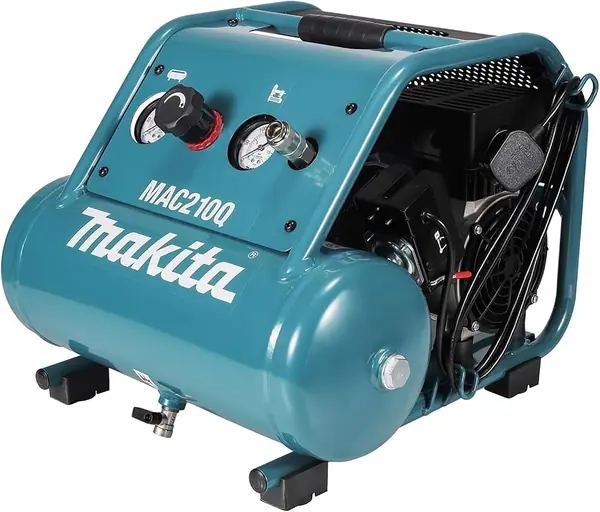
Makita MAC210Q Quiet Series compressor in teal with roll cage and two-gallon tank

Indoor trim work

Shop Score 92/100
Tank Size
2 gallons
Noise Level
60 dB
Maximum Pressure
135 psi
Airflow
1.6 CFM
View on Amazon

Two gallons is the whole story with the MAC210Q. At 1.6 CFM it's a trim compressor — casing, baseboard, a face frame, a few dozen fasteners at a time — and no amount of hush turns it into a cabinet-shop machine.

What the small tank buys is portability and quiet. Sixty decibels, a roll cage for a handle, and a footprint that fits on a shelf mean it can go up a flight of stairs, sit on a drop cloth in a finished room, and cycle while the homeowner is still on the phone. We think that's the right trade for finish carpentry, where the job is short and the setting is somebody's house.

The build is the other reason it lands here. The dual-piston oil-free pump needs no oil, the cage shrugs off a truck bed, and 135 PSI of headroom is more than a brad nailer will ever ask for. We recommend it to the carpenter who wants one small, quiet machine that starts every time it's plugged in.

Worth Noting

  • Premium price for a two-gallon tank
Our Verdict

For finish carpentry inside a furnished house, we pick the MAC210Q: 60 dB and a two-gallon tank that carries like a toolbox.

Check Latest Price
4.

California Air Tools 1P1060S Best Lightweight

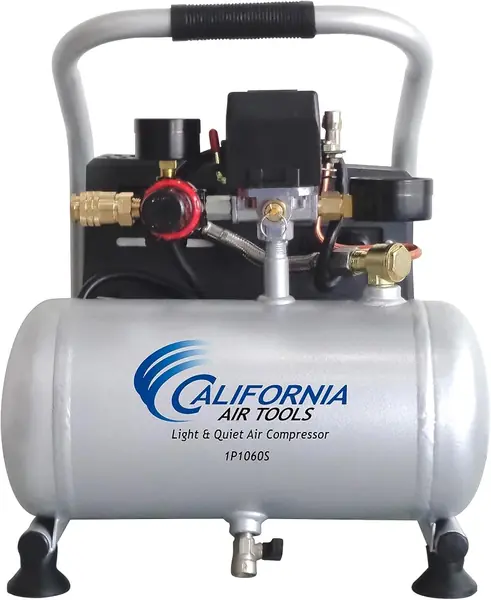
California Air Tools 1P1060S one-gallon compressor with silver steel tank and carrying handle

Punch-list nailing

Shop Score 91/100
Tank Size
1 gallon
Airflow At 90 PSI
1.2 CFM
Weight
29 lb
Noise Level
56 dB
View on Amazon

One hand on the handle, the other holding a level — the 1P1060S is the compressor that goes where the work is. At 29 pounds and 56 dB it's the lightest and quietest machine on this list, and it's the one we take for punch-list work: a loose baluster, a cabinet door, a run of shoe molding upstairs.

The single-gallon tank refills about as fast as a pin nailer drains it, which is why a few hundred brads in an afternoon is realistic. It also holds pressure between sessions, so you're not waiting on the pump every time you lift it off the shelf — a small thing that turns into a real one when you're carrying it room to room.

Treat it as a second compressor, or as a first one for small work. It's the least expensive pick here, it starts on a household circuit at 4.5 amps, and nothing else in this group is as easy to bring to a repair. Just don't ask it to spray a cabinet.

Worth Noting

  • 1.2 CFM limits it to brad and pin nailers
Our Verdict

We keep the 1P1060S for small work: 56 dB and 29 pounds make it the easiest compressor here to carry to a repair.

Check Latest Price
5.

Porter-Cable C2002-WK Best Kit for Beginners

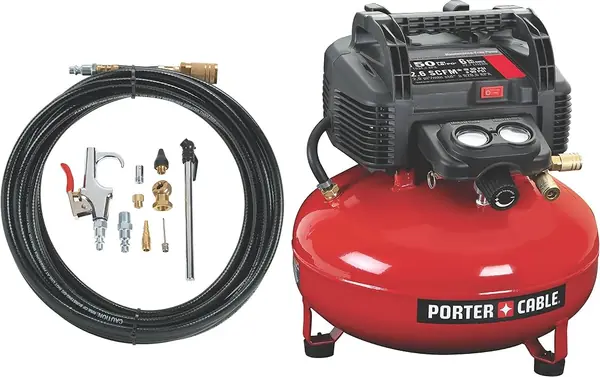
Porter-Cable C2002-WK red and black pancake compressor with handle and accessory kit

Starter kit

Shop Score 90/100
Tank Size
6 gallons
Airflow At 90 PSI
2.6 SCFM
Maximum Pressure
150 psi
Hose Length
25 feet
View on Amazon

The hose is the reason to look here. The C2002-WK arrives with a 25-foot air hose and a 13-piece accessory kit, so a first compressor doesn't need a second order before it can fire a nail. You unbox it, fill the tank, and start working.

Behind the kit is a familiar pancake compressor: six gallons, 150 PSI, and 2.6 SCFM at 90 PSI, which covers a brad or finish nailer through an afternoon and a tire top-off afterward. The low-amp motor is the sleeper feature — it starts in a cold garage or on a longer extension cord, which is more than every compressor in this group can claim at the end of a winter.

We recommend it as a starter kit for someone who wants everything at once. The pancake sits flat on a bench or a floor, the drain valve is easy to reach, and the regulator is simple enough to set without digging out the manual. It's a garage-and-driveway compressor, and that's exactly how we'd expect most buyers to use it.

Worth Noting

  • 82 dB is loud for indoor work
Our Verdict

The C2002-WK is our pick for a first compressor: it brings the hose and fittings, and 150 PSI handles trim work all afternoon.

Check Latest Price
6.

Klutch 29-Gallon Vertical Best for Spray Finishing

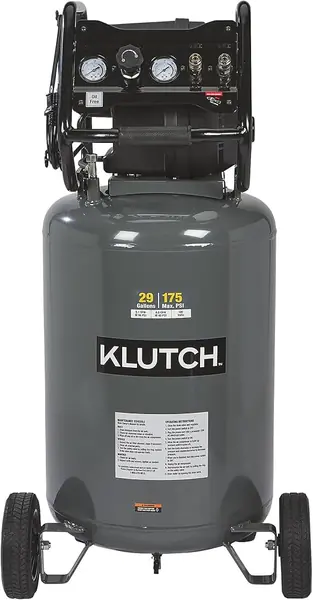
Klutch 29-gallon vertical air compressor with tall steel tank and flat-free wheels

Spray finishing

Shop Score 89/100
Tank Size
29 gallons
Airflow At 90 PSI
5.1 SCFM
Weight
127 lb
Maximum Pressure
175 psi
View on Amazon

Spray finishing is where the rest of this list runs out of air, and it's the reason the Klutch is here. At 5.1 SCFM at 90 PSI it moves more air than anything else we cover — enough to keep a conversion gun fed, and enough for the tools that empty a one-gallon unit in seconds, like a die grinder or a hard-worked blow gun.

The vertical format is the other half of the appeal. Twenty-nine gallons standing about four feet tall claim a corner of the shop rather than a stretch of bench, and the large flat-free tires roll it out for a project and back against the wall afterward. The 175 PSI ceiling gives air tools a wake-up that the small units can't.

Set it up like an appliance. It draws 14.5 amps, so give it a circuit that isn't shared with a table saw, and work the drain after every session — 29 gallons of stored air carries a lot of water with it.

For a shop with a permanent corner and a spray gun, this is the machine that makes finishing practical rather than a series of waits. For everyone else it's more compressor than the work asks for, and the footprint is a commitment you can't undo once the tank is full.

Worth Noting

  • 127 pounds means it stays put
  • Fittings can work loose over time
Our Verdict

If you spray finishes, we point you to the Klutch: 5.1 SCFM at 90 PSI is more air than anything else here.

Check Latest Price
7.

Limodot LJ8120K

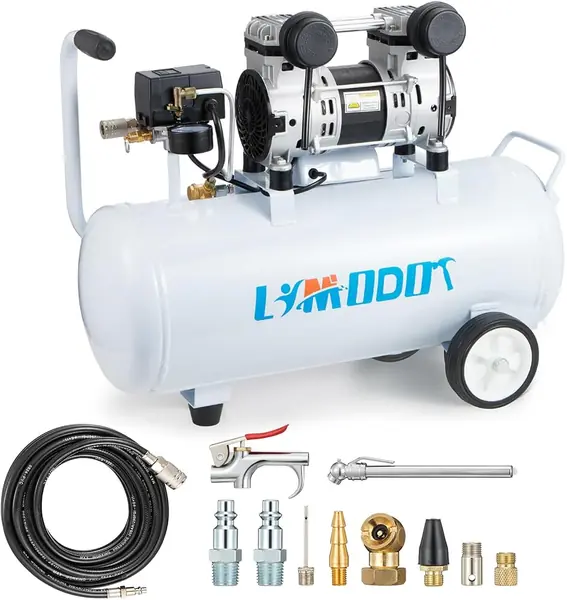
Limodot LJ8120K eight-gallon compressor in white with hose and accessory kit

Value shop kit

Shop Score 88/100
Tank Size
8 gallons
Airflow At 90 PSI
2.8 CFM
Maximum Pressure
120 psi
Hose Length
25 feet
View on Amazon

Eight gallons, a 25-foot hose, and a bag of fittings for about the same money as our top pick — the Limodot is the value play of this group, and it lines up on paper with compressors that ask more.

The numbers hold up: 2.8 CFM at 90 PSI, a 120 PSI ceiling, and a recovery time short enough that a brad nailer won't outrun it. The kit is the practical part — quick-connect fittings, a blow gun, a tire chuck — the sort of extras that otherwise turn into a second order the week after the compressor arrives.

So where does it fit? As a second compressor for the garage, or a first one for a woodworker who wants eight gallons and a hose without paying for a name. It's the pick we mention when a reader likes our top choice but wants the accessories in the box and a smaller outlay.

Worth Noting

  • Noise claim is optimistic for a garage
Our Verdict

Eight gallons and a full hose kit make the Limodot our value pick for a garage shop.

Check Latest Price

How We Tested Air Compressors for Woodworking

We pulled spec sheets for two dozen compressors and narrowed to ten we could test, dropping anything that couldn't be moved and started by one person. Those ten, from small carry units to a full-height vertical, ran for six months in a working garage shop, on a driveway, in a spare bedroom mid-trim, and on punch-list calls. One person unboxed, set up, and started each one before it entered the rotation.

We didn't trust the airflow ratings on the box. Each unit was paired with the tools it claims to serve — a brad nailer, a trim nailer, a framing gun, a spray gun — and we counted fasteners driven before the motor kicked on, then timed the recovery. A sound meter at operator height logged the room from a few feet away, and we noted whether we could talk over it or had to leave. Soapy water went on every factory fitting, coupler, and drain; we marked what bubbled.

Each unit was weighed and then moved the way a job moves: over a threshold, down basement stairs, into a truck bed, so we knew where wheels earned their keep and where a handle didn't. Oil-lubricated pumps were checked for oil consumption; oil-free ones were watched for heat on long runs. Between sessions we drained the tanks and reached for the drain valve with the compressor in place — if it's hard to get to, the tank rusts from the inside.

Footprint, hose length, and every included fitting were logged, and each unit ran on a circuit sized for its amp draw, never sharing a run with other shop machines. The seven that stayed in rotation did it by starting every time, holding pressure overnight, and staying within earshot of the tool they were feeding.

How to Choose an Air Compressor for Woodworking

Match the Airflow to the Tool, Not the Tank

A six-gallon tank and an eight-gallon tank running the same pump deliver the same air; the bigger tank only delays the moment the motor restarts. What matters is CFM at 90 PSI. Brad and pin nailers sip air and run on 1.2 CFM. Trim and framing nailers want 2.5 or more. A conversion gun for spray finishing wants 4 CFM and up, and that is where most home compressors fall short.

That is the trap in shopping by tank size: a big pancake compressor can look more capable than a smaller machine that actually moves more air. Read the flow figure first, then let the tank size tell you how often the motor will run.

Decibels Decide Where You Can Work

An 82 dB compressor in a garage with the door open is a non-issue. In a basement under a bedroom it ends the evening. The quiet machines here run 56 to 60 dB, roughly conversation level, and the loud ones sit in the low 80s. We put a premium on the quiet end, because most home woodworking happens close to the house.

Treat a decibel claim as a claim rather than a measurement. If a number sounds too good for a machine that size, plan on it being louder in the room than the box says, and buy where you can return it.

Oil-Free or Oil-Lubricated

Oil-free pumps need no oil changes and shrug off cold, dusty shops; the trade is a shorter service life and a sealed pump you replace rather than repair. Oil-lubricated cast-iron pumps run cooler and can be serviced, and that is why our daily-use pick here is oil-lubricated.

If you nail a few weekends a year, oil-free is the simpler ownership and the maintenance you skip is worth more than the life you give up. If the compressor is the center of the shop, pay for cast iron.

Tank Shape, Weight, and What Comes in the Box

Tank shape matters more than most shoppers expect. A pancake compressor sits flat and stable on a bench or a floor, a twin stack is compact but tall, and a vertical tank claims a corner and stays there. Then think about the trip the machine actually makes — bench to driveway, truck bed to a job — because weight and wheels decide whether you use it or dread it.

Check the box before you buy: a hose, quick-connect fittings, and a drain valve you can reach without kneeling save a second order. Expect to drain the tank after every session in a cold shop.

Frequently Asked Questions

Final Verdict

The California Air Tools 8010 is the compressor we point most woodworkers to, because 60 dB and eight gallons solve the two problems a home shop actually has: noise that follows you into the house, and a pump that starts again mid-run of nails.

If nailing is the main event rather than the finish work, the Makita MAC2400's 4.2 CFM and cast-iron pump justify the weight and the money. If you spray, the Klutch's 5.1 SCFM is the only one here that keeps up.