↑↓ navigate ↵ open Esc close All results →

Best Airless Paint Sprayers of 2026

An airless sprayer can turn a two-weekend repaint into a single Saturday, leaving a smoother finish on cabinet doors than a brush and covering siding faster than a roller—unless poor pressure control or awkward flushing hands back a two-hour cleanup. Drawing unthinned latex straight from the bucket requires adjustable pressure, a tip matched to the coating, and enough hose length to keep the pump safely on the ground.

Running unthinned latex, primer, and stain through eight machines over nine months on interior rooms, a fence, a deck, and a shed—while timing every post-job flush—showed that peak PSI numbers tell very little on their own. Rated gallon capacity over a project and how cleanly a sprayer minimizes overspray mist indoors matter far more over time.

From compact handheld units suited to doors and furniture to stand and cart rigs built for whole exteriors, matching pump capacity to annual gallon volume keeps maintenance predictable.

Our Top Picks

The Best Airless Paint Sprayers

1.

Graco Magnum X5 Best Overall
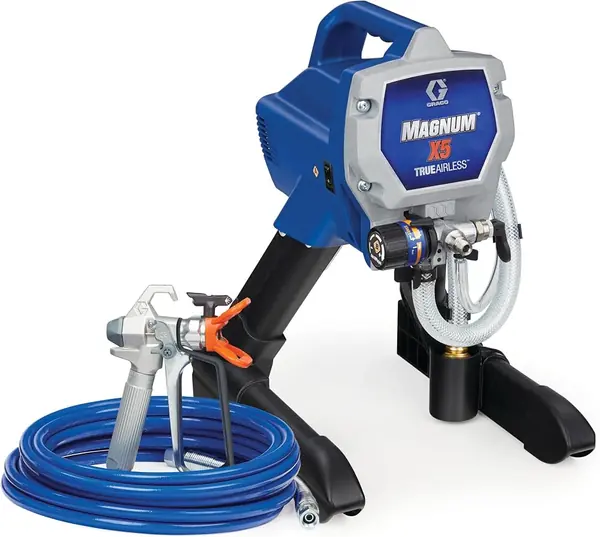
Graco Magnum X5 blue stand airless paint sprayer with pressure control and hose

Most home projects

Shop Score 93/100
Maximum Pressure
3000 psi
Weight
15 lb
Hose Length
25 ft, accepts up to 75 ft
Project Capacity
Up to 10 gallons
View on Amazon

Spraying latex straight from a five-gallon bucket without thinning is the test a real airless sprayer passes and a glorified pump fails, and the Magnum X5 passes it at whatever pressure you dial in. The flexible suction tube drops into a 1- or 5-gallon container, so there's no ladling paint into a hopper between passes.

That pressure control is what earns it the top spot here. Turned down with a fine tip it lays a smooth coat on cabinet doors and trim; opened up it covers a fence line or a garage ceiling without complaint. At 15 pounds it's light enough to carry one-handed and set on a stair tread, the pump is rated for projects up to 10 gallons, and it accepts hose up to 75 feet, so a second-story run doesn't mean dragging the machine onto scaffolding.

In the box you get a 25-foot hose, the SG2 metal gun, and a RAC IV 515 switch tip, with a quick-start guide that's genuinely usable for a first-timer. What we minded is the flush at the end of the day — it's the slowest stretch of the project. Run water through right after the last pass, use the PowerFlush adapter, finish with the Pump Armor fluid, and the next start is painless.

For the breadth of work it covers — a bedroom ceiling on Saturday, a fence line on Sunday — nothing else here covers as much ground, and with a fine tip in the gun you don't need a second machine for trim.

Worth Noting

  • Pumps can fail mid-project
Our Verdict

We recommend the X5 to anyone with more than one room to paint: it sprays unthinned latex and stain at any pressure and covers projects up to 10 gallons.

Check Latest Price
2.

Graco Magnum ProX19 Best for Large Jobs

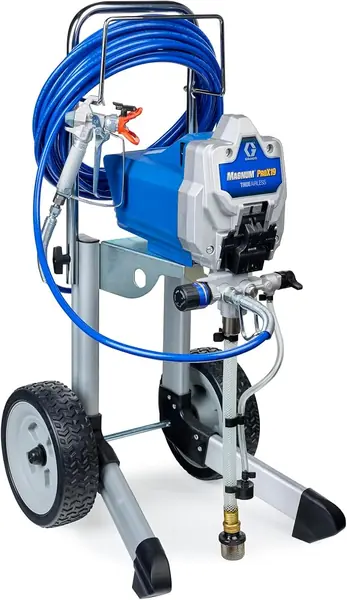
Graco Magnum ProX19 blue and white cart airless paint sprayer with hose

Large repeat jobs

Shop Score 91/100
Maximum Pressure
3000 psi
Weight
42 lb
Annual Capacity
Up to 500 gallons
Pump Replacement
ProXChange, no tools
View on Amazon

The ProX19's selling point is the cart, and that's what sells us on it: it stands on its own wheels beside the wall while you work, hose trailing where you need it, and you never lift it between passes. For a whole exterior, that is the difference between a job you finish in a weekend and one you quit at lunchtime. Above the wheels sits a 3000 psi stainless piston pump with fully adjustable pressure that sprays paint unthinned, set up for up to 500 gallons a year — a working machine rather than a weekend one.

Two details we paid close attention to. The ProXChange system lifts the pump out without tools, so a failure mid-job becomes a swap rather than a shipment back to the factory, and the InstaClean filter catches debris before it ever reaches the tip. The RAC IV tip reverses to blow a clog clear without pulling the gun apart.

What it isn't is a first sprayer. A homeowner painting two rooms a year pays for output and capacity that never get used, and a machine built for this much work wants a garage to live in rather than a closet shelf. For a remodeler, a landlord, or anyone keeping up a house, a barn, and a rental, that capacity is the whole argument.

Worth Noting

  • 42 lb cart takes two hands to load
Our Verdict

Our pick for whole-house and repeat work — the cart, the 500-gallon-a-year rating, and a pump you swap without tools make a long job manageable.

Check Latest Price
3.

Wagner Control Pro 130 Best for Indoor Painting

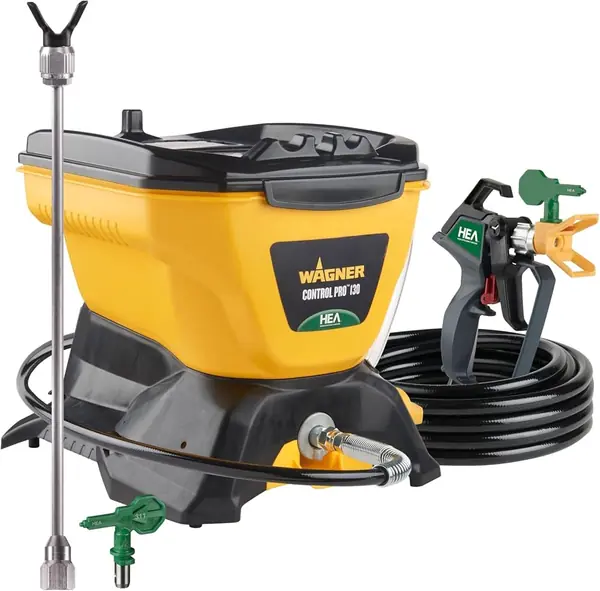
Wagner Control Pro 130 yellow hopper airless sprayer with hose and two tips

Interior rooms

Shop Score 86/100
Maximum Pressure
1600 psi
Weight
9.5 lb
Included Tips
413 and 515, plus 12 in wand
Hopper Capacity
1.5 gallons
View on Amazon

Indoors, overspray is the whole job. Every extra foot of mist in a finished room turns into masking film, tape, and a wipedown, which is why the high-efficiency airless design here matters: Wagner puts the reduction at up to 55 percent less overspray than a traditional airless pump, with a softer spray that's easier to steer along a cut line.

For walls and ceilings in a house you're living in, this is the one we reach for. It runs at 1600 psi rather than 3000, draws from an on-board hopper, and weighs 9.5 pounds — light enough to carry room to room and set on a step stool. The kit includes a 413 and a 515 tip plus a 12-inch extension wand, which is exactly the pair you want for walls, trim, and a ceiling that's easier to reach from the floor.

Gravity feed does ask you to keep the pump head above the work, so it rides a stool rather than the floor. What you get back is a machine you'll actually pull out for one room, with far less taping and setup than dragging out a 3000 psi rig with a bucket of its own.

Worth Noting

  • 1.5-gallon hopper needs frequent refills
Our Verdict

If masking a furnished room is what's stopping you, buy this one: high-efficiency airless cuts overspray indoors and the whole kit weighs 9.5 pounds.

Check Latest Price
4.

InoKraft NEO Best Budget Kit

InoKraft NEO compact airless paint sprayer kit with hose tips and cleaning tools

First-time buyers

Shop Score 85/100
Maximum Pressure
3000 psi
Weight
10.1 lb
Max Output
0.26 GPM
Hose Length
25 ft
View on Amazon

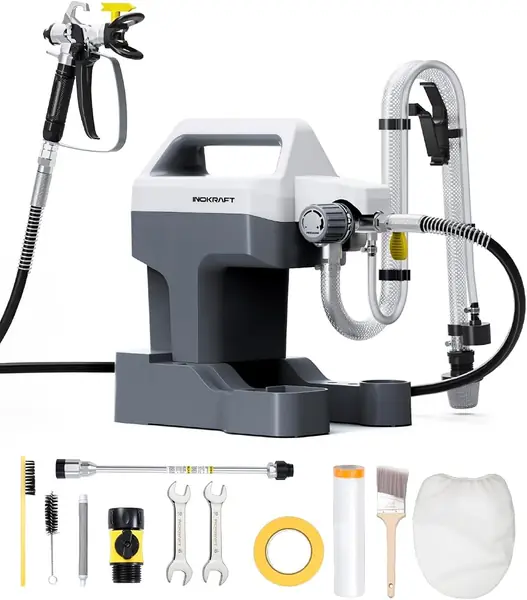
Open the NEO's box and you find a first-project kit rather than just a pump: a 515 nozzle and adapter, 25 feet of hose, a 12-inch tip extension, masking film, painter's tape, a strainer, a touch-up brush, cleaning tools, and goggles. For someone who has never owned an airless sprayer, that's the difference between starting on Saturday morning and driving to the store on Saturday morning.

The machine is a 10.1-pound, 3000 psi unit that pulls compatible latex and stain from a 1- or 5-gallon bucket without thinning, and the built-in Flush-Ease valve lets you hook a garden hose straight to it, so flushing is a few minutes of work rather than an evening. The trade for the light body and the modest outlay is pace: this is a sprayer you walk behind, not one you chase.

Where it earns its place is as a first sprayer — a couple of rooms, a set of cabinet doors, a small deck, with directions written for someone who has never primed a pump. We like that the kit settles the accessory question, since those extras are the part first-timers forget to order. If spraying becomes a habit, output is what you'll outgrow first.

Worth Noting

  • 0.26 GPM output is the slowest here
Our Verdict

A first sprayer for a first-timer: the NEO arrives with the tips, tape, and hose you need, and it weighs 10.1 pounds.

Check Latest Price
5.

InoKraft MaXpray M1 Best for Big DIY Exteriors

InoKraft MaXpray M1 stainless airless sprayer with 25-foot hose and extension

Bigger DIY exteriors

Shop Score 84/100
Maximum Pressure
3000 psi
Weight
22.6 lb
Max Output
0.31 GPM
Hose And Reach
25 ft hose with 12 in extension
View on Amazon

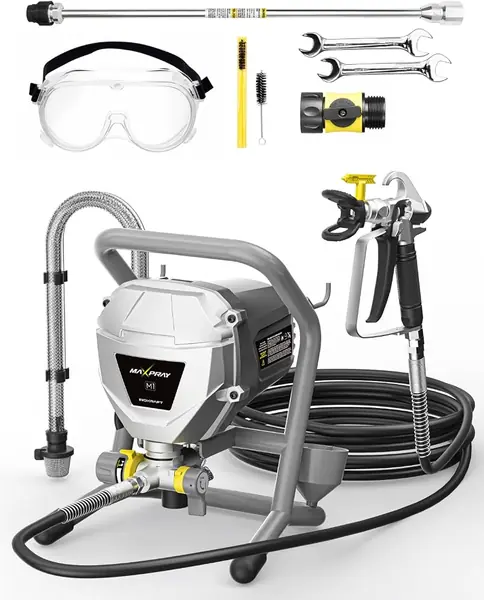
Compared with the NEO, the MaXpray M1 is the same idea with a bigger pump and a heavier body: 0.31 GPM against 0.26, a 3000 psi stainless pump, a 25-foot hose, and a 12-inch tip extension on a 360-degree swivel so the gun reaches a ceiling without your shoulder doing the work.

That extra output is what makes a fence, siding, or a whole run of rooms feel routine instead of endless, and the reversible carbide 515 tip flips to clear a clog without pulling the gun apart. We were also impressed by how complete the kit is — two wrenches, goggles, a Flush-Ease valve, and a laminated quick-start guide. It supports up to 75 feet of hose, so the pump can sit in the shade while you work around a corner.

For a homeowner with an exterior to repaint every few years, this lands in the middle of the range: more output than the NEO, far less machine than a pro cart, and a finish that holds up on siding and deck rails. It's the one we'd hand to someone whose projects got bigger than their first sprayer.

Worth Noting

  • No cart, so you carry all 22.6 lb
Our Verdict

We think the M1 hits the sweet spot for big DIY exteriors, with 0.31 GPM of output and a 12-inch extension for ceilings.

Check Latest Price
6.

Gyfent X9 Best for Fences and Sheds

Gyfent X9 blue airless paint sprayer with 25-foot hose and extension rod

Fences and sheds

Shop Score 83/100
Maximum Pressure
3000 psi
Max Output
0.39 GPM
Hose Length
25 ft
Motor
650W
View on Amazon

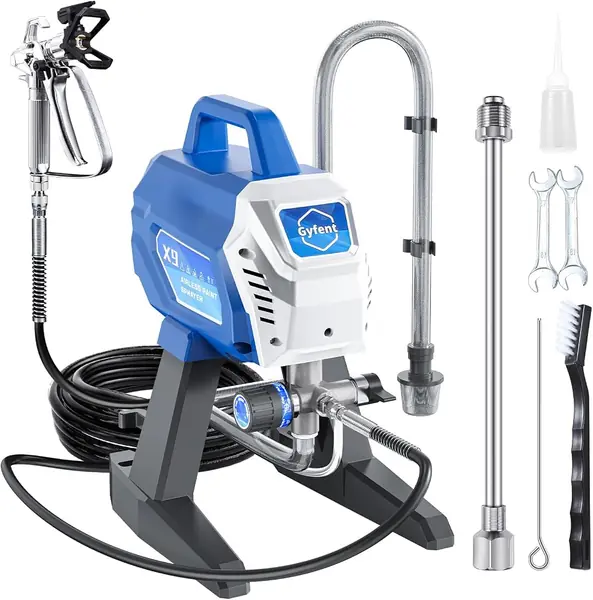
The X9's number sheet is the most aggressive here: 650 watts, 3000 psi, a claimed 0.39 GPM, 25 feet of hose, an 11.8-inch extension rod, a shoulder strap, and a cleaning kit — more claimed output than either InoKraft. What a spec sheet can't tell us is how the pump behaves on the third bucket of exterior stain, and that's the question a sprayer ultimately has to answer.

For a shed, a fence line, and garage walls — work a machine gets twice a year — it covers the job, and the shoulder strap means it can hang on a hook rather than take up shelf space. The single nozzle in the box is the thing to sort before you start: order a smaller tip for trim and a wider one for siding in the same order, because swapping tips mid-project is what turns a cheap sprayer into a frustrating afternoon.

Worth Noting

  • Ships with only a single spray nozzle included
  • Long-term pump performance on multi-bucket jobs is unproven
Our Verdict

The most output per dollar here on paper, and a sensible choice if your spraying is a fence and a shed twice a year.

Check Latest Price

How We Tested the Airless Sprayers

We started with spec sheets and the questions that decide a purchase: how many gallons a pump is rated to push in a project and over a year, whether pressure is adjustable, what tips, hose, and wand come in the box, and whether it sprays unthinned latex on day one. Anything that needed paint cut with water to move, or that arrived without a hose and gun, came off the list.

Eight units then spent nine months with us on a rotation that mirrored a real homeowner's year: two interior rooms with ceilings, a set of kitchen cabinet doors and drawer fronts on sawhorses, a fence, a deck, and a shed exterior, with primer on fresh drywall in between. We wore eye protection and a respirator for every session, ventilated or isolated indoor spaces with plastic sheeting and fans, and never pointed a gun anywhere but the surface.

We timed how long a coat took on the same room every time, weighed the bucket before and after to see how much paint reached the wall versus the air, and hung white paper at three, six, and nine feet to measure how far the mist carried indoors. Cleanup got a stopwatch: how many minutes of flushing before the gun ran clear.

We also weighed each unit, carried it between rooms and up a ladder, and swapped tips mid-project to see what the finish did. Clogs got logged on the heavier latex: when a fan started tailing off or spitting, and whether straining the paint fixed it. Pumps sat stored with protecting fluid between jobs and had to start cold the next time. Value came last: a unit that sprayed beautifully but left us buying tips and hose separately didn't score well.

How to Choose an Airless Paint Sprayer

Match the Pump to the Gallons You'll Push

There's a real difference between a machine rated for projects up to 5 gallons and one rated for 500 gallons a year, and it isn't marketing. The first is built for a homeowner's fence and a couple of rooms; the second has the duty cycle to run all day, several days a week. Count the gallons your project actually needs before you shop, then buy one step above it — a pump run flat out at its ceiling is the one that quits mid-job.

Don't shop by psi alone. Pressure is what forces paint through the tip, but output and tip size set your pace, which is why a 0.31 GPM machine finishes a fence noticeably faster than a 0.26 GPM one at the same 3000 psi.

Decide How Much Overspray You Can Live With

Traditional airless throws a fine mist that settles on everything in the room, so masking isn't optional — it's an hour or two before the first pass. High-efficiency airless machines like the Wagner run at lower pressure and claim up to 55 percent less overspray, with a softer spray that's easier to control along a ceiling line.

Our rule: rooms full of furniture call for the low-overspray machine, while an empty house, a new build, or an exterior calls for the standard 3000 psi pump with the reach to match. Even a low-overspray unit needs floors covered, and mist drifts farther than the room you're in — a garage isn't automatically safe.

Get the Tip Right and the Finish Follows

Tips are numbered for a reason: in a 515 tip, the first two digits give a 10-inch fan at 12 inches from the surface, and the last two give the orifice size. So a 413 lays a narrower, finer pattern for trim and cabinet doors, while a 515 covers wall and ceiling at speed. Buy reversible tips — they flip to clear a clog with a trigger pull instead of a gun teardown.

A worn tip leaves streaks and wastes paint, so keep a spare in the size you use most. If you're spraying stain rather than paint, step down to a smaller orifice so the coating goes on in coats rather than runs.

Weigh the Machine Against the Reach You Need

A 9.5-pound hopper sprayer moves from room to room without a thought; a 15-pound stand unit is a one-hand carry that can live on a stair tread; a 42-pound cart is a two-person load into a truck but never has to be lifted while you work. Be honest about stairs, ladders, and how much room you have to store it.

Hose and wand length matter as much as the pump. Twenty-five feet gets you around a room, 75 feet lets the machine sit in the shade while you spray a fence, and a 12-inch extension keeps you off the ladder for ceilings and eaves.

Plan the Cleanup Before You Prime

Flushing is the part of spraying nobody enjoys and everybody has to do: water through the pump, hose, and gun the moment the last pass ends, then a storage fluid to keep the pump from seizing between jobs. A machine with a flush valve or a power-flush adapter turns that from a chore into a short job rather than an evening.

We weight cleanup as heavily as output, because a sprayer that's miserable to clean is a sprayer that stays on the shelf while you reach for a roller.

Frequently Asked Questions

Final Verdict

The Graco Magnum X5 is the sprayer we point most people toward: unthinned latex and stain at any pressure, light enough to carry, and rated for the 10 gallons a typical homeowner sprays in a year. If your work is a whole exterior or a rental turnover, the ProX19's cart and 500-gallon rating earn their keep in a season.

And if masking a furnished room is the thing that stops you from spraying at all, the Wagner Control Pro 130 is the cleaner answer indoors.