↑↓ navigate ↵ open Esc close All results →

Best HVLP Paint Sprayers of 2026

An HVLP sprayer delivers a smooth coat for the first ten minutes, right before a mid-pass sputter lands a heavy droplet on a fresh cabinet door or a sloppy fan pattern oversprays narrow trim. Reliable sprayers prevent both problems with predictable flow control, crisp pattern shaping, and passages simple enough to strip clean without losing an entire evening.

Nine months of spraying cabinet doors on sawhorses, shutters, trim, and a fence line with eight HVLP units reinforced how dramatically teardown simplicity affects real shop use. Testing also showed that most orange peel and spitting stems from paint left slightly too thick rather than hardware defects, making proper viscosity checks essential before pulling the trigger.

Both plug-in handheld sprayers and higher-output turbine-and-hose systems earn consideration depending on finish standards and project size, judged here by coats smooth enough to skip extra sanding.

Our Top Picks

The Best HVLP Paint Sprayers

1.

Fuji Spray Semi-PRO 2 Gravity Best Overall
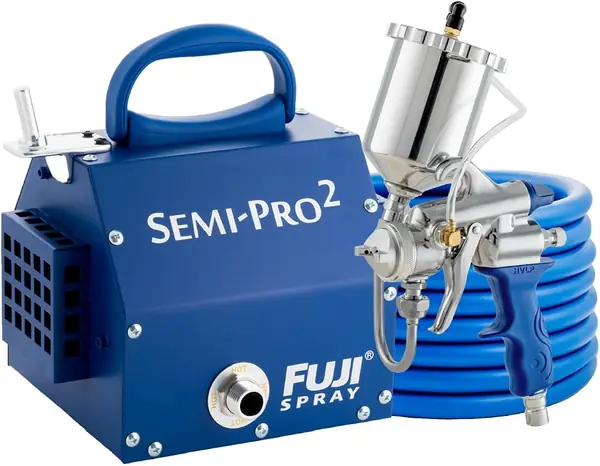
Fuji Spray Semi-PRO 2 blue turbine and gravity-feed HVLP spray gun with hose

Furniture and cabinets

Shop Score 93/100
Cup Capacity
400 ml gravity
Hose Length
25 ft with air control valve
Maximum Pressure
5 psi
Turbine Motor
1400W, two-stage
View on Amazon

The knob on the side of the gun is the first thing we reach for. Fuji mounts fan pattern control on the M-model gun, so the spray goes from a tight circle for a chair spindle to a wide fan across a cabinet door with a turn of the knob, and because the gun is non-bleed the air moves only when you pull the trigger. Behind it sits a 1400-watt two-stage turbine running 5 psi into 25 feet of hose with its own air control valve. That pairing is why we recommend the Semi-PRO 2 as the default for anyone finishing furniture at home: it sprays stain, shellac, waterborne poly and thinned cabinet enamel without a compressor in the room.

In use, the split between gun and turbine is the luxury. The turbine stays in the doorway or the next room, so the noise, the cord and the heat sit behind you while the hose follows you around the piece. The 400 ml gravity cup keeps material flowing evenly to the last of it, and cleaning is a gun-only job — pull the air cap and nozzle, flush, wipe, reassemble. That short list of parts is what separates a sprayer you pull out for every project from one that lives on a shelf.

The cup is the compromise. Four hundred milliliters empties quickly on a fence or a wall, so this is a furniture and cabinet sprayer before it is a fence sprayer, and a turbine whines through a long session the way a compressor does not. Neither bothers us at a bench. If your work is a deck every few years, it is more machine than the job needs.

Worth Noting

  • 400 ml cup empties fast on flat work
Our Verdict

We recommend the Semi-PRO 2 as the default for home furniture and cabinet work: a real two-stage turbine, a gun with fan control, and a finish that flatters the piece.

Check Latest Price
2.

Wagner Control Spray Max Best Midrange Pick

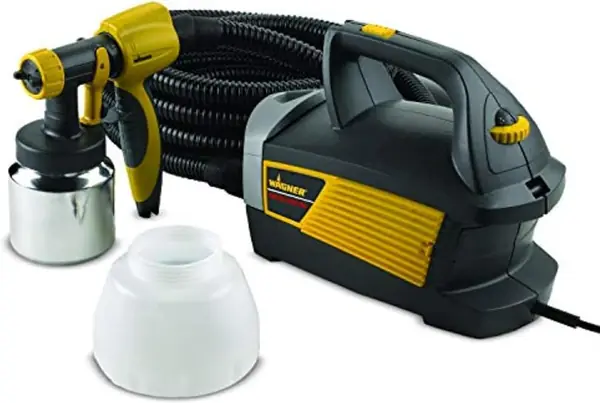
Wagner Control Spray Max yellow and black two-stage HVLP turbine sprayer with cups

Decks and cabinets

Shop Score 92/100
Cup Capacity
1.5 qt
Hose Length
20 ft
Spray Patterns
Three, 1/2 in to 12 in
Turbine
Two-stage, 510W
View on Amazon

Twenty feet of hose changes the way you stand. On the Control Spray Max the turbine is a base unit you set on the floor, so what you hold is a gun and a cup, and the 510-watt motor's weight never reaches your wrist. That sounds like a small thing until the fourth cabinet door, when a handheld unit starts to feel like a brick.

We point budget-minded cabinet and furniture painters here first. Two stages of turbine move enough air to lay thinned latex and primer evenly, the fan widens from about half an inch to a foot, and the 1.5-quart cup means far fewer refills than any handheld on this page. A pressure dial and a material flow adjuster let you back off for trim and open up for door faces, and cleanup is a handful of parts and a short flush.

Thick material is where it slows down. Latex straight from the can needs thinning before it will atomize cleanly, and heavy primer takes patience, so plan on spending the first session learning the mix rather than spraying. At the top of its pressure range it throws a wider cloud, which is a masking job rather than a problem. Work in stains, sealers and thinned enamel and you never hit that wall.

Worth Noting

  • Thick latex needs thinning before it sprays
Our Verdict

Our pick for the middle of the market: a stationary turbine and a big cup that take the weight and the refills out of cabinet and fence work.

Check Latest Price
3.

Fuji Spray Mini-Mite 4 Platinum Best for Furniture-Grade Finishes

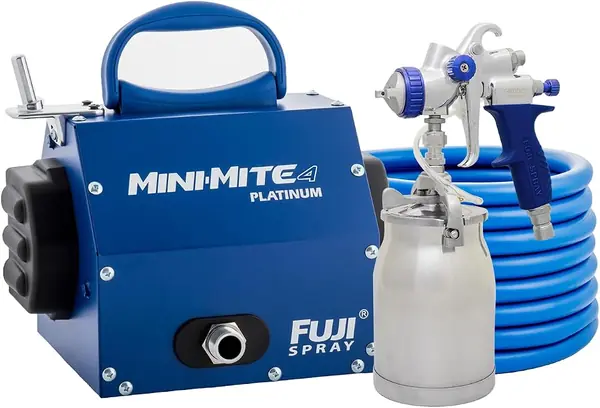
Fuji Spray Mini-Mite 4 Platinum blue turbine with T-70 bottom-feed spray gun

Fine furniture finishing

Shop Score 91/100
Cup Capacity
1 qt bottom-feed
Hose Length
25 ft with air control valve
Turbine
Four-stage
Maximum Pressure
9 psi
View on Amazon

Nine psi at the nozzle is close to double what the two-stage systems here produce, and the difference shows up in the cup rather than the gauge. Fuji's four-stage turbine is the most powerful unit in this group, and it sprays cabinet enamel and primer with noticeably less thinner added, which means a heavier coat per pass and less solvent flashing off into a door face.

For a shop that finishes cabinets and built-ins on a schedule, we think this is the last sprayer you buy. The T-70 gun's side knob changes the fan while you are spraying, the one-quart bottom-feed cup leaves the top of the gun clear so you can see the edge you are following, and the 25-foot hose carries an air control valve so you can trim pressure at the gun instead of walking back to the turbine. The metal case holds the gun, and the heat-dissipation chamber is there to keep the motor alive through a long afternoon.

It is shop equipment, though. Nearly twenty-nine pounds of turbine and a quart of material in a bottom cup are not going up a ladder, and this is the most expensive unit here by a wide margin. What that buys is a finish that comes off the gun flat enough that you are scuffing between coats instead of repairing them.

Worth Noting

  • Heavy turbine and quart cup stay in the shop
Our Verdict

For a shop that finishes cabinets and built-ins, we see the Mini-Mite 4 as the endgame: four stages, less thinning, and a gun you can adjust mid-pass.

Check Latest Price
4.

VONFORN 700W Paint Sprayer Best Budget Handheld

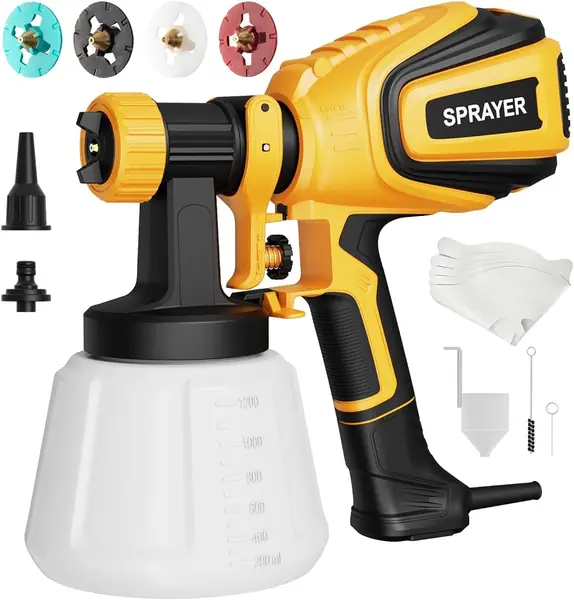
VONFORN yellow handheld HVLP paint sprayer with four nozzles and 1200 ml cup

First-time spraying

Shop Score 90/100
Cup Capacity
1200 ml
Nozzles
Four, 1.0 to 3.0 mm
Motor
700W
Weight
3.7 lb
View on Amazon

Two accessories on this sprayer have nothing to do with atomizing paint: a dust-blowing joint and a cleaning connector that thread onto the gun. The first one earns its place in a woodworking shop. A blast of air clears sanding dust out of a corner before finish goes on, which is the step most of us skip when we are impatient to spray.

The rest is a well-sorted handheld paint gun. Seven hundred watts, a 1200 ml cup, four nozzles from 1.0 to 3.0 mm and three patterns, with a flow knob that lets you back off for trim and open up for a panel. At 3.7 pounds it is light enough to hold through a set of doors, and the container, spray head and nozzle come off for cleaning without a screwdriver.

What you are buying is a first sprayer, and this is the one we hand to someone who has never sprayed: cheap enough to learn on, capable enough to finish a fence or a set of shutters in an afternoon. Durability is the gamble at this end of the market — a motor that runs rough out of the box is worth sending back rather than nursing — and a machine that sprays well twice a year is not the same as one that sprays every week.

Worth Noting

  • Inconsistent output with thicker coatings
Our Verdict

We hand this one to first-time sprayers: it is light, inexpensive, and comes with the nozzles and cleaning fittings to finish a fence or a set of shutters.

Check Latest Price
5.

LESONJOY 1000W Paint Sprayer Best for Large Panel Projects

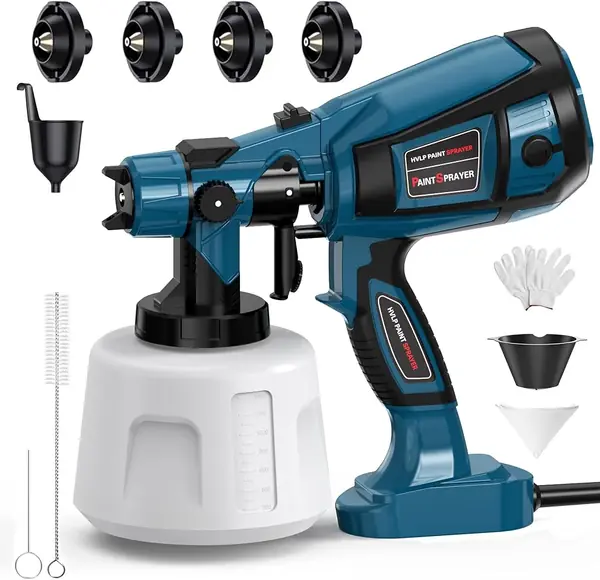
LESONJOY blue handheld HVLP paint sprayer with 1400 ml cup and four copper nozzles

Large panel projects

Shop Score 89/100
Cup Capacity
1400 ml
Nozzles
Four copper
Spray Patterns
Vertical, horizontal, circular
Motor
1000W
View on Amazon

The cup is the largest in this group of handheld sprayers — 1400 ml, about a quart and a half — and that is the whole argument for this one. On a fence, a set of panel doors or a run of pickets, fewer refills is the difference between finishing before dark and not. A 1000-watt motor, four copper nozzles, three patterns and a flow knob round out a kit that also includes a viscosity cup, filters, gloves and a cleaning brush.

What we noticed in use is how little fiddling it takes to get a workable pattern. The flow knob has enough range to go from a light stain pass to a wet paint coat, the four nozzles cover sealer up to thick latex, and the body comes apart without tools, which matters more than any spec once you are standing at a sink at the end of the day.

A full cup is heavy in a way an empty one is not, so this is a sprayer you refill as you go rather than top off to the brim. For furniture, doors and fence panels we did not mind the weight; for a ceiling, look elsewhere.

Worth Noting

  • 6-foot hose keeps the turbine close behind you
Our Verdict

We like it for anyone spraying panels or pickets on a budget: the largest cup among the handhelds means the fewest interruptions.

Check Latest Price
6.

WIBENTL W60 Paint Sprayer Best for Trim and Shutters

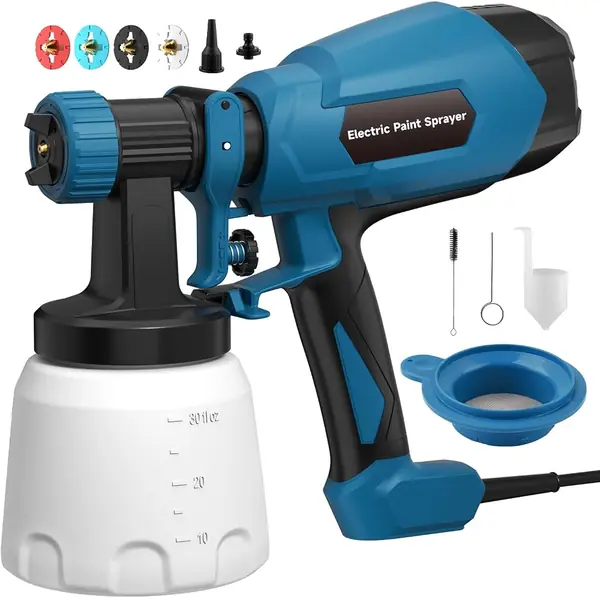
WIBENTL W60 bright blue handheld paint sprayer with four brass nozzles

Trim and shutters

Shop Score 86/100
Cup Capacity
30 fl oz
Nozzles
Four brass, 1.0 to 3.0 mm
Spray Patterns
Three patterns
Warranty
1 year
View on Amazon

The least expensive sprayer here also has the smallest cup — 30 fluid ounces, which is a trim-and-shutters capacity, not a deck capacity. That trade tells you what this one is for: small projects where you were going to refill anyway.

The hardware is better than the price suggests. Four brass nozzles from 1.0 to 3.0 mm and three patterns give you real control over the fan, the flow knob backs the material down for trim, and the box includes the cleaning connector and dust-blowing joint that make the VONFORN handy. Corded power means no battery fading halfway through a door.

So we treat this as the try-it sprayer. If you want to find out whether spraying suits the way you work before spending real money on a system, this is the least expensive way to find out, and the one-year warranty is honest about what you are buying. If the answer turns out to be yes, the cup size is what will push you toward something bigger.

Worth Noting

  • 30 fl oz cup needs frequent refills
  • One-year warranty limits long-term coverage
Our Verdict

We treat the W60 as the try-it sprayer: the lowest cost here, a small cup, and enough control to see whether spraying suits your work.

Check Latest Price

How We Tested HVLP Paint Sprayers

We narrowed the field on paper first, sorting handheld units from turbine-and-hose systems and comparing nozzle sets, pattern options, cup size, hose length, warranty terms, and whether replacement parts were actually available. From that shortlist we brought eight sprayers into a garage shop and used them for nine months, on cabinet doors laid flat across sawhorses, a fence line, a set of shutters, and a stack of trim.

Finish quality got the closest look. We sprayed each coating onto scrap plywood and cabinet doors, then read the surface under a raking light for orange peel, spits, and splatter. Latex, primer, and waterborne finishes went through every unit, thinned only as the coating maker directs and never in a sprayer the material wasn't rated for. Solvent-based work happened outdoors with cross-ventilation and organic-vapor respirators, with turbines, cords, and guns kept well away from the water heater and any pilot light.

For control, we ran the fan from its narrowest to its widest across a test panel and sprayed trim and broad faces with the same gun, dialing flow until the coat went on wet without running. Cup capacity we judged by counting doors per fill; hose reach by walking the length of a fence until the line tugged. Then we counted the parts that touch paint and timed the teardown, checked whether each nozzle and cup seated firmly — some hold by magnet — and stayed put mid-pass, and ran hour-long sessions to track hand fatigue, motor heat, and noise. Price only came into it at the end, weighed against warranty length and how many parts could be replaced.

How to Choose an HVLP Paint Sprayer

Handheld Unit or Turbine-and-Hose System

A handheld sprayer puts the turbine in the body you hold: a cup, a short hose, one piece to store, and the least expensive way into spraying. A system splits the two — the turbine sits on the floor and 20 to 25 feet of hose feeds a lighter gun with a bigger cup. We reach for a system whenever the work involves furniture or a run of cabinet doors, because the motor weight stays off your wrist all afternoon.

The trap is the word compact. A handheld's six-foot hose means the motor rides in your hand for the whole job, which is fine across a fence and tiring across six doors. Spray weekly and buy the system; spray twice a year and the handheld is enough.

Match the Turbine Stages to Your Coatings

More stages mean more pressure at the nozzle — roughly 5 psi on a two-stage, 6.5 on a three-stage, 9 on a four-stage — and pressure is what lets you push thicker material through with less thinner added. Stain, sealer, shellac and thinned poly are comfortable on a two-stage. Cabinet enamel, primer and waterborne paint reward the extra stages with a heavier coat per pass.

The trap here is expecting any turbine to spray latex straight from the can. Every unit on this page wants some thinning for thick paint, so budget for a viscosity cup and a practice panel no matter what you buy.

Cup Size and Hose Length Set Your Rhythm

A 400 ml gravity cup is light in the hand and quick to top off; a 1.5-quart cup keeps you spraying longer but, on a handheld, hangs real weight off your wrist by the end of a wall. Hose length decides whether the turbine can stay outside the room you are working in. Twenty-five feet reaches through a doorway; six feet does not.

Think about your last project rather than a hypothetical one. Fence or deck, and cup size wins. A room full of trim or a set of doors, and hose length plus a light gun win.

Cleanup Decides How Often You Spray

Every sprayer here comes apart for cleaning; what differs is how many pieces touch paint and whether they come off without tools. A gun with a simple air cap and nozzle cleans in a few minutes. A stack of seals and a pickup tube takes longer and loses parts in the sink.

We weight cleanup heavily, because a sprayer that takes longer to wash than to spray gets used exactly once. Flush with the right solvent the same day, every time, and the gun will outlast the project list.

Frequently Asked Questions

Final Verdict

We recommend the Fuji Spray Semi-PRO 2 for most home shops. It sprays every coating you are likely to put through a gun, the fan control on the M-model gun moves from spindle to panel without a nozzle change, and 25 feet of hose keeps the turbine and its noise out of the room.

Step up to the Mini-Mite 4 when cabinet work is regular and you want the least thinning possible. For a first fence or a set of shutters, the VONFORN costs a fraction of either and does the job.