↑↓ navigate ↵ open Esc close All results →

Best HVLP Spray Guns for Latex Paint of 2026

Unthinned latex is heavy coating, and spray guns engineered mainly for thin stains or lacquers expose themselves immediately by spattering wall paint instead of atomizing a soft mist. True HVLP systems rely on high air volume at low pressure from a dedicated turbine or motor to lay that heavy paint down evenly rather than forcing hours of corrective sanding.

Spraying 10 latex-rated guns over nine months across fences, cabinet doors, garden chairs, and a garage ceiling made cup-to-cup consistency and fast disassembly the primary separators. Guns that pushed thick latex with minimal thinning, maintained a steady fan pattern through repeated refills, and broke down cleanly saved far more time than bargain models that jammed mid-project.

None of these seven guns represents the cheapest way to coat drywall, yet each continues laying down a level finish well past the fourth cup refill.

Our Top Picks

The Best HVLP Spray Guns for Latex Paint

1.

Wagner Control Spray Max Best Overall
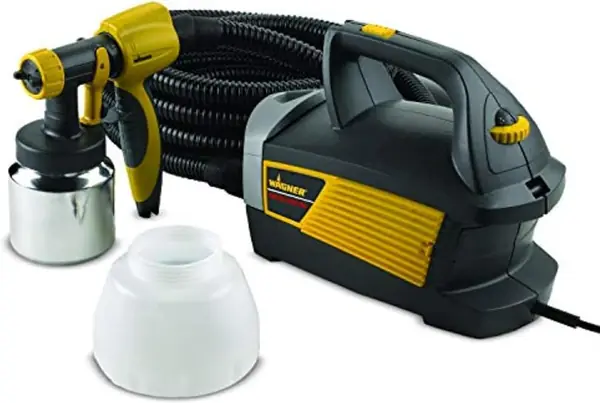
Wagner Control Spray Max two-stage HVLP paint sprayer with hose and cups

Walls and fences

Shop Score 93/100
Cup Capacity
1.5 quarts
Hose Length
20 feet
Turbine
Two-stage
Power
510W
View on Amazon

The 20-foot hose is the first thing that separates the Wagner Control Spray Max from the handheld crowd: the turbine stays on the floor while the gun goes where the work is, which matters when you are circling a fence or reaching the top of a cabinet run. The two-stage turbine is the other half of the story. It gives thinned latex enough air to atomize without making you drag a compressor into the driveway.

In use, the 1.5-quart cup and adjustable pattern make it a practical all-arounder. The pattern runs from a narrow 1/2 inch to a 12-inch fan, so you can switch from trim to a door panel without changing guns. The pressure dial and material flow adjuster are easy to reach, and the stationary base keeps the weight out of your hand. We did have to thin latex to get a smooth coat; the 510W motor and 2.63 psi max are not a magic wand for thick paint. Spray quality is the variable: some setups lay down an even coat, while others need more thinning and a slower pass. We think the 20-foot hose and two-stage turbine still make it the best default for home projects.

Cleaning is straightforward: the cup, nozzle, and air cap come apart without tools, and the included cleaning kit is enough for a latex session. The 1.5-quart cup is big enough for a set of cabinet doors or a fence section. We like it best as a home-painter's sprayer—capable of a smooth finish on trim, doors, and fences, but not a production tool. If you already own a large compressor and want a bare gun, the Titan is the other route; for a first latex sprayer, this is the system that makes the job feel manageable.

Worth Noting

  • Full walls require frequent refills
Our Verdict

We recommend the Wagner Control Spray Max as the best all-around HVLP sprayer for home painters spraying thinned latex on trim, doors, fences, and walls.

Check Latest Price
2.

Fuji Spray Semi-PRO 2 Best Upgrade

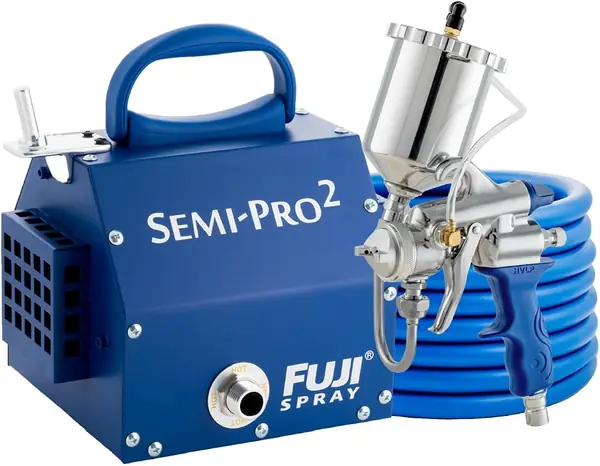
Fuji Spray Semi-PRO 2 gravity HVLP system with turbine gun and hose

Cabinets and furniture

Shop Score 92/100
Cup Capacity
400cc gravity
Hose Length
25 feet
Motor
1400W
Turbine
Two-stage
View on Amazon

The Semi-PRO 2 costs several times what a handheld sprayer does, and the first thing we noticed is what that money buys: a 1400W two-stage turbine, a 25-foot hose, and an M-Model gun with a fan-pattern control that feels more like a shop tool than a home gadget.

For furniture and cabinets, that control is the point. The 1.3mm air cap and 400cc gravity cup are set up for thinner finishes, but the two-stage turbine has enough air to handle latex and primer with less thinning than the cheap handhelds. We found the non-bleed gun and adjustable fan pattern let us narrow the spray for a cabinet door and open it up for a panel, and the stainless nozzle and needle are easy to keep clean. The 25-foot hose gives you room to move, and the gun holder keeps the gun off the floor between passes.

We also appreciate the quick-change turbine filters, small details that make a session less messy. For occasional fence painting, the Wagner is the more sensible spend. The Semi-PRO 2 is not the easiest first sprayer, but it is the one we reach for when the finish matters more than the setup.

Worth Noting

  • 400cc cup needs frequent refills on big jobs
  • 25.2-pound turbine is a separate piece to store
Our Verdict

The Fuji Semi-PRO 2 is the upgrade we recommend for cabinet and furniture work, where its 1400W turbine and fan control deliver a finer finish than handheld sprayers.

Check Latest Price
3.

LESONJOY CN-6000 Best Budget

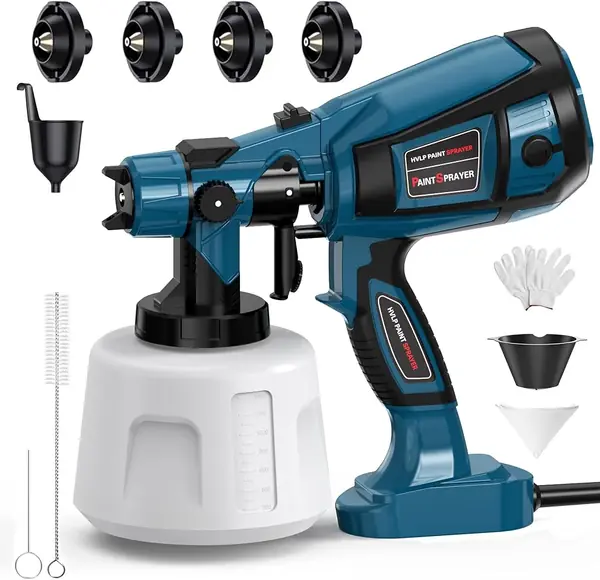
Blue LESONJOY CN-6000 handheld HVLP paint sprayer with four nozzles

Occasional DIY

Shop Score 91/100
Cup Capacity
1400 ml
Hose Length
1.8 meters
Motor
1000W
Max Pressure
20 psi
View on Amazon

A 1000W motor and four nozzles at a budget price is the pitch, and on paper the LESONJOY CN-6000 looks like the handheld that should make the others nervous. We think it earns that attention for occasional projects, with a couple of caveats that keep it from the top spot.

The 1400ml cup is the practical highlight: it holds more than most handhelds here, so you are not stopping every few minutes to refill. The four copper nozzles and three patterns give you a start on trim, furniture, and fence work, and the flow-control knob is easy to reach with a gloved hand. The 20 psi max pressure is respectable for a corded handheld, and the included viscosity cup and filters are the right extras for latex. We did find the 1.8-meter hose short; you will move the unit with you more than with a turbine system.

The light body helps overhead, and the controls are easy to reach with a glove. We have not had a long-term durability read on this one, so we treat it as a first sprayer or a second sprayer for small jobs, not the one to buy if you are spraying cabinets for a living. At the budget end, it gives you more power and capacity than most of the cheap handhelds, and that is enough to earn a place.

Worth Noting

  • Plastic body feels light-duty
Our Verdict

Budget-minded DIYers who want a big cup and four nozzles for occasional latex projects will like the LESONJOY, as long as they can work with a short hose.

Check Latest Price
4.

VONFORN 700W Best for Occasional Projects

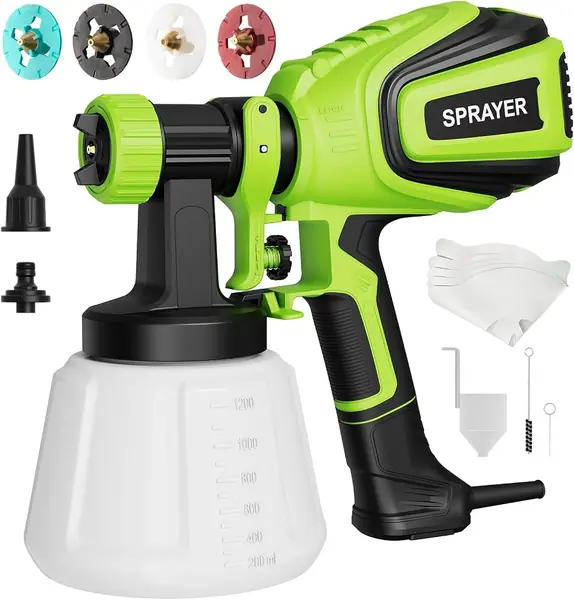
Grass green VONFORN 700W handheld HVLP paint sprayer with nozzle set

Small DIY jobs

Shop Score 90/100
Motor
700W
Nozzle Sizes
1.0, 1.5, 2.0, and 3.0mm
Cleaning
Tool-free assembly
Spray Patterns
Three
View on Amazon

The dust-blowing joint is an unusual extra on a budget sprayer, and it turned out to be the detail we used most: a quick pass clears sanding dust from trim or a cabinet frame before the first coat, so you are not spraying over a surface that will fish-eye.

The rest of the VONFORN package is aimed at the same occasional user. The 700W motor is lighter than the 1000W handhelds, and the four nozzles (1.0mm, 1.5mm, 2.0mm, and 3.0mm) plus three patterns cover everything from sealer to thick latex. We found the tool-free assembly and the cleaning connector make a quick job out of cleanup, and the flow-control knob is easy to set. The spray output is not as consistent as the better turbine systems: you need to thin latex to the viscosity cup and test on scrap before you commit to a door. We treat that as a setup step, not a dealbreaker.

For a fence, a set of garden chairs, or a room's trim, the VONFORN is a low-cost way to get a smooth coat without a compressor. It is not the sprayer we choose for a cabinet shop, but the dust-blowing joint is the reason we reach for it before a sanding-heavy job.

Worth Noting

  • Durability is a question mark for frequent use
Our Verdict

We recommend the VONFORN for occasional fences, furniture, and trim; it is light and versatile, but thin latex carefully and do not expect shop-grade durability.

Check Latest Price
5.

Fuji Spray Q5 Platinum Best Splurge

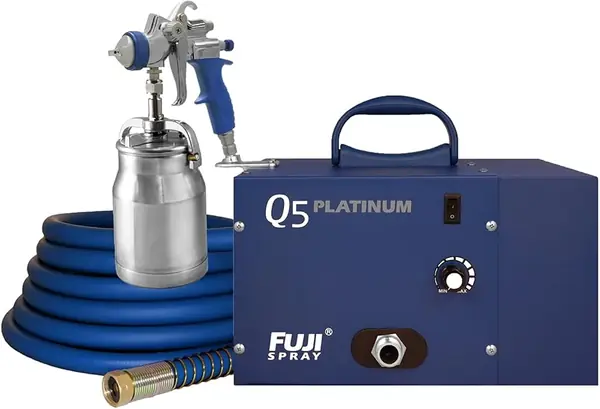
Fuji Spray Q5 Platinum five-stage HVLP turbine system with T-70 gun

Frequent finishers

Shop Score 89/100
Cup Capacity
1 quart
Hose Length
25 feet
Turbine
5-stage
Max Pressure
9.5 psi
View on Amazon

The Q5 Platinum's five-stage turbine is the quiet, powerful center of a system that costs more than most DIYers spend on a used table saw. The question is not whether it works—it does—but whether you spray often enough to justify owning it.

For a cabinet shop or a serious finisher, the answer is easier. The five-stage turbine produces 9.5 psi, and the variable-speed dial lets you turn the air down for a thin coat or up for a heavier build. We found the T-70 non-bleed gun and side pattern control give you fine adjustment without breaking your stride, and the 25-foot hose is long enough to move around a shop. The noise-reduction design is real: this is the HVLP system we can run without feeling like we need hearing protection, though it is still a turbine and not silent.

The 1-quart cup is fine for cabinet parts, but a full wall means refills. We think the Q5 is the right tool for someone who sprays weekly and wants a smooth finish on cabinets and furniture; for occasional projects, the Semi-PRO 2 or the Wagner is the simpler choice. It is a beautiful tool, and the quiet operation is the part we appreciate most after a long session.

Worth Noting

  • Costs far more than a handheld sprayer
  • 39.4-pound turbine is a heavy piece to move
Our Verdict

The Fuji Q5 Platinum is the premium choice for frequent finishers who want a quiet, powerful turbine and a shop-grade finish, and it is overkill for occasional DIY.

Check Latest Price
6.

Tilswall 800W Best for Small Rooms

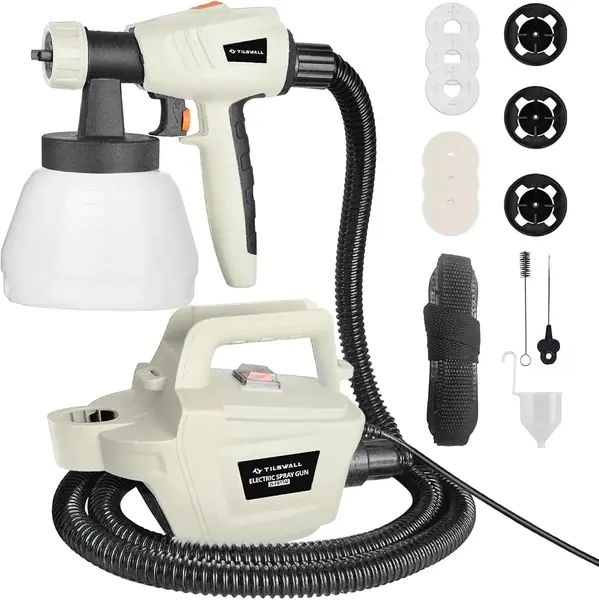
White Tilswall 800W handheld HVLP paint sprayer with detachable handle

Small rooms

Shop Score 87/100
Cup Capacity
1300 ml
Hose Length
8.2 feet
Motor
800W
Nozzle Sizes
1.0, 1.8, and 2.6mm
View on Amazon

The Tilswall's handle separates from the motor, and that split design is more than a gimmick: it lets you carry the 1300ml cup and gun as one piece while the motor hangs from the included shoulder strap, which takes the weight off your wrist on a ladder or overhead.

For small rooms, furniture, and quick touch-ups, that portability is the reason to pick it. The three nozzles (1.0mm, 1.8mm, and 2.6mm) and three patterns give you enough range for primer, latex, and stain. We found the 8.2-foot hose short enough to keep the unit close but long enough to move around a piece of furniture, and the 1300ml cup holds a useful amount before a refill. The spray is not as fine as a turbine system, so thin latex to the viscosity cup and keep the gun moving.

Cleanup is straightforward because the nozzle assembly separates from the handle, and the parts are easy to rinse before latex dries. We like the Tilswall as a small-project sprayer and a good first step for someone who does not want to store a turbine. For a garage or spare room, the small footprint is the real win.

Worth Noting

  • Less power than 1000W handhelds
Our Verdict

The Tilswall is a good fit for furniture, small rooms, and touch-ups, where its detachable handle and big cup make more sense than a long hose.

Check Latest Price
7.

Titan Capspray Maxum II Best for Capspray Systems

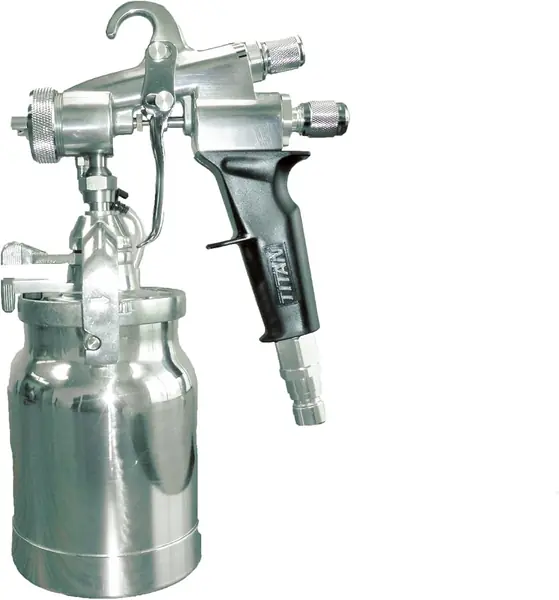
Titan Capspray Maxum II stainless steel HVLP spray gun with air cap

Capspray systems

Shop Score 86/100
Cup Capacity
48 fluid ounces
Max Pressure
34 psi
Power Source
Air powered
Needle And Nozzle
Stainless steel
View on Amazon

This is a gun, not a kit: the Titan Capspray Maxum II arrives without a turbine, so it only makes sense if you already own a compatible Capspray system and want a better trigger and nozzle set. We think it is a smart upgrade for that buyer, and a frustrating purchase for everyone else.

The parts that matter are the stainless-steel needle and nozzle, the click-in air cap, and the dual-pivot trigger. The trigger is the detail we noticed most: it takes less pull to keep the gun running, which matters when you are holding a gun for a long cabinet session. The 48-fluid-ounce cup is generous, and the Teflon seals are meant to stand up to solvent-based finishes. The 34 psi max pressure is higher than the small turbines here, so check that your turbine can supply the volume the gun needs before you order.

There is no motor or hose in the box, just the gun and the #3 Pro Set, so the value depends entirely on the turbine you already own. We see it as a replacement or upgrade gun for a Capspray system, not a first sprayer. If you are starting from nothing, the Wagner or Fuji Semi-PRO gives you a complete system for less fuss.

Worth Noting

  • Includes only the gun without turbine or hose
  • High 34 psi demand requires a compatible turbine
Our Verdict

The Titan Capspray Maxum II is a worthwhile upgrade gun for someone who already owns a compatible Capspray turbine, but it is not a turnkey sprayer for latex projects.

Check Latest Price

How We Picked and Tested These HVLP Spray Guns

We started with every electric and turbine HVLP gun we could find that the manufacturer actually rates for latex paint, then narrowed by the specs that change the job: turbine stages or motor wattage, cup size, hose length, and how many nozzle sizes come in the box. Ten made the cut, and we sprayed with each one for nine months — on a backyard fence, a stack of cabinet doors across sawhorses, garden chairs, a small bedroom, and the ceiling of a garage, since overhead work is where a heavy gun stops being fun.

Every gun got the same gallon of wall paint, thinned only as far as its maker allows. We timed how long a cup lasted before a refill and counted refills on a long fence run, walked the hose out until it pulled taut, and weighed each gun with a full cup before the overhead stretches. Nozzle and pattern changes were timed with a stopwatch, and we logged how many passes a cabinet door took before the coat looked even and unbroken.

Cleaning got its own stopwatch: full teardown, rinse, reassembly. We noted which guns needed a wrench and which came apart by hand, then checked the same fittings after a dozen sessions to see whether threads and seals still seated and whether anything had started to weep at the cup. Once a coat dried, we ran a hand over the panel looking for the pebbled texture that means the paint wasn't atomized finely enough, and hung masking paper behind the work to see how far the overspray carried.

All of it happened in a ventilated shop with NIOSH-approved respirators on, turbines and cords kept clear of wet ground and solvent rags, and every gun cleaned between coatings and never pushed past its stated pressure, nozzle, or material limits.

How to Choose an HVLP Spray Gun for Latex Paint

Match the turbine or motor to thick latex

Latex is thick, so the air supply matters more than the label. A two-stage turbine or a 1000W handheld gives you a better chance of atomizing thinned latex than a small single-stage unit; the Wagner Control Spray Max and Fuji Semi-PRO 2 both use two-stage turbines, while the LESONJOY relies on a 1000W motor. Wattage alone does not guarantee a fine finish, though. Start with the manufacturer's thinning recommendation, use the viscosity cup, and test on scrap before you commit to a door or a wall.

Cup capacity and hose length set your pace

A bigger cup means fewer stops, but it also means more weight in your hand. For walls, fences, and a run of cabinet doors, a 1.5-quart cup like the Wagner's is a practical size; the Fuji Semi-PRO 2's 400cc gravity cup is better for furniture and smaller parts. Hose length is the other half of the equation. A 20- or 25-foot hose lets you leave the turbine in one spot, while the Tilswall's 8.2-foot hose is better suited to a small room or a piece of furniture you can walk around.

Nozzles and patterns do the detail work

The nozzle sets the upper limit on what you can spray. A 1.3mm to 1.8mm tip is a reasonable starting point for thinned latex and sealer; step up to a 2.0mm or larger tip for thicker primer or heavy body paint. Three patterns—vertical, horizontal, and circular—cover most home projects, but the fan adjustment on a gun like the Fuji Semi-PRO 2 gives you more control than a simple selector. Keep the gun moving at a consistent distance, and overlap each pass by about half a pattern.

Cleaning and durability decide how long it lasts

Latex dries fast, and a clogged nozzle is the quickest way to ruin a finish. Look for tool-free disassembly and a cleaning kit, then flush the gun as soon as you stop spraying; the VONFORN's cleaning connector and the Wagner's removable cup and air cap make that job easier. Budget handhelds with plastic bodies are fine for occasional projects, but if you spray often, a metal turbine and stainless-steel needle and nozzle are worth the step up. The Titan gun is a good example of the latter—provided you already own the turbine it needs.

Overspray, finish, and the space you're spraying

HVLP stands for high volume, low pressure, and it does reduce overspray compared with a conventional gun—but it does not eliminate it. Mask adjacent surfaces, cover the floor, and keep the area ventilated. A narrower pattern helps around trim and cabinet frames, while a wider fan covers a door or fence panel faster. We start with a narrow pattern and a test pass on cardboard, then open the fan only after the spray looks even. If the finish looks dry or pebbly, the paint is too thick or the air is too low; if it looks wet and heavy, thin the material or speed up your pass.

Frequently Asked Questions

Final Verdict

For most home painters spraying thinned latex on trim, doors, fences, or a small wall, the Wagner Control Spray Max is the pick: its two-stage turbine and 20-foot hose make the job manageable without a premium price. If you are finishing cabinets and furniture and want a finer, more adjustable finish, step up to the Fuji Semi-PRO 2. The Fuji Q5 only makes sense if you spray often enough to justify a shop-grade turbine.