↑↓ navigate ↵ open Esc close All results →

Best Bandsaw Blades for Wood of 2026

On a single cast-iron frame, swapping the blade changes how a bandsaw behaves on real lumber. A narrow strip turns tight radii for box lids and toy parts, while a wide resaw blade slices thin veneer off a walnut board—yet the wrong blade makes a capable machine feel sluggish and prone to wander.

Checking the saw's manual for exact loop length comes first, since old packaging is easy to misread; after that, width, tooth count, and steel grade govern feed speed and edge life. Evaluating 16 blades across five months on 9-inch benchtop to 14-inch floor-standing saws—cutting tight curves and resawing maple—showed that hardware-store impulse picks tend to burn turns and drift off the line.

What separates dependable blades from frustrating ones comes down to unglamorous details: a straight, flush weld that doesn't tick through the guides, teeth that stay sharp past the first board, and sensible pricing for a consumable part.

Our Top Picks

The Best Bandsaw Blades for Wood

1.

Timber Wolf 93-1/2-Inch 4 TPI Bandsaw Blade Best Overall
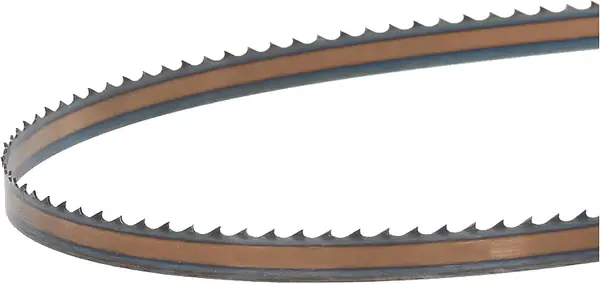
Timber Wolf 93-1/2-inch by 1/2-inch 4 TPI bandsaw blade with silver alloy steel body

14-inch resaw work

Shop Score 92/100
Blade Length
93-1/2 inches
Teeth
4 TPI
Blade Width
1/2 inch
Material
High-silicon alloy steel
View on Amazon

Fourteen-inch saws are the backbone of a home shop, and 93-1/2 inches is the length most of them take. Timber Wolf's 1/2-inch, 4 TPI band is the blade we mount first on a saw like that. It is high-silicon, low-carbide steel run at lower tension than a standard carbon blade, which means a 1-hp motor spends less effort dragging the band around the wheels and more of it cutting.

The 1/2-inch width is the useful middle: wide enough to hold a straight line through a tall resaw, narrow enough to steer a gentle curve. Four teeth per inch, with the round gullet and the 6.5-degree rake Timber Wolf grinds into it, clears chips out of thick stock instead of packing them into the cut.

Heat is what we noticed first. Hard maple and walnut came off the saw without the scorch marks a dull carbon blade leaves, and the band ran quiet once we tensioned it the way the included instructions describe. Those instructions are worth reading, because a low-tension blade is not tensioned like a carbon one.

It costs more than anything else here and it is one blade, not a pack, so the trade is a bigger outlay against far fewer changes. On a saw that sees hardwood and resaw work every week, that trade is easy to make. On a saw that mostly cuts pine and plywood jigs, buy the carbon two-pack and save this one for the good stock.

Worth Noting

  • Premium price for a single blade
Our Verdict

The blade we put on a 14-inch saw before anything else: low-tension silicon steel cuts cooler, holds an edge in hardwood, and asks less of a small motor.

Check Latest Price
2.

Timber Wolf 105-Inch 3/4-Inch VPC Bandsaw Blade Best for Resawing

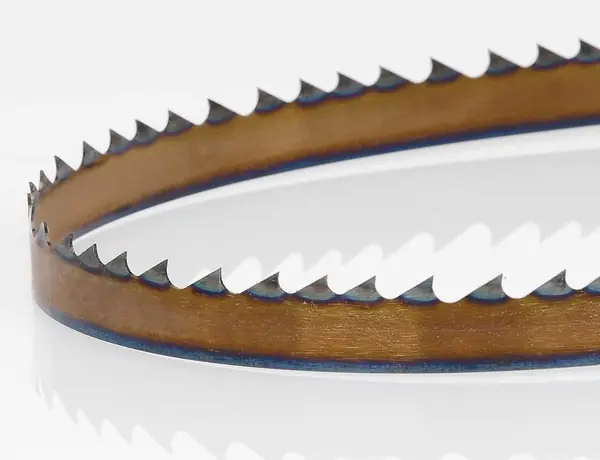
Timber Wolf 105-inch by 3/4-inch variable positive claw resaw bandsaw blade in brown and silver

Riser-block resawing

Shop Score 91/100
Blade Length
105 inches
Blade Width
3/4 inch
Material
Swedish silicon steel
Tooth Profile
Variable positive claw
View on Amazon

Resawing is where a band saw earns its floor space, and it is where a general-purpose blade runs out of ideas. The 3/4-inch VPC from Timber Wolf is the blade we fit when the job is tall boards: the variable positive claw tooth pattern keeps the cut from setting up a harmonic, and the wide body puts real beam strength behind the tooth line.

On a 14-inch saw with a riser block, 105 inches is the length the kit calls for, and this is the resaw blade sold for that setup; on a larger saw it is simply the resaw blade. Either way it is silicon steel, run at lower tension and cooler than carbon, and it leaves a surface you can send straight to the planer.

What it asks in return is a saw that already tracks true. A band this wide amplifies every problem in the guides and the tires, and it takes a few test cuts to get it running where you want it. Once it is dialed, wide hardwood goes through at a feed rate that feels almost wrong for a band saw.

Worth Noting

  • Wide 3/4-inch body rules out curved cuts
Our Verdict

If you resaw wide boards on a 14-inch saw with a riser block or a larger machine, this 3/4-inch variable-tooth band is the one we fit for fast, straight cuts.

Check Latest Price
3.

Olson 93-1/2-Inch 4 TPI Skip Bandsaw Blade Best for Tight Curves

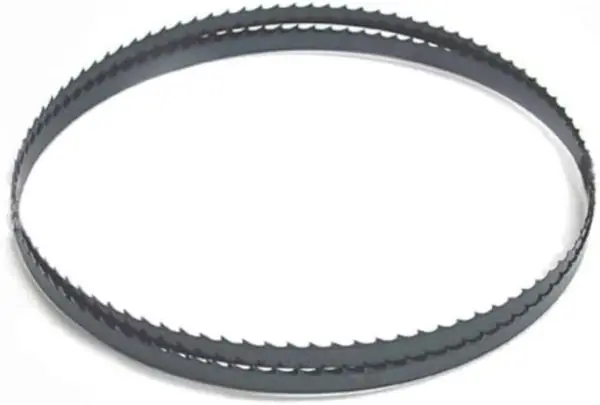
Olson 3/16-inch by 93-1/2-inch 4 TPI skip tooth bandsaw blade in silver steel

Curves and boxes

Shop Score 90/100
Blade Length
93-1/2 inches
Teeth
4 TPI skip
Blade Width
3/16 inch
Material
Hard-edge flex-back steel
View on Amazon

Stack four species into a blank, cut a wavy line through all of them, then do it twenty more times without the blade wandering. That is band saw box work, and it is why a 3/16-inch blade belongs in the drawer. The Olson hard-edge flex-back with 4 TPI skip teeth is the one we reach for on a 14-inch saw.

The balance is what we like. Three-sixteenths of an inch turns a radius that otherwise needs a scroll saw, but the flex-back body still has enough stiffness to follow a line through a three- or four-inch laminated blank. Skip teeth clear sawdust out of a deep curving cut instead of packing it in, which is exactly where a fine-tooth band bogs down and burns.

It is a curve blade, not a resaw blade, and 3/16 inch will not hold a straight line through tall stock. That is not a fault, just the job it was ground for. Keep it for pattern work, boxes, and tight joinery cuts and it will outlast the projects you bought it for.

Worth Noting

  • Leaves a coarser surface than finer-tooth blades
Our Verdict

We keep a 3/16-inch skip-tooth blade on hand for band saw boxes: it turns radii a wider band cannot and still follows a line in thick blanks.

Check Latest Price
4.

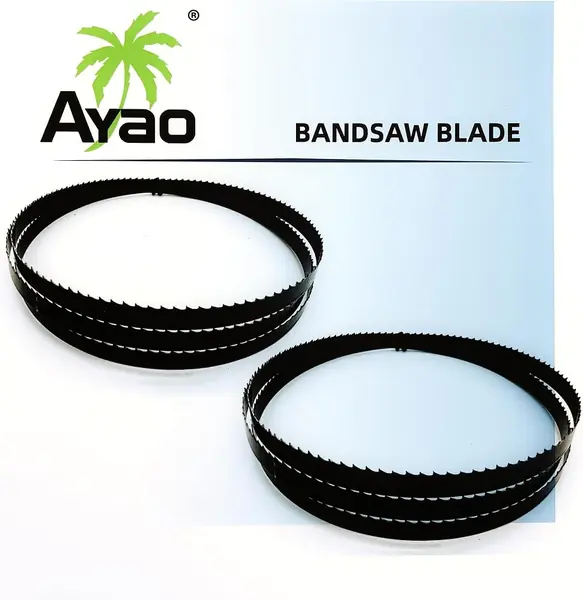
AYAO 93-1/2-Inch 3/8-Inch 6 TPI Bandsaw Blades (2-Pack) Best Budget

Two AYAO 93-1/2-inch 3/8-inch 6 TPI ground tooth bandsaw blades in dark blue

Budget 14-inch cutting

Shop Score 89/100
Blade Length
93-1/2 inches
Teeth
6 TPI raker
Blade Width
3/8 inch
Pack Size
2 blades
View on Amazon

Two 3/8-inch blades for noticeably less than a single premium silicon band. That is the case for the AYAO two-pack, and it is a good case for the work most home shops actually do. The 3/8-inch by 6 TPI raker-set band is the middle-of-the-road blade a 14-inch saw wants, and the 0.018-inch body is thin enough that a small motor does not labor.

We keep the pair for construction lumber, shop jigs, and the cuts where a premium blade would be wasted, and the second blade hangs on the hook as a spare, which is the real argument for buying two. The ground teeth are a step above stamped ones at this price, and the fit list covers the common 14-inch saws, so it goes on without measuring twice.

Worth Noting

  • Thin body flexes in deep resaw cuts
Our Verdict

Our pick when you need two blades rather than one great one: a 3/8-inch 6 TPI pair that handles general cutting without a premium outlay.

Check Latest Price
5.

POWERTEC 93-1/2-Inch Bandsaw Blade Assortment (3-Pack) Best Assortment for 14-Inch Saws

POWERTEC 93-1/2-inch bandsaw blade assortment of three carbon steel blades in silver

New 14-inch saws

Shop Score 88/100
Blade Length
93-1/2 inches
Material
High carbon steel
Blades Included
3 (1/2, 1/4, and 1/8 inch)
Tooth Hardness
RC 64-66
View on Amazon

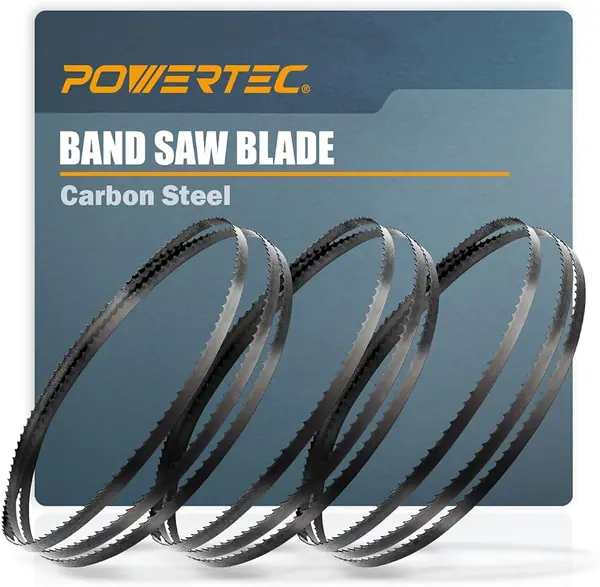
Three blades in one box, a 1/2-inch, a 1/4-inch, and a 1/8-inch scroll band, all 93-1/2 inches, is the fastest way to learn what a 14-inch saw will do. We hand this set to anyone who has just bought a used saw and does not yet know whether they are a curve cutter or a resawer.

The teeth are hardened to RC 64-66 with an even raker set, and because all three blades share the same length they swap on without moving the guides. The 1/2-inch stays on for general ripping and shallow resawing, the 1/4-inch handles curves in one-inch stock, and the 1/8-inch is the scroll blade for tight patterns and thin blanks. For a first set on an unfamiliar saw, that range is worth more than any single blade.

Worth Noting

  • Carbon steel dulls faster than silicon blades
Our Verdict

The set we hand a new 14-inch saw owner: three widths in one length, so you learn what your saw and your work actually need.

Check Latest Price
6.

AYAO 59-1/2-Inch Bandsaw Blade Assortment (3-Pack) Best for 9-Inch Benchtop Saws

AYAO 59-1/2-inch bandsaw blade three-pack in 1/8, 1/4, and 3/8-inch widths

9-inch benchtop saws

Shop Score 87/100
Blade Length
59-1/2 inches
Teeth
12, 10, and 6 TPI
Blades Included
3 (1/8, 1/4, and 3/8 inch)
Tooth Grind
Ground raker set
View on Amazon

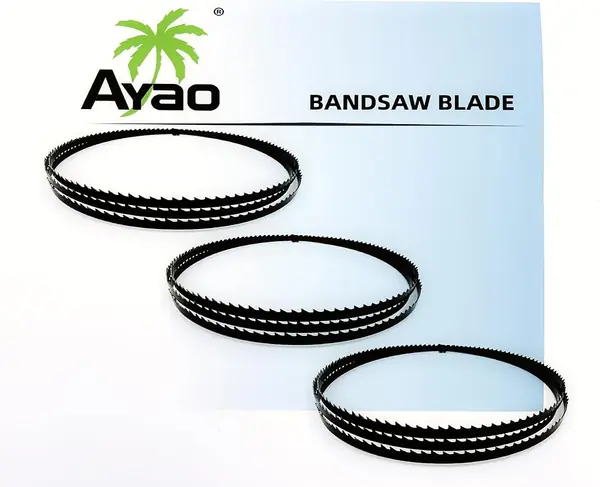
The blade that ships on a 9-inch benchtop band saw is usually the cheapest part of the machine, and it is the first thing to change. This three-pack replaces it with a 1/8-inch 12 TPI, a 1/4-inch 10 TPI, and a 3/8-inch 6 TPI, all 59-1/2 inches long, all ground tooth rather than stamped, and all raker set.

The widths map onto what a small saw can actually do. The 1/8-inch takes the tight radii that a benchtop saw is surprisingly good at, the 3/8-inch holds a line through one-inch stock and short rips, and the 1/4-inch sits between them for general curve work. The weld on each is dressed smooth, so the joint does not announce itself every revolution.

We like this as a starter set because it answers the question a new benchtop owner actually has, which is which width for which cut, without committing to a premium blade. Check the manual before ordering: some 9-inch saws take 62 inches, and a 59-1/2-inch band will not stretch to fit.

Worth Noting

  • 3/8-inch maximum width limits resaw capacity
Our Verdict

A cheap, honest upgrade for a 9-inch benchtop saw: three ground-tooth widths that cover curves, general cutting, and short rips.

Check Latest Price
7.

FOXBC 80-Inch 1/2-Inch 6 TPI Bandsaw Blades (2-Pack) Best for 12-Inch Craftsman Saws

FOXBC 80-inch by 1/2-inch 6 TPI hook tooth bandsaw blade two-pack in black

12-inch Craftsman saws

Shop Score 86/100
Blade Length
80 inches
Teeth
6 TPI hook
Blade Width
1/2 inch
Pack Size
2 blades
View on Amazon

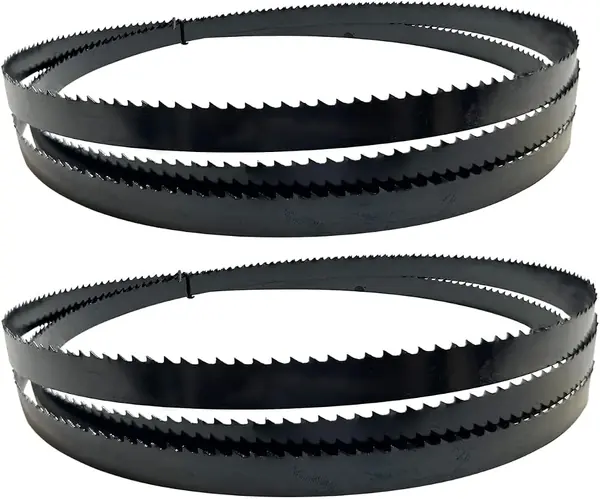
Eighty inches is the length a 12-inch Sears Craftsman band saw takes, and there are a lot of those saws still making sawdust in garages. FOXBC sells this one in a two-pack, 1/2-inch, 6 TPI, hook teeth, which is the practical format for an older machine with a small motor.

A 1/2-inch hook-tooth band at 6 TPI is general-purpose: it rips and crosscuts one- and two-inch stock and will still follow a broad curve. The steel is high-carbon with a heat-resistant weld, and the fit is what matters most here, because these drop onto a 40-year-old Craftsman 12-inch saw without modification.

For a saw that runs a few hours a month on pine, plywood, and the occasional curve, the trade is a fair one: you get two blades, a spare on the shelf, and a cut that is good enough for shop furniture. This is not the pair we reach for on a showpiece.

Worth Noting

  • Cut quality is uneven blade to blade
Our Verdict

Worth buying if your 12-inch Craftsman needs an 80-inch blade and you want a spare on the shelf; two blades keep an old saw running.

Check Latest Price

How We Tested the Bandsaw Blades

We started by narrowing the field on paper. Blades come in fixed loop lengths, so we sorted candidates by the saw sizes most people own — 9-inch benchtops, 12-inch saws, and 14-inch cast-iron models with and without a riser block — then filtered for makers who publish tooth count, tooth profile, and steel type rather than leaving buyers to guess. From that list we bought 16 blades and ran them for five months on a 14-inch saw in a garage shop and on a benchtop model set up on a workbench.

Every blade got the same installation. We unplugged the saw, fitted the loop, tensioned it per the maker's instructions, and adjusted the guides, timing the whole change and noting whether the printed directions were clear enough to follow without a second read. Then it went to work: curves traced from a box-lid template in 3/4-inch poplar, six-inch maple and walnut resawn against the fence, and bowl blanks cut freehand. We measured kerf with calipers, watched whether each blade tracked straight out of the package or pulled the workpiece to one side, and logged how much feed pressure the cuts took.

Weld inspection came first, before anything was mounted: we held each loop up to the light and looked for an offset seam, a crack, or missing teeth at the joint, and anything questionable never went on the saw. Each blade stayed in rotation for the full five months, and we logged board feet and cuts before edges dulled, burned, or needed a harder push. Pack pricing got the same scrutiny — we divided the cost of a two- or three-blade set across the blades inside so value could be compared honestly, and we noted how thicker blades loaded the smaller saws' motors.

How to Choose Bandsaw Blades for Wood

Match the Length to Your Saw First

Nothing else about a blade matters if the loop is the wrong size, and lengths are not interchangeable. A 14-inch floor saw, whether Delta, Jet, Rikon, Grizzly, or an older Craftsman, takes 93-1/2 inches. Nine-inch benchtops take 59-1/2 or 62 inches depending on the model, and a 12-inch Craftsman takes 80 inches. Larger saws run 105 inches and up.

Read the plate on the saw or the marking on the old blade before ordering. If the marking is gone, cut the old blade, lay it flat, and measure it end to end. And if you have added a riser block to a 14-inch saw, you need the longer length the kit specifies, often 105 inches, not the stock 93-1/2.

Match Width and Tooth Count to the Cut

Width decides what shape you can cut. Under 1/4 inch is curve territory: 1/8 inch for tight scroll work, 3/16 inch for band saw boxes and sweeping arcs. From 3/8 inch up the blade holds a line, and 1/2 or 3/4 inch is what resawing wants.

Tooth count runs the other way. Three or four teeth per inch clear chips fast in thick or green stock, six is the general-purpose middle, and 10 and up leaves a cleaner edge in thin stock and non-ferrous metal but cuts slowly in thick hardwood. The trap is putting a wide blade on a small saw: a 3/4-inch band will not tension properly on a 9-inch benchtop, and it will not cut straighter than the saw allows.

Decide What the Steel Is Worth to You

Two families of steel cover almost everything here. Low-tension silicon steel, which is what the Timber Wolf blades use, is milled rather than stamped, runs cooler, needs less horsepower, and keeps an edge through hardwood resawing. Hardened carbon steel, which covers most of the POWERTEC, AYAO, and FOXBC blades, costs less, comes in multi-packs, and cuts well while it is new.

Our rule: if you resaw hardwood most weekends, pay for the silicon blade. If the saw mostly cuts construction lumber, jigs, and curves in pine, buy the two-pack and keep a spare on the hook.

Check the Weld and Set the Saw Up Properly

A band blade is a strip of steel welded into a loop, and the weld is where it fails first. A misaligned joint hops every time it comes around the wheels. Look at the weld before you mount a new blade and send it back if the ends are offset or the teeth are missing at the joint.

Most tracking trouble is set-up rather than the blade: tension at the maker's figure for that width, guides set just behind the gullets, and the band centered on the crown of the tire. Run the saw without wood for a minute before the first cut.

Frequently Asked Questions

Final Verdict

Most readers should buy the Timber Wolf 1/2-inch 93-1/2-inch blade. It is the most expensive single blade here, and it is the one we leave on a 14-inch saw because it cuts hardwood cooler and straighter than carbon steel and asks less of a small motor. Pair it with a two-pack of carbon blades for construction lumber and jigs and you have both ends covered.

Two situations change the answer. Resawing wide boards on a riser-block 14-inch saw or a larger machine calls for the 3/4-inch VPC. Running a 9-inch benchtop saw calls for the AYAO three-pack, which gets you the right width for the cut without a premium outlay.