↑↓ navigate ↵ open Esc close All results →

Best Coping Saw Blades of 2026

Coping a baseboard inside corner looks like a five-minute task until a blade wanders off the pencil line or snaps halfway through the profile. Because a coping saw relies on a slender blade to turn tight radii no miter saw can reach, blade geometry and steel quality give out long before the frame does.

Swapping 14 packs through the same frame across four months of trim coping and curved cuts revealed steep drops in edge life: some blades dulled after two corners while better steel tracked cleanly through dozens. When cuts go sideways, the frame itself is rarely at fault—standard pin-end lengths fit most saws, and most breaks happen when a fine detail blade is forced through thick stock suited to a coarse tooth.

Keeping mixed assortments, bulk single-count packs, and fine-tooth detail blades on hand matches tooth pitch to the trim without overspending per replacement.

Our Top Picks

The Best Coping Saw Blades

1.

FOXBC 6-1/2-Inch Coping Saw Blades Best Overall
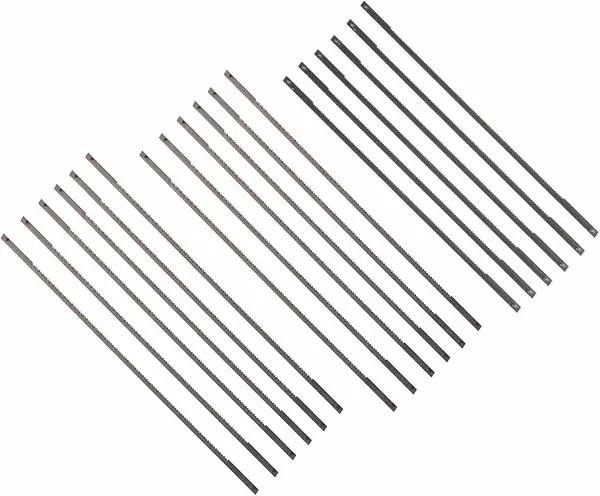
FOXBC pin-end coping saw blades in black high carbon steel, 18-piece pack

Mixed-material workshop cutting

Shop Score 91/100
Pack Size
18 blades, six of each count
Blade Material
High carbon steel
Length Between Pins
6-1/2 inches
Tooth Counts
15, 18 and 24 TPI
View on Amazon

Three tooth counts in one box is why this pack earned our top spot. Six 15 TPI blades clear waste out of pine and poplar in a hurry, six 18s handle general coping and trim, and six 24s get through thin plastic and soft metal without the chatter a coarse blade brings. You get the whole spread in one purchase instead of three, and the right blade is already in the drawer when a cut goes sideways.

What we appreciated most shows up at the frame: the pins are even and the blades seat straight, so a change takes seconds and the blade runs true from the first stroke. Each count is different enough in the hand that we grab the right one without reading the stamp. We were also pleased by how the 24 TPI blades handled plastic sheet, where a coarser blade tends to grab and chip at the exit.

Eighteen blades is more inventory than a weekend woodworker will burn through, but they keep, and the mix means you are never short of the count you actually use. What we did not expect was how much faster a blade change gets once the right counts live in one place, and that small convenience is what keeps this pack in our own frames.

Worth Noting

  • Assortment tops out at 15 TPI for thick stock
Our Verdict

We recommend this pack to almost anyone buying coping saw blades: three tooth counts, eighteen blades, and a fit that suits standard frames.

Check Latest Price

2.

Eclipse 71-CP7R Coping Saw Blades Best for Fast Coarse Cuts

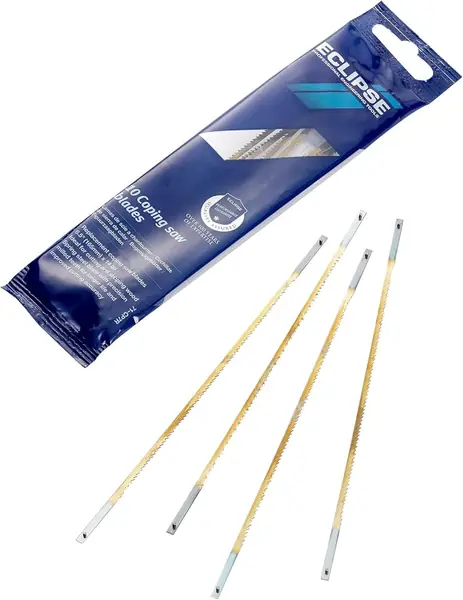
Eclipse silver carbon steel coping saw blades in a ten-blade pack

Thick stock cutting

Shop Score 90/100
Pack Size
10 blades
Blade Material
High carbon steel
Tooth Count
14 TPI
Blade Length
6-1/2 inches
View on Amazon

Fourteen teeth per inch is the coarsest blade in this group, and that is exactly what we want it for. Coarse teeth throw chips instead of scraping dust, so thick poplar, built-up molding, and PVC trim come away quickly and the kerf stays clear instead of packing. Ten blades of one count means the count you lean on hardest is never the one you run out of.

The steel is hardened carbon spring, the blades measure 6-1/2 inches, and the pins seat in a standard frame without shimming. Ours tensioned without twisting, and the blade ran straight from the first stroke rather than bowing the way a soft blade will.

Where this pack earns its keep is volume and consistency: ten blades of one count is what a shop doing steady trim work actually goes through. Eclipse lists the same blade in a 24 TPI version if your work runs fine, which is the sensible way to cover both ends. One thing we watch with a coarse blade: in thin stock the teeth can tear on the exit side before you feel it coming, so back the work with a scrap and ease off at the end of the cut.

Worth Noting

  • Pricier per blade than the budget packs
Our Verdict

Buy these if your work runs to thick stock, molding, and PVC, where a coarse 14 TPI blade clears waste fastest; ten blades keep you going.

Check Latest Price
3.

Zona 36-678 Coping Saw Blades Best for Smooth Finishes

Zona pin-end coping saw blades in silver steel, four-blade pack

Clean visible joints

Shop Score 89/100
Pack Size
4 blades
Tooth Count
15 TPI
Length Between Pins
6-1/2 inches
Blade Dimensions
0.125 inch wide x 0.020 inch thick
View on Amazon

A coped joint is a joint you look at, and a fuzzy edge on a profile shows from across the room. Zona builds this blade for that job: 6-1/2 inches between pins, .125 inch wide, .020 inch thick, 15 TPI, with teeth formed for a smooth finish rather than for speed.

The thin body is the part we care about. A .020-inch blade turns inside a tight radius without loading up, which is what makes it useful for coping crown and for notching a cabinet side to fit. It also means you steer with the frame instead of your wrist — lean on a blade this thin and it bends out of the kerf and starts cutting where you did not aim.

After a few weeks of finish work, these are the blades we reach for when the joint will be seen. Fifteen teeth per inch is the useful middle: fine enough to leave a clean shoulder on pine and poplar, coarse enough that the gullets do not clog. What surprised us was how little pressure the blade needed — two or three light strokes and the waste dropped free, with an edge that needed almost no cleanup.

Worth Noting

  • Only four blades per pack
Our Verdict

For joints you will actually look at, we reach for these 15 TPI blades; the finish is the best of this group, though the pack is small.

Check Latest Price
4.

Bahco 303-5P Coping Saw Blades Best OEM Fit for Bahco Frames

Bahco silver tempered steel coping saw blades in a five-blade pack

Bahco 301 frames

Shop Score 88/100
Pack Size
5 blades
Blade Material
Hardened and tempered steel
Tooth Count
14 TPI
Overall Length
6-1/2 inches
View on Amazon

Bahco built the 301 around this blade, which makes the 303-5P the least speculative buy in this guide for anyone with that frame in the toolbox. Five blades, hardened and tempered steel, milled and set teeth, and a length that matches a standard coping frame.

We like the set of the teeth on these. The offset gives the blade clearance in the cut, so it keeps turning through a curve instead of binding and polishing the wood, and the milled edge leaves a tidier shoulder than a stamped one.

For a frame that lives on the bench and cuts mostly wood, one count is not much of a hardship; this is the blade the saw was designed around rather than a kit for every material. In a run of oak trim the blade was still cutting cleanly well past the point where we expected to be leaning on the saw.

Worth Noting

  • Small five-blade pack
  • Highest cost per blade of the picks here
Our Verdict

If you have a Bahco 301, start here: these are the blades the frame was built around, milled and set, in a small five-pack.

Check Latest Price
5.

Mutt Tools 6.5-Inch Coping Saw Blades Best for Fine Detail Work

Mutt Tools carbon steel coping saw blades in a silver sixteen-blade set

Fine detail work

Shop Score 87/100
Pack Size
16 blades
Blade Material
Carbon steel
Blade Length
6-1/2 inches
Tooth Type
Fine tooth
View on Amazon

Sixteen blades in one set suits the saw that lives in a drawer until a trim job comes around. They measure 6-1/2 inches, are carbon steel with pin ends, and carry a fine tooth — the count for thin stock, plastic sheet, and light trim rather than for heavy cutting.

Finishing is the reason to pick these over a coarse pack. The fine teeth leave a clean edge in soft plastic and thin hardwood, with less tearout on the exit side than we get from the 15 TPI blades we keep for pine. The pin ends are the universal type and seated in a standard frame without fuss, and the set arrives with protective storage bags, which matters when sixteen loose blades share a drawer.

Judged as a stocking-up set, it does the job: enough blades to be careless with, one fine count for small work, and a cost per blade second only to our top pick. What we noticed on plastic sheet was the lack of chipping at the exit, which is usually where an inexpensive blade gives itself away.

Worth Noting

  • Fine tooth only, so thick stock cuts slowly
Our Verdict

A sensible stocking-up buy for occasional cutters, with sixteen fine-tooth blades that handle thin stock, plastic, and trim.

Check Latest Price

How We Tested Coping Saw Blades

We started with pin-end blades sized to fit a standard coping saw frame, then filtered by pin spacing, tooth count, and whether a pack sold as an assortment or a single count. We kept coarse and fine options in the mix and compared cost per blade within each group before any of them touched wood.

Every pack went into the same frame over four months and into the same rotation: coping baseboard and shoe molding around inside corners, cutting curved brackets from thin stock, and trimming small pieces clamped in a vise. We counted strokes through thick and thin stock, watched whether a blade tracked on the waste side of the line or climbed into it, noted how much it fought us through a tight radius, and checked the cut face for fuzz and tear-out where a joint would show. We also watched how each blade seated — whether it dropped onto the pins and tensioned straight or needed fussing before it would run true — and timed blade changes mid-cut.

Durability ran the length of the test. We tallied how many corners and curves each blade finished before it dulled or snapped, and noted whether the third blade out of a pack cut like the first, since sharpness varied widely from one blade to the next. Eye protection stayed on for every cut, and we matched tooth count to stock thickness throughout, because that mismatch is what kills thin blades. At the end we did the cost-per-blade arithmetic and set it against how long each pack actually lasted.

How to Choose Coping Saw Blades

Match Tooth Count to the Work

A coping saw gets asked to do two opposite jobs: rip waste out of a molding quickly, and leave a clean edge on a joint someone will inspect. Tooth count divides them. Blades in the 14 to 15 TPI range cut fastest and suit thick stock, PVC trim, and built-up molding. Eighteen TPI is the general-purpose middle. Twenty-four TPI and finer leave the cleanest edge in thin stock, plastic sheet, and soft metal.

The trap is buying a bag of one count and making it do everything. A fine blade clogs and wanders in thick stock, and a coarse one tears thin material before you feel it going. If you are buying a single pack, buy an assortment — the 15/18/24 set we recommend first exists precisely so you can stop guessing.

Fit: Length Between Pins and Pin Type

Pin-end blades are sized by the distance between the pins, not the overall length, so a blade that measures 12 inches end to end can still be a 6-1/2-inch blade where it counts. Standard hand frames take pin-end blades in the 6 to 6-1/2 inch range, which is what every pack here is built to.

Measure your own frame from pin to pin before you order a large lot. A frame that takes 6-inch blades will not tension a 6-1/2-inch blade properly, and an under-tensioned blade bows and cuts behind the line instead of through it. On older or imported frames, check the pin diameter too, since a fat pin will not seat in a narrow slot.

Steel, Teeth, and How the Blade Behaves

Most coping blades are hardened and tempered carbon spring steel, and thinness is the point: Zona's 15 TPI blades, for example, are .020 inch thick for a reason, because a narrow body turns inside a radius a thicker blade cannot follow. Teeth are punched or milled and set, and a set tooth gives the blade clearance so it does not bind halfway around a curve.

That thinness is also the fragility. Lean on a blade sideways and it can snap at the pin, so steer with the frame, keep the blade square to the cut, and let light forward strokes do the work. Blades are consumables — budget for replacing them rather than expecting one to last a season.

Pack Size and Cost Per Blade

Because blades break and dull, the number that matters is cost per blade, not what the pack costs. A four- or five-blade pack suits someone coping a handful of joints a year; ten to eighteen blades is a working quantity for regular trim work.

Our top pick works out cheapest per blade of the packs here, and the Eclipse ten-pack sits in the middle. But the arithmetic only holds if you use the counts you bought — a bargain box of fine blades is poor value for someone who only cuts molding, and the reverse is just as true.

Frequently Asked Questions

Final Verdict

The FOXBC 18-pack is what we hand most people who ask about coping saw blades. Fifteen, 18 and 24 TPI in one box cover trim, plastic, and light metal, the pin ends fit standard frames, and it is the cheapest per blade of the packs we tested.

If your work is mostly thick stock, PVC, or built-up molding, move to the Eclipse ten-pack, where a coarse 14 TPI blade clears waste faster than anything else here. For joints that will be seen, the Zona 15s leave the cleanest edge.