↑↓ navigate ↵ open Esc close All results →

Best Reciprocating Saw Blades of 2026

A reciprocating saw is the least polite tool in the bag. It shudders, throws dust, and will chew through whatever you point it at — which is why the blade matters so much. Fit the right one and that violence turns into a cut that tracks your pencil line; fit the wrong one and it binds, burns, and leaves an edge you'll sand all afternoon.

Six months and 16 blade sets in, we've learned that tooth count does more for a cut than the name stamped on the steel. More teeth give you a smoother edge and a slower, hotter cut; fewer teeth clear chips fast in green wood and demolition. What separates a good pack from a bad one is how the teeth hold up after they hit a nail.

The picks below cover what fills a weekend: a bathroom gut, a deck tear-out, a limb over the driveway. We weighed them on cost per blade as much as cut quality, because blades get used up. What they share is a tooth pattern that genuinely suits the job.

Our Top Picks

The Best Reciprocating Saw Blades

1.

Milwaukee 12-Piece Sawzall Blade Set Best Overall
Milwaukee 49-22-1129 Sawzall blade set with twelve white blades and a roll-up storage pouch

General remodeling

Shop Score 97/100
Blade Count
12
Storage
Five-compartment roll pouch
Blade Thickness
0.042 to 0.062 in.
Blade Lengths
6 in. and 9 in.
View on Amazon

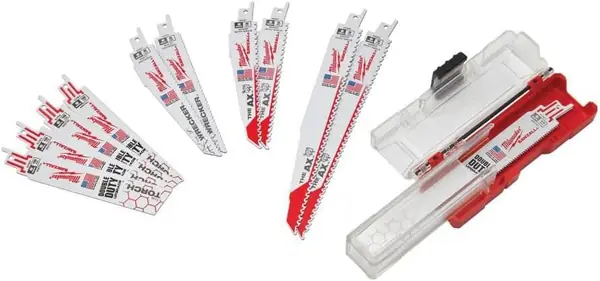
Unroll the pouch on the Milwaukee 12-piece set and twelve blades fan out across two lengths: 6-inch Wrecker, Torch and Axe profiles for work between studs, and 9-inch versions for reach. Tooth pitches run from 5/8 TPI for lumber with fasteners buried in it up to 14 TPI for metal, which is the widest spread of any Sawzall blade kit we tested. That spread is why it stays our default: one roll covers a deck tear-out, a stack of conduit and a morning of limb cutting without a trip back to the store.

Body thickness is where it pulls ahead of the cheaper sets, at .042 to .062 inch with a full inch of blade height. In a deep cut through framing, that stiffness is the difference between a blade that tracks straight and one that wanders and pinches, and a pinched blade usually comes out bent. We paid close attention to the shank end too, and every blade seated firmly in a tool-free clamp without chattering.

The pouch rolls into a five-compartment bundle that drops into a toolbox instead of claiming a drawer, and it is the reason the blades are still sorted a month in. Twelve blades also means you are not rationing: keep a 9-inch wood blade on the saw, a metal blade in the pouch, and a spare of whichever one you burn through first.

Worth Noting

  • Soft fabric pouch, not a hard case
Our Verdict

Our default pick: a dozen blades across two lengths that handle framing, demolition and metal, with the thickest bodies here and a pouch that keeps them sorted.

Check Latest Price
2.

Bosch RAP7PK 7-Piece Blade Set Best Value

Bosch RAP7PK seven-piece reciprocating saw blade set in black with wood and metal blades

Small DIY jobs

Shop Score 96/100
Blade Material
Bi-metal and high carbon steel
Blade Count
7
Materials
Wood, metal, plastic, PVC
Tooth Pitches
6 TPI, 5/8 variable, 10/14 variable
View on Amazon

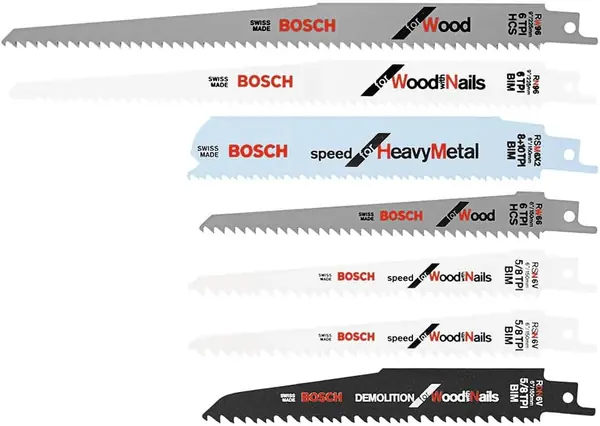
Seven blades in the Bosch RAP7PK does not sound like much until you count the jobs. There is a 6 TPI wood blade for framing and plywood, bi-metal blades with 5/8 variable pitch for lumber that has nails in it, 10/14 variable-pitch demolition blades, and thin-kerf .035-inch metal blades that cut conduit without wandering. Four different cuts from one cardboard sleeve, with no filler blades thrown in to raise the count.

We think the value here is the hardest to beat in this group. Nothing in the construction is exotic — high carbon steel for the wood blades, bi-metal for anything meeting metal — but the tooth geometry is the same shape the premium sets use, and the whole kit costs less than a single carbide pruning blade. For a woodworker who needs one blade of each type on hand rather than five of one, that is the right trade.

The limit is depth of supply. One blade per profile means the day the 6 TPI hits a knot full of grit and dulls, the wood work stops until you reorder. Treat the set as a way to learn which profiles you actually burn through, then buy those in fives. The universal shank seated properly in every saw we tried, from a compact 12-volt body to a full-size corded one.

Worth Noting

  • One blade per profile, no spares
Our Verdict

We think this is the smartest spend here: four tooth profiles covering wood, nails and metal in one small kit, as long as you accept one blade per profile.

Check Latest Price
3.

DEWALT DW4856 6-Piece Blade Set Best Budget Starter Set

DEWALT DW4856 six-piece reciprocating saw blade set in yellow with a collapsible storage case

Occasional repairs

Shop Score 95/100
Blade Material
Bi-metal
Blade Count
6
Storage
Collapsible case
Number Of Teeth
24
View on Amazon

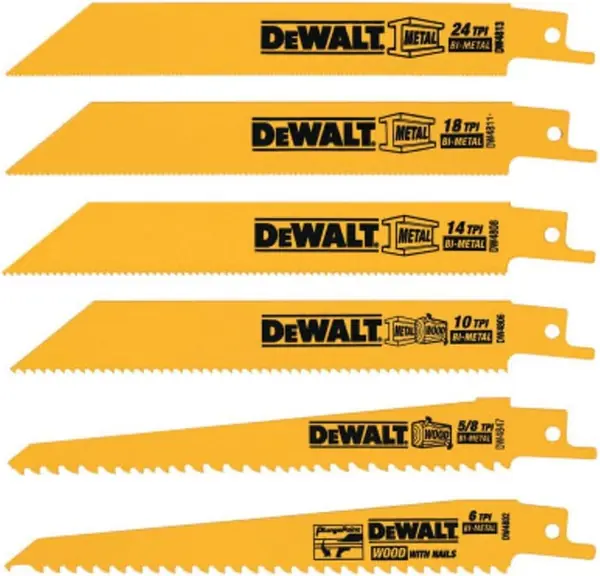
The DW4856 is the least expensive way to put a complete wood-and-metal set in a toolbox: six bi-metal blades, a collapsible case, and enough tooth counts that you are not cutting conduit with a pruning blade. Bi-metal at this price is the part worth noting, since plenty of low-cost sets use plain high-carbon steel that gives up the first time it touches a nail.

The finest teeth here are 24 TPI, which is metal territory — conduit, sheet, thin angle — while the coarser blades take 2x lumber and plywood without clogging. The bodies are on the thin side, though, and a hard push in demolition is where they bend. These are blades for cutting and trimming, not for tearing a deck apart.

For the homeowner cutting a few boards and a length of pipe a year, we think this is the right set at the right money, and the case collapses flat enough to live in a drawer. Anyone cutting pallets or old studs with nails should pay more for thicker blades, because a bent blade halfway through a cut costs more time than the upgrade does.

Worth Noting

  • Bodies bend under hard demolition cuts
Our Verdict

Our budget pick — the least expensive complete set here, and the one most likely to bend if you push it through demolition.

Check Latest Price
4.

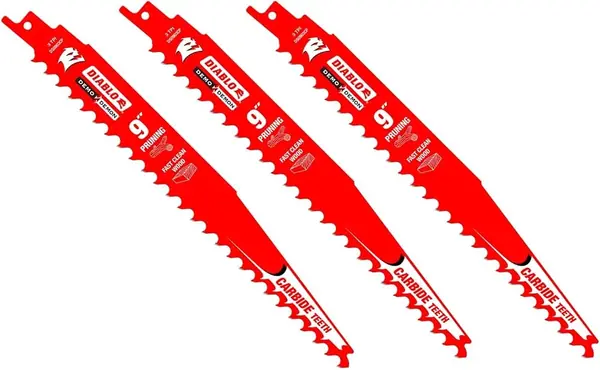
Diablo Demo Demon 9-Inch Carbide Pruning Blades Best for Pruning and Clean Wood

Diablo Demo Demon nine-inch carbide-tipped pruning reciprocating blades in red three-pack packaging

Pruning and roots

Shop Score 94/100
Blade Material
Carbide tipped
Pack Size
3
Blade Length
9 in.
Teeth Per Inch
3
View on Amazon

Carbide is what changes the arithmetic on a pruning blade. High-carbon steel is cheap and sharp and quits the moment it meets dirt, and a root ball is nothing but dirt with wood running through it. The carbide teeth on the Demo Demon are the reason we keep this pack for stumps cut at ground level and roots that have to come out of a hole.

The geometry is aggressive even for pruning: 3 TPI with deep gullets to clear chips, a full inch of blade height, and an oversized body so the blade does not fold when you lean on it. The Perma-SHIELD coating scuffs off the face of the blade early and looks worse than it is — the carbide edge is what does the cutting, and it keeps cutting after the black finish is gone.

Three blades to a pack is the trade-off, and at this price you are buying teeth rather than volume. If your pruning is a couple of rose bushes a season, high-carbon blades do the job for a fraction of the money. Where the carbide earns it back is repeated dirty work: a fence line, a hedge, the stump you keep promising to grind out.

Worth Noting

  • Premium price for a three-blade pack
Our Verdict

We keep these for roots and ground-level stumps: carbide teeth that go on cutting in dirt where high-carbon blades give up.

Check Latest Price
5.

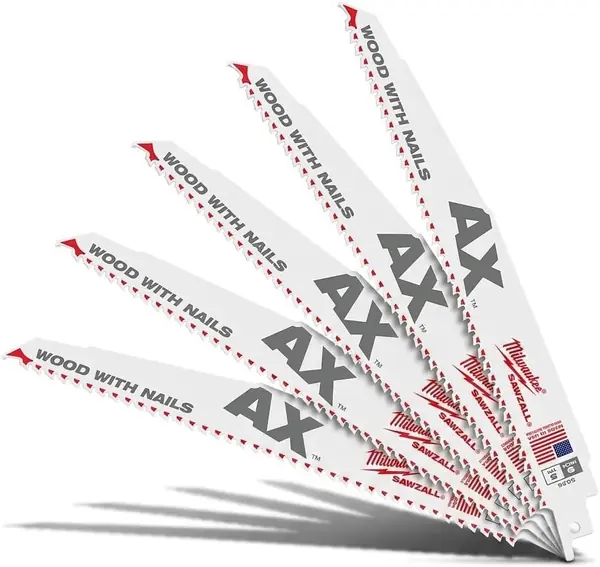
Milwaukee The Ax 9-Inch Demolition Blades Best for Nail-Embedded Wood

Milwaukee The Ax nine-inch five-TPI reciprocating saw blades five-pack with sloped plunge noses

Nail-heavy demolition

Shop Score 93/100
Pack Size
5
Blade Length
9 in.
Teeth Per Inch
5
Blade Thickness
0.062 in.
View on Amazon

Tearing out a deck or a wall of old studs means hitting fasteners you cannot see, and that is the job the Ax is built for. Nine inches, 5 TPI, and .062 inch of blade body — among the thickest in this group — with a sloped nose that starts a plunge cut in the middle of a sheet instead of a drilled starter hole. Bi-metal construction means the teeth give rather than shatter when they find a nail.

Five identical blades is a deliberate limitation: this is the blade you buy when the work is nail-heavy, not an assortment that covers a remodel. The 5 TPI cut is fast and rough, so plan on cleaning up any edge that will show. What we appreciate is the predictability — the same blade every time, no digging through a pouch for the right pitch while the saw idles.

Worth Noting

  • Five identical blades and no assortment
Our Verdict

Our pick for lumber that might have nails in it: a thick shatter-resistant body and a sloped nose that starts a plunge cut without skating.

Check Latest Price
6.

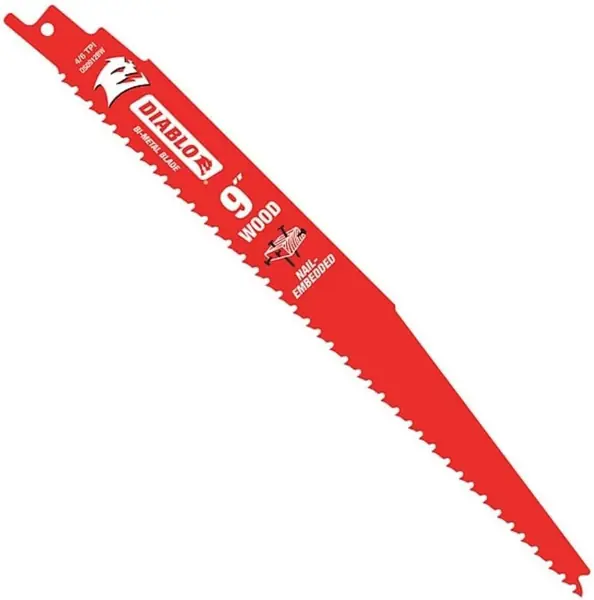
Diablo 9-Inch Nail-Embedded Wood Blades (25-Pack) Best Bulk Pack

Diablo nine-inch bi-metal reciprocating saw blades in a red twenty-five-pack box

Framing crews

Shop Score 92/100
Blade Material
Bi-metal
Pack Size
25
Blade Length
9 in.
Application
Nail-embedded wood
View on Amazon

Twenty-five of one blade is a purchase that only makes sense if you go through them, and a framing or remodeling crew does. The point is not savings so much as rhythm: nobody stops to swap in a good blade, nobody hoards the last sharp one, and the box lives in the truck where the work is.

The blade is nine inches of bi-metal built for nail-embedded lumber, with Diablo's full-contact arched edge putting more teeth into the wood on every stroke and a Perma-SHIELD coating to keep pitch and heat from building. The body is thick enough to stay straight through a deep plunge, which is what you want when you are cutting out a rotten sill plate.

Where we hesitate is commitment. A 25-pack locks you to one profile, and you still need a fine metal blade, a pruning blade, and something that leaves a presentable edge. The sensible order is an assortment first, then a box of whatever you wore out — and for most framers this is the blade that gets worn out.

Worth Noting

  • Commits you to one blade profile for 25 blades
Our Verdict

Our pick for crews: 25 nail-embedded wood blades in one box, so nobody rations the sharp ones or stops to swap.

Check Latest Price
7.

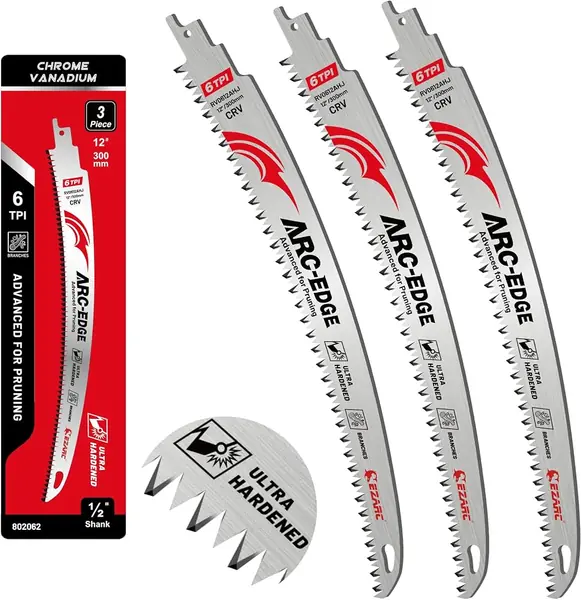
EZARC Arc Edge 12-Inch Pruning Blades Best for High Limbs

EZARC arc edge twelve-inch pruning reciprocating saw blades three-pack in silver chrome vanadium steel

High limbs

Shop Score 91/100
Blade Material
Chrome vanadium steel
Pack Size
3
Blade Length
12 in.
Teeth Per Inch
6
View on Amazon

Twelve inches of blade gets to limbs a 9-inch pruning blade cannot reach, which is the entire pitch: cutting overhead, over a fence, or across a hedge without fetching a ladder. If your pruning happens above shoulder height, reach matters more than tooth count.

The arc edge is a curved cutting profile with 6 TPI teeth ground on three angles, and the curve keeps more of the tooth in contact through the stroke while letting you roll the blade as the limb moves. EZARC rates the cutting capacity at up to 250 mm, roughly 10 inches, in diameter. Chrome vanadium steel keeps the price near the middle of this group, well below carbide.

Where these need care is the shank. Twelve inches of blade gives you leverage a shorter blade does not, and a blade levered sideways in a bind can snap right where it enters the clamp. That is a good argument for keeping a spare in the truck and for never using a pruning blade as a pry bar.

We keep a 12-inch blade around for palm fronds, fence rows and storm cleanup, and that is the work this one is built for. For anything you would call carpentry, the length works against you: a long blade flexes more, and 6 TPI leaves a rough edge.

Worth Noting

  • One profile per pack, so it cannot replace a mixed set
Our Verdict

We reach for the 12-inch length when limbs are overhead; just know the shank is the weak point when the blade gets levered.

Check Latest Price
8.

VICRING 9-Inch Pruning Blades

VICRING nine-inch high-carbon steel pruning reciprocating saw blades five-pack with blue coating

Yard cleanup

Shop Score 90/100
Blade Material
High carbon steel
Pack Size
5
Blade Length
9 in.
Teeth Per Inch
5
View on Amazon

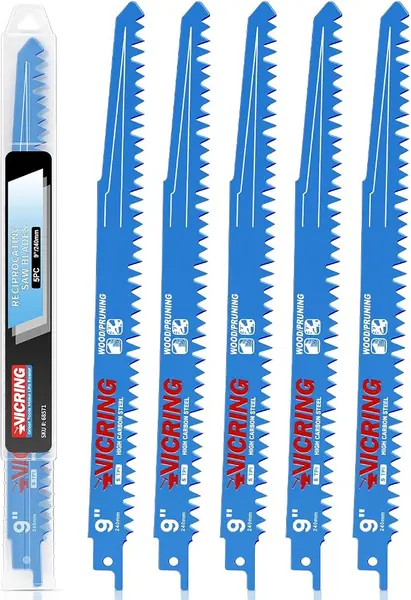
High-carbon steel, 5 TPI, five blades in a sleeve: the VICRING pack is the disposable approach to pruning. The steel is hardened to HRC 48-52, hard enough to hold an edge in green wood and cheap enough that hitting a rock is not a disaster.

The teeth are corrugated and alternate, which keeps the blade from chattering out of a wet limb, and .06 inch of body is enough for a 9-inch blade. These seat in a compact 12-volt saw as readily as in a full-size one, and a small saw with a coarse blade is a more capable yard tool than we expected from a pack this cheap.

Speed is the soft spot. Green branches and pine go quickly; dry hardwood bogs down, where coarse carbon-steel teeth have little to help them. Expect to work the saw rather than lean on it in anything seasoned.

Buy them by the pack and treat them as consumables — five of these cost less than one carbide blade, so the math works for a hedge line, a few storm-dropped limbs, and the brush pile behind the garage. If you cut roots out of dirt every season, spend the money on carbide instead.

Worth Noting

  • Dulls quickly in dry hardwood and dirty wood
Our Verdict

Our cheap-and-cheerful pruning pick: five high-carbon blades you can dull without wincing, sharp in green wood and slow in dry hardwood.

Check Latest Price

How We Tested Reciprocating Saw Blades

We started with spec sheets, narrowing a long list of listings by tooth pitch and geometry, blade material, length, thickness, and how many blades came in the pack. We bought 16 sets at retail — small starter assortments through a 25-pack of a single blade — and ran them for six months instead of saving them for best.

Most of the cutting happened during a bathroom gut and a deck tear-out: slicing PVC drain lines, cutting backer board, and running blades into decking furred with old nails. Weekends went to an oak with limbs over the driveway and to breaking down pallets that were more nail than wood. Goggles went on for anything overhead or nail-embedded, every time.

We counted cuts before an edge went dull, inspected the teeth after every nail strike, and dragged a few blades through dirt-caked roots on purpose to see how fast grit killed them. We noted whether a blade tracked the pencil line in plywood or wandered, whether it chipped the edge of PVC, how far it reached past the shoe on a buried cut, and whether the body flexed or snapped when we leaned on it in a bind.

Every blade change started with the battery out of the saw — no exceptions, and no reaching into the shoe with the trigger live. At the end we divided pack price by blade count, then checked whether the roll pouch or case kept the blades sorted and dry riding in a truck bed. The ones that stayed in rotation were the ones we grabbed without thinking about it.

How to Choose Reciprocating Saw Blades

Tooth Count Decides the Cut

Coarse teeth carry big chips; fine teeth leave a smooth edge and cut slowly. Green wood, limbs and rough carpentry want 3 to 6 TPI. Lumber that might have nails in it wants 5/8 to 10 TPI, where the teeth are stout enough to survive a fastener. Metal wants 14 to 24 TPI, and thin sheet wants the finest pitch available so the teeth do not catch and tear.

Pick the material first, then the count. A 24 TPI blade in a 4x4 will clog and burn its way along, and a 6 TPI blade in conduit will snag on every pass. If you cut both, that is an argument for an assortment rather than one heroic do-everything blade.

Carbon Steel, Bi-Metal, or Carbide

High-carbon steel takes the sharpest edge for the least money and loses it fast in dirt, grit or heat — fine for clean pruned limbs, poor for roots pulled out of soil. Bi-metal welds a hardened tooth strip to a flexible body, so it survives nails and the flex of a demolition cut. Carbide lasts longest in abrasive work and costs the most per blade.

Match the steel to how dirty the material is, not to how big the job is. A clean 2x4 does not need carbide; a stump sitting in gravel does.

An Assortment First, Then Fives of One Blade

Almost everyone should start with a mixed set, because you do not know which profile you will burn through until you have burned through it. After that, buying five or twenty-five of the one blade you actually use is cheaper and less annoying than replacing another assortment, and a roll pouch or case is what keeps the profiles distinguishable at a glance.

Watch the piece count on budget sets. Thirty-two blades at a low price usually means thin bodies, and a blade that snaps on its first cut is not a bargain at any price per piece.

Length Is About Reach, Not Power

Six-inch blades fit between studs and cut flush against a floor; nine inches is what most jobs want; twelve inches reaches overhead limbs and lets you work at ground level without kneeling. Longer is not automatically better. A 12-inch blade flexes more under a hard push, so keep the long ones for reach and let the saw do the feeding.

Frequently Asked Questions

Final Verdict

For most people the Milwaukee 12-piece set is the one to buy. It is the only kit here that pairs both common blade lengths with the tooth pitches for framing, nails and metal, and its thicker bodies hold a straight line in cuts where the budget blades bend. Buying one roll beats assembling the same coverage blade by blade.

Two situations argue for something else. If the saw only comes out for pruning, the Diablo carbide pack cuts dirty roots and ground-level stumps that would ruin carbon steel. And if you want the smallest sensible kit, the Bosch seven-piece covers the same four jobs with fewer spares and a lower outlay.