↑↓ navigate ↵ open Esc close All results →

Best Reciprocating Saw Blades for Metal of 2026

Drop a general-purpose blade onto cast iron pipe and a reciprocating saw that breezed through nail-embedded framing stalls out, skates off the mark, and strips its teeth in seconds. Thin sheet, heavy rebar, and thick-wall pipe punish weak metal blades immediately, turning quick plumbing or salvage cuts into ragged wander and wasted packs.

Six months of cutting plumbing tear-outs, rebar, sheet metal, and shop scrap across 16 bi-metal and carbide-tipped blades confirmed that tooth pitch and tooth alloy govern almost every outcome. Beyond how cleanly a blade tracked through a pipe wall, judging edge longevity against per-blade price separated economical cutters from costly disposables.

Skipping the TPI rating is the quickest way to stall a cut: a fine 24 TPI edge made for 18-gauge sheet overheats in half-inch plate, while an 8 TPI carbide strip chews through heavy steel without binding. Spanning 6- and 9-inch lengths across sheet, pipe, and demolition steel, these eight packs match specific tooth geometries to the metal in front of the shoe.

Our Top Picks

The Best Reciprocating Saw Blades for Metal

1.

Diablo Steel Demon Carbide Blade Best Overall
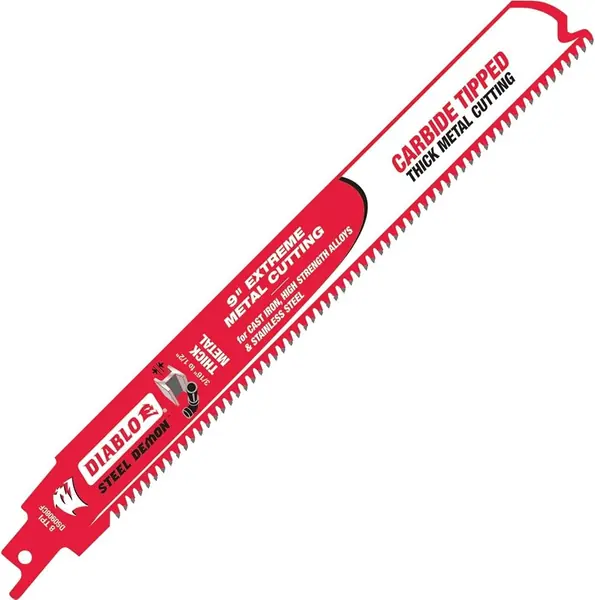
Diablo Steel Demon carbide-tipped reciprocating saw blade, 9-inch 8 TPI, coated body

Thick metal cutting

Shop Score 95/100
Blade Length
9 in.
Teeth Per Inch
8 TPI
Blade Body
1 in. wide
Cutting Thickness
3/16 in. to 9/16 in.
View on Amazon

Cast iron drain pipe is the material that turns a good bi-metal blade into a smooth, useless strip of steel. The Steel Demon is built for exactly that: a 9-inch, 8 TPI carbide-tipped blade aimed at stock from 3/16 to 9/16 inch thick. What we noticed first is the 1-inch body. It sits down in a cut instead of flexing out of one, so the blade tracks straighter and the saw chatters far less than it does with a narrow bi-metal blade.

The teeth are the real argument. Each carbide tip is welded to the body and ground sharp, and carbide holds its edge at temperatures that leave bi-metal teeth soft and polished. Diablo rates the blade at up to 50 times the cutting life of a standard bi-metal blade, a figure we can't verify, but the mechanism behind it is real: a blade that is still biting after a cut that would have dulled three bi-metal blades is the difference between finishing the job and driving to the store. The Perma-Shield coating is the quieter benefit. It keeps paint, tar, and gum from loading up the teeth, which matters on old galvanized pipe and anything salvaged.

The limitation is thickness in the other direction. Eight teeth per inch is coarse, and coarse teeth on 20-gauge sheet grab, tear, and leave a ragged edge. Keep a fine-pitch blade — the DEWALT 24 TPI or the Bosch 18 TPI here — for anything under about 1/8 inch, and let this one handle plate, pipe, angle, and rebar.

What you get for the trouble is a cut you can live with. The kerf is narrow and straight, and on visible work — a gate frame, a bumper, a railing — that saves a session with a grinder and a file. That is the part that keeps this blade in the saw rather than in the case.

Worth Noting

  • Sold as a single blade, not a pack
Our Verdict

We reach for this one on anything thick, rusty, or hardened, because a carbide tooth keeps cutting after bi-metal has gone smooth.

Check Latest Price

2.

Milwaukee Torch Metal Blade Best for Heavy Demolition

Milwaukee Torch 6-inch 14 TPI reciprocating saw blade, five-pack, black finish

Heavy demolition

Shop Score 94/100
Blade Length
6 in.
Teeth Per Inch
14 TPI
Pack Size
5 blades
Blade Height
1 in.
View on Amazon

A full inch of blade height on a 6-inch blade is what we look for in a demolition blade, and it is the detail that sells us on the Torch. A tall body resists bowing in a deep cut, so the blade goes through a frame rail or a length of channel straight instead of wandering and binding halfway. Milwaukee heat-treats the whole blade and runs 14 teeth per inch down the edge, a pitch meant for heavy metal: plate, structural steel, rusted brackets, the stock that stalls a finer blade.

The failure you are trying to avoid in demolition is a snapped blade buried in a kerf you cannot widen. A stiff body and a coarse pitch are aimed squarely at that, and the combination is what we want when the material is heavy and the access is poor — under a truck, inside a frame, behind a fender where the saw barely fits.

Six inches also keeps it compact, which is an advantage under a vehicle and a limit everywhere else. A long pipe run or a cut deep inside a wall wants one of the 9-inch blades here, such as the Diablo Steel Demon or the TOLESA. For the ugly structural work, though, it is the blade we are happiest to own five of.

Worth Noting

  • Tears thin sheet and conduit
Our Verdict

We want this blade when the metal is thick and the access is bad, because the tall body tracks straight and the coarse pitch keeps cutting.

Check Latest Price
3.

DEWALT DW4813 Bi-Metal Blades Best Value

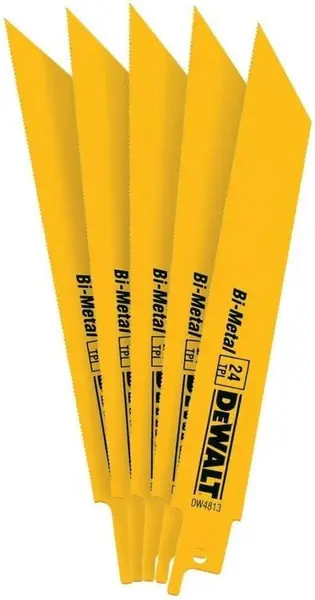
DEWALT DW4813 6-inch 24 TPI bi-metal reciprocating saw blades, five-pack, yellow

Thin metal jobs

Shop Score 93/100
Blade Length
6 in.
Teeth Per Inch
24 TPI
Pack Size
5 blades
Blade Material
Bi-metal
View on Amazon

Five metal-cutting blades for less than the price of a single carbide one is the trade the DW4813 offers, and on thin stock it is a good trade. These are 6-inch, 24 TPI bi-metal blades with a straight back, a fine pitch aimed at sheet metal, conduit, thin-wall tube, and the small hardware that turns up halfway through a project.

The pitch is the whole story, and it is what we like about the blade. At 24 teeth per inch it starts easily without skating across the surface, cuts a narrow kerf, and leaves an edge that a few strokes of a file will close. On 1/8-inch and thinner it is quick and clean; on 1/4-inch plate it still gets through, just slowly and with more heat than you want. The bi-metal body has enough flex that a jam is more likely to bend the blade than shatter it.

Where these earn their place is the unglamorous work: a shelf bracket, a length of 20-gauge duct, a hinge pin rusted solid. A five-pack means one stays in the saw, one lives in the case, and you never stop to think about it. That is why this pack stays in the bag even when there is carbide in the toolbox.

Worth Noting

  • Dulls fast in thick steel
Our Verdict

We keep this pack around for thin metal and small jobs, where a fine 24 TPI edge starts cleanly and the price lets you be careless.

Check Latest Price
4.

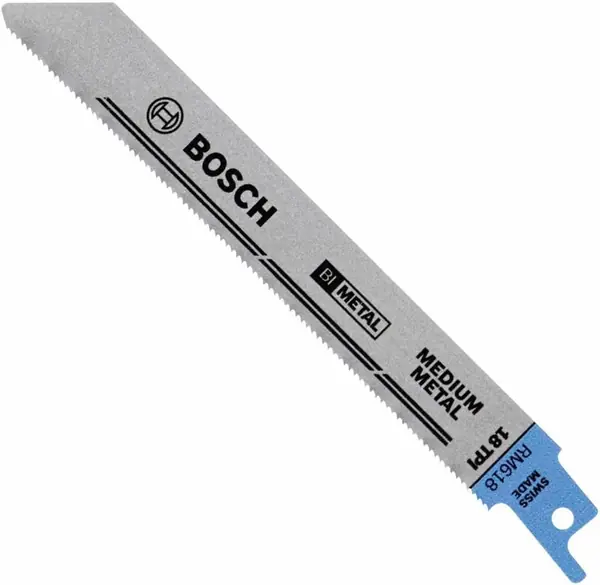
Bosch RM618 Metal Blades Best for Clean Cuts

Bosch RM618 6-inch 18 TPI metal-cutting reciprocating saw blades, five-pack, blue

Clean sheet cuts

Shop Score 92/100
Blade Length
6 in.
Teeth Per Inch
18 TPI
Blade Material
Bi-metal
Blade Thickness
0.035 in.
View on Amazon

A cut that needs no cleanup is the reason to care about tooth geometry, and the RM618 is built around exactly that. Bosch sets the teeth in pairs, two facing left and two facing right, at an 18 TPI pitch with a 0 degree hook angle, and calls it a blade for 10- to 16-gauge ferrous and non-ferrous sheet.

We like the pair-set tooth for a practical reason: the kerf stays wide enough to clear chips instead of packing them, so the blade keeps its speed through a long cut and does not heat up as fast. The 0.035-inch body is thin enough to flex into a flush cut against a wall or a floor, and the 3/4-inch height still keeps it tracking on a straight line. It leaves an edge you can take straight to a weld or a bolt-up.

The limits are the ones you would expect from an 18 TPI blade. It is happiest in sheet and tube up to about 16 gauge, and thick cast iron or heavy plate is carbide work; you will get through 1/4-inch steel, but slowly, with heat building the whole way. For the thin metal it was designed for, that trade costs you nothing.

Worth Noting

  • Thin body bends if you lean on it
Our Verdict

For clean cuts in sheet metal and thin-wall tube, we have not found a better-behaved blade in this group than this one.

Check Latest Price
5.

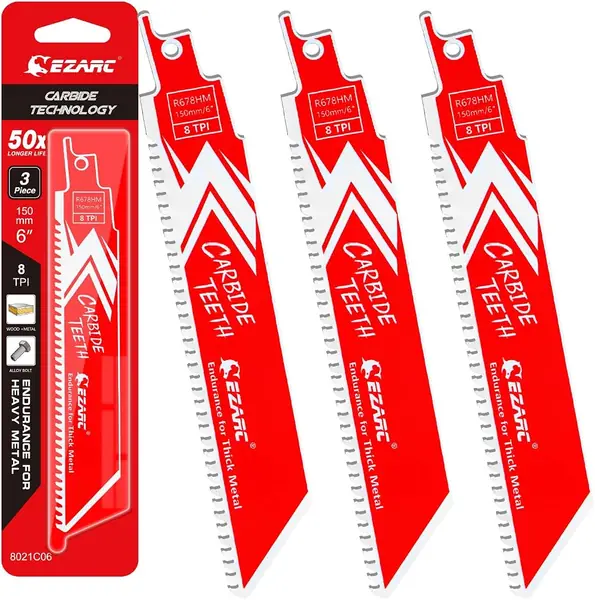
EZARC Carbide Blades Best Carbide Value

EZARC 6-inch 8 TPI carbide reciprocating saw blades, three-pack, black finish

Hardened steel

Shop Score 91/100
Blade Length
6 in.
Teeth Per Inch
8 TPI
Pack Size
3 blades
Cutting Range
1/8 in. to 1/2 in.
View on Amazon

Three to a pack is the detail that changed how we think about carbide blades. EZARC's 6-inch blade runs 8 teeth per inch through stock from 1/8 to 1/2 inch, with each carbide tooth ground and welded on individually, the construction that lets a reciprocating saw get through stainless, cast iron, rebar, and hardened bolts that would ruin a bi-metal edge. Buying carbide three at a time means a broken tip does not end the job.

The coarse pitch is what makes it work in thick metal: 8 TPI clears chips fast enough to keep the blade moving in 1/4- to 1/2-inch pipe and plate, which is where a fine blade bogs down and cooks itself. The 1/2-inch universal shank drops into any Sawzall-style saw without an adapter. EZARC quotes up to 50 times the life of bi-metal, and while the honest range is narrower than that, the tips do survive cuts that leave a bi-metal blade smooth.

What it is not is a sheet-metal blade. Eight teeth per inch on 20-gauge grabs and tears, so keep the Bosch or the DEWALT here for anything under about 1/8 inch. At 6 inches it is also compact, and long pipe runs want a 9-inch blade. Those are boundaries, not flaws: buy it for the metals that eat everything else and keep it out of the thin work.

Worth Noting

  • Life drops fast when the cut runs hot
Our Verdict

We point anyone cutting stainless, cast iron, or hardened bolts to this three-pack, because carbide gets through what bi-metal cannot.

Check Latest Price
6.

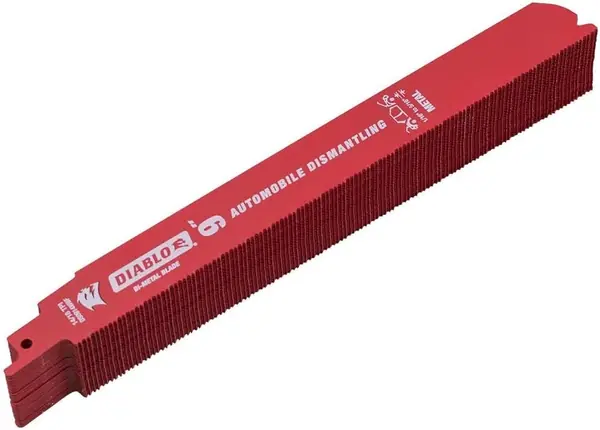
Diablo 9 in. Bi-Metal 25-Pack Best Bulk Pack

Diablo 9-inch 14/18 TPI bi-metal reciprocating blades, 25-pack, red packaging

Shop bulk supply

Shop Score 90/100
Blade Length
9 in.
Teeth Per Inch
14/18 TPI
Pack Size
25 blades
Blade Material
Bi-metal
View on Amazon

Twenty-five blades in one box is either exactly what you need or a lifetime supply, and which one depends on whether metal cutting is a regular part of your week. The DS0914WBF25 is a 9-inch, 14/18 TPI bi-metal blade with Diablo's dual-tooth geometry and a 1-inch demolition body, sold in a shop-size box.

The geometry separates it from a generic 14 TPI blade. Paired teeth with small gullets clear material faster and keep the cut from packing, and the arched full-contact profile puts more of the edge against the work on each stroke, so you make fewer passes and put less heat into the blade. The Perma-Shield coating is there for the same reason, since heat, gumming, and corrosion kill a bi-metal blade before the teeth actually wear out. It is aimed at auto dismantling, which is a polite way of saying rusted, painted, and awkward metal.

The box changes a small habit. At this pack size the per-blade cost lands in the middle of what is here, and with 24 blades behind the one in the saw you swap a tired blade instead of pushing it through one more cut. That habit is what keeps blades from snapping, and it is worth more than the few dollars a cheaper box saves. Buy it if you cut metal often; buy a five-pack if you cut it twice a year.

Worth Noting

  • Big outlay if you rarely cut metal
Our Verdict

A 25-blade box makes sense if metal cutting is regular work, and the dual-tooth geometry is built for car frames and pipe.

Check Latest Price
7.

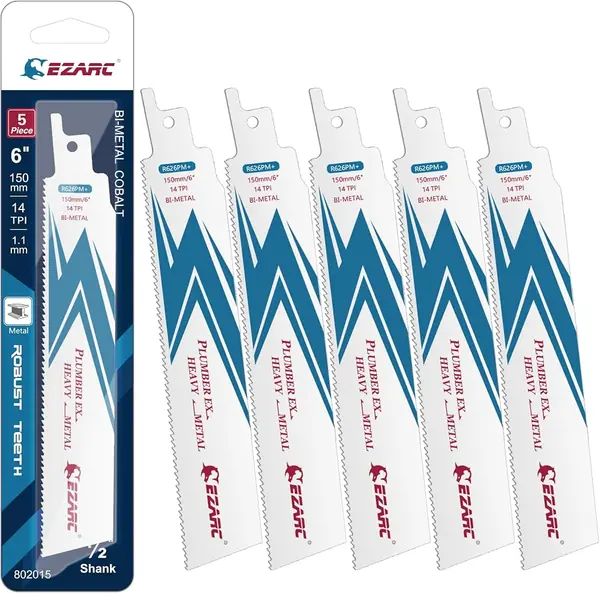
EZARC Cobalt Bi-Metal Blades Best for Everyday Metal Cutting

EZARC 6-inch 14 TPI cobalt bi-metal reciprocating saw blades, five-pack

Everyday metal cutting

Shop Score 89/100
Blade Length
6 in.
Teeth Per Inch
14 TPI
Pack Size
5 blades
Blade Material
M42 cobalt bi-metal
View on Amazon

Nothing about EZARC's bi-metal five-pack is exotic: 6 inches long, 14 teeth per inch, M42 cobalt in the teeth. That is the point. It is the pitch and the length that cover the widest stretch of ordinary metalwork, and the price keeps a full pack in the case instead of a single blade you save for a special job.

Fourteen TPI sits in the middle of the range, which is where most metal cutting actually happens: pipe and profile up to about 4 inches across, sheet and plate from roughly 3 to 10 mm thick. The cobalt in the teeth is what lets it take heat that would soften a plain bi-metal edge, and the 1/2-inch shank fits standard reciprocating saws.

It is not the blade for a cast iron stack or a stainless flange, and it will not leave the polished edge the Bosch does in 20-gauge. What it will do is start a cut in a bracket without skating and get through a length of black pipe without a swap, which is most of what a home shop asks.

Where it lands for us is the everyday blade: cheap enough to keep five, general enough to handle a fence post, a chain-link rail, or a painted piece of angle iron you could have unbolted. It will not outlast carbide on stainless and it will not match the Steel Demon on a drain line, but it costs less than either and gets through the work most of us actually do.

Worth Noting

  • Wears out quickly in continuous cutting
Our Verdict

A general-purpose cobalt bi-metal blade we keep five of, because it handles pipe and plate without carbide money.

Check Latest Price
8.

TOLESA 9 in. Cobalt Blades Best for Long Reach Cuts

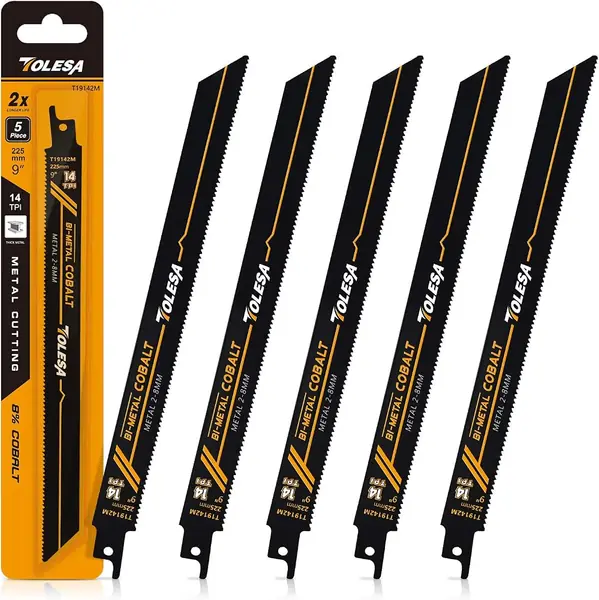
TOLESA 9-inch 14 TPI cobalt bi-metal reciprocating saw blades, five-pack

Long reach cuts

Shop Score 88/100
Blade Length
9 in.
Teeth Per Inch
14 TPI
Pack Size
5 blades
Blade Material
Bi-metal with 8% cobalt
View on Amazon

Nine inches of blade gets into places a 6-inch one cannot: through a pipe with room on both sides, past a heat shield, into a cut where the saw body will not fit. TOLESA's 14 TPI cobalt blade is built for that reach, with a 0.9 mm thin wall and set teeth to keep the kerf clear.

The stated range is medium-thick sheet from 2 to 8 mm and pipe or profile under 100 mm across, which covers the plumbing and fence work people buy a long blade for. The teeth carry 8 percent cobalt, and the thin body is meant to hold down heat while chips clear faster in a deep cut.

Reach is where the money goes. A chain-link rail set in concrete, a cast drain line cut between joists, a tailpipe hanger you cannot reach with a grinder: those are the jobs where length beats every other quality, and a short blade does not enter the conversation.

We keep one of these in the case as the long option rather than the everyday blade, and at a budget price that is an easy slot to fill. It is not a carbide substitute, so for stainless or cast iron go to the Steel Demon or the EZARC carbide pack. For the once-a-month cut a 6-inch blade physically cannot make, it saves the afternoon.

Worth Noting

  • Dulls quickly in long hard cuts
Our Verdict

A long, inexpensive cobalt blade for reaching into pipe and awkward cuts where a 6-inch blade simply cannot go.

Check Latest Price

How We Tested Metal-Cutting Reciprocating Saw Blades

We started with the blades actually sold for metal — bi-metal and carbide-tipped, in 6- and 9-inch lengths, with tooth counts from 8 to 24 TPI — then set aside anything that wouldn't lock firmly into the saws in our shop, since a loose shank chatters and dulls an edge fast. We also recorded pack size and price per blade next to every other number, because an expensive blade has to cut noticeably longer to be worth carrying.

Sixteen blades went into testing over six months. Every workpiece was clamped in a bench vise or lashed to sawhorses before the saw came out, we unplugged the cord or pulled the battery before each blade change, and safety glasses stayed on for every cut, since metal chips and snapped teeth travel. Coarse 8 TPI blades went into 3/16- to 9/16-inch plate; 14 TPI blades took on pipe, angle iron, and rebar; 18 and 24 TPI blades were run through 18-gauge sheet and thin-wall conduit.

Every cut was timed and every blade counted — how many cuts it made before it stopped pulling itself through the steel, and how far the kerf drifted from the line we'd scribed. We noted how much each blade flexed when pushed into a deep cut, felt the body for heat after long runs, and watched the tooth tips for blueing. A missing or broken tooth ended a blade's run early, and we wrote down exactly where it happened.

How to Choose Reciprocating Saw Blades for Metal

Match the Teeth to the Thickness

Teeth per inch is a thickness rating in disguise: the thinner the metal, the more teeth you need to spread the cut across. Twenty-four TPI is the fine end, right for sheet metal, flashing, and thin-wall conduit where a coarse blade grabs and tears. Eighteen TPI handles 10- to 16-gauge sheet and square tube cleanly. Fourteen TPI is the all-round metal pitch for pipe, angle, and plate up to about 1/4 inch. Eight TPI is for the thick stuff, where a fine blade only heats up and polishes.

The trap is buying one pitch and expecting it to do everything. A 24 TPI blade in 3/8-inch plate dulls in a hurry, and an 8 TPI blade in 20-gauge duct is genuinely risky, because it grabs and kicks the saw. Two pitches, a fine one and a 14 TPI, cover most of what a home shop cuts.

Bi-Metal or Carbide

Bi-metal blades weld a hardened tooth strip to a flexible steel body, which is why they bend instead of shattering and why they are inexpensive enough to buy by the five-pack. They dull with heat, though, and hardened or stainless steel will kill one in a single cut.

Carbide blades weld individual carbide tips to the body. They stay sharp at temperatures that ruin bi-metal, which is what makes them viable on cast iron, stainless, rebar, and hardened bolts. They cost several times as much per blade, a jam can take a tooth, and they are almost always coarse. Carbide is a tool for thick, hard metal, not an upgrade for every cut.

Length and Blade Body

Six inches is the general-purpose length and the easiest to control. Nine inches gives you reach into pipe and past obstructions a short blade cannot manage, and twelve inches is demolition territory: useful for cutting a stack in place, awkward everywhere else. The longer the blade, the more it can whip and wander in a tight cut.

Blade height matters as much as length. A 1-inch body resists bowing in a deep cut and tracks straighter, while a 3/4-inch body is more flexible and easier to start cleanly in sheet. If your cuts keep wandering, look at the blade body before you blame your technique.

Pack Size and Cost Per Blade

Reciprocating saw blades are consumables, so the useful question is cost per blade rather than the number on the box. A five-pack is the right size for a home shop: enough that you do not stop mid-project, few enough that you are not storing a decade of blades. Buy 25 at a time only if metal cutting is regular work — a fabricator, an auto shop, or anyone dismantling equipment on a schedule.

Keep at least two pitches in the case, a fine one and a 14 TPI, because the blade you do not have is the one that ends the afternoon. And swap a blade when it stops throwing chips. Pushing a hot blade through one more cut is how most of them die.

Frequently Asked Questions

Final Verdict

Decide by what is in your scrap pile. If it is pipe, plate, cast iron, and rusted hardware, the Diablo Steel Demon is the blade we recommend: carbide teeth keep cutting when bi-metal goes smooth, and the 1-inch body keeps the cut straight enough to skip the grinder.

If most of your metal is thin — sheet, duct, thin-wall tube — the DEWALT 24 TPI five-pack does the job for a fraction of the money, and the Bosch RM618 cuts it more cleanly. Buy one fine pitch and one 14 TPI blade, and you have covered nearly everything a reciprocating saw is asked to do.