↑↓ navigate ↵ open Esc close All results →

Best Metal Cutting Circular Saw Blades of 2026

Buying a metal-cutting circular saw blade by diameter alone is an easy mistake when thickness ratings and maximum RPM decide whether the blade belongs on the saw at all. Matched properly to the machine and stock, a toothed metal blade trades an abrasive wheel's shriek and spark shower for a lower hum, cool silver chips, and a square edge that rarely needs grinding afterward.

Fourteen ferrous and non-ferrous blades ran for eight months on 7-1/4-inch circular saws, 10-inch miter saws, a 12-inch dry-cut chop saw, and a compact 4-1/2-inch saw through mild steel sheet and plate, aluminum extrusion, trim, and plastic. Because metal blades are consumables, notes tracked burr formation, noise, cut quality, and how quickly teeth dulled.

Before choosing tooth count, confirm the blade's gauge or inch thickness rating matches the stock and its max RPM exceeds the saw's no-load speed; the eight blades below are grouped by saw format and metal type.

Our Top Picks

The Best Metal Cutting Circular Saw Blades

1.

Diablo Steel Demon 7-1/4-Inch 70T Best Overall
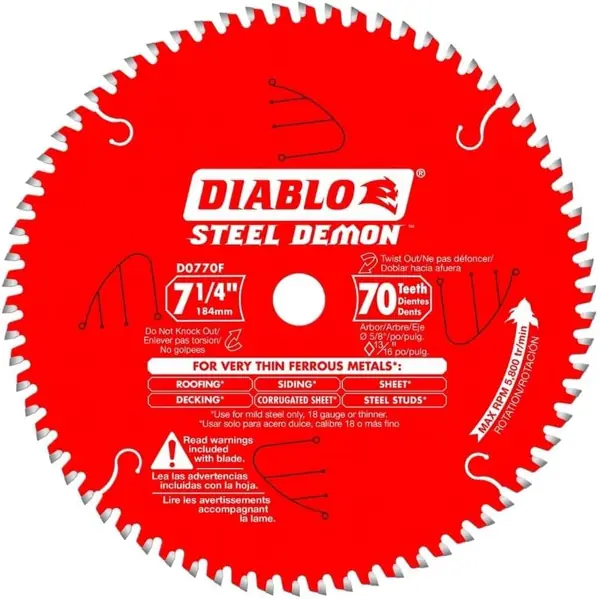
Diablo Steel Demon 7-1/4-inch 70-tooth carbide circular saw blade in red

Thin ferrous metal

Shop Score 93/100
Teeth
70 TCG
Diameter
7-1/4 inches
Kerf
Thin kerf
Rated Material
Mild steel, 12 gauge or thinner
View on Amazon

Most of us own exactly one circular saw, and it takes a 7-1/4-inch blade. That is the whole case for the Steel Demon 70T: it drops onto the saw already hanging in your shop and turns it into something that cuts sheet steel, roofing panels, studs, and conduit without a shower of sparks. Abrasive wheels still have their place, but this is the blade that keeps us from reaching for the grinder.

Seventy triple-chip teeth in a thin kerf do the work. The TCG geometry takes a small bite and clears it, so the blade runs cool instead of burning its way through the panel, and the thin body keeps the load low enough that a battery saw doesn't bog down. Inside its rating the edge comes off close to burr-free, light enough to handle almost immediately, which is more than you can say for a cutoff wheel.

The limit is printed on the blade: mild steel, 12 gauge or thinner. Stay inside that and it is a pleasure; lean on it in quarter-inch plate and the edge is gone in a sitting. That is less a flaw than a job description. This is a sheet metal blade, and Diablo builds a 48-tooth version of the same blade for thicker stock.

Two details we appreciate: the Perma-SHIELD coating keeps gumming and corrosion from eating the teeth between jobs, and the thin kerf asks less of whatever battery you are running. For roofing, siding, studs, and ductwork, this is where we start.

Worth Noting

  • Ferrous only
Our Verdict

If you own one circular saw and want to cut metal with it, this is our pick: clean, cool cuts in sheet steel and roofing with no specialty saw required.

Check Latest Price
2.

Diablo Steel Demon 7-1/4-Inch 48T Best for Thicker Steel

Diablo Steel Demon 7-1/4-inch 48-tooth carbide ferrous metal cutting blade

Thicker ferrous stock

Shop Score 92/100
Teeth
48 TCG
Diameter
7-1/4 inches
Max Speed
5,800 RPM
Rated Material
Mild steel up to 1/4 inch
View on Amazon

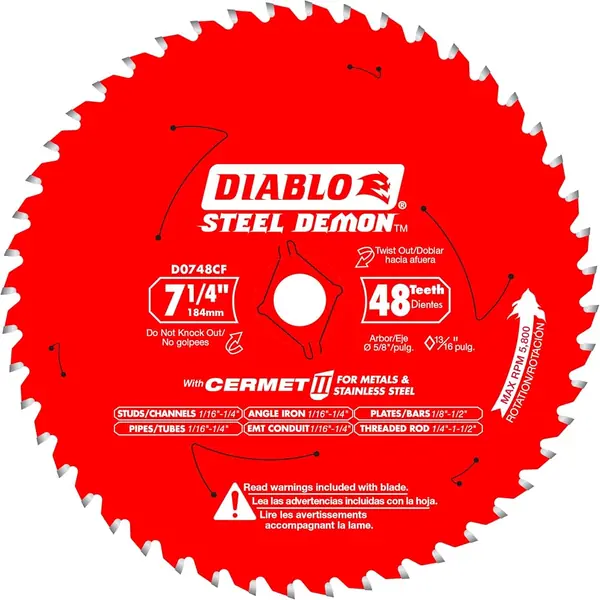
Quarter-inch plate, angle iron, square tube, all-thread: the 48-tooth Steel Demon is the version you reach for when the metal has some body to it. It mounts on the same 7-1/4-inch saw as our top pick, but where that blade stops at 12 gauge, this one is rated to cut through 1/4-inch mild steel.

What we noticed first is how little drama there is. Fewer sparks than an abrasive, chips instead of dust, and an edge you can run a thumb along a minute later. It is slower than the 70-tooth in thin sheet because the bigger chip load pulls harder, but from 3/16 inch up it is the blade that makes a circular saw feel like the right tool instead of a compromise.

The premium is real: this is the priciest blade in this guide, and the money buys thickness capability rather than longevity. Keep the offcut supported so the blade is not pinching, ease up on the feed, and the price makes more sense every time a length of angle iron skips the grinder.

Worth Noting

  • Mild steel only
  • Edge life drops off in continuous thick cuts
Our Verdict

We keep this one for the jobs the top pick cannot touch, plate, angle, tube, and pay the premium because it is the only 7-1/4-inch blade here rated through quarter-inch steel.

Check Latest Price
3.

TOMAX 7-1/4-Inch 60T Best Value

TOMAX 7-1/4-inch 60-tooth carbide blade for aluminum and non-ferrous metal

Aluminum and trim

Shop Score 91/100
Teeth
60 TCG
Diameter
7-1/4 inches
Arbor
5/8-inch diamond knockout
Rated Material
Aluminum and non-ferrous metal
View on Amazon

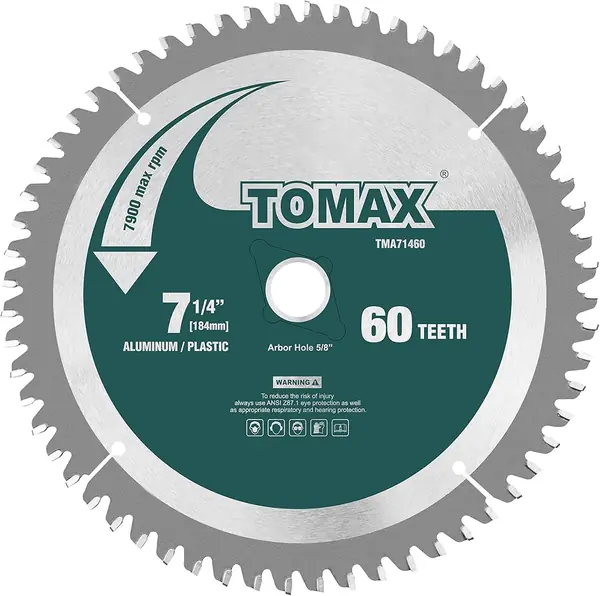
Clean aluminum cuts usually cost you. This TOMAX is the least expensive 7-1/4-inch blade here with a 60-tooth grind, and it lists a 5/8-inch DMK arbor, the diamond knockout that Makita-style saws need and that most blades ignore.

Sixty teeth in a triple-chip pattern is the right count for extrusion, trim, and sheet: enough teeth to shear rather than tear, not so many that the gullets load up with soft metal. The carbide is described as construction grade, and the electrophoretic coating is there to fight the corrosion that kills a blade left in a damp shop. For window frames, threshold, and railing, it is the sensible money.

What you give up is information. TOMAX does not publish a maximum RPM for this blade, so compare it against the no-load speed printed on your saw before you mount it; most 7-1/4-inch saws spin at 5,000 RPM or more. Do that and the rest is straightforward, because for trim, railing, and extrusion it cuts without asking much of your wallet.

Worth Noting

  • No thickness rating for aluminum plate
Our Verdict

Our budget pick for aluminum: 60 clean-cutting teeth and a diamond-knockout arbor for less than the Diablo alternatives.

Check Latest Price
4.

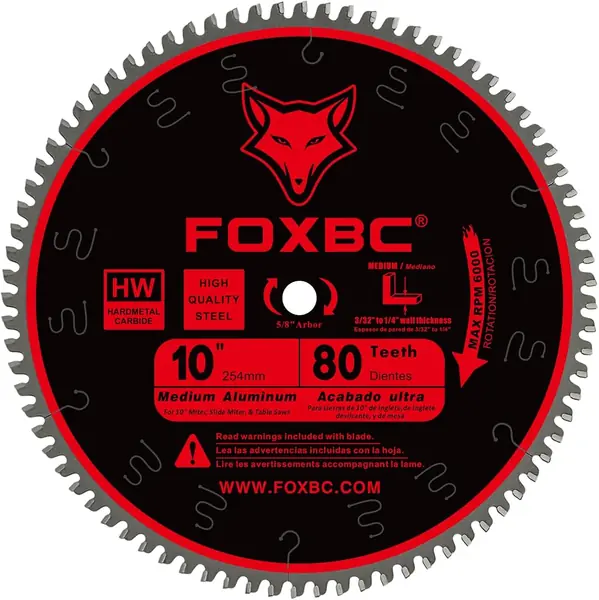
FOXBC 10-Inch 80T Best for Miter Saws

FOXBC 10-inch 80-tooth TCG carbide blade in red for aluminum and plastic

10-inch miter saws

Shop Score 90/100
Teeth
80 TCG
Diameter
10 inches
Arbor
5/8 inch
Kerf
0.094 inch
View on Amazon

A 10-inch miter saw is the biggest blade most home shops own, and it will cut aluminum beautifully if you stop putting a wood blade in it. FOXBC's 80-tooth TCG is our pick for that saw: a 0.094-inch kerf, a 5/8-inch arbor, and enough teeth that trim and extrusion come off the table needing a wipe rather than a file.

We were ready for a hobby-grade blade at this price and found something closer to a shop blade. Aluminum, acrylic, and nylon all come off clean with no chipping or tear-out, and the laser-cut stabilizer vents keep the blade from walking in a long cut. The 0.094-inch kerf is also easy on a smaller saw's motor.

Non-ferrous only, and the listing says so: aluminum, copper, brass, plastic, fiberglass, no steel. It is a 10-inch blade, so it stays on the miter and table saws, because there is no mounting this on your sidewinder. If steel studs are on your list, look at the ferrous blades above; if aluminum railing and window trim are, this is the one.

Worth Noting

  • Rated for non-ferrous metals and plastics only, never steel
  • Ten-inch diameter fits miter and table saws, not sidewinders
Our Verdict

This is the blade we put on a 10-inch miter saw for aluminum trim: 80 teeth, no burrs, and a finish that does not need a file.

Check Latest Price
5.

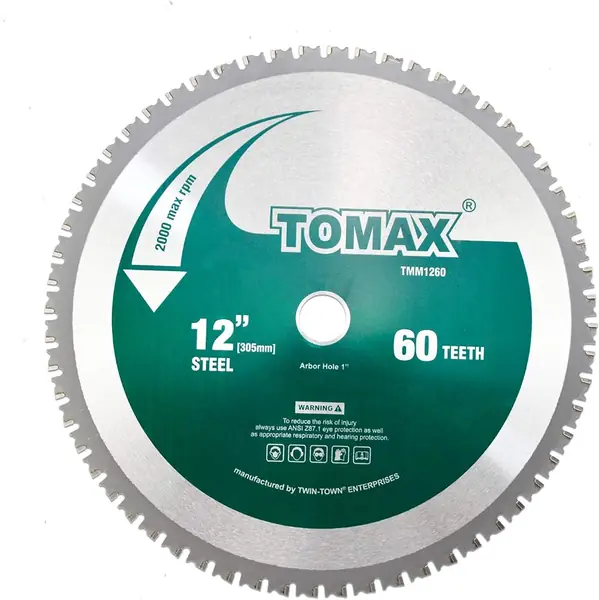
TOMAX 12-Inch 60T Best for Dry-Cut Saws

TOMAX 12-inch 60-tooth cermet blade with 1-inch arbor in silver

Dry-cut chop saws

Shop Score 89/100
Teeth
60
Diameter
12 inches
Arbor
1 inch
Max Speed
2,000 RPM
View on Amazon

The number that matters on this blade is 2,000, and it is a ceiling, not a suggestion. The TOMAX 12-inch 60-tooth is built for low-speed dry-cut saws such as the Evolution and Makita LC1230, machines that turn at 1,700 to 2,000 RPM and leave a cold, nearly spark-free cut in mild steel. Put it on a high-speed abrasive chop saw and you are running a 12-inch blade at roughly twice the speed it was made for.

On the right machine it is a quiet, inexpensive way through angle iron, pipe, channel, and studs: 60 cermet teeth, a 1-inch arbor, a 2.2 mm kerf, and an edge cool enough to pick up. Cermet is the reason, since the ceramic-and-metal tips hold their hardness at temperatures that would soften plain carbide. We like it as the second blade for someone who already owns a dry-cut saw and does not want to pay premium prices for every consumable; confirm your arbor is 1 inch and your spindle tops out at 2,000 RPM before you order.

Worth Noting

  • Limited to mild steel profiles
Our Verdict

For anyone with a low-RPM dry-cut saw, this is the sensible consumable: cool, clean cuts in mild steel without the premium cermet price.

Check Latest Price
6.

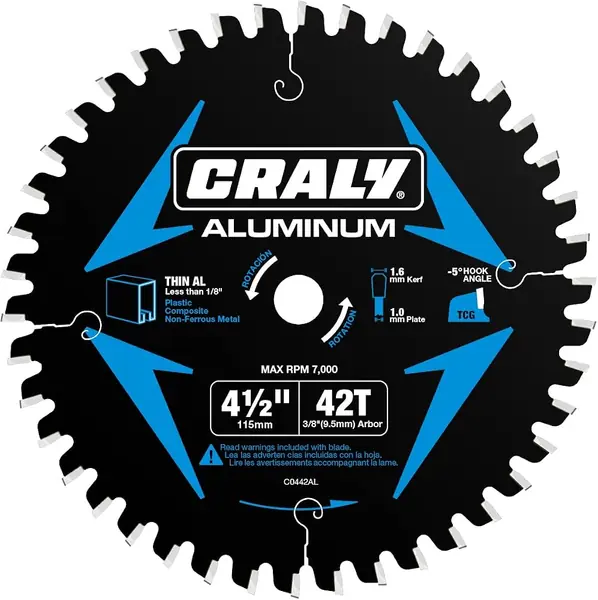
CRALY 4-1/2-Inch 42T Best for Compact Saws

CRALY 4-1/2-inch 42-tooth carbide blade in black for aluminum and plastic

Compact circular saws

Shop Score 88/100
Teeth
42 TCG
Diameter
4-1/2 inches
Arbor
3/8 inch
Kerf
1.6 mm
View on Amazon

Mini circular saws ship with a wood blade, and that blade is why so many of them end up in a drawer after one project. CRALY's 4-1/2-inch 42-tooth carbide blade is the fix: a 3/8-inch arbor, a 1.6 mm kerf, and a triple-chip grind meant for aluminum, plastic, and composite rather than pine.

The size is the point. A 4-1/2-inch blade on a compact saw gets into cabinet sides, soffit, and closet rod without dragging out a full-size tool, and 42 teeth are fine enough to leave a smooth edge in aluminum bar and 3/8-inch L-bracket. Check your arbor before ordering, since 3/8 inch is the compact-saw standard but not every mini saw uses it.

What surprised us is how much of this blade's value is in cutting things that are not metal: plexiglass, carbon fiber sheet, nylon, G10. A compact saw plus one of these replaces a jigsaw and a lot of sanding on trim and plastic work, and at this price it is an easy second blade to keep in the case.

Worth Noting

  • Non-ferrous only
Our Verdict

If your compact saw is collecting dust, this blade is the reason to get it out: smooth cuts in aluminum, plastic, and composite for very little money.

Check Latest Price
7.

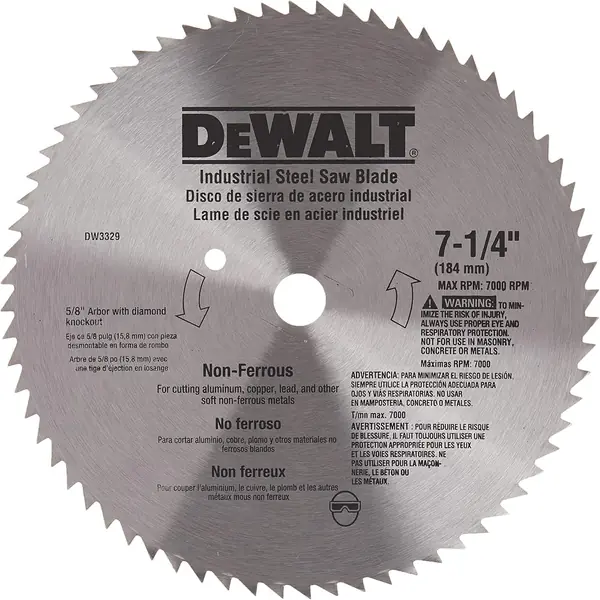
DEWALT DW3329 7-1/4-Inch 68T Best for Aluminum Extrusions

DEWALT DW3329 7-1/4-inch 68-tooth steel circular saw blade in silver

Aluminum extrusions

Shop Score 87/100
Teeth
68
Diameter
7-1/4 inches
Arbor
5/8 inch and diamond knockout
Material
High-speed steel
View on Amazon

Every other pick here is carbide. The DW3329 is high-speed steel, and that single difference explains both how it cuts and who should own it. Sixty-eight precision-sharpened teeth in a hardened body take aluminum flat bar, channel, and door threshold cleanly, and the thicker plate DeWalt builds into it keeps the blade steady through a long cut.

Steel teeth give rather than fracture, so this is the blade that survives being handed to someone who is going to hit a hidden fastener or let the kerf pinch. In a shop where a chipped carbide tooth means a new blade, that tolerance is worth real money.

The arbor is the quiet advantage: 5/8 inch with a diamond knockout, so it seats on the worm-drive and Makita-style saws that need the diamond as well as the standard sidewinders that do not. No adapter to lose.

Where it earns a place is aluminum work in a shared shop: it takes the handling that chips carbide, and 68 teeth leave a smoother edge on extrusion than the 60-tooth blades here. Match it to the material on the bench and, in our experience, it is the least fussy blade in this guide.

Worth Noting

  • Steel teeth dull faster than carbide
  • Non-ferrous only
Our Verdict

A steel-toothed non-ferrous blade we trust around aluminum extrusion, especially in a shop where several people use the same saw.

Check Latest Price
8.

TWIN-TOWN 8-Inch 52T Best for Thick Steel Profiles

TWIN-TOWN 8-inch 52-tooth cermet blade in silver for steel and ferrous metal

Thick steel profiles

Shop Score 86/100
Teeth
52 ATB
Diameter
8 inches
Arbor
5/8 inch
Max Speed
4,300 RPM
View on Amazon

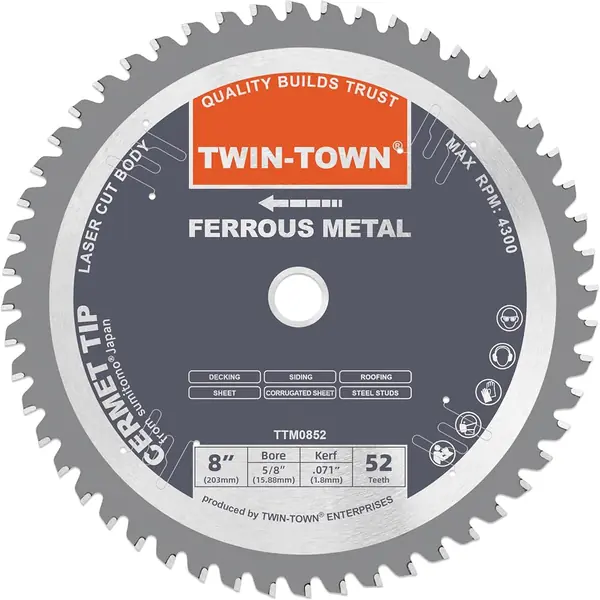
Eight inches is a different club from 7-1/4, and if you are in it, dry-cut saws and the bigger metal-cutting circular saws, TWIN-TOWN's 52-tooth cermet blade is the least expensive way into thick steel: a 4,300 RPM rating, a 5/8-inch arbor, and tips that take heat better than plain carbide.

Fifty-two teeth in an ATB grind is unusual for steel, where triple-chip is the norm, and it shows in the cut: smooth edges, small chips, and no tendency to grab in 1/4-inch angle and tube. The laser-cut stabilizer vents and the electrophoretic coating are there for the same reasons they show up on premium blades, cooler running and less corrosion between jobs.

Blade life is the honest caveat. Budget cermet is inconsistent: the same design can run for months of daily cutting or quit after a handful of cuts in the same material, and feed pressure seems to decide it more than anything else. Buy two, keep one on the shelf, and let the teeth cut.

Our take: this is the blade for a shop that cuts thick steel regularly and does not want to pay premium prices for every consumable. It will not match a top-tier cermet blade cut for cut, but the trade is easy to live with.

Worth Noting

  • Requires an 8-inch saw not a 7-1/4-inch
Our Verdict

For 8-inch saws cutting thick steel, this is the value play: cermet teeth and a smooth cut at a budget price.

Check Latest Price

How We Tested Metal-Cutting Circular Saw Blades

We started with specs, not reviews: the saws people actually own — 7-1/4-inch circular saws, 10-inch miter saws, 12-inch dry-cut chop saws, and the compact 4-1/2-inch saws that live in a toolbox — then filtered by ferrous versus non-ferrous rating, rated thickness in gauge or inches, arbor size and diamond knockout, and the tooth count and grind that decide how clean a cut comes off. Fourteen blades made it into the shop.

Testing ran eight months, split between a working garage shop and a job site where the same blades got used for real work. Every cut was made with the saw's guards in place, the work clamped, and eye and ear protection on, and we checked each blade's maximum RPM against the saw's no-load speed before it went near the arbor. Mild-steel blades met mild steel only — hardened, high-carbon, and stainless stock stayed off the bench unless a maker rated the blade for it.

In practice that meant 12-gauge sheet, 1/4-inch plate, aluminum extrusion for a fence frame, thin trim, conduit, and plastic. After each pass we wrote down how hard the saw pulled, whether the chips came off blue, how hot the cut stayed, how much burr a shop rag snagged on, and how much kerf the blade took out of the work. We noted noise too, since a blade that screams is usually working harder than it should.

Durability was the long game. Each blade stayed mounted until it quit, and we counted cuts in the same plate before the saw started laboring. Some dulled gradually; a couple chipped teeth on a hidden weld in scrap and were done in one pass. Dividing what a blade cost by the cuts it delivered is what separated real value from merely cheap, and it's how the final eight were chosen.

How to Choose a Metal Cutting Circular Saw Blade

Ferrous or Non-Ferrous Comes First

There are two families of metal cutting blade and they do not swap. Ferrous blades take mild steel: studs, angle iron, tube, channel, sheet. Non-ferrous blades are ground for aluminum, brass, copper, and often plastic and composite. Put a ferrous blade in aluminum and the gullets load up with soft metal; put a non-ferrous blade in steel and you will take the tips off in a few inches.

The trap is the phrase metal cutting on the package, which can mean a blade that handles 26-gauge roofing and nothing heavier. Read the material list, not the headline. Stainless and hardened steel sit outside both families and want a blade rated for them specifically.

Fit the Saw Before You Buy the Blade

Diameter has to match the saw exactly: 7-1/4 inch for a standard sidewinder, 8 inch for an 8-inch metal-cutting saw, 10 inch for a miter or table saw, 12 inch for a dry-cut chop saw. Then check the arbor. A 5/8-inch round or diamond knockout covers most American circular saws, while 12-inch dry-cut blades use a 1-inch bore.

The one people skip is speed. A blade's maximum RPM has to meet or exceed the saw's no-load speed, and a 12-inch dry-cut blade capped at 2,000 RPM must never go on a high-speed abrasive chop saw. We check that number before anything else, because it is the difference between a blade and a projectile.

Read the Thickness Rating

A blade rated for 12-gauge steel is not a blade rated for quarter-inch plate, and that difference decides whether you get a hundred cuts or five. Sheet metal and roofing blades stop at 12 gauge or thinner; the thicker-rated 7-1/4-inch blades top out around 1/4 inch of mild steel. Aluminum has its own ceiling, and plate over about half an inch wants coarser teeth than trim does.

Buy for the thickest thing on your list, not the average. If you mostly cut 26-gauge roofing but occasionally need angle iron, two blades cost less than the time you lose forcing one past its rating.

Tooth Count and What the Cut Looks Like

Triple-chip grind is the standard for metal: it takes a small, controlled bite and clears the chip instead of packing it. Within that, more teeth mean a smoother, slower cut, 70 to 80 for sheet, trim, and extrusion, 42 to 52 for thicker stock and faster feed. A thin kerf cuts with less resistance, which matters most on a cordless saw.

We prefer a finish-ready edge and let the saw work at its own pace. If you are chasing speed through quarter-inch angle, drop the tooth count and accept a rougher cut, because a fine-tooth blade pushed hard heats up and dulls before it finishes the run.

What You Give Up When You Leave the Abrasive Wheel

The case for a toothed blade is the cut itself: chips instead of sparks, an edge cool enough to touch, and little or no burr to dress. The trade is cost and fragility. These are consumables with a real per-cut price, and carbide is brittle, so a pinched kerf or a dropped blade can end one early.

Clamp the work so the offcut cannot close on the blade, keep the saw base flat, and let the teeth cut. Forcing a blade is the fastest way to shorten its life.

Frequently Asked Questions

Final Verdict

The Steel Demon 70T is the blade we point most people to, because it fits the saw already in the shop and handles the metal most home projects involve: sheet, roofing, studs, and conduit. The first time you need to cut quarter-inch plate or angle iron, move up to the 48-tooth version of the same blade.

And if your metal is aluminum rather than steel, the TOMAX 60-tooth gets you a clean edge for less, while a 10-inch miter saw deserves the FOXBC instead.